

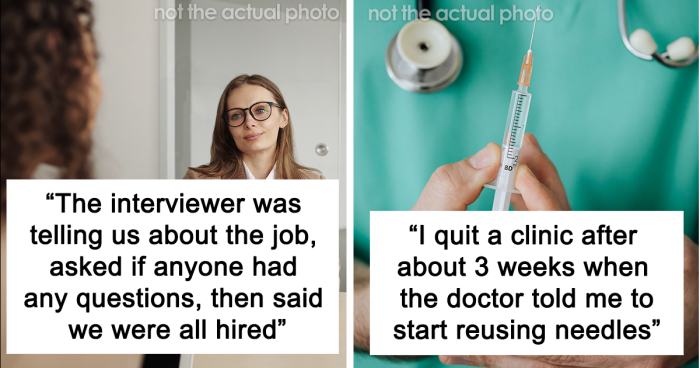
Most people picture quitting a job as a slow-motion movie scene: a polite resignation letter, a slightly awkward meeting, two weeks of handovers, and one last sad cupcake in the break room. But sometimes a new job reveals its true personality before your coffee has even reached room temperature.
In a collection of stories from former employees, people described leaving jobs after only minutes, hours, or a single shift. Some walked out after discovering the job they accepted was nothing like the one advertised. Others encountered unsafe working conditions, rude managers, sketchy pay practices, harassment, or requests that crossed an ethical line so aggressively that even the office printer seemed uncomfortable.
These fast exits are not simply stories about impatience or “quiet quitting” with better shoes. They reveal a bigger truth about workplace culture: employees often know very quickly when a job is going to cost them too much in stress, safety, dignity, or peace of mind. A first day can tell you a lot. Sometimes it tells you enough to leave before you have learned where the bathrooms are.
Why People Leave a Job So Quickly
The stories shared by ex-employees are not a scientific survey, and every workplace situation is different. Still, the same warning signs appear again and again: bait-and-switch job descriptions, impossible expectations, disrespectful leadership, unsafe work environments, unpaid labor, and behavior that makes people think, “I would rather fold laundry for strangers than stay here another hour.”
A quick resignation is rarely about one tiny inconvenience. It is usually about a moment that confirms a deeper problem. A manager’s cruel comment may reveal a culture of bullying. A surprise schedule may expose a company that treats workers as spare parts. A dangerous task without proper training may signal that safety is more of a decorative poster than an actual policy.
The Job Description Suddenly Changes Shape
One of the most common reasons people leave immediately is the classic bait-and-switch. A person applies for an office role, customer service position, data-entry job, or retail shift. Then, on day one, they discover they have actually joined a door-to-door sales operation, a commission-only scheme, a high-pressure telemarketing room, or a role with entirely different hours.
That kind of surprise is more than annoying. It breaks trust before the first payroll cycle begins. A job candidate makes decisions based on the information provided during the interview process. They may arrange childcare, commute plans, school schedules, or transportation around a promised shift. Changing the deal after hiring is like ordering a chicken sandwich and being handed a trombone. Technically, someone gave you something, but it is not what you signed up for.
Unsafe Work Is a Deal Breaker, Not a Character Test
Some former employees described being asked to do physically risky work without proper equipment, training, or supervision. Stories included workers being placed at heights without adequate safety protection, asked to operate machinery without clear instruction, or expected to handle heavy loads in unsafe conditions.
There is a strange workplace myth that brave employees should “just push through” unsafe tasks to prove they are team players. That is nonsense. A strong employee is not someone who ignores danger. A strong employee is someone who recognizes that an injury, accident, or serious mistake can affect them long after a manager forgets the shift was short-staffed.
When a workplace treats safety as optional, employees should pay attention. Missing equipment, vague instructions, rushed training, or supervisors who mock legitimate questions are all serious red flags. A paycheck is useful. Having functioning knees, hands, lungs, and general optimism is also useful.
Instant Disrespect Can End a Job Before Lunch
Many quick-exit stories begin with a manager, supervisor, or coworker saying something that immediately changes the mood. A new hire may be insulted, dismissed, mocked, pressured, or treated as though they should be grateful for the privilege of being poorly managed.
First-day behavior matters because people are usually trying their hardest during onboarding. If a supervisor is rude when they are supposedly making a good first impression, employees reasonably wonder what happens after three months, one missed target, or a request for a day off. The answer is rarely “surprise kindness and a fruit basket.”
Respect is not a workplace luxury. It is basic operating equipment. Employees can handle busy shifts, difficult customers, tight deadlines, and occasional chaos. What burns people out is chaos combined with humiliation.
Pay, Tips, and Scheduling Problems Raise Immediate Questions
Some workers left after discovering that the pay structure was not what they had been told. Others encountered unexplained deductions, confusing tip practices, surprise split shifts, unpaid extra work, or schedules that made a normal life nearly impossible.
Compensation problems are especially alarming because they affect the reason most people work in the first place: paying bills. A company may talk endlessly about culture, values, teamwork, innovation, and “being a family.” But when payday arrives, employees tend to become very interested in arithmetic.
A healthy employer explains how pay works before a worker accepts the job. They are clear about hourly rates, commissions, overtime rules, tip policies, training pay, scheduling expectations, and benefits. When a company becomes vague about money, workers should not assume the mystery will end with a delightful plot twist.
Ethical Red Flags Make People Walk Out Fast
Some of the strongest stories involve employees being asked to participate in behavior they believed was unsafe, dishonest, unsanitary, discriminatory, or morally unacceptable. This can happen in healthcare, food service, retail, sales, manufacturing, education, and nearly any other field.
Employees may see shortcuts that put customers at risk, questionable treatment of vulnerable people, deceptive sales tactics, or pressure to ignore rules. In those moments, leaving can feel less like quitting and more like refusing to become part of a problem.
Not every bad workplace is illegal, and not every uncomfortable moment requires an immediate exit. But when a job demands that employees compromise their safety, ethics, or professional standards, a fast departure can be a rational decision rather than an impulsive one.
When Should You Leave Immediately?
There is no universal rule for quitting without notice. Some people can leave on the spot because they have savings, family support, another offer, or a low-risk temporary job. Others need to make a careful plan because they depend on a paycheck, health coverage, housing stability, or a professional reference.
Still, certain situations deserve urgent attention. A worker may need to leave quickly when they feel physically unsafe, are threatened, experience harassment, witness serious misconduct, are pressured to do something illegal or unethical, or face behavior that makes them fear for their well-being.
In less urgent situations, it can be wise to pause before making a dramatic exit. Take notes. Review your offer letter, contract, union agreement, employee handbook, or benefit information. Save copies of schedules, pay records, written instructions, and relevant communications. Keep personal evidence on a personal device, while respecting confidentiality rules and avoiding the removal of protected company information.
The goal is not to create a courtroom drama in the parking lot. The goal is to protect yourself, understand your options, and make a decision that supports both your immediate safety and your longer-term career.
How To Quit a Job Quickly Without Creating More Chaos
Leaving fast does not require a speech worthy of an awards show. In many cases, a brief and professional message is enough.
Keep Your Resignation Short
You can say: “I am resigning effective today. Thank you for the opportunity.” If you want to provide a reason, keep it factual: “The role and working conditions do not match what I understood during hiring.” You do not owe a manager a forty-slide presentation titled Reasons I Am No Longer Participating in This Nonsense.
Return Company Property
Return keys, ID badges, uniforms, laptops, paperwork, access cards, and other company items. Ask for written confirmation when possible. This protects you from future confusion about missing property or equipment.
Document Important Details
Write down what happened while the details are fresh. Note dates, times, names, witnesses, instructions, safety concerns, pay issues, or statements that raised alarms. A simple timeline can be more useful than a stressed-out memory several weeks later.
Check Pay, Benefits, and Final Paperwork
Before disappearing into the sunset like a very tired cowboy, confirm how you will receive final pay, whether unused benefits or earned compensation are affected, and whether you need to update health insurance or retirement arrangements. Rules vary by employer, state, contract, and employment status, so a little paperwork can save a lot of future frustration.
Do Not Post While Angry
It may be tempting to publish a furious social-media post before you even reach your car. Take a breath. Publicly naming people, sharing confidential material, or posting accusations without careful thought can create unnecessary complications. You can tell the truth about your experience without giving the internet a live episode of workplace reality television.
What Employers Should Learn From Fast Resignations
When employees leave within minutes or days, employers may call them unreliable. Sometimes that is fair. But companies should also ask a harder question: what did the workplace reveal so quickly that people felt they had to escape?
Good employers reduce early turnover by being honest during hiring. They clearly explain job duties, pay, schedules, performance expectations, training requirements, physical demands, and workplace culture. They do not wait until orientation to reveal that the “flexible daytime office job” is actually a commission-only street-sales role involving a van, a clipboard, and emotional weather damage.
Managers also set the tone. New employees should receive clear instructions, basic courtesy, realistic workloads, and safe equipment. The first day should help people feel capable and welcomed, not like they have accidentally joined a survival challenge with fluorescent lighting.
Fast resignations are often expensive for employers. They waste recruiting time, training costs, manager energy, and team morale. More importantly, they can damage a company’s reputation. Employees talk. Candidates read reviews. And no amount of free pizza can fully repair a workplace known for treating new hires like disposable batteries.
Additional Experiences: What Fast Job Exits Teach Us
Stories of people leaving jobs quickly can sound funny from a distance, especially when someone walks out after ten minutes and later tells the tale at a dinner party. But behind the humor is often a useful lesson: first impressions are data. They are not always the whole story, but they can reveal patterns that deserve attention.
Consider the new restaurant worker who arrives for training and discovers that the kitchen is disorganized, understaffed, and visibly unsanitary. One messy rush does not automatically mean the business is doomed. Restaurants are chaotic by nature; a lunch crowd can turn a calm kitchen into a scene from an action movie involving fries. But if supervisors dismiss food-safety concerns, refuse to provide gloves or cleaning supplies, or tell employees to ignore obvious problems, the issue is not “a busy shift.” It is a culture problem.
Then there is the worker who accepts a customer-service job and learns that the real task is pressuring strangers into buying products they do not need. Sales work itself is not inherently bad. Plenty of ethical sales professionals help customers solve real problems. The red flag appears when training focuses on manipulation, misleading claims, or making employees feel ashamed for refusing to push vulnerable people into bad decisions.
Another common experience involves impossible scheduling. A new hire may be promised a steady shift, only to be told on day one that they must stay late every night, work every holiday, remain on call without compensation, or cover multiple roles because “everyone else is unavailable.” Flexibility is part of many jobs. But there is a difference between helping a team occasionally and being recruited as a human emergency backup generator.
Some employees leave after observing how a company treats its most vulnerable workers. A new staff member may watch a manager insult a teenager, mock an older employee, blame a worker for asking about pay, or ignore someone reporting harassment. In these moments, people often think ahead: “If this is how they treat that person today, what happens when I need help tomorrow?” That question can make the exit decision surprisingly clear.
There are also quieter fast exits. A worker may not encounter yelling, danger, or obvious misconduct. They may simply realize that the environment is intensely draining: no training, no direction, no respect for boundaries, and no chance to use their skills. The job may be technically legitimate, but it feels like being hired to row a boat with a spoon. Leaving early can be an act of self-awareness.
The smartest lesson from these stories is not “quit at the first inconvenience.” It is “listen when a workplace shows you who it is.” Ask questions before accepting an offer. Confirm job duties in writing. Clarify pay, schedules, training, safety procedures, and expectations. Pay attention to how interviewers speak about employees, customers, and former staff members. A company may polish its website, but it is much harder to polish its behavior.
Final Thoughts
The stories of employees leaving after fifteen minutes, one shift, or one awful conversation may be entertaining, but they also underline an important point: workers are not wrong for expecting honesty, safety, fair pay, and basic respect. A job does not have to be perfect. It does, however, need to be real, reasonably safe, and worthy of the hours people trade for it.
Sometimes the fastest resignation is not a failure to tough it out. Sometimes it is the moment a person realizes that their time, health, and dignity are worth more than a name badge and a bad orientation video.