

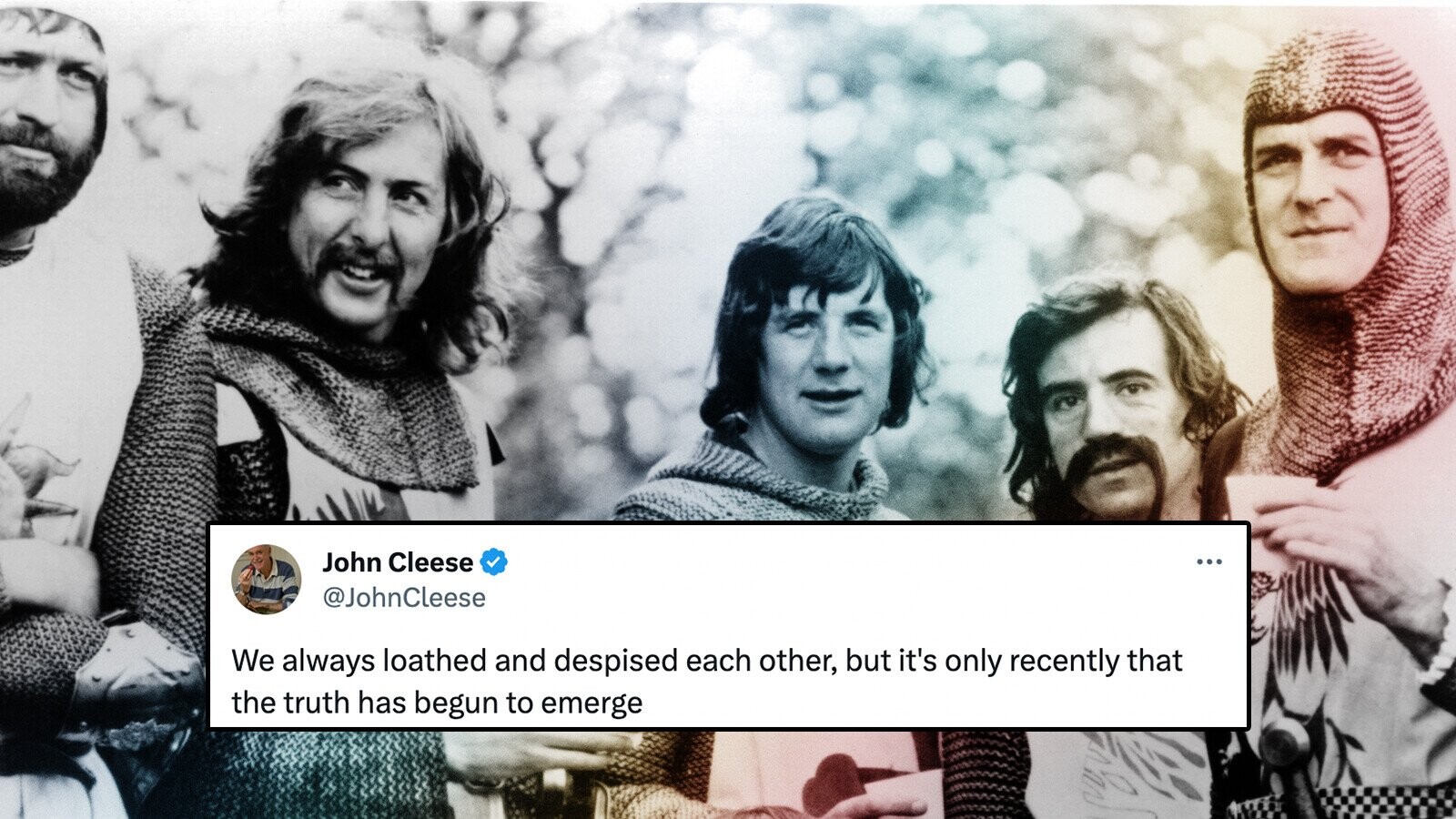
Few comedy groups have built a legacy as gloriously silly, intellectually sharp, and stubbornly immortal as Monty Python. The troupe gave the world dead parrots, silly walks, argumentative philosophers, coconut-powered horses, and a crucifixion anthem so catchy that it somehow became a singalong for life’s worst days. So when John Cleese appeared to fire back at Eric Idle with the wonderfully savage line, “We always loathed and despised each other,” fans understandably dropped their teacups, clutched their spam, and asked: wait, were the Pythons secretly miserable this whole time?
The short answer is: not exactly. The longer answer is far more Python-esque. The remark came during a public back-and-forth involving Cleese, Idle, Monty Python’s finances, and the management of the group’s remaining business interests. It sounded like a declaration of war, but Cleese later clarified that the line was meant as a joke aimed at the whole group, not a literal confession of lifelong hatred. In other words, a famous absurdist made an absurd statement, and the internet briefly responded as if Basil Fawlty had issued a corporate memo.
Still, the moment revealed something real. Behind the surreal sketches and beloved films, Monty Python was always a creative machine powered by strong personalities, different writing styles, business tensions, and the strange afterlife of a comedy brand that refuses to die. The latest Python feud is not just a celebrity squabble. It is a story about friendship, money, legacy, aging, collaboration, and what happens when a joke becomes a headline before anyone checks whether it is wearing a fake mustache.
What Sparked the Latest Monty Python Feud?
The public dust-up began when Eric Idle pushed back against the assumption that all surviving members of Monty Python were comfortably wealthy from decades of reruns, films, merchandise, and musical spin-offs. Idle suggested that Python’s income streams had declined sharply and criticized the management of the group’s assets, specifically referencing Holly Gilliam, the daughter of fellow Python Terry Gilliam.
Idle’s point was blunt: people assume a legendary comedy brand automatically means endless checks in the mail, but he said the financial reality was far less rosy. That struck a nerve because Monty Python is not merely a show from the late 1960s and 1970s. It is a global comedy institution with films, albums, books, stage productions, streaming availability, and a fan base that can still quote “Nobody expects the Spanish Inquisition!” faster than most people can find their car keys.
John Cleese then stepped in to defend Holly Gilliam, saying he had worked with her for years and found her efficient, clear-minded, hard-working, and pleasant. He also indicated that Michael Palin and Terry Gilliam shared that positive view. This turned a private-ish business disagreement into a very public Python-on-Python exchange, complete with the kind of dry British acidity that makes tea curdle out of respect.
John Cleese’s “Loathed and Despised” Line Explained
Cleese’s now-famous line arrived after a fan asked whether the Pythons had fallen out of touch. Cleese replied, “We always loathed and despised each other, but it’s only recently that the truth has begun to emerge.” On paper, that looks brutal. Spoken in the voice of John Cleese, it also sounds like the sort of exaggerated comic overstatement he has been delivering for more than half a century.
After the remark was picked up as a sign of a serious feud, Cleese clarified that it was a joke and that it referred to all members of Monty Python, not just Eric Idle. That distinction matters. Cleese was not issuing a solemn psychological report on six comedians trapped in a BBC cupboard since 1969. He was using irony, the native language of Monty Python, and then watching modern media translate it into plain panic.
That does not mean there are no tensions. Idle has made clear that he has not maintained close relationships with some of the surviving Pythons in recent years. Cleese and Idle also appear to disagree on the management story, including the transition from longtime manager Jim Beach to Holly Gilliam. Cleese has disputed the idea that he removed Beach and installed Gilliam, saying Beach stepped down after health issues and that Gilliam, who had been his number two, took over naturally.
Why Monty Python’s Business Legacy Is Complicated
Monty Python was formed in 1969 by Graham Chapman, John Cleese, Terry Gilliam, Eric Idle, Terry Jones, and Michael Palin. Their BBC sketch series, Monty Python’s Flying Circus, ran from 1969 to 1974 and rewired television comedy by rejecting tidy punchlines, polite structure, and anything that smelled faintly of normality. Sketches could end midstream, morph into animation, or be interrupted by a man in armor hitting someone with a rubber chicken. It was chaos with a university degree.
The troupe then expanded into films, including Monty Python and the Holy Grail, Life of Brian, and The Meaning of Life. Later, Eric Idle helped turn the Arthurian nonsense of Holy Grail into Spamalot, a Broadway musical with music by John Du Prez and lyrics and book by Idle. The show became a major success and won the Tony Award for Best Musical in 2005.
But comedy empires are not self-cleaning ovens. Rights, royalties, tours, management decisions, lawsuits, revivals, streaming deals, and brand licensing can turn even the funniest legacy into a spreadsheet wearing a Viking helmet. Monty Python’s 2014 reunion at London’s O2 Arena was widely celebrated by fans, but it also had a financial context. The group had faced legal and business pressures, including royalty disputes related to Spamalot. In that light, Idle’s frustration about money does not appear out of nowhere. It belongs to a bigger story about how entertainment properties age, earn, and sometimes disappoint the people who created them.
Eric Idle’s Side: A Working Legend Who Says He Still Has to Work
Idle’s comments landed because they challenged a popular fantasy: that anyone involved in an iconic franchise must be swimming through a vault like Scrooge McDuck. He has said, in effect, that Spamalot made money years ago, but that he still has to work for a living. For fans, that can feel surprising. For people familiar with entertainment contracts, residual structures, changing media markets, and aging intellectual property, it is less shocking.
Idle has remained busy with books, stage work, interviews, and tours. His career beyond Python includes The Rutles, his songwriting, the Broadway success of Spamalot, and decades of public affection for “Always Look on the Bright Side of Life.” That song alone has traveled farther than many politicians’ promises, and with better whistling.
His frustration seems rooted not simply in personal grievance but in a larger disappointment: Monty Python owns or controls a valuable body of work, yet Idle believes the income has not been managed as well as it could have been. Whether fans side with Idle, Cleese, neither, or the dead parrot, the disagreement points to a very modern problem. A legacy can be beloved and still be financially messy.
John Cleese’s Side: Defense, Irony, and a Very Cleese Response
Cleese has always specialized in a certain kind of comic impatience. From Basil Fawlty to the Ministry of Silly Walks, his persona often thrives on exasperation so theatrical it becomes music. His response to Idle was consistent with that temperament: defend the person he felt was being unfairly criticized, reject a version of events he considered inaccurate, and sharpen the whole exchange with a line that could cut cheese from across the room.
His defense of Holly Gilliam was specific. He described her in positive professional terms and said others in the Python circle agreed. Later, when the “loathed and despised” joke was treated as a serious statement, Cleese pushed back again, suggesting that the press had missed the irony.
There is a small lesson here for anyone who posts jokes online: irony travels badly without luggage. A line that would sound obviously comic in a live conversation can become a headline when stripped of tone, context, facial expression, and the speaker’s lifelong habit of turning irritation into performance art. Cleese did not invent that problem, but he walked directly into it wearing a large sign that said “Please Misinterpret Me.”
Were the Pythons Ever Really Friends?
The romantic version of Monty Python imagines six comic geniuses skipping happily through absurdity, occasionally pausing to share a group hug and a tin of processed meat. The reality was always more complicated. The Pythons were collaborators, not a boy band. They wrote in different pairings, had different temperaments, and often pursued separate projects. Cleese and Graham Chapman formed one major writing partnership. Michael Palin and Terry Jones formed another. Idle often worked more independently. Gilliam contributed the visual insanity that made the show feel as if a medieval manuscript had eaten a television.
Creative groups do not need constant warmth to produce great work. Sometimes they need tension, contrast, irritation, and enough mutual respect to keep the machinery running. The Beatles were not always skipping through strawberry fields together either. Great ensembles often contain friction because talented people have strong instincts, and strong instincts bump into each other like shopping carts in a very intellectual supermarket.
Monty Python’s brilliance came partly from that collision. Cleese’s precision, Palin’s genial versatility, Jones’s structure, Chapman’s anarchic edge, Idle’s musical wit, and Gilliam’s surreal visuals created something none of them could have made alone. That does not mean they were always close. It means they were chemically reactive. Sometimes chemistry makes fireworks. Sometimes it makes smoke alarms go off.
Why Fans Care So Much About the Python Feud
Fans do not like discovering that their favorite creative families are, in fact, workplaces. Monty Python feels intimate because viewers grew up with the sketches, repeated the lines, watched the films with friends, and treated the comedy as a private language. When Cleese and Idle trade barbs, it can feel less like two elderly comedians disagreeing about management and more like someone announced that the Knights Who Say “Ni!” have entered arbitration.
But the emotional reaction also proves the strength of the work. People care because Monty Python mattered. It expanded what sketch comedy could do. It influenced generations of writers, performers, animators, satirists, and internet humorists. Its anti-structure helped create a world where absurdity, non sequitur, meta-comedy, and comic disruption could become mainstream tools.
The feud is therefore not just gossip. It forces fans to separate the art from the myth of the group. Monty Python can be hilarious even if the Pythons were not always harmonious. The “Dead Parrot” sketch does not become less funny because the surviving members disagree about asset management. The Spanish Inquisition remains unexpected. The silly walks remain silly. The coconut horses remain environmentally questionable but emotionally correct.
What This Reveals About Comedy, Aging, and Legacy
The Cleese-Idle exchange also highlights a broader truth about aging entertainers. Public affection does not always translate into financial security. Older performers may keep working because they want to, because audiences still love them, or because the business requires it. In Idle’s case, he has been candid about continuing to work later in life. Cleese, too, has remained active with stage projects, appearances, and new versions of earlier work.
Comedy ages strangely. Some jokes become classics. Some become historical artifacts. Some need context. Some remain funny because human beings continue to be pompous, frightened, vain, bureaucratic, horny, greedy, confused, and ridiculous. Monty Python understood that better than almost anyone. The troupe’s best work was not merely random; it was a precise attack on the absurdity of institutions, language, class, religion, war, and authority.
That is why the current feud feels almost like a lost Python sketch. A legendary anti-establishment comedy group becomes an institution. The institution develops management disputes. The management dispute becomes a media story. The media story hinges on whether a joke about hatred was actually a joke. Somewhere, a man with a fake mustache enters and says, “And now for something completely financial.”
Is the Python Feud Really That Serious?
It is serious enough to reflect real distance between former collaborators. Idle has described a lack of contact with some members, and Cleese has publicly disputed parts of Idle’s account. There are real emotions here, and possibly real business concerns. But it is also not a simple story of heroes and villains.
Idle can be genuinely frustrated about income and management. Cleese can genuinely believe Holly Gilliam is being treated unfairly. Both things can exist in the same room, even if that room is filled with flying sheep and a large foot descending from the sky.
The safest reading is this: the surviving Pythons are older men with a long shared history, separate lives, and different perspectives on what happened to their collective legacy. Their public comments reveal tension, but also the habits of people who spent their careers turning discomfort into jokes. The feud may be real. The “loathed and despised” line, by Cleese’s own clarification, was not meant literally. That makes the whole thing less like a civil war and more like a family argument conducted through a megaphone shaped like a fish.
Experience Notes: What the John Cleese and Eric Idle Feud Teaches Creative Teams
Anyone who has worked in a creative team can recognize pieces of the Monty Python feud, even without a dead parrot on the conference table. A group can make something brilliant together and still contain disagreements that never fully disappear. In fact, the very traits that make a team exceptional can later make it difficult to maintain. Strong taste, fast wit, perfectionism, pride, and independence are wonderful ingredients for art. They are less wonderful when the topic becomes accounting, credit, or who replaced whom in the management structure.
One common experience in creative partnerships is that the work creates a public fantasy. Audiences see the finished product and imagine harmony behind the curtain. They do not see the rewrites, bruised egos, financial negotiations, uneven workloads, or years of quiet resentment. A comedy sketch may last four minutes, but the relationship behind it can last decades. Over time, memories become personal property. One person remembers sacrifice. Another remembers opportunity. One remembers being ignored. Another remembers saving the project. Both may be telling the truth from their own seat.
The Python dispute also shows why business clarity matters, especially when friendship and intellectual property mix. When a group is young, hungry, and making strange work for uncertain rewards, it is easy to treat contracts and future rights as boring details. Decades later, those details become the entire battlefield. Who manages the brand? Who approves new projects? Who receives royalties? Who controls licensing? Who speaks for the group? These questions are not glamorous, but ignoring them is like building Camelot on a swamp and acting surprised when the gift shop sinks.
There is also an emotional lesson. Creative relationships often change after the work ends. People move countries, start families, develop new priorities, or simply become different versions of themselves. A collaborator from your twenties may not be someone you naturally call in your eighties. That does not erase the work. It simply means the relationship served one extraordinary purpose at one extraordinary time. Fans may want eternal friendship, but artists are human beings, not museum displays with pulse rates.
For modern creators, the Cleese-Idle exchange is a reminder to protect both the art and the relationship. Put agreements in writing. Revisit them when circumstances change. Keep communication boringly clear. Do not assume that affection will solve money problems. Do not assume that money problems mean affection never existed. And when joking publicly during a sensitive dispute, remember that irony online is like a fragile antique shipped without padding. It may arrive, but probably in pieces.
Most importantly, the feud teaches fans to hold two truths at once. Monty Python changed comedy, and its members may not all feel warm and fuzzy about one another today. That is not a contradiction. It is the messy, human underside of collaboration. The work can still matter. The laughter can still be real. And “Always Look on the Bright Side of Life” can still whistle cheerfully through the wreckage, even when the people who made it are arguing about the bill.
Conclusion
John Cleese’s “We always loathed and despised each other” comment sounded like a bombshell, but the fuller story is more nuanced and far more Monty Python. Cleese later said the line was a joke, while the surrounding feud grew from Eric Idle’s frustration over Python income and questions about the group’s management. The exchange is funny, prickly, sad, and oddly fitting for a troupe that spent its career exposing the absurdity of human institutions.
Monty Python’s legacy remains intact because it was never built on the idea that six comedians were perfectly harmonious saints. It was built on intelligence, friction, timing, madness, and the fearless refusal to behave properly. Whether the surviving Pythons are close friends today may matter to them personally, but for audiences, the work continues to march across culture with coconuts in hand. The feud may sting, but the laughter still lands. And if there is one lesson Python taught better than anyone, it is that life is ridiculous, authority is suspect, and sometimes the most dramatic headline is just a joke wearing a very serious hat.