

Energy storage usually makes people think of batteries, giant plugs, and maybe a futuristic wall in a garage humming like it knows your utility bill better than you do. But some of the most important energy storage systems on Earth are not solid at all. They slosh. They flow. They sit in tanks, pipelines, and insulated vessels. In other words, a huge share of stored energy lives in liquid form.
That includes familiar liquids like gasoline, diesel, and biofuels, but also newer contenders such as liquid hydrogen carriers, ammonia, methanol, liquid electrolytes in flow batteries, molten salts in thermal storage, and even ultra-cold liquid air. These systems do not all solve the same problem, and that is exactly why they matter. Some are built for moving energy across oceans. Some are built for storing solar heat after sunset. Some are built for helping wind and solar show up when the weather is feeling uncooperative.
If the energy transition is a team sport, liquid storage is not the star player in every game, but it is definitely the versatile athlete who somehow ends up useful in almost every lineup.
What Does It Mean to Store Energy in Liquid Form?
At its core, storing energy in liquid form means using a liquid medium to hold usable energy until we need it later. That energy may be stored chemically, as in a fuel; electrochemically, as in a flow battery electrolyte; thermally, as in molten salt; or cryogenically, as in liquid air.
This distinction matters because not all stored energy is created equal. Some liquids are designed to release energy by burning. Others release it through a battery reaction. Others simply hold heat or cold until a power system is ready to turn that temperature difference back into electricity.
That is why “liquid energy storage” is really an umbrella term, not one single technology. It is a family of approaches built around one big idea: liquids are easy to move, easy to pump, and often easier to scale than rigid, cell-based systems.
Why Liquids Are So Attractive for Energy Storage
Liquids come with a practical advantage that engineers love and spreadsheets respect: infrastructure. We already know how to handle tanks, valves, pumps, pipes, tanker trucks, and shipping terminals. Society has been moving liquids around for a very long time, sometimes brilliantly, sometimes while creating an environmental mess that future generations now get to clean up. Still, the logistics playbook exists.
Liquids also make it easier to separate where energy is stored from where power is delivered. In a flow battery, for example, the size of the tanks determines how much energy you can store, while the cell stack determines how much power you can send out at once. That flexibility is a big deal for grid operators who do not enjoy one-size-fits-all technology any more than the rest of us do.
Another advantage is duration. Conventional lithium-ion batteries are excellent for fast response and short-to-medium duration work, but liquids can shine when the job is measured in many hours, days, or longer. Chemical carriers such as ammonia or methanol can also be transported over long distances, which makes them appealing when the goal is not just storage but storage plus shipping, export, seasonal balancing, or industrial use.
The Main Types of Liquid Energy Storage
1. Liquid Fuels: The Oldest Energy Storage Workhorse
The most common example of energy stored in liquid form is plain old fuel. Petroleum-based fuels store chemical energy in molecular bonds. That is not new, but it is still incredibly effective. A tank of liquid fuel packs a lot of energy into a small space, is refillable in minutes, and fits neatly into a global distribution system that already exists.
The catch is equally obvious: conventional fossil liquid fuels come with major carbon emissions. So while they remain powerful from a storage standpoint, they are not a climate-friendly long-term answer by themselves.
This is where biofuels and synthetic liquid fuels enter the conversation. Biofuels convert biomass into usable liquid fuels. Synthetic fuels, often called e-fuels, aim to turn renewable electricity, water, and carbon-containing molecules into transportable liquid energy carriers. These approaches try to preserve the logistical magic of liquids while reducing lifecycle emissions.
2. Hydrogen Carriers: Liquid Ways to Move a Very Uncooperative Gas
Hydrogen is often described as a promising clean energy carrier, and that is fair. It can be produced using electricity, used in fuel cells, and stored for long periods. But hydrogen has one personality trait that engineers would probably describe more bluntly over coffee: it is annoyingly hard to store and move efficiently.
That is why researchers are exploring liquid hydrogen carriers. Instead of transporting hydrogen only as a compressed gas, they look at liquids that either contain hydrogen or can be converted into hydrogen later. Major examples include ammonia, methanol, and liquid organic hydrogen carriers (LOHCs).
Ammonia gets so much attention because it is easier to store and transport than gaseous hydrogen and can work as both a fuel and a hydrogen carrier. Methanol is also attractive because it is a liquid under ordinary conditions and fits neatly into liquid-fuel handling systems. LOHCs are especially interesting because they act a bit like reusable liquid hydrogen shuttles: hydrogen goes in, hydrogen comes out, and the carrier liquid can potentially cycle again.
That said, liquid hydrogen carriers are not magic potions. Methanol production often depends on carbon dioxide supply and policy economics. Ammonia must be managed carefully because of toxicity and emissions risks if the system is poorly designed. And if you want hydrogen back out of ammonia or an LOHC, you usually need extra equipment, extra energy, and extra patience.
3. Flow Batteries: Electricity Stored in Liquid Electrolytes
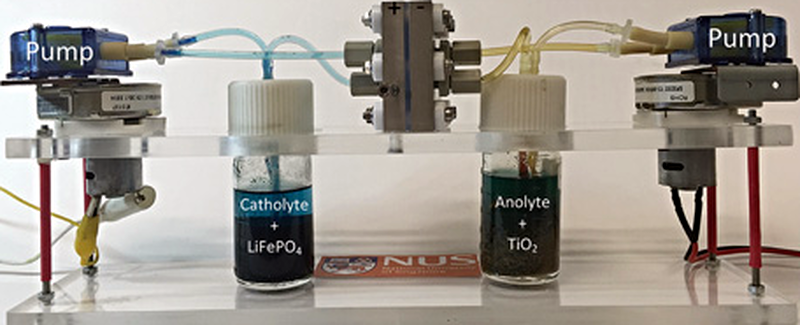
Flow batteries are one of the clearest examples of storing electricity in liquid form. Instead of locking all the chemistry inside a sealed battery pack, these systems keep energy in liquid electrolytes stored in external tanks. The liquids are pumped through a cell stack during charging and discharging.
This design has some major benefits. It can be easier to scale storage capacity by adding bigger tanks. It can reduce certain degradation challenges compared with packed cell architectures. And it is often well suited for stationary grid storage, where size and weight matter less than durability, flexibility, and safety.
Traditional flow batteries have often faced criticism for lower energy density than lithium-ion batteries. But research groups are pushing that boundary. Newer concepts involving high-density liquid chemistries aim to make flow systems more compact and more useful for a wider set of applications. In short, the phrase “tank battery” may sound like a contradiction, but in grid storage it is increasingly a serious idea.
4. Molten Salt: Hot Liquid Storage for Solar and Beyond
Not all liquid energy storage is about fuels or electrochemistry. Some of it is about heat. Molten salt storage is one of the best-known thermal storage technologies, especially in concentrating solar power systems. In these systems, a liquid salt mixture is heated to very high temperatures, stored in insulated tanks, and later used to produce steam and electricity when sunlight is gone.
This matters because solar power does not stop being useful at sunset just because the sun gets the memo and leaves. Thermal storage lets a solar plant keep producing after dark, smoothing output and improving dispatchability.
Researchers are also working on better molten salts with lower melting points, higher energy density, and better compatibility with materials. That may sound like a chemistry problem hidden in a hard hat, but it is actually central to cost, reliability, and performance.
5. Liquid Air and Cryogenic Storage
Then there is the wonderfully weird category: liquid air energy storage. In this approach, excess electricity is used to cool air until it becomes liquid. Later, the liquid air is warmed, expands dramatically, and drives machinery to generate power.
Think of it as storing electricity by turning the atmosphere into a temporary cold reservoir. That is not the kind of sentence most people expect to read before lunch, but it is real engineering.
Liquid air systems are attractive for long-duration storage because they rely on abundant materials and can be integrated with thermal systems. But they are also more complex than simply charging a battery. Efficiency depends heavily on heat integration, cold recovery, and system design. So while cryogenic storage is promising, it tends to reward elegant engineering and punish sloppy thermodynamics.
6. Liquid Metal Batteries: A Hotter Take on Grid Storage
Liquid metal batteries occupy a fascinating middle ground between batteries and thermal systems. In these designs, molten metal layers act as electrodes, separated by a molten salt electrolyte. Because the materials naturally separate into layers, the system can be conceptually simple and potentially durable for large-scale stationary use.
This is not the battery you want in your pocket, unless your pocket is a utility-scale substation and your tailor is an electrical engineer. But for the grid, liquid metal concepts could become useful where long life, heavy cycling, and large stationary footprints are acceptable.
Where Liquid Energy Storage Fits Best
The smartest way to think about storing energy in liquid form is not to ask, “Will this replace batteries?” That question is too blunt to be useful. A better question is, “Which liquid solution fits which job?”
For example, flow batteries may fit grid-scale shifting and renewable balancing. Molten salt fits thermal plants and concentrating solar systems. Ammonia, methanol, and LOHCs may fit bulk transport, export markets, industrial fuel switching, maritime uses, or long-duration energy storage. Liquid air may fit long-duration grid applications where siting and materials availability matter. Biofuels and synthetic liquids may fit sectors that are hard to electrify directly, such as aviation, shipping, or certain industrial processes.
In other words, liquid storage is less a single winner and more a toolbox. And the energy transition is going to need a very crowded toolbox.
The Biggest Challenges
For all their promise, liquid energy systems have real limitations.
First, there is efficiency. If electricity becomes hydrogen, then ammonia, then hydrogen again, then electricity again, some energy is lost at almost every step. That may still be worthwhile for long-duration storage or transport, but it is not ideal when direct electrification is possible.
Second, there is safety and handling. Ammonia is toxic. Liquid hydrogen is cryogenic. Molten salts run extremely hot. Flow battery chemistries vary in their risks. Liquid fuels can leak, burn, or contaminate. The common thread is that liquids are manageable, but only when systems are engineered and operated well.
Third, there is cost and complexity. Some technologies look fantastic on a lab bench and much less charming when they meet corrosion, scaling, maintenance, permitting, and utility procurement documents written in a font that drains the soul.
Finally, there is climate integrity. A liquid fuel is not automatically low carbon just because it is new, shiny, or marketed with enough green gradients. Feedstocks, production pathways, energy inputs, and emissions control all matter.
Experiences From the Real World of Liquid Energy Storage
One of the most interesting things about storing energy in liquid form is how physical the experience becomes once you leave the whiteboard. This is not abstract storage. It is tanks, pumps, heat tracing, valves, insulation, transfer lines, fluid chemistry, operating windows, and a lot of people asking whether the liquid is where it is supposed to be.
In grid and industrial settings, operators tend to appreciate liquid systems because the hardware feels familiar. A utility may not love a new chemistry, but it certainly understands vessels, pipes, and maintenance schedules. That matters more than it sounds. Technologies do not scale just because they work in theory. They scale when real teams can run them safely on a Tuesday morning when the weather is bad and someone is already late to a meeting.
Molten salt systems offer a perfect example. On paper, storing solar heat in hot liquid tanks sounds elegant. In practice, the experience teaches a tougher lesson: temperature management is everything. If the salt cools too much, it can freeze where you definitely do not want it to freeze. So real projects become exercises in thermal discipline. Good insulation, reliable heating, and careful operating procedures are not side notes. They are the whole game.
Flow batteries bring a different kind of experience. People often expect batteries to be compact boxes, so seeing energy stored in tanks of liquid changes the mental picture. But once operators understand that tank size can control storage duration while the stack controls power, the concept starts to feel intuitive. It becomes less like a gadget and more like plant equipment. That shift in perception is important because long-duration storage often needs to look more like infrastructure than consumer electronics.
Ammonia and methanol create another real-world lesson: energy storage does not happen in a vacuum. It happens inside supply chains, regulations, ports, factories, and safety programs. The practical experience here is not only about storing the liquid. It is about training people, monitoring leaks, managing emissions, and making sure the fuel can be converted or used without creating a new environmental problem while trying to solve the old one.
Cryogenic liquids such as liquid air or liquid hydrogen teach humility fast. Cold enough to change how materials behave, these systems reward careful engineering and punish shortcuts. Boil-off, insulation losses, and thermal integration are not tiny footnotes. They shape whether the economics work at all. The experience of running these systems is often less “plug and play” and more “thermodynamics never takes a day off.”
Even biofuels add a practical lesson. The storage tank may be simple, but the feedstock story behind that liquid is not. The real-world experience depends on crop inputs, waste streams, refinery design, transport logistics, and lifecycle emissions. A renewable liquid fuel only earns its reputation if the whole chain holds up under scrutiny.
That may be the biggest experience-based takeaway of all: liquid energy storage is rarely just about the liquid. It is about the system around the liquid. The chemistry matters, of course, but so do the pipes, the process heat, the maintenance crew, the local regulations, the source of the electricity, and the end use. When those pieces align, liquids can do something remarkable. They can take hard-to-use energy, hold it in a transportable form, and deliver it later where and when it is actually needed. That is not flashy. It is better. It is useful.
Conclusion
Storing energy in liquid form is not one technology chasing one market. It is a broad, practical strategy for handling some of the hardest problems in modern energy. Liquids can store chemical energy, thermal energy, electrochemical energy, and cryogenic potential. They can help balance renewable power, move clean energy across long distances, support industrial decarbonization, and keep electricity useful after the sun goes down or the wind slows to a sulk.
The biggest lesson is simple: the future of energy storage will not be all batteries, all hydrogen, or all fuels. It will be a mix. And in that mix, liquids are likely to play a larger role than many people realize. Not because they are trendy, but because they are flexible, scalable, and surprisingly good at doing the unglamorous work that keeps energy systems running.
Sometimes the future arrives with a sleek app. Sometimes it arrives in a tank.