

Note: This article is written as a factual, educational, non-operational overview. It avoids tactical instructions, sensitive technical details, and weapon-related keyword targeting.
America’s newest strategic bomber has a name with a long memory: the B-21 Raider. It sounds like something a Hollywood trailer would whisper over dramatic music, but the name is not just for flair. It honors the Doolittle Raiders, the World War II airmen who carried out a daring mission in April 1942 and became symbols of American resolve during one of the darkest chapters of the war.
The U.S. Air Force officially announced the name “Raider” on September 19, 2016. At the time, the aircraft was still mostly a concept wrapped in artist renderings, security protocols, and enough mystery to make aviation fans squint at every curved shadow. Since then, the B-21 has moved from nameplate to public unveiling, flight testing, production planning, and basing decisions. In other words, the Raider is no longer just a sleek drawing on a conference screen. It is becoming the centerpiece of the future U.S. bomber force.
Why the B-21 Is Called the Raider
The name “Raider” reaches back to the Doolittle Raid of April 18, 1942. Led by Lt. Col. James “Jimmy” Doolittle, the mission involved U.S. Army Air Forces crews launching B-25 Mitchell bombers from the aircraft carrier USS Hornet. That alone sounds like a sentence designed to make aviation engineers spill their coffee. Land-based medium bombers were not exactly born to take off from carrier decks, yet the crews trained, adapted, and launched anyway.
The raid came just months after Pearl Harbor. Its military effects were important, but its psychological effect was enormous. It showed that the United States could strike back, even when the odds looked rude, stubborn, and badly dressed. For the American public, the mission became a morale boost. For military planners, it demonstrated the power of long-range airpower, joint operations, innovation, and bold timing.
By naming the B-21 after the Doolittle Raiders, the Air Force connected a next-generation aircraft to an older idea: reach matters. Surprise matters. Courage matters. And sometimes the name on an aircraft is not just branding; it is a reminder of the people whose risks shaped the tradition behind it.
What the B-21 Raider Represents
The B-21 Raider is designed to become a major part of America’s long-range bomber force. It is being developed by Northrop Grumman for the U.S. Air Force as a stealthy, long-range aircraft capable of supporting conventional and nuclear deterrence missions. That phrase may sound like it was assembled in a Pentagon conference room with very strong coffee, but the idea is straightforward: the aircraft is meant to help discourage conflict by making potential adversaries think very carefully before starting one.
The Raider is often described as the first new U.S. strategic bomber in more than three decades. That matters because the existing bomber fleet includes aircraft from very different eras. The B-52 Stratofortress is legendary and long-lived, the B-1 Lancer brought speed and payload capacity, and the B-2 Spirit introduced the flying-wing stealth look that still makes people stop mid-scroll. The B-21 builds on that lineage while aiming for improved maintainability, digital engineering, and future upgrade flexibility.
Public descriptions of the B-21 emphasize survivability, range, open systems, and the ability to operate in highly contested environments. The Air Force has been careful not to reveal sensitive details, which is both expected and sensible. A stealth bomber that arrives with a full public instruction manual would be less “strategic deterrent” and more “terrible idea with landing gear.”
From Secret Program to Public Aircraft
The aircraft began as part of the Long Range Strike Bomber program. In 2015, the Air Force awarded Northrop Grumman the engineering and manufacturing development contract. The name came the next year. The public saw the aircraft in person for the first time during a December 2022 rollout in Palmdale, California, where the Raider appeared under dramatic lighting and instantly became one of the most discussed military aircraft in the world.
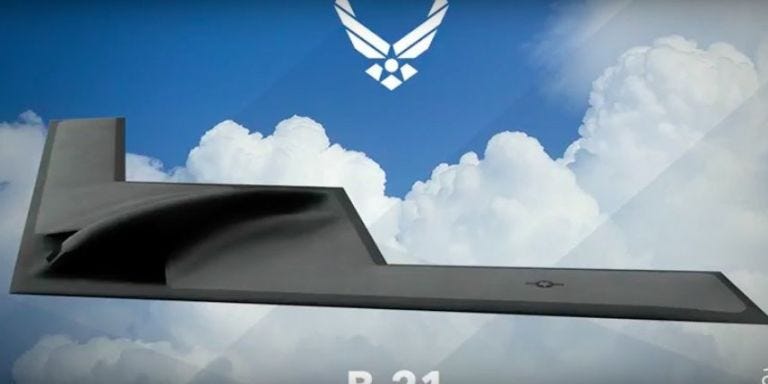
The unveiling was carefully staged. Viewers saw the front of the aircraft, its smooth flying-wing shape, and enough of its design language to understand the family resemblance to the B-2 Spirit. What they did not see was just as important. Many details remained hidden, because stealth aircraft are not exactly famous for oversharing.
That public debut marked a turning point. The B-21 was no longer just a program name in budget documents. It had become a visible aircraft, a future fleet, and a national symbol of modernization. Aviation watchers compared shapes, defense analysts discussed procurement, and casual observers mostly agreed on one thing: it looked like a very expensive bat from the future.
The Role of the B-21 in the Bomber Fleet
The Air Force expects the B-21 to gradually replace portions of the B-1 and B-2 fleets. Official planning has long referenced a minimum goal of 100 aircraft, though discussions about future fleet size continue as global security conditions evolve. The core idea is to create a bomber force that can remain relevant for decades, not just through the aircraft’s initial design but through software, sensors, mission systems, and modular upgrades.
This is one of the most important parts of the B-21 story. Modern military aircraft are no longer just aluminum, composites, engines, and sharp paint jobs. They are flying digital platforms. The ability to update software and integrate new systems over time may matter as much as the airframe itself. The Raider is being presented as an aircraft built for adaptation, which is a polite way of saying that nobody wants a 21st-century bomber that becomes outdated faster than a phone charger.
The B-21 is also part of the broader modernization of U.S. strategic deterrence. That includes aircraft, submarines, missiles, command systems, and supporting infrastructure. In this larger picture, the Raider is not a lone superhero aircraft. It is one piece of a much bigger deterrence puzzle.
Where the Raider Will Be Based
Basing decisions are a major part of any new aircraft program. For the B-21, Ellsworth Air Force Base in South Dakota was selected as the first main operating base and the location of the formal training unit. Whiteman Air Force Base in Missouri and Dyess Air Force Base in Texas have also been identified as future B-21 bases.
These decisions matter because a bomber is not just an aircraft; it is an ecosystem. Bases need facilities, maintenance areas, training pipelines, security systems, hangars, runways, support personnel, and local communities prepared for long-term change. The Raider may look elegant in photos, but behind every elegant aircraft is an enormous amount of planning, construction, logistics, and paperwork quietly doing push-ups in the background.
Ellsworth’s role as the first operational home gives South Dakota a special place in the Raider story. The base is expected to help shape how the aircraft enters regular service, how crews train, and how support systems mature. That makes the Raider not only a national program but also a local transformation for the communities connected to its future bases.
Testing, Production, and Recent Progress
After the rollout, the B-21 moved into flight testing and production development. Edwards Air Force Base in California plays a central role in the test program. Public updates have described continued testing, additional test aircraft, and program progress toward operational delivery.
In 2025, the Air Force announced the arrival of a second B-21 test aircraft at Edwards, expanding the testing effort. In 2026, official updates highlighted continued progress, including aerial refueling activity and further program acceleration. These milestones are important because aircraft development is not a single dramatic moment. It is a long chain of testing, measuring, adjusting, retesting, and occasionally discovering that reality has strong opinions.
For a program like the B-21, testing is not simply about proving that the aircraft can fly. It is about verifying systems, improving reliability, validating maintenance processes, refining training, and preparing the aircraft for real-world service. The public sees a clean aircraft photo. The program sees thousands of data points, checklists, and engineering reviews.
Why the Raider’s Design Gets So Much Attention
Even people who do not follow military aviation closely tend to notice the B-21’s shape. Its flying-wing design gives it a futuristic appearance, with smooth lines and minimal visible clutter. That design approach is associated with stealth, efficiency, and long-range performance, though the most sensitive specifics remain classified.
The B-21’s visual similarity to the B-2 Spirit is not accidental. Both aircraft reflect decades of research into low-observable design and long-range strike needs. Yet the Raider is not simply “B-2, Part Two: Electric Boogaloo.” It is intended to be easier to maintain, more digitally adaptable, and better suited to modern operational requirements.
In plain English, the B-21 is supposed to be stealthy without being a maintenance diva. That matters because advanced aircraft are only useful if they can be kept ready, upgraded, and operated at scale. A beautiful aircraft that spends too much time waiting for specialized care becomes less of a deterrent and more of a very dramatic garage ornament.
The Meaning Behind the Name
Names matter in military aviation. “Mustang,” “Eagle,” “Spirit,” “Raptor,” and “Lightning” all carry personality. “Raider” fits into that tradition because it is short, forceful, and historically loaded. It suggests speed, initiative, reach, and surprise without needing a paragraph-long explanation every time someone says it.
The name also creates a bridge between eras. The Doolittle Raiders flew modified B-25s in a desperate wartime moment. The B-21 Raider belongs to a world of stealth design, digital engineering, and strategic competition. The technology could hardly be more different, but the theme is similar: reach across distance when it matters.
That historical connection gives the B-21 more than a model number. “B-21” tells you it is the first bomber of the 21st century. “Raider” tells you what memory it carries. Together, the name says: modern aircraft, old-school nerve.
Public Interest and Responsible Curiosity
The B-21 attracts attention for obvious reasons. It is rare for a new strategic bomber to appear. It is expensive, secretive, visually striking, and connected to major debates about defense spending, deterrence, technology, and global security. That combination is catnip for aviation fans, policy analysts, historians, and anyone who enjoys aircraft silhouettes that look like they were designed by a moon shadow.
Still, responsible curiosity matters. The public can learn about the Raider’s name, history, role, basing, and broad development milestones without needing sensitive technical details. In fact, that is the healthiest way to discuss it. The B-21 is important not because every detail is public, but because its public story reveals how the United States thinks about deterrence, modernization, and the future of airpower.
For readers, the most useful takeaway is not a secret specification. It is the strategic logic. The Raider is meant to help the United States maintain credible long-range deterrence in a world where air defenses, sensors, cyber systems, and geopolitical tensions are all evolving quickly. That is the serious part. The fun part is that it also looks like it escaped from a science-fiction storyboard and filed a flight plan.
Experience Section: What the Raider Story Feels Like From the Ground
To understand why the B-21 Raider fascinates people, imagine standing at an aviation museum in front of an older bomber. The aircraft is enormous. The tires look like they belong on a building. The wing stretches so far that your brain briefly asks whether it is still indoors. Nearby, a display explains the Doolittle Raid, and suddenly the word “Raider” feels less like a label and more like a time machine.
That experience changes how people read about the B-21. It is easy to talk about aircraft programs as budgets, basing plans, and production schedules. Those things matter, of course. But aircraft also carry stories. The Doolittle Raiders were young crews asked to do something that seemed almost impossible. They trained in unusual conditions, launched from a carrier deck in land-based bombers, and flew into history with no guarantee of a safe return.
Now fast-forward to the B-21. The crews who will eventually fly and maintain it are not living in the same world as the airmen of 1942. Their aircraft is digital, stealthy, and shaped by modern engineering. Their missions, training environments, and support systems are completely different. Yet the emotional thread remains recognizable: preparation, trust, teamwork, and the pressure of carrying a national responsibility.
For someone reading about the Raider from outside the military, the most relatable experience may be the feeling of scale. A program like this is not created by one genius in a lab coat dramatically tightening a bolt. It is built by engineers, software developers, test pilots, maintainers, logisticians, construction crews, budget analysts, trainers, inspectors, and factory workers. It is a national-scale group project, except the group project flies, costs billions, and nobody gets to blame the printer.
There is also a local experience. Around bases like Ellsworth, Whiteman, and Dyess, the Raider is not just a headline. It means construction, jobs, training, relocation, community planning, school impacts, local business activity, and new rhythms around base life. A new aircraft can reshape a community’s identity for decades. People see road work, hangar projects, new families, and increased attention from national media. The futuristic bomber eventually becomes part of everyday life.
Then there is the aviation enthusiast experience. The B-21’s public photos invite careful looking. People compare the nose, canopy, landing gear doors, wing edges, and overall planform. They debate what can be safely inferred and what should remain unknown. This is where curiosity needs a seatbelt. It is fine to admire the aircraft and study public information, but the healthiest discussion stays broad, historical, and responsible.
The Raider’s story is also a reminder that technology never stands alone. A bomber is a machine, but the reason people care about it is human: fear of war, hope for deterrence, respect for service members, pride in engineering, concern about cost, and fascination with flight. The B-21 sits at the intersection of all those feelings. It is a symbol of power, yes, but also of caution. The best strategic aircraft is one that helps prevent conflict, not one that makes conflict feel casual.
That may be the most meaningful experience connected to the B-21 Raider: it asks readers to think beyond the aircraft itself. The name points backward to the Doolittle Raiders. The design points forward to the future of airpower. The program sits in the present, where nations make hard choices about security, spending, technology, and responsibility. For a machine that appears so smooth and silent, the Raider carries a remarkably loud conversation.
Conclusion
The B-21 Raider is more than a new bomber with a dramatic name. It is a bridge between history and future strategy. Its name honors the Doolittle Raiders, whose 1942 mission became a symbol of courage and long-range airpower. Its design reflects decades of stealth research, digital engineering, and changing security needs. Its basing plan points to a long operational future, beginning with Ellsworth Air Force Base and expanding to other major bomber communities.
As the Raider continues testing and moves closer to operational service, public interest will only grow. The aircraft will be discussed as a technology project, a defense investment, a deterrence platform, and a piece of aviation history still being written. The best way to understand it is not through hype or guesswork, but through the story its name already tells: a story of reach, resolve, innovation, and responsibility.