

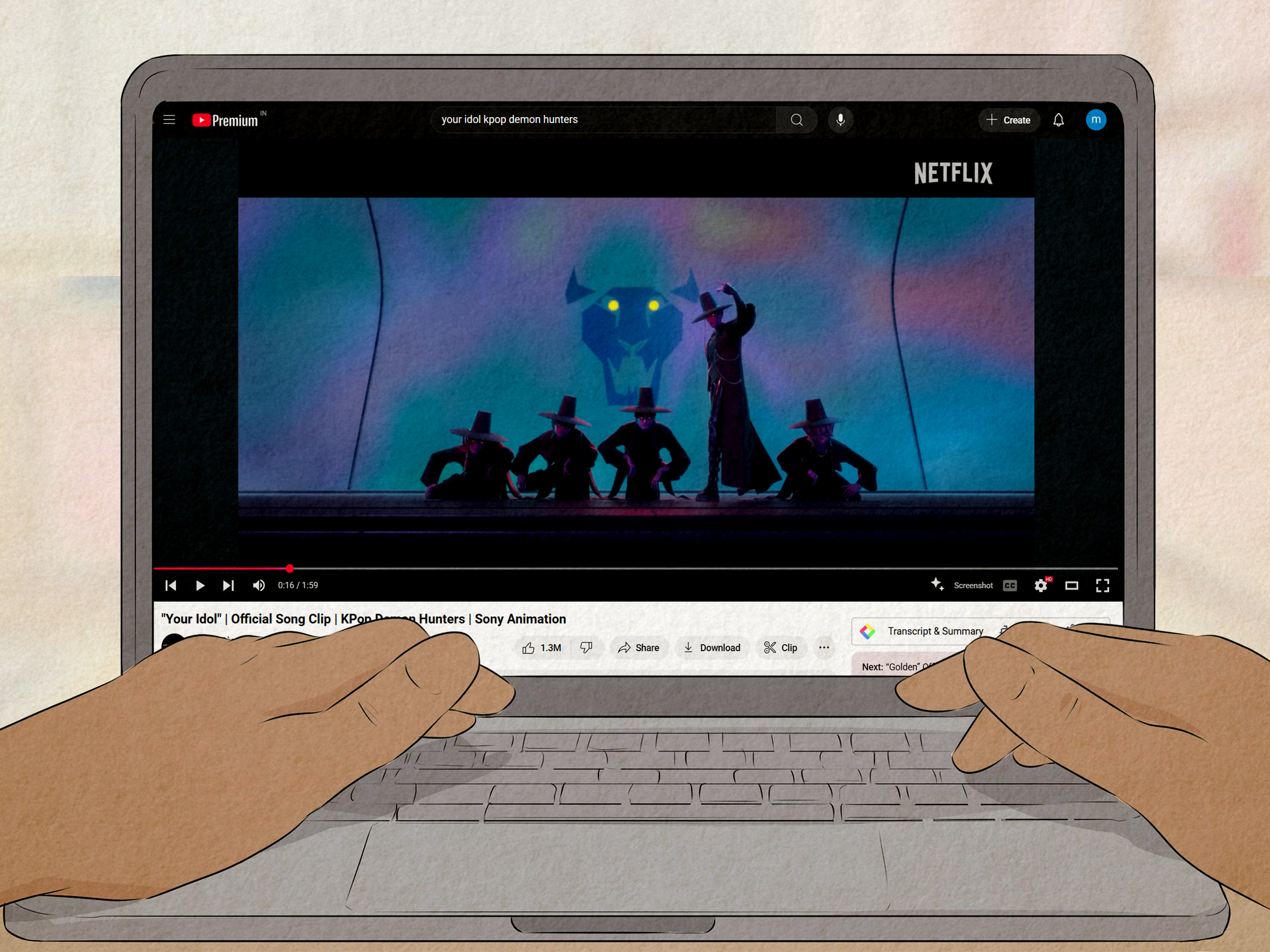
Note: This article analyzes the themes and meaning of "Your Idol" from KPop Demon Hunters without reproducing the full copyrighted lyrics.
"Your Idol" is the kind of villain song that walks into the room wearing black, smiles like it knows your search history, and somehow still lands on your playlist. In Netflix and Sony Pictures Animation’s KPop Demon Hunters, the track belongs to the Saja Boys, the dazzling demon boy band whose charm is not just stagecraft. It is bait. Very catchy bait, yes, but bait all the same.
At first listen, "Your Idol" sounds like a dark K-pop performance built for stadium lights, synchronized choreography, and thousands of fans screaming in suspiciously perfect harmony. But inside the movie, the song does much more than entertain. It reveals the Saja Boys’ true purpose, exposes the danger of blind devotion, and turns idol worship into a supernatural weapon. That is why fans keep searching for "Your Idol" lyrics meaning: the song is not just a bop. It is a trap with a beat drop.
In this in-depth breakdown, we will explore how "Your Idol" works in the story, what its lyrics suggest about fame and control, why the Saja Boys’ performance feels so hypnotic, and how the song fits into the larger emotional world of KPop Demon Hunters.
What Is "Your Idol" in KPop Demon Hunters?
"Your Idol" is performed by the fictional K-pop boy group the Saja Boys, the rival act that challenges HUNTR/X, the heroic girl group made up of Rumi, Mira, and Zoey. On the surface, the Saja Boys are polished, handsome, smooth-voiced performers with enough charisma to make a stadium lose its collective mind. Underneath all that glitter, however, they are demons in disguise.
The song arrives at a crucial point in the film, after the Saja Boys have already won over fans with their bright, sugary public image. Their earlier track, "Soda Pop," works like a fizzy introduction: cute, addictive, and lightly suspicious if you pay close attention. "Your Idol" is the mask-off moment. The sweetness is gone. The boys are no longer hiding behind innocent flirtation. Now the performance becomes a dark ritual.
That shift matters because KPop Demon Hunters is a musical where songs carry plot, character, and emotional truth. HUNTR/X use music to protect people and express identity. The Saja Boys use music to possess attention, drain power, and prepare fans for Gwi-Ma, the movie’s major villain. In other words, both groups sing. Only one group should be allowed near your soul.
The Short Meaning of "Your Idol"
The meaning of "Your Idol" is simple on the surface and sharp underneath: the Saja Boys are promising comfort, status, and obsession while actually demanding submission. The word "idol" works in two ways. It refers to a K-pop celebrity, but it also carries older religious meaning: an object of worship, devotion, or misplaced faith.
That double meaning is the heart of the song. The Saja Boys are not merely saying, "Admire us." They are saying, in effect, "Give yourself to us. Let us define what you want, who you follow, and how much power you have left." It is fandom turned inside out. What should be joyful becomes parasitic.
This is why "Your Idol" feels more threatening than a normal villain number. The danger is not just that the demons are strong. It is that they are attractive, polished, and easy to love. The song understands something very real about pop culture: charisma can be thrilling, but it can also become manipulative when audiences are encouraged to surrender judgment completely.
How the Lyrics Turn Fan Devotion Into Control
Because the full lyrics should be heard through official channels, we will focus on themes rather than line-by-line quotation. The lyrics repeatedly frame the Saja Boys as figures who can occupy the listener’s mind, guide their feelings, and become the center of their emotional universe. That is classic idol language, but the movie darkens it.
In real-life pop music, artists often sing directly to fans. They promise love, escape, confidence, or loyalty. "Your Idol" twists that familiar pop language until it becomes predatory. The Saja Boys do not just want attention; they want dependence. They do not just want applause; they want surrender. If a normal concert says, "Sing with us," this performance says, "Forget you have a choice."
The lyric concept also plays with repetition. Repetition is a powerful part of K-pop songwriting: hooks are designed to lodge in your brain, choreography reinforces the rhythm, and visuals make the song instantly recognizable. Here, that catchiness becomes creepy on purpose. The more memorable the song is, the more believable its mind-control effect becomes inside the movie.
Why "Your Idol" Is a Perfect Villain Song
It Sounds Seductive Before It Sounds Dangerous
The best villain songs are not boring lectures from evil people. Nobody wants a demon to sing, "I am bad and here is my quarterly plan." Great villain songs seduce first. "Your Idol" understands that rule beautifully. Its production is heavy, dark, and dramatic, but it still has the sleek confidence of a real K-pop hit.
That is what makes it work. The listener can understand why fans inside the movie are mesmerized. The Saja Boys are not cartoonishly unappealing. They are cool. They are stylish. They move like they have never once tripped over a charging cable. Their danger is wrapped in perfection.
It Reveals the Villains at the Right Time
"Your Idol" lands after the Saja Boys have already gained influence. That timing is important. If the film introduced them with this level of darkness immediately, the audience would know not to trust them. Instead, the movie lets them build fan loyalty first. By the time "Your Idol" arrives, their control feels earned within the story.
The performance tells us: this was always the plan. The charm, the polished branding, the romantic poses, the boy-band glownone of it was random. It was strategy. The lyrics then become a confession disguised as a concert.
It Gives the Audience a Moral Test
Part of the fun of "Your Idol" is that viewers may catch themselves enjoying the song while recognizing how evil it is. That tension is not a flaw. It is the point. The movie asks: how often do we confuse charisma with trustworthiness? How easily can a beautiful performance make us ignore warning signs?
That is a surprisingly grown-up question for an animated musical about demon hunters, and it is one reason the song has stuck with fans. "Your Idol" lets us enjoy the spectacle while quietly poking us in the ribs and whispering, "You sure about this guy?"
The Religious and Cult-Like Imagery in the Song
One of the most interesting parts of "Your Idol" is its use of worship imagery. The song does not treat fandom as casual admiration. It frames devotion as something sacred, intense, and dangerous. The Saja Boys are not simply performers on a stage; they behave like false gods asking for loyalty.
This connects directly to the title. An idol can be a pop star, but an idol can also be something worshiped in place of truth. The movie uses that double meaning to create a critique of obsession. Fans are not mocked for loving music. In fact, KPop Demon Hunters celebrates music as connection, healing, and identity. What the movie criticizes is the loss of self that can happen when admiration becomes total surrender.
The choral, almost cathedral-like atmosphere of the song deepens that idea. Instead of sounding like a regular pop performance, parts of "Your Idol" feel ritualistic. The voices swell, the staging darkens, and the performance becomes less like a concert and more like a ceremony. Unfortunately, this ceremony is not offering complimentary light sticks. It is offering soul extraction.
How "Your Idol" Connects to Jinu and Gwi-Ma
The Saja Boys’ leader Jinu is one of the most compelling figures in the film because he is not only a villainous performer. He has a tragic backstory and a connection to Gwi-Ma, the manipulative demonic force behind the group’s mission. That makes "Your Idol" more layered than a simple evil anthem.
Jinu represents the cost of selling yourself for fame, talent, or survival. His appeal is real, but it is also corrupted. Through him, the song becomes a warning about what happens when ambition is severed from freedom. He has the spotlight, the voice, the fans, and the visual package. But he is not truly free. His power is borrowed, and the debt collector is terrifying.
Gwi-Ma’s presence makes the song feel like more than a performance. The Saja Boys are not merely stealing fans from HUNTR/X in a chart rivalry. They are preparing an audience to be consumed. The lyrics’ controlling tone reflects this hierarchy: the boys control the fans, but Gwi-Ma controls the boys. In that sense, "Your Idol" is also about how systems of exploitation trap both the worshiped and the worshipers.
Why the Song Contrasts So Strongly With HUNTR/X
HUNTR/X and the Saja Boys are mirror images. Both are idol groups. Both command huge audiences. Both use performance as power. But their relationship to fans is completely different.
HUNTR/X protect their fans, even when the work is exhausting and emotionally complicated. Their songs often move toward honesty, self-acceptance, and unity. Rumi’s arc especially centers on shame, secrecy, and learning to accept the parts of herself she was taught to fear. The Saja Boys, by contrast, use performance to erase the audience’s agency.
That contrast makes "Your Idol" the dark twin of the film’s more empowering songs. Where HUNTR/X sing to awaken people, the Saja Boys sing to numb them. Where HUNTR/X move toward truth, the Saja Boys move toward illusion. Where HUNTR/X ask listeners to join in, the Saja Boys ask listeners to submit.
The K-Pop Influence Behind "Your Idol"
Musically, "Your Idol" draws on darker K-pop traditions: dramatic chanting, intense vocal layering, sleek production, and performance concepts that mix beauty with menace. Fans have compared its atmosphere to the grand, theatrical side of boy-group music, where mythology, obsession, and transformation often appear as visual themes.
The creative team behind KPop Demon Hunters worked with experienced K-pop songwriters and producers, including contributors connected to THEBLACKLABEL. That authenticity matters. The song does not feel like a parody made by people who skimmed three music videos and called it research. It understands the architecture of a K-pop performance: the hook, the visual concept, the member dynamics, the choreographic drama, and the way a group can become a whole universe.
At the same time, "Your Idol" exaggerates those elements for fantasy. The black hats, supernatural lighting, demonic spectacle, and booming vocal textures push the song beyond ordinary idol performance into full mythic villain mode. It is K-pop as dark magic. Honestly, some comeback stages already feel halfway there, minus the soul-eating part.
What "Your Idol" Says About Fame
One of the smartest things about "Your Idol" is that it does not claim fame is automatically evil. KPop Demon Hunters clearly loves pop music. It loves choreography, fashion, hooks, fandom, and the ridiculous joy of screaming when your favorite group appears on screen. The movie is not wagging a finger at fans for caring too much.
Instead, the song asks what happens when fame becomes one-sided. Healthy fandom contains joy, creativity, community, and personal meaning. Unhealthy obsession turns the star into a replacement for selfhood. "Your Idol" dramatizes that danger by making it literal. The fans are not just distracted; they are spiritually endangered.
This is why the song resonates outside the film. In the age of social media, parasocial relationships are everywhere. Fans can feel close to artists they have never met. That connection can be comforting, but it can also be manipulated by marketing, algorithms, and carefully managed images. "Your Idol" turns that modern anxiety into a demon-boy-band anthem, which is both hilarious and alarmingly efficient.
Why Fans Love "Your Idol" Anyway
Fans love "Your Idol" because it does what all unforgettable villain songs do: it makes bad behavior sound fantastic. The track is dark, sleek, theatrical, and incredibly replayable. It has the confidence of a hit single and the narrative punch of a major plot twist.
It also gives the Saja Boys a strong identity. They are not generic evil rivals. They have a sonic signature: seductive, ominous, polished, and grand. Their music tells us who they are before the dialogue needs to explain anything. That is good musical storytelling.
Another reason the song works is that it is fun to analyze. The title, staging, vocal arrangement, and lyrics all point in the same direction: control disguised as devotion. Fans can enjoy the song as music, unpack it as narrative, and debate its symbolism online. That combination gives "Your Idol" a long life beyond the movie.
Experiences Related to "Your Idol" Lyrics & Their Meaning in KPop Demon Hunters
Watching "Your Idol" for the first time feels like realizing the charming stranger at the party has been standing a little too close to the exits. You know something is wrong before the movie fully says it. The staging gets darker, the performance grows heavier, and the boys’ smiles stop reading as cute. Suddenly, the same idol charisma that seemed playful in "Soda Pop" becomes dangerous.
That experience mirrors what many viewers feel when they revisit the song after finishing the film. On a first watch, the track may register as the "cool villain song." On a second watch, it becomes more unsettling. The lyrics sound less like flirtation and more like a contract. The confidence feels less romantic and more possessive. Even the catchiness starts to feel suspicious, as if the song knows it has already won a corner of your brain and is decorating it with black velvet curtains.
For K-pop fans, the experience is especially layered. Many viewers understand the thrill of idol performance: the comeback teasers, the carefully built concepts, the music videos full of symbolism, the choreography that makes you wonder whether your own knees are underachieving. "Your Idol" borrows that familiar excitement and twists it. It asks fans to recognize how powerful performance can be when every detail is designed to command attention.
At the same time, the song does not shame fandom. That is important. Most fans know the difference between admiration and unhealthy obsession. They stream music, make edits, buy albums, trade photocards, and joke online because fandom is fun. The danger in "Your Idol" is not loving a group. The danger is losing yourself inside the image of a group. The Saja Boys do not invite fans into community; they pull them into dependency.
That is why the song can feel personally relevant even though the plot involves demons, soul-feeding, and a villain with extremely poor boundaries. Many people have had moments when they gave too much power to someone charismatic: a celebrity, a crush, a leader, a friend group, or even an online community. At first, it feels exciting to be swept up. Later, you may realize your own voice got quieter. "Your Idol" turns that emotional pattern into pop spectacle.
The best viewing experience is to listen for how the song changes the atmosphere around the audience inside the film. The fans do not simply cheer; they become part of the ritual. That is the scary part. The performance absorbs them. In contrast, HUNTR/X songs often bring people back to themselves. Their music creates connection without erasing individuality. That difference gives the movie its moral heartbeat.
For writers, musicians, and creators, "Your Idol" is also a useful case study. It proves that a song in a movie musical should not be decorative. It should change the story. By the time "Your Idol" ends, the stakes are clearer, the villains are more frightening, and Rumi’s intervention feels urgent. The song does character work, plot work, world-building work, and playlist work all at once. Frankly, it deserves hazard pay.
For casual listeners, the experience is simpler: the song is addictive because it is well-built. The dark production creates atmosphere, the vocals sell confidence, and the hook is easy to remember. But the reason it stays interesting is the meaning underneath. "Your Idol" is not just about demons pretending to be pop stars. It is about how easily performance can become power, and how important it is to keep your own voice even when the whole stadium is singing along.
Conclusion: The Real Meaning of "Your Idol"
"Your Idol" is one of the standout songs in KPop Demon Hunters because it operates on several levels at once. It is a dark K-pop banger, a villain reveal, a warning about obsession, and a clever exploration of what happens when admiration becomes worship. The Saja Boys use the language of idol devotion to make fans feel chosen, protected, and consumed. The horror is that those feelings are not separate. In the world of the movie, being consumed is the point.
The song’s meaning becomes even stronger when placed beside HUNTR/X’s music. The heroines use song to reveal truth, build connection, and restore agency. The Saja Boys use song to hide truth, create dependency, and steal agency. That contrast makes "Your Idol" more than a catchy villain number. It is the movie’s sharpest warning about fame without honesty and fandom without selfhood.
So yes, "Your Idol" is dangerously replayable. But that is exactly why it works. It lets us feel the pull of the Saja Boys while reminding us why Rumi, Mira, and Zoey have to fight back. In a film full of demons, glitter, high notes, and emotional growth, "Your Idol" proves that the scariest monster might be the one with perfect hair, perfect harmonies, and a chorus you cannot stop humming.