

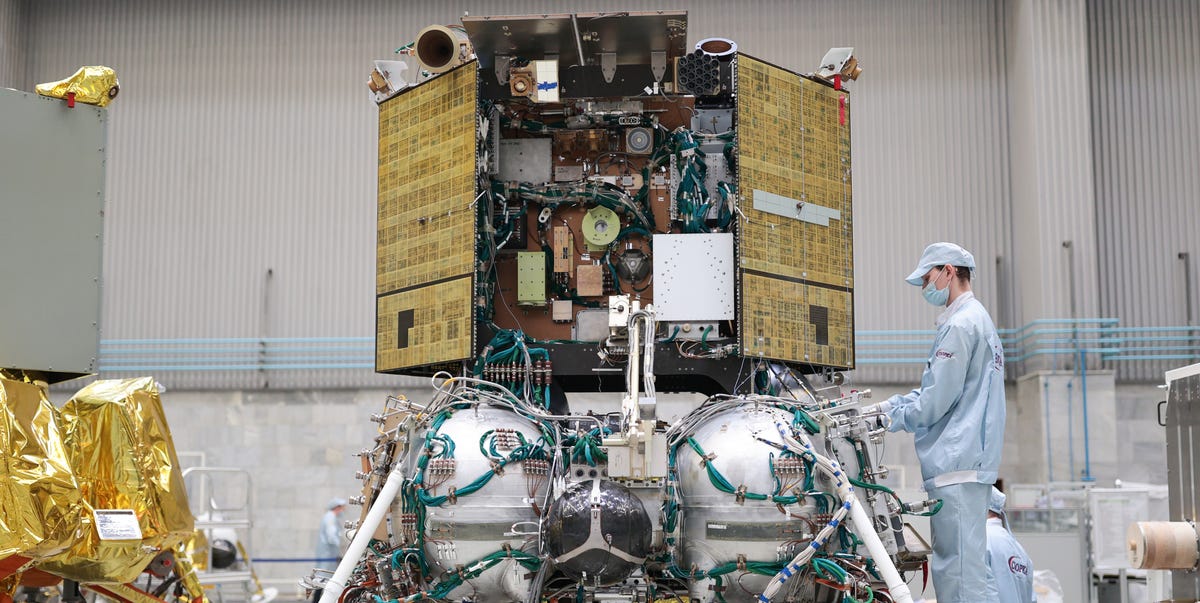
For nearly half a century, the Soviet Union’s Luna program sat in space-history display cases like a beautifully engineered fossil: impressive, important, and very much not launching. Then Russia tried to revive the name with Luna 25, a robotic moon lander designed to return the country to lunar exploration after the final Soviet moon mission, Luna 24, brought samples back to Earth in 1976. In theory, it was a glorious comeback. In practice, the Moon replied with the cosmic equivalent of, “Please check your landing settings and try again.”
The story of the Luna reboot is not just about one spacecraft. It is about the legacy of Soviet lunar exploration, the modern race to the Moon’s south pole, the scientific hunt for water ice, and the brutal fact that landing on another world remains extremely hard. Even with decades of experience, clever engineers, and rockets that look like they were designed by people who drink black coffee for breakfast, the Moon does not hand out participation trophies.
The Original Luna Program: Small Machines, Huge Firsts
The Soviet Luna program began in 1959 and became one of the most productive robotic exploration campaigns of the early Space Age. While the United States became famous for Apollo astronauts walking on the Moon, the Soviet Union built a remarkable record with uncrewed missions. The Luna spacecraft flew past the Moon, struck it, orbited it, photographed its far side, landed softly on its surface, deployed rovers, drilled into lunar soil, and returned samples to Earth.
Luna 1, launched in January 1959, missed the Moon but became the first spacecraft to escape Earth’s gravity and enter orbit around the Sun. That is a pretty stylish way to miss a target. Luna 2 followed later that year and became the first human-made object to reach the lunar surface. Luna 3 then delivered one of the great “wait, that’s what it looks like?” moments in science by returning the first images of the Moon’s far side.
The program kept pushing. Luna 9 achieved the first soft landing on the Moon in 1966 and returned surface photographs. Luna 10 became the first spacecraft to orbit the Moon. Luna 16 returned lunar soil robotically in 1970, proving that sample return did not always require astronauts, flags, or dramatic television commentary. Luna 17 carried Lunokhod 1, the first successful robotic rover on another world, which rolled across the Moon years before Mars rovers became science celebrities.
Luna 24: The Last Soviet Trip to the Moon
The final Soviet lunar mission, Luna 24, launched in August 1976. It landed in Mare Crisium, drilled into the lunar regolith, and returned 170.1 grams of material to Earth. That amount may sound small, roughly the weight of a generous sandwich, but in planetary science, a few grams of ancient alien dirt can be a treasure chest. Those samples helped researchers study the Moon’s volcanic plains, soil structure, and geologic history.
After Luna 24, the Soviet lunar effort stopped. The country continued to do extraordinary work in human spaceflight and space stations, but the Moon slipped into the background. Political priorities changed, budgets shifted, the Soviet Union collapsed, and Russia inherited a space program with legendary expertise but growing financial and industrial headaches. The Luna name became a museum label, a chapter heading, a reminder of what robotic exploration had once achieved.
Why Reboot Luna at All?
The modern answer is simple: the Moon is interesting again. NASA’s Artemis program, China’s Chang’e missions, India’s Chandrayaan program, private lunar landers, and international research partnerships have transformed the Moon from Cold War trophy into a practical proving ground. Scientists want to understand lunar geology, test technologies for deep-space missions, and investigate resources that may support future explorers.
The biggest prize is the lunar south pole. Unlike the familiar Apollo landing sites near the Moon’s equator, the south polar region contains permanently shadowed craters where sunlight almost never reaches. These cold traps may preserve water ice and other frozen volatiles. Water is not just useful for drinking. It can potentially be split into hydrogen and oxygen for rocket fuel, used for life support, and studied as a record of impacts, solar wind, and the Moon’s ancient history.
That is why Luna 25 mattered. It was not merely a nostalgia project with a vintage nameplate. It was Russia’s attempt to re-enter the front row of lunar exploration at the exact moment the world was turning its telescopes, budgets, and PowerPoint decks toward the Moon’s south pole.
Luna 25: The Reboot That Reached the Moon but Not the Surface
Luna 25 launched in August 2023 aboard a Soyuz-2.1b rocket from the Vostochny Cosmodrome. The mission was designed as a stationary lander targeting the Moon’s south polar region. Its scientific goals included studying the lunar surface, analyzing regolith, and investigating volatile compounds. It was also supposed to demonstrate that modern Russia could design, launch, navigate, and land a robotic spacecraft on the Moon after a 47-year lunar gap.
For a few days, the comeback looked promising. Luna 25 reached lunar orbit. It sent back images, including views of the far-side Zeeman crater. Then came the critical maneuver to move into a pre-landing orbit. During that burn, the spacecraft’s engine reportedly operated longer than planned. Instead of gently setting up for descent, Luna 25 entered an unintended path and crashed into the Moon on August 19, 2023.
In short, the reboot made it to the loading screen and then blue-screened on the Moon. That joke is easy; the engineering reality is not. Lunar landing demands frightening precision. A spacecraft must manage speed, altitude, orientation, engine performance, guidance software, terrain hazards, communication delays, and fuel margins. The Moon has no thick atmosphere to slow a lander with parachutes. There is no runway, no air traffic controller, and no forgiving ocean splashdown. There is only gravity, dust, rock, and math.
What Went Wrong?
Russian investigators later pointed to a malfunction involving the onboard control system and acceleration measurement data. The lander’s propulsion system fired for about 127 seconds instead of the planned 84 seconds during the orbit-lowering maneuver. That extra burn changed the spacecraft’s trajectory enough to doom the mission. NASA’s Lunar Reconnaissance Orbiter later imaged a new crater believed to be associated with the impact site near Pontécoulant G crater.
The failure was painful because Luna 25 had carried more than scientific instruments. It carried institutional memory, national prestige, and the emotional weight of a once-dominant space program trying to prove that it could still deliver beyond low Earth orbit. It also arrived at an awkward moment: India’s Chandrayaan-3 successfully landed near the lunar south pole just days later, making India the first nation to achieve a soft landing in that region.
The South Pole Is Crowded for a Reason
The Moon’s south pole has become the hottest cold place in space. NASA, China, India, Japan, Europe, and private companies all have reasons to care about it. The region offers scientific value because ancient ice may preserve clues about comet impacts, solar activity, and the delivery of water across the inner solar system. It offers practical value because water could support future habitats. It offers strategic value because whoever learns how to operate there gains experience that may shape the next era of space exploration.
Still, the south pole is not a friendly parking lot. The Sun sits low on the horizon, casting long shadows. Some areas receive useful sunlight; others remain in darkness. Temperatures can swing violently. Terrain can be rugged. Communication geometry can be tricky. A lander has to be smart enough to avoid hazards, stable enough to touch down, and tough enough to operate in one of the strangest environments near Earth.
Russia’s Future Luna Missions: Ambition Meets Delay
Luna 25 was intended to be the first step in a larger sequence. Luna 26 was planned as an orbiter to map the Moon and support future missions. Luna 27 was expected to be a more advanced lander focused on the south polar region, with instruments designed to search for water and analyze lunar soil. Luna 28, Luna 29, and Luna 30 were discussed as later missions involving sample return, rovers, or broader lunar infrastructure goals.
But the path has become complicated. European cooperation on Luna 25, Luna 26, and Luna 27 ended after Russia’s 2022 invasion of Ukraine. Sanctions, supply-chain problems, budget stress, and the Luna 25 failure all increased pressure on the schedule. Reports in 2026 indicated that later Russian lunar missions, including Luna 28 through Luna 30, had been pushed into the 2032–2036 range. In other words, the reboot has not been canceled, but it is moving with the speed of a printer that says “processing” while everyone in the office stares at it.
Why the Luna Legacy Still Matters
It would be a mistake to judge the Luna program only by Luna 25’s crash. The original Luna missions helped define robotic planetary exploration. They showed that machines could do serious work on another world long before modern autonomous navigation, high-resolution digital imaging, and compact computers. The Soviet sample returns also proved that a nation could collect lunar material without sending humans, a model that is once again highly relevant as countries and companies plan lower-cost science missions.
The Luna legacy also reminds us that exploration is cumulative. Luna 3’s blurry far-side images were crude by modern standards, but they changed humanity’s view of the Moon. Lunokhod 1’s rover tracks were not glamorous, but they helped prove that robotic mobility was possible beyond Earth. Luna 24’s sample return was small, but it kept lunar science alive for decades. Space history is not built only from spectacular firsts. It is built from patient engineering, repeated attempts, and a willingness to learn from machines that occasionally become very expensive craters.
What Luna 25 Teaches Modern Space Programs
1. Heritage Is Not a Substitute for Testing
A famous name can inspire confidence, but hardware does not care about branding. A modern lunar lander must be tested, validated, simulated, and reviewed as if no one has ever landed before. Because for that exact team, with that exact spacecraft, under those exact conditions, no one has.
2. The Moon Is Still Hard
The recent lunar era has included successes and failures from governments and private companies alike. Soft landing remains one of the toughest achievements in spaceflight. A tiny navigation error can become a mission-ending mistake. A late software bug can defeat years of design. The Moon may look calm from Earth, but as an engineering destination, it is an unforgiving stone referee.
3. International Cooperation Matters
Modern lunar missions often rely on global partnerships. Instruments, cameras, drills, navigation systems, ground stations, and scientific teams may come from different countries. When political relationships collapse, mission architecture can collapse with them. The Luna reboot shows how geopolitics can move from headlines directly into wiring diagrams.
4. Lunar Water Is the New Strategic Magnet
The Moon’s water story has evolved dramatically. Once considered dry, the Moon is now known to host water or water-related molecules in multiple forms and locations, from sunlit surfaces to shadowed polar regions. That does not mean the Moon has convenient underground lakes waiting for astronauts with buckets. It means the science is rich, the engineering challenge is serious, and the resource potential is too important to ignore.
The New Moon Race Is Not the Old Moon Race
The original space race was largely a duel between the United States and the Soviet Union. The new lunar race is messier, more commercial, and more international. NASA works with private companies under Commercial Lunar Payload Services. China has achieved major robotic successes with the Chang’e program. India’s Chandrayaan-3 demonstrated precision and national ambition. Japan, Europe, South Korea, and others are building roles. Even small payloads can now ride to the Moon as part of broader mission ecosystems.
That makes Russia’s Luna reboot more difficult. It is not trying to return to a world where two superpowers dominate the scoreboard. It is trying to compete in a crowded field where budgets, technology access, industrial modernization, and international trust matter as much as heroic history. The Luna name opens the door, but it does not guarantee a seat at the table.
Experience Section: What Following the Luna Reboot Feels Like
Following the Luna reboot is a strange experience because it blends childhood wonder with adult realism. On one hand, the name “Luna” still has magic. It sounds clean, old, and mythic, like something stamped on the side of a spacecraft in a black-and-white documentary. If you grew up reading about the Space Age, Luna feels like a message from the era when engineers wore short-sleeved shirts, slide rules had social status, and every launch seemed to announce a new chapter of the future.
On the other hand, Luna 25’s story is a reminder that space exploration does not run on nostalgia. Watching a mission return to the Moon after almost five decades should feel triumphant, and for a while it did. There was the launch, the lunar transfer, the arrival in orbit, the possibility of landing near the south pole before anyone else. For space fans, it had the suspense of a championship game, except the ball was a robot, the stadium was 240,000 miles away, and the referee was orbital mechanics.
Then came the crash. The emotional whiplash was real. One moment, the mission symbolized renewal; the next, it became a cautionary tale. That is one of the most honest experiences spaceflight offers: it makes room for both awe and disappointment. A failed mission is not just a technical report. It is the silence after the signal stops, the engineers checking screens, the scientists recalculating what data survived, and the public remembering that exploration has always involved risk.
There is also a deeper lesson for anyone building, writing, researching, or dreaming big. Reboots are hard. Whether you are restarting a lunar program, reviving a business, learning an old skill, or returning to a goal after years away, the past can inspire you but cannot do the work for you. Systems age. Teams change. Knowledge gets lost. Suppliers vanish. Assumptions expire. The Luna reboot shows that restarting is not the same as continuing; it is often closer to rebuilding from the foundation while everyone keeps pointing at the old trophy case.
Still, the story is not only sad. Luna 25 reached lunar orbit. It generated public attention. It proved that the ambition remained alive, even if the landing failed. The Moon has a long memory, but space programs do too. Engineers learn from anomalies. Mission planners adjust. Future landers get redesigned, retested, and re-argued in conference rooms where the coffee is probably terrible but the stakes are magnificent.
For readers, the best way to experience the Luna story is to look up at the Moon with two thoughts at once. First, humanity has already done astonishing things there with machines smaller and simpler than today’s smartphones. Second, we are still beginners. The Moon is familiar in the sky but alien under a lander’s feet. That tension is what makes Luna’s reboot fascinating. It is not just Russia returning to an old destination. It is humanity rediscovering that the nearest world beyond Earth is still full of unfinished business.
Conclusion: A Reboot Written in Dust, Ice, and Lessons
The Soviet Union’s Luna program was one of the great robotic exploration achievements of the twentieth century. It delivered firsts that shaped lunar science and proved that machines could scout, land, roam, drill, and return samples from another world. Nearly 50 years later, Russia’s Luna 25 attempted to revive that legacy for a new era focused on the Moon’s south pole and the search for water ice.
The mission failed, but the story is not over. If anything, Luna 25 made the reboot more revealing. It showed how much expertise must be rebuilt after decades away from deep-space landing. It showed how competitive the modern Moon race has become. It showed why the lunar south pole matters to science, strategy, and future exploration. Most of all, it reminded everyone that the Moon is close enough to see every night but still hard enough to humble a spacefaring nation.
The Luna program’s reboot is therefore not a neat comeback movie. It is a longer, rougher, more interesting story: part history lesson, part engineering drama, part geopolitical chessboard, and part reminder that space does not care how impressive your résumé is. The Moon waits patiently. Reboots take work.