

Architect Visit: PPAG is not simply a tour of an architecture studio; it is a doorway into a design attitude that treats buildings, furniture, classrooms, courtyards, restaurants, and city blocks as parts of one big human experiment. PPAG architects, the Vienna- and Berlin-based practice led by Anna Popelka and Georg Poduschka, has built a reputation for work that feels intelligent without being icy, inventive without shouting, and practical without giving up its personality.
In a design world where some buildings look as if they were rendered by a very serious spaceship, PPAG’s work often feels refreshingly grounded. The firm’s projects show a fascination with everyday life: how children move through a school, how neighbors share a courtyard, how a restaurant expands without losing its soul, and how a simple piece of public furniture can become a city icon. That is the charm of visiting PPAG, even on the page. You are not just looking at architecture. You are watching architecture think.
Who Is PPAG?
PPAG architects was founded in 1995 by Anna Popelka and Georg Poduschka. The studio is known for crossing boundaries between architecture, urban planning, furniture design, housing research, education spaces, and cultural projects. Instead of treating each commission as a repeatable formula, PPAG tends to approach each project as a prototype. In plain English: they do not copy and paste. They investigate.
This experimental spirit is one reason PPAG has appeared in international architecture coverage, from residential and school projects to restaurants and public seating. The firm’s portfolio ranges from compact interiors and low-budget domestic spaces to ambitious urban blocks and educational campuses. It is a broad range, but the work holds together because of a consistent question: How can design create better everyday life?
The Design Language: Simple, Smart, and a Little Mischievous
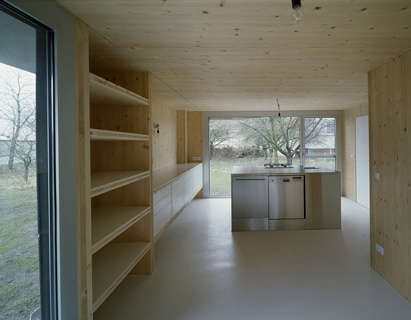
One of the most memorable aspects of PPAG’s early residential and interior work is its use of plain materials, especially unpainted wood. These spaces avoid decorative fuss. They feel warm, economical, and direct. A PPAG interior does not usually beg for attention with gold faucets or dramatic marble veining. Instead, it says, “Here is a room that works, breathes, and will not panic if someone leaves a coffee cup on the table.”
This simplicity is not laziness. It is discipline. Minimalist architecture can sometimes feel like a museum where humans are tolerated only if they wear beige socks. PPAG’s version is friendlier. Wood surfaces, built-in storage, flexible rooms, and carefully shaped openings give their spaces a sense of use. The result is modern architecture that still understands the comedy of real life: shoes pile up, children run, chairs migrate, and nobody wants a kitchen that looks perfect but functions like a puzzle box.
Architecture as Everyday Infrastructure
PPAG’s strongest work often begins with ordinary questions. Where do people meet? Where do they pause? How does a corridor become more than a corridor? Can a school encourage cooperation just through spatial organization? Can a housing complex feel dense and intimate at the same time? These questions sound modest, but they are the real engine of good architecture.
Rather than chasing a single signature style, PPAG works with systems, patterns, movement, and social behavior. Their buildings often include shared zones, terraces, courtyards, outdoor rooms, and thresholds that blur strict divisions between public and private. The architecture becomes a set of invitations: sit here, pass through there, look across, gather, retreat, return.
PPAG and Educational Architecture
Educational architecture is one of PPAG’s major strengths. The firm’s school projects are especially interesting because they do not treat learning as something that happens only in a classroom. In PPAG’s hands, stairs, terraces, corridors, gardens, and shared halls can become learning environments too.
Bildungscampus Sonnwendviertel
The Bildungscampus Sonnwendviertel in Vienna is a key example. Completed in 2014, the campus brings together kindergarten, primary school, and secondary school functions for children from infancy through age 14. Instead of separating every age group into rigid compartments, the project encourages flowing transitions between facilities. This creates opportunities for shared use, flexible teaching, and social exchange.
The project reflects a broader trend in school design: learning environments now need to support collaboration, movement, informal study, and different speeds of development. PPAG’s campus responds by treating the building as a neighborhood for learning. Children do not simply move from room to room; they move through a small world designed around discovery.
Längenfeldgasse Primary and Vocational School
Another important PPAG education project is the Längenfeldgasse Primary and Vocational School in Vienna, completed in 2020. The project combines a 17-class primary school for younger children with a 23-class vocational school for older students. That mixture alone is unusual. It asks one building to serve very different users, from children learning basic classroom rhythms to teenagers preparing for practical professional futures.
PPAG’s answer is not to flatten those differences but to organize them. The building extension works as an urban addition to an existing school campus, using architecture to manage density, identity, circulation, and shared space. It is a good example of how PPAG approaches complexity: not by hiding it, but by giving it structure.
Furniture That Became a City Habit: The Enzi
One of PPAG’s most lovable contributions to public life is not a building at all. It is furniture. The Enzi seating elements, designed for Vienna’s MuseumsQuartier in 2002, became a recognizable part of the city’s cultural landscape. These large modular pieces invite people to sit, lounge, lean, chat, read, flirt, people-watch, or pretend to read while actually people-watching. Urban life is full of such noble multitasking.
The Enzi shows PPAG’s ability to think across scales. A piece of furniture can change how a public courtyard is used. It can create informal gathering spaces without signs, barriers, or over-instruction. The later Enzo version, developed with product designers, continued the idea with durable, hollow forms. What began as seating became a social tool.
This is a lesson many cities could use: public space does not always need grand gestures. Sometimes it needs objects that give people permission to stay.
Restaurants, Greenhouses, and Alpine Drama
PPAG’s restaurant work reveals another side of the studio: theatrical, precise, and deeply aware of atmosphere. The firm worked on Steirereck in Vienna, one of the world’s best-known fine dining destinations, where the challenge was to expand and reformulate the restaurant while respecting its prestige and daily operational demands. Restaurants are difficult architectural clients because they combine performance, logistics, comfort, acoustics, service choreography, and the emotional pressure of people judging the bread basket. PPAG handled the task with spatial intelligence rather than empty spectacle.
Steirereck am Pogusch
The later Steirereck am Pogusch project in the Austrian Alps is even more adventurous. Located at a mountain pass surrounded by farmland, the project includes hospitality, gastronomy, agricultural functions, glasshouses, cabins, and wellness spaces. It feels less like a single building and more like a small village of experiences.
The glasshouses are especially striking because they mix utility and fantasy. They support the restaurant’s relationship to farming and food culture while also creating memorable architecture. Sleeping near a greenhouse and eating in a carefully staged alpine setting sounds like something invented by a chef after too much espresso, but PPAG makes it architectural. The project is playful, but it is not random. It connects landscape, production, hospitality, and design into one system.
Housing as a City-Making Tool
PPAG’s housing projects show the firm’s commitment to social structure and urban density. The studio is not interested in housing as a stack of isolated units. Instead, housing becomes a way to build relationships between private life and the city.
Slim City in Seestadt Aspern
Slim City in Vienna’s Seestadt Aspern district is a strong example. The project uses slender towers of different heights to form a dense but varied urban quarter. Instead of one monolithic block, the design creates a “city within the city,” with public and semi-private spaces distributed between the buildings. The result is calculated but intentionally irregular, almost as if it had grown over time.
This is important because new districts often struggle with artificial neatness. Everything lines up. Everything behaves. Everything looks as though it was approved by a committee that fears surprises. PPAG’s approach introduces variety, compression, openness, and spatial rhythm, making the urban environment feel more lived-in from the beginning.
Rivus Vivere
Rivus Vivere, an urban building block on Breitenfurter Straße in Vienna, continues this exploration of density and human scale. The project includes hundreds of apartments and commercial units, with courtyards, passages, stairs, and shared outdoor zones forming a layered neighborhood. It aims to reconcile urban density with individual needs, which is basically the great housing challenge of our age.
What makes Rivus Vivere notable is the way it treats density not as a punishment but as a design opportunity. The project creates a network of places where residents can encounter one another without being forced into awkward togetherness. Good housing understands that people want both community and escape. We enjoy neighbors, but we also enjoy closing the door and eating cereal in silence. PPAG designs for both truths.
What Makes an Architect Visit to PPAG Worthwhile?
An architect visit to PPAG matters because the studio’s work offers lessons beyond Austria. For American readers, especially those interested in residential design, schools, urban housing, and public space, PPAG demonstrates how architecture can be practical and experimental at the same time.
In the United States, cities continue to face challenges around housing affordability, school design, adaptive reuse, public space, and sustainable density. PPAG’s projects do not provide simple copy-and-paste answers, but they do offer valuable thinking. Their work suggests that density can include generosity, schools can behave like communities, restaurants can become landscapes, and public furniture can create civic identity.
Lesson 1: Start With Behavior, Not Style
PPAG’s architecture often begins with how people use space. This is a powerful lesson for homeowners, designers, and city planners. Before choosing finishes, ask what life needs to happen there. Do people gather? Do children need messy zones? Does a hallway need storage? Can a courtyard support both play and quiet?
Lesson 2: Budget Can Inspire Creativity
Some of PPAG’s admired interiors were designed for clients with limited budgets. Instead of treating budget as a creative death sentence, the firm used simple materials and smart planning to produce strong spaces. Unpainted wood, built-ins, flexible layouts, and clear detailing can do a lot of work without turning the project into a financial horror movie.
Lesson 3: Shared Space Needs Design, Not Just Leftover Land
PPAG’s urban and housing projects show that courtyards, passages, stairs, and plazas should not be leftover space after the “real” building is done. They are the connective tissue of daily life. When designed well, shared space supports casual encounters, privacy gradients, play, rest, and movement.
Why PPAG Still Feels Fresh
PPAG’s work remains relevant because it resists two common traps: flashy architecture that ignores daily life, and purely practical architecture that forgets imagination. Their projects are rarely boring, but they are also not desperate to become icons. Even when the forms are unusual, they usually serve a social or spatial purpose.
This balance gives PPAG’s architecture staying power. The firm’s projects reward attention. At first, you may notice the wood, the glasshouse, the school terraces, or the modular furniture. Look longer, and the deeper logic appears: circulation, adaptability, human scale, urban density, and the careful choreography of public and private life.
Experiences Related to Architect Visit: PPAG
Imagining an architect visit to PPAG is a bit like entering a workshop where every model, drawing, and material sample is part of a larger conversation about how people live. The experience would not feel like a glossy showroom tour where everything is polished beyond recognition. Instead, it would likely feel investigative. You would expect to see sketches, study models, diagrams, prototypes, and perhaps the occasional object that looks strange until someone explains it, at which point it suddenly becomes obvious and you wonder why every city does not already have one.
The first experience connected to PPAG is the importance of looking slowly. Their work is not always about instant drama. Some projects reveal themselves through patterns of use: the way a school stair becomes a meeting place, the way a courtyard creates a soft border between public and private, or the way wooden interiors make a modest room feel generous. During a visit, the best question would not be, “What style is this?” but “What problem is this solving?” That shift changes everything.
A second experience is understanding how architecture moves across scales. Many firms specialize in either buildings, interiors, or urban design. PPAG’s work suggests that these categories are connected. A chair can influence public life. A classroom layout can influence learning culture. A housing block can shape neighborhood behavior. A restaurant can become part of an agricultural landscape. Seeing these scales together helps visitors understand architecture as an ecosystem rather than a collection of separate objects.
A third experience is the value of constraints. Limited budgets, dense sites, existing buildings, mixed programs, and complicated users are not obstacles to be politely cursed and then hidden in the appendix. For PPAG, constraints often become the starting point for invention. A low-budget interior can become warmer and more focused because it uses fewer materials. A dense housing site can become richer because it requires shared spaces to work harder. A school with different age groups can become more interesting because it needs flexible boundaries.
A fourth experience is the humor of usefulness. PPAG’s work can be playful, but the play is rarely empty. The Enzi seating at MuseumsQuartier is fun because people immediately understand what to do with it. The Steirereck am Pogusch glasshouses are memorable because they connect dining, farming, sleeping, and landscape. The playfulness works because it has a job. It is not architecture wearing a party hat for no reason.
For homeowners and design lovers, the PPAG experience also offers practical inspiration. You do not need a mountain restaurant or a Viennese school campus to learn from their approach. You can start with simpler questions at home. Can one wall become storage, seating, and display? Can a small kitchen feel calmer through material restraint? Can a hallway become useful instead of merely narrow? Can outdoor space be shaped for lingering rather than just passing through? These are PPAG-style questions because they treat design as a tool for better living.
Finally, an architect visit to PPAG would likely leave a visitor with a refreshing conclusion: good architecture does not have to choose between intelligence and warmth. It can be analytical and human, experimental and practical, disciplined and slightly mischievous. That is the real appeal of PPAG. Their work reminds us that architecture is not only about making buildings look interesting. It is about making life work better, preferably with enough character that people remember the place long after they leave.
Conclusion
Architect Visit: PPAG offers a compelling look at a practice that turns architecture into a living research project. From simple wood interiors and iconic public furniture to schools, housing districts, restaurants, and alpine glasshouses, PPAG architects shows how design can improve daily life without losing its sense of invention. Their work is thoughtful, spatially rich, and deeply concerned with how people actually use buildings. For anyone interested in modern architecture, educational design, urban housing, or warm minimalism, PPAG is a studio worth studying closely.
Note: This publish-ready article is based on real information about PPAG architects and their documented projects, rewritten in original American English for SEO and readability.