

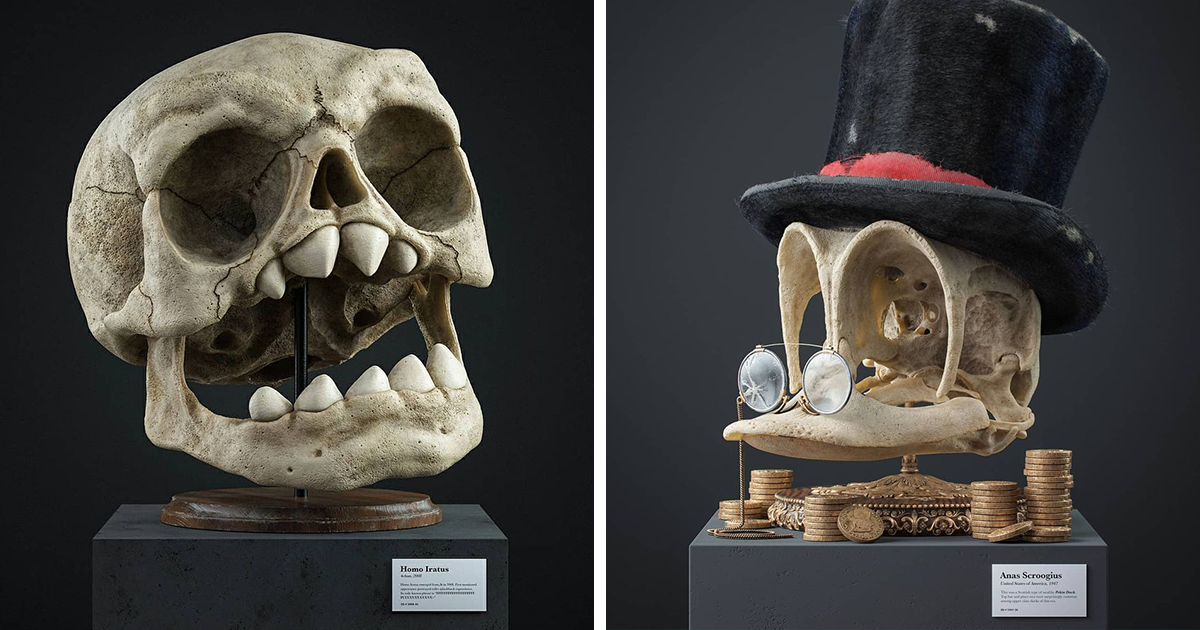
Cartoon characters are supposed to live forever. They get flattened by pianos, blasted through walls, chased by villains, swallowed by whales, and still show up in the next episode with perfect comic timing and suspiciously shiny shoes. But artist Filip Hodas asked a wonderfully odd question: what would happen if these beloved animated icons were treated not like eternal mascots, but like museum specimens?
The result is Cartoon Fossils, a series of striking 3D artworks that imagines anatomically correct skulls of popular cartoon characters. The idea is clever, a little eerie, and unexpectedly funny. Instead of simply drawing creepy fan art, Hodas presents each skull like a scientific artifact: carefully lit, beautifully textured, and labeled with mock-Latin names that make the whole thing feel like a natural history museum curated by someone who grew up on Saturday morning cartoons.
The collection has gained attention across art, design, and pop culture communities because it hits a rare sweet spot. It is nostalgic without being sugary, spooky without being gross, and technically impressive without needing a 20-minute lecture to enjoy it. One glance tells you exactly who the skull belongs to, even when the character’s familiar eyes, fur, feathers, or sponge-like face are gone. That is the magic trick.
Who Is Filip Hodas?
Filip Hodas is a Prague-based 3D illustrator known for detailed digital art, surreal pop culture objects, and clean, cinematic rendering. His work often takes familiar icons and places them in unexpected contexts. In Cartoon Fossils, he does not merely parody famous characters; he studies their silhouettes, proportions, and most recognizable traits, then rebuilds them as if they were fossil remains from some strange entertainment-based ecosystem.
The project feels like a natural fit for an artist who enjoys skull forms, digital sculpting, and pop culture archaeology. Hodas uses the visual language of science displaysaged bone, specimen labels, clay-like studies, and neutral museum lightingto make impossible creatures feel oddly believable. The joke works because the presentation is serious. The more official the skull looks, the funnier the concept becomes.
What Makes These Cartoon Skulls So Fascinating?
The phrase “anatomically correct cartoon skulls” sounds like a contradiction wearing a lab coat. Cartoons are famous for ignoring anatomy. Their heads stretch, their eyes float, their mouths open wider than physics allows, and their noses often appear to have signed a separate contract from the rest of the face. Yet Hodas makes these impossible designs feel structurally plausible.
That is where the project becomes more than a visual gag. It asks viewers to think about how character design works. The most memorable cartoon characters are not built from realistic anatomy. They are built from shape language: circles, triangles, curves, spikes, beaks, ears, hats, bows, teeth, and exaggerated proportions. Hodas turns those design choices into bone structure. In other words, he translates animation logic into fossil logic.
The Museum Effect
Each skull is displayed like an artifact from a fictional natural history collection. The clean background, careful lighting, and Latin-style naming system create the feeling that these characters once roamed the earth, possibly in herds, possibly near snack cabinets. The skulls are not thrown into a horror scene. They are treated with calm, clinical dignity, which makes them even more memorable.
This “museum effect” also changes the viewer’s emotional response. Instead of thinking, “That is a scary version of a cartoon,” we think, “That looks like something a paleontologist might have discovered under the ruins of an old television studio.” The humor becomes smarter because it relies on contrast: childhood icons presented with scholarly seriousness.
Famous Characters Reimagined As Fossils
The collection includes skulls inspired by widely recognized cartoon figures such as Goofy, Scrooge McDuck, SpongeBob SquarePants, Popeye, Minnie Mouse, Tweety Bird, and other animated icons. Hodas gives them scientific-sounding names such as Canis Goofus, Anas Scroogius, Spongia Bobae, and Homo Popoculis. These labels are part of the fun. They suggest a world where cartoon characters are not intellectual property but biological species.
Take the Goofy-inspired skull, for example. The elongated snout, large teeth, and familiar hat create immediate recognition. Even without eyes, voice, or body language, the character’s identity survives through proportion. That is a powerful reminder that great character design begins with silhouette. A strong silhouette can outlive color, costume, and even fleshat least in the strange universe of digital fossil art.
The SpongeBob-inspired skull is another standout because it solves a ridiculous design problem: how do you give a skeleton to a sponge? Hodas approaches the character like a square-bodied organism with distinctive facial structure. The result is absurd, but surprisingly convincing. It looks like a specimen from a marine biology exhibit that got lost on its way to a comedy club.
The Popeye-inspired piece leans into the character’s unmistakable jaw and facial proportions. Popeye’s design has always been exaggerated, with a squint, pipe, huge forearms, and a face that seems carved from stubbornness. By turning that exaggerated identity into bone, Hodas reveals how much of Popeye’s personality is built into his shape.
Why Cartoon Anatomy Is So Weird In The First Place
Cartoons are not designed to obey anatomy. They are designed to communicate instantly. A character’s shape tells us whether they are friendly, silly, sneaky, heroic, childish, rich, angry, or chaotic before they say a word. Big eyes suggest innocence or expressiveness. Oversized heads make emotions easier to read. Tiny bodies make movement funnier. Long noses, round cheeks, and impossible mouths turn personality into architecture.
Animation also relies on principles like exaggeration, squash and stretch, timing, and appeal. A character may bend like rubber because the goal is not realism; the goal is emotional clarity. When a cartoon face expands in shock or compresses in frustration, the audience understands the feeling immediately. Real bones would make that difficult. Very few skeletons are known for their comedic flexibility.
That is why Hodas’s project feels so delightfully wrong. It reverse-engineers a medium built on elasticity and gives it rigid structure. The skulls look like they belong to characters who somehow evolved to survive slapstick physics. They are impossible, but they follow enough visual rules to make the brain say, “Fine, I’ll allow it.”
The Art Of Making Impossible Skulls Look Real
One reason the series works so well is its technical polish. The skulls have convincing material qualities: porous surfaces, cracks, stains, subtle shadows, and the kind of lighting associated with high-end 3D product photography or museum documentation. The textures make the fantasy feel tangible. If the models looked too smooth or cartoonish, the concept would lose its power.
Hodas also understands restraint. He does not overload the images with unnecessary horror elements. There are no dramatic haunted-house backgrounds or cheap shock tactics. Instead, the skulls sit quietly, almost politely, as if waiting for a docent to explain their diet and migration patterns. That restraint makes the work more sophisticated and more shareable.
The best pieces preserve one or two iconic accessories: a hat, a bow, glasses, or another instantly recognizable detail. These objects act like visual punchlines. The viewer identifies the character, then notices the anatomical transformation, then laughs at the seriousness of the presentation. It is a three-step joke, and it lands beautifully.
Pop Culture Archaeology: Why We Love Seeing Icons Rebuilt
Part of the appeal of Cartoon Fossils is that it treats pop culture like ancient history. We are used to seeing dinosaur bones in museums because they represent vanished worlds. Hodas applies that same format to animated characters, suggesting that cartoons are also cultural fossils. They preserve the values, humor, design trends, and childhood memories of the eras that created them.
A character that first appeared decades ago may still feel alive because it keeps being rerun, rebooted, quoted, memed, and printed on lunchboxes. But when that character becomes a skull, we suddenly see it as a relic. The familiar becomes historical. A goofy face turns into evidence. A mascot becomes a specimen.
This is why the series resonates beyond the initial joke. It taps into nostalgia, but it does not simply flatter it. It pokes at it. It says, “Remember this character you loved? Let’s imagine future archaeologists trying to classify it.” That blend of affection and absurdity gives the work lasting charm.
Not The First Cartoon Skeleton Experiment, But A Memorable One
Artists have long been fascinated by the hidden anatomy of fictional characters. Michael Paulus, for example, became known for skeletal studies of famous cartoon figures, presenting familiar characters alongside imagined internal structures. Other artists have explored similar territory through illustration, Photoshop, sculpture, and digital modeling.
What makes Hodas’s approach distinctive is the fossil presentation. Rather than showing a full skeleton beneath a cartoon body, he creates standalone skull specimens. This narrower focus gives the series a cleaner visual identity. It also makes each piece feel like an artifact from the same fictional museum collection. The consistency is part of the pleasure.
By combining pop culture, paleontology aesthetics, 3D modeling, and deadpan humor, Hodas creates something that feels both internet-friendly and gallery-ready. It is easy to enjoy quickly, but it rewards close looking. The longer you stare, the more design decisions you notice.
Why The Series Works So Well Online
Online audiences love art that can be understood in seconds but discussed for minutes. Cartoon Fossils fits that pattern perfectly. The images are visually striking, the concept is easy to explain, and the subject matter invites instant recognition. People share the work because it creates a reaction: surprise, laughter, discomfort, admiration, or all four at once.
The project also benefits from list-friendly presentation. “Fourteen anatomically correct skulls of cartoon characters” immediately sounds clickable because it promises variety. Viewers want to know which characters were included, which skulls are the most accurate, and which one will gently ruin their childhood in the most elegant way.
At the same time, the artwork avoids feeling like disposable meme content. The craftsmanship gives it weight. The rendering, composition, and naming system show real care. That combinationhigh skill plus playful conceptis exactly what helps digital art travel across design blogs, social platforms, and pop culture sites.
What These Skulls Teach Us About Character Design
Hodas’s skulls reveal a key truth about cartoons: the most iconic characters are built from unforgettable shapes. Strip away color and motion, and a strong design still survives. That is why a mouse-like skull with round ears, a duck-like skull with a bill, or a sponge-like skull with squared structure can still be recognized.
For artists, designers, and animators, the lesson is practical. A memorable character should work as a silhouette. It should have proportions that tell a story. It should contain one or two defining features that remain readable even when the style changes. Hodas proves this by changing the style dramatically while keeping the identity intact.
For casual viewers, the lesson is simpler: cartoons are weird. Wonderfully weird. Their bodies make no sense, and that is exactly why they work. Trying to make them anatomically correct exposes the delightful absurdity hidden inside the designs we have accepted since childhood.
Why The Work Feels Funny Instead Of Just Creepy
There is a fine line between eerie and unpleasant. Hodas stays on the right side of it by focusing on form, wit, and presentation rather than fear. The skulls are spooky in a Halloween-decoration kind of way, not in a disturbing way. They invite curiosity more than dread.
The humor comes from recognition. A viewer sees a skull and thinks, “That cannot be who I think it is.” Then the accessory, silhouette, or label confirms it. The brain connects childhood memory with museum realism, and the result is comic whiplash. It is like finding your favorite cartoon character in a paleontology textbook, right between “prehistoric bird” and “creature that definitely needed dental insurance.”
The mock-scientific names add another layer. They parody the authority of classification while celebrating the characters’ traits. The names are not just labels; they are tiny jokes disguised as taxonomy. That is a big reason the series feels smart rather than merely strange.
Experiences Related To The Topic: Seeing Childhood Characters Through Adult Eyes
One of the most interesting experiences connected to Cartoon Fossils is the way it changes how you look at characters you thought you already knew. Many people grow up with cartoons as background comfort. They are there after school, on weekend mornings, during sick days, and sometimes in the form of toys scattered across the living room like a tiny plastic civilization. We rarely stop to analyze why these characters look the way they do.
Then a project like this comes along and flips a switch. Suddenly, the big eyes, enormous heads, strange mouths, and impossible bodies become design decisions worth studying. You start noticing how much information is packed into a character’s outline. You realize that a bow, a hat, a beak, or a toothy grin can carry decades of recognition. It is a little like hearing the bass line in a song for the first time: once you notice it, you cannot un-notice it.
Viewing these skulls can also feel like visiting a fictional museum from the future. Imagine walking through a quiet gallery where each glass case contains the remains of a character once believed to exist only on screens. The label says the specimen was “discovered” in the United States in a certain year. The lighting is soft. The skull is carefully preserved. Somewhere in the distance, a museum guard is probably wondering why visitors keep giggling.
That imagined experience is part of the project’s charm. It gives pop culture the same treatment usually reserved for ancient animals and historical artifacts. For anyone who loves museums, animation, or visual design, the series creates a playful mental bridge between education and entertainment. It encourages viewers to ask questions: What would a cartoon species eat? How would it move? Would a sponge need cheekbones? Would a duck billionaire have a stronger jaw from yelling about money?
The series also reminds us that nostalgia is not fragile. Some people worry that strange reinterpretations “ruin” childhood memories, but good nostalgia can handle a joke. In fact, playful reinterpretation often makes old characters feel fresh again. Seeing them as fossils does not erase the original cartoons. It adds a new layer of appreciation. You can love the cheerful character and still enjoy the absurd possibility of its scientifically labeled skull.
For artists, the experience can be inspiring. Hodas shows how a simple “what if” question can become a full visual universe when executed with discipline. The idea could have remained a quick sketch or a one-off gag. Instead, he built a coherent series with consistent lighting, naming, materials, and presentation. That is a useful reminder for creative people: the difference between a funny concept and memorable art is often commitment.
For viewers, the collection offers the pleasure of discovery. Each skull becomes a small puzzle. You identify the shape, decode the reference, appreciate the technique, and then enjoy the joke. That sequence makes the work satisfying to browse. It is not passive viewing; it is visual detective work with a cartoon twist.
Perhaps the best experience of all is sharing the images with someone else. These artworks are perfect for the sentence, “You have to see this.” They invite reactions. One person may admire the craftsmanship. Another may laugh at the Latin names. Someone else may stare at the SpongeBob-like skull and quietly reconsider marine biology. That social quality is part of why the project has traveled so widely online.
In the end, Cartoon Fossils is not just about skulls. It is about memory, design, humor, and the strange afterlife of animated characters. These figures were created to move, bounce, shout, sing, and survive impossible accidents. Hodas freezes them in museum stillness and somehow makes them feel alive in a different way. That is a rare artistic achievement: making the deadpan feel lively.
Conclusion
Artist Creates Anatomically Correct Skulls Of Popular Cartoon Characters (14 Pics) is more than a catchy title. It describes a project that turns familiar animated icons into clever, beautifully rendered museum specimens. Filip Hodas’s Cartoon Fossils works because it respects the characters while playfully exposing how bizarre their anatomy would be if translated into the real world.
The series blends digital craftsmanship, pop culture nostalgia, anatomy-inspired design, and dry humor into something instantly memorable. It shows that great cartoon characters are recognizable even when reduced to structure and silhouette. It also proves that the internet still has room for art that is strange, thoughtful, and funny without needing to shout for attention.
If cartoons are modern myths, Hodas has imagined their archaeological remains. And honestly, if future museums ever do display the skull of a square sea sponge or a pipe-chomping sailor, we can only hope the gift shop is excellent.
Note: This HTML draft is written for web publishing, uses only the body section, avoids source-link clutter inside the article, and keeps the SEO tags at the end in JSON format as requested.