

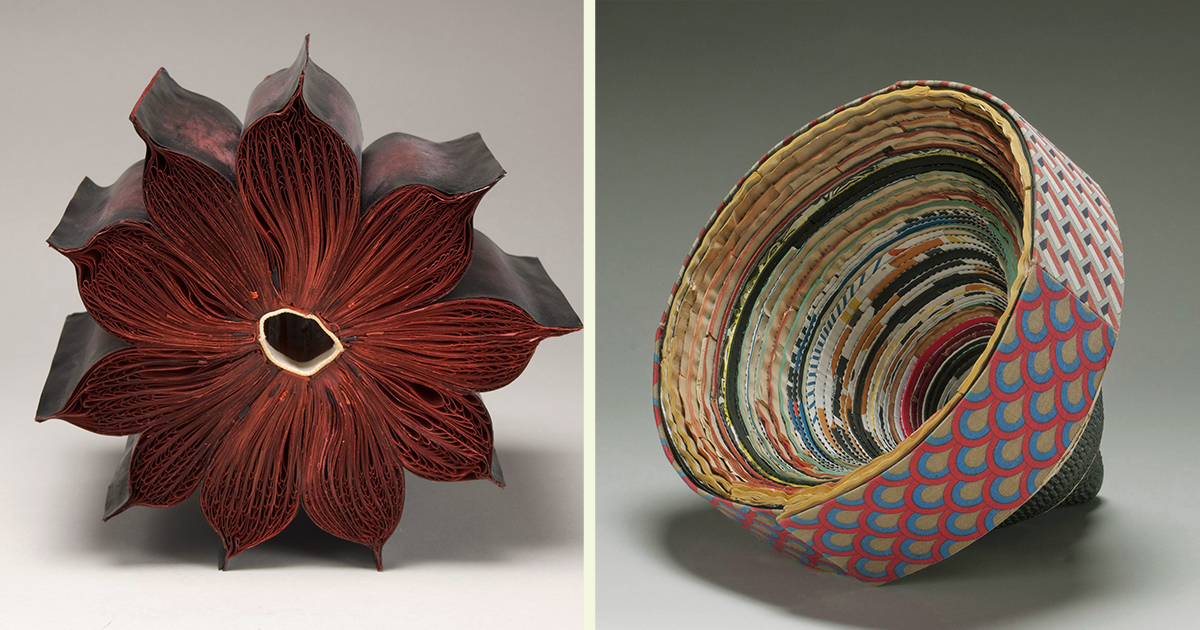
Some people see an old book with a cracked spine and think, “Poor thing, off to the donation bin.” I see the same book and think, “Congratulations, you are about to become a mountain range, a fossil, a flower, or possibly a very dramatic paper tornado.” That is the strange little magic of book sculpture: it turns forgotten pages into objects that can be touched, circled, questioned, and admired from every angle.
Book alchemy is not about destroying stories. It is about changing their state. A book begins as a vessel for language, memory, facts, fantasy, and someone’s suspiciously confident 1970s advice about indoor plants. When transformed into sculpture, it becomes something else without completely abandoning what it was. The pages still whisper. The cover still carries scars. The typography, stains, margins, and paper grain all remain part of the artwork’s DNA.
In the world of altered books and artists’ books, creators cut, fold, soak, carve, stitch, stack, compress, ink, and sometimes even fire books to reveal new meanings. The result can be delicate as lace or rugged as driftwood. It can look like a flower blooming from a binding, an archaeological artifact, a topographic map, or a relic rescued from a library on the moon. This is where literature steps off the shelf and starts doing yoga.
What Is Book Alchemy?
Book alchemy is the creative transformation of old, damaged, unwanted, or obsolete books into sculptural art. The term feels theatrical, but it fits. Traditional alchemy searched for transformation: base material into gold, ordinary matter into mystery. Book sculpture does something similar with paper. It takes an object that may no longer be read and gives it a second life as visual art.
In practical terms, book alchemy belongs to the larger field of altered books and book arts. An altered book is changed from its original form through techniques such as cutting, folding, tearing, painting, stitching, collage, embedding, or reshaping. An artist’s book, meanwhile, treats the book itself as the artwork rather than simply as a container for words. Some artists preserve the familiar structure of pages and covers. Others dismantle that structure until the book is barely recognizable.
The magic lies in the tension between reading and seeing. A reader usually moves through a book one page at a time. A viewer of book sculpture may experience dozens or hundreds of pages at once. Instead of “Chapter One,” the eye sees layers, shadows, cavities, fragments, and form. The book becomes a landscape. The story becomes architecture.
Why Transform Old Books Instead of Leaving Them Alone?
Book lovers can be protective, and understandably so. A book is not just paper. It may be a childhood memory, a parent’s inscription, a college survival tool, or the reason someone developed unrealistic expectations about vampires. So, yes, cutting into a book can feel scandalous at first.
But ethical book sculpture begins with respect. Most serious book artists do not carve into rare first editions, irreplaceable archives, or historically significant volumes. They work with books that are mass-produced, damaged, discarded, outdated, or unlikely to be read again. Old encyclopedias, obsolete manuals, duplicate novels, worn textbooks, and thrift-store finds often make better candidates than collectible books.
This matters because books already have material lives. They are printed, shipped, handled, shelved, forgotten, donated, pulped, recycled, or landfilled. According to national waste data, paper and paperboard remain major parts of the municipal waste and recycling stream in the United States. Turning an unwanted book into art is not the only sustainable option, but it can be a meaningful form of reuse. It says, “Before this becomes anonymous fiber, let’s see whether it has one more story in it.”
There is also an emotional reason. Old books are full of texture that new materials cannot fake. Foxed pages, sun-faded covers, brittle edges, handwritten notes, library stamps, and broken bindings create a history-rich surface. A fresh sheet of paper is polite. An old book has gossip.
The Artistic Roots of Altered Books
Book sculpture did not appear out of nowhere like a rabbit from a magician’s hat, although some pieces certainly look capable of doing that. Artists have been questioning the book form for decades. Museums and book arts centers have documented how artists use books as spaces for experimentation, combining text, image, binding, paper engineering, sculpture, typography, and mixed media.
The National Gallery of Art describes artists’ books as works that take traditional book forms as a starting point, then alter or arrange them in many ways to achieve an artistic vision. That broad definition is helpful because book art can be elegant, chaotic, scholarly, funny, political, intimate, or all of those things before breakfast.
MoMA has also explored altered book workshops where participants used repurposed books as canvases for mixed-media work. This shows that altered books are not just museum objects; they are also an accessible creative practice. A person does not need marble, bronze, or a forklift. They need curiosity, patience, a book ready for reinvention, and ideally a cutting mat unless they want their dining table to become “accidentally contemporary.”
Jacqueline Rush Lee and the Poetry of Repurposed Books
The title “Book Alchemy: I Transform Old Books Into Sculptures” strongly recalls the work of Jacqueline Rush Lee, a Hawai‘i-based artist originally from Northern Ireland who has transformed used books into sculptural objects for many years. Her practice has included soaking, drying, scraping, stitching, inking, stacking, compressing, and even kiln-firing books. The results feel organic, weathered, and strangely alive.
Her sculptures often draw attention to transformation, time, memory, and the life cycle of books. Some works resemble seed pods, fossils, botanical forms, or cultural artifacts. Others appear as if the book has survived a storm, a ritual, or a very intense graduate seminar. What makes the work powerful is that it does not simply decorate a book; it asks what a book becomes when its readable function is interrupted.
In works associated with her “Book Alchemy” approach, Lee has used Asian literary texts, philosophy books, encyclopedias, graphic design books, and book components to create new forms. The original content is not always readable in the usual way, but it remains present as material memory. The sculpture becomes a kind of visual archaeology: the viewer senses that knowledge is inside, even when the text has been folded, darkened, sealed, or reshaped beyond easy reading.
Brian Dettmer and the Book as Excavation Site
Another major figure in contemporary book sculpture is Brian Dettmer, often associated with intricate carved book works. Smithsonian American Art Museum notes that Dettmer uses old volumes found at thrift stores and estate sales, then selectively carves and excavates images and text without adding or moving content. His sculptures reveal what was already inside the book, layer by layer.
Dettmer’s process turns reading into excavation. Instead of flipping pages, he cuts into them. Instead of adding a new image, he uncovers existing ones. The book becomes both archive and quarry. Medical diagrams, maps, illustrations, captions, and fragments of text emerge like artifacts from a dig site. It is precise, slow, and a little surgical, which is why people often describe this kind of work as if the artist brought a scalpel to a library and somehow everyone was okay with it.
His example shows one of the most important principles of book alchemy: transformation can be subtractive. Art does not always require adding more. Sometimes it requires removing just enough to reveal what was hidden in plain sight.
Materials: Choosing the Right Book for Sculpture
Not every book wants to become a sculpture. Some books should be preserved, repaired, donated, archived, or read again. Before transforming a book, I ask a few questions. Is it rare? Is it valuable? Does it contain personal inscriptions or family history? Is it culturally significant? Is it in good enough condition to serve readers elsewhere? If the answer is yes, I leave it alone.
The best candidates for book sculpture are usually books with low resale value, duplicate copies, damaged bindings, obsolete reference content, or pages that already have strong visual qualities. Old dictionaries, encyclopedias, manuals, atlases, textbooks, hymnals, cookbooks, and outdated technology guides are especially interesting. Their illustrations, charts, diagrams, and typography give the sculpture built-in visual rhythm.
Paper quality also matters. Thick pages hold cuts well. Thin pages create delicate layering but can tear if handled like a wrestling opponent. Coated paper behaves differently from absorbent paper. Cloth covers, leatherette, library buckram, and paperbacks each respond differently to glue, moisture, pressure, and folding. Book sculpture teaches you very quickly that paper is not one material. It is a whole personality spectrum.
Techniques That Turn Pages Into Sculpture
Cutting and Carving
Cutting is one of the most dramatic altered book techniques. Using craft knives, scalpels, or precision blades, the artist removes sections of pages to create windows, tunnels, relief images, or layered landscapes. This method works beautifully with illustrated books because every layer can reveal a new surprise. The danger is overcutting. One extra slice and suddenly the carefully carved bird has become abstract poultry.
Folding and Pleating
Folding turns pages into structure. A book can become a fan, a spiral, a honeycomb, a wave, or a geometric object. Folded book art often uses repetition, which gives the finished piece a meditative quality. It is also a test of patience. After folding 200 pages, you may begin to understand monks, accountants, and anyone who alphabetizes spices.
Soaking and Drying
Water changes a book’s body. When soaked and dried, pages buckle, swell, warp, cling, and harden. The book may become more organic, like bark, bone, coral, or compressed sediment. This technique can be unpredictable, which is part of its appeal. The artist collaborates with moisture, gravity, pressure, and time. In other words, the book gets a vote.
Stitching and Binding Interventions
Thread adds both structure and symbolism. Stitching can hold pages in sculptural positions, repair wounds, create pattern, or suggest mending. A stitched book often feels intimate because sewing carries associations with clothing, bodies, care, and domestic labor. It can make a damaged book feel not discarded, but healed.
Ink, Graphite, Paint, and Surface Treatment
Some book sculptures preserve the original pages; others invite mark-making. Ink can soak into page edges, darken cavities, or create cloud-like blooms across paper. Graphite can emphasize ridges and folds. Paint can unify mismatched volumes or create contrast between old text and new form. The trick is restraint. A book already has visual noise. Add too much and the sculpture starts shouting in twelve fonts at once.
The Ethics of Cutting Books
The biggest question in book sculpture is simple: is it okay to alter a book? The honest answer is: it depends. Books deserve respect, but respect does not always mean permanent preservation. Libraries, archives, and museums preserve materials according to rarity, condition, significance, and use. The Library of Congress offers guidance on careful book handling, storage, cleaning, and preservation because some books truly are cultural treasures.
For artists, that guidance becomes a useful ethical compass. Do not use rare books casually. Do not destroy a book with clear historical, financial, or family value. Avoid culturally sensitive materials unless you understand the context and have a responsible reason. Work with discarded, duplicate, damaged, or mass-produced books whenever possible.
It also helps to document the original book. I often photograph the cover, title page, inscriptions, and interesting marks before beginning. That record honors the object’s earlier life. It also protects the artist from the awkward future moment when someone asks, “What book was this?” and the answer is, “Something beige with opinions.”
Why Viewers Respond So Strongly to Book Sculpture
Book sculpture has a built-in emotional charge because almost everyone has a relationship with books. Even people who claim they “don’t read much” have encountered textbooks, recipe books, comic books, religious texts, instruction manuals, yearbooks, or bedtime stories. Books are familiar objects, so seeing them transformed creates instant tension.
That tension is productive. A carved book can feel beautiful and uncomfortable at the same time. A soaked book can look wounded, reborn, or fossilized. A folded book can seem playful until the viewer realizes hundreds of pages have been permanently reshaped. This push and pull keeps the artwork alive.
There is also nostalgia. In a digital age, printed books carry the romance of touch. Screens scroll; books accumulate fingerprints. A book sculpture reminds us that knowledge has weight, stories have bodies, and paper ages in ways pixels do not. No offense to e-books, which are very useful, but nobody has ever said, “Ah yes, smell that fresh tablet update.”
Book Sculpture as Sustainable Art
Book alchemy fits naturally into the upcycling movement, where discarded materials are transformed into objects of higher artistic or practical value. Instead of buying new sculptural materials, the artist begins with something already in circulation. This does not make every altered book automatically eco-friendly, but it encourages slower, more thoughtful consumption.
Old books can be difficult to recycle because covers, glues, coatings, and mixed materials may complicate processing. Donation is wonderful when books are wanted and usable, but not every outdated textbook or damaged encyclopedia set has a long line of eager readers waiting outside in the rain. Art offers another path. It gives selected books a new cultural role.
The best sustainable art does not simply say, “Look, I reused something.” It asks viewers to reconsider value. Why do we discard certain objects? What makes one book precious and another disposable? Can beauty emerge from surplus? Can an obsolete reference book still teach us something, even after its facts have expired like yogurt in the back of the fridge?
How to Start Your Own Book Alchemy Practice
If you want to try transforming old books into sculptures, start small. Choose a damaged or unwanted book with no rare or personal value. Gather basic tools: a cutting mat, craft knife, metal ruler, pencil, bone folder, glue, clips, brush, and patience. Patience is not sold at craft stores, unfortunately, though it should be available in gallon containers.
Begin by studying the book. Look at its paper, binding, illustrations, margins, and wear. Ask what the book already suggests. A gardening book may want to become a flower. An atlas may want to become a mountain or oceanic wave. A dictionary may want to become a sculpture about language, memory, or the heroic struggle to spell “rhythm.”
Do not rush to impose an idea. Book sculpture works best when the artist listens to the material. Fold a few pages. Test how the paper cuts. See whether the spine can support an open form. Notice how shadows fall between pages. The book may resist your first plan and offer a better one. That is not failure. That is collaboration with a very papery colleague.
Common Mistakes Beginners Make
The first mistake is choosing a book that is too meaningful. If the thought of cutting it makes your stomach drop, choose another book. Art should be brave, but it does not need to begin with emotional vandalism.
The second mistake is using too much glue. Glue can stabilize pages, but excess adhesive creates warping, shine, stiffness, and sadness. Apply thin layers and test first. The third mistake is forgetting structure. A sculpture needs support. Pages may sag, covers may pull, and heavy sections may collapse if the form is not planned with gravity in mind. Gravity is undefeated.
The fourth mistake is overdecorating. Old books already contain typography, color shifts, stains, diagrams, and texture. Let those qualities breathe. The goal is transformation, not disguising the book until it looks like it lost a fight with a craft drawer.
Specific Examples of Book Alchemy Concepts
A discarded science encyclopedia can become a layered specimen cabinet. By carving windows around diagrams of insects, planets, plants, and machines, the artist can create a miniature museum inside the pages. The piece might explore how knowledge is classified, preserved, and eventually replaced.
An outdated road atlas can be folded into a wave or mountain form, suggesting travel, migration, memory, or the changing meaning of maps in the GPS era. A damaged hymnal can be stitched into wing-like shapes, turning music and devotion into motion. A worn cookbook can be stained with tea, folded into vessel shapes, and displayed with handwritten recipe fragments to honor family memory.
A philosophy book can be compressed, blackened with ink, and opened only slightly, creating an object about hidden thought. A romance novel can be cut into a blooming form because subtlety is lovely, but sometimes the metaphor is standing there wearing a satin robe and waving.
Experience Notes: What Transforming Old Books Has Taught Me
After spending time with old books as sculptural material, I have learned that every volume has a temperament. Some books cooperate immediately. Their pages fold crisply, their spines remain steady, and their covers behave like responsible citizens. Others complain from the first cut. The glue cracks, the pages tear, the cover sheds mysterious dust, and the whole object seems to mutter, “I was happier as a 1986 guide to home accounting.”
The first real lesson is humility. A book sculpture rarely follows the original sketch exactly. Paper has memory. It remembers being pressed, bound, opened, stored in damp rooms, dropped in boxes, highlighted by students, and abandoned on shelves. When you soak it, cut it, or fold it, that history affects the result. You can guide the process, but you cannot fully dominate it. That is part of the beauty.
The second lesson is that slowness matters. Book alchemy is not a fast craft. Cutting one page at a time forces attention. Folding hundreds of pages turns minutes into a rhythm. Waiting for soaked paper to dry teaches patience with the enthusiasm of a strict gym teacher. In a culture obsessed with speed, an old book quietly insists that transformation takes time.
The third lesson is that mistakes can become style. A torn page can become an opening. A warped cover can become a curve. Ink that bleeds too far can suggest weather, smoke, or age. Many of the most interesting effects happen when control slips a little. The trick is knowing when to rescue the piece and when to follow the accident. Artists call this intuition. Everyone else calls it “pretending you meant to do that.”
I have also learned that viewers bring their own stories. Someone may look at a folded dictionary and think about childhood spelling tests. Someone else may see an altered hymnbook and remember a grandmother’s church. A carved encyclopedia may make one person nostalgic and another person uneasy. The sculpture is not finished when the glue dries; it continues changing through the memories people bring to it.
Most of all, transforming old books has taught me that reuse can be tender. It is easy to treat discarded objects as failures. But an unwanted book is not necessarily a dead book. It may simply be waiting for another form. When its pages become petals, roots, ribs, waves, or caves, it reminds us that stories do not always end where the final chapter says they do. Sometimes they become sculpture. Sometimes they become a question. Sometimes they become a beautiful mess on the studio table, and honestly, that counts too.
Conclusion: The Gold Hidden in Old Pages
Book alchemy transforms old books into sculptures, but the deeper transformation happens in how we see. A discarded volume becomes a landscape. A damaged spine becomes structure. A forgotten page becomes texture, shadow, and memory. The work invites us to reconsider what is useful, what is beautiful, and what deserves another chance.
In the hands of artists like Jacqueline Rush Lee, Brian Dettmer, and many others working across altered books and book arts, the book is not merely an object to be preserved behind glass or consumed as text. It is a material with a body, a history, and a surprising ability to shape-shift. Book sculpture can be ethical, sustainable, poetic, funny, and deeply moving when it begins with respect.
So the next time you see an old book with a frayed cover and tired pages, do not write it off too quickly. It may no longer want to sit quietly on a shelf. It may be ready for its second act: part sculpture, part story, part paper phoenix rising from the clearance bin.