

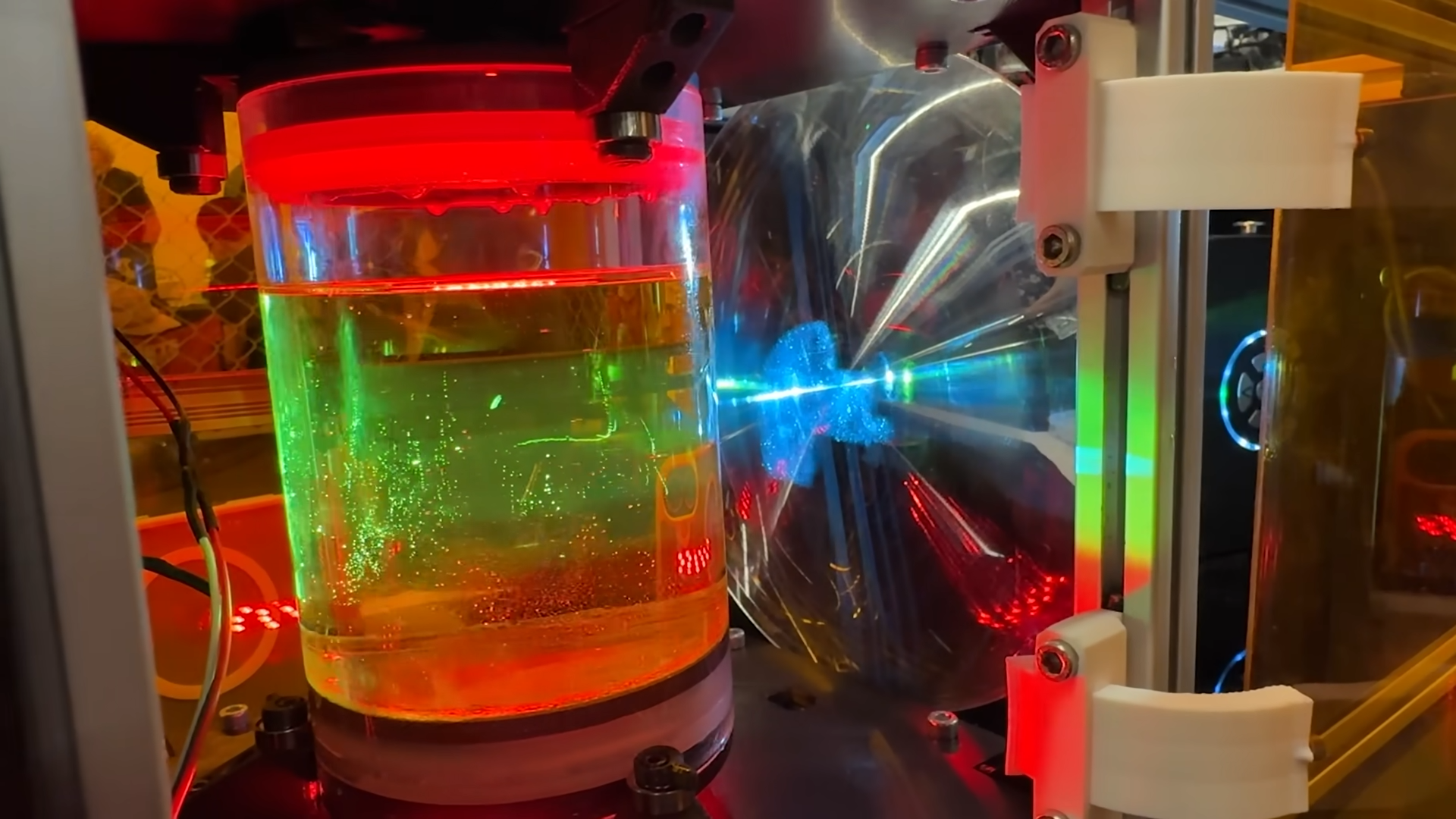
Most 3D printers build parts the way a cautious bricklayer builds a wall: one layer at a time, one tiny step after another, hoping gravity behaves and the supports do not turn into a tragic sculpture. Computed axial lithography, better known as CAL 3D printing, throws that script out the window. Instead of stacking slices, CAL projects changing light patterns into a rotating vat of resin so the object forms throughout the volume almost all at once. The result feels a little like science fiction, a little like a magic trick, and a lot like a serious manufacturing idea.
If traditional additive manufacturing is a patient builder, CAL is more like a choreographer. Light, chemistry, motion, and timing all have to hit their marks. When they do, the printed part appears with smooth surfaces, unusual geometric freedom, and none of the familiar “I can see every layer from across the room” drama. That is why CAL has attracted attention far beyond the usual 3D-printing crowd. Engineers see speed. Designers see freedom. Medical researchers see softer materials and more delicate structures. Space researchers see a future where replacement parts could be made on demand instead of packed years in advance like cosmic luggage.
What CAL 3D Printing Actually Is
A CT Scan in Reverse
The easiest way to understand computed axial lithography is to think about a CT scanner, then flip the whole idea backward. A CT scanner sends energy through an object from many angles so a computer can reconstruct what is inside. CAL takes a digital 3D model, calculates the projection patterns needed from many angles, and shines those patterns into a spinning container of photocurable resin. Instead of measuring the object, the system creates it.
That “reverse CT” comparison is not just clever marketing. It explains why CAL belongs to the broader family of volumetric additive manufacturing. The geometry is not built as a stack of pancakes. It is formed as a 3D dose of light inside a volume. Wherever the accumulated light energy crosses the resin’s curing threshold, the material solidifies. Everywhere else stays liquid and can be drained away. In plain English: the printer does not draw every layer like a tiny hot glue gun with ambition issues. It sculpts a light field and lets chemistry do the heavy lifting.
Why the Resin Has to Spin
The spinning is not just for show, and it is definitely not because the printer enjoys a dramatic entrance. The rotating vat lets the projected images hit the resin from continuously changing angles. Over time, those light patterns add up into a targeted 3D exposure map. That is what allows the process to create a solid part within the liquid instead of tracing the outer surface one strip at a time.
This also explains one of CAL’s most important technical tricks: thresholded curing. The resin formula is designed so low doses of light do not trigger solidification, while higher accumulated doses do. That sharp boundary helps the machine form a part while leaving the surrounding resin uncured. It is a balancing act involving optics, photoinitiators, oxygen behavior, resin transparency, and motion control. In other words, CAL looks like magic only because a lot of very un-magical engineering is hiding behind the curtain.
Why People Got Excited So Fast
Speed Without the Layer-Line Hangover
One reason CAL made such a splash is simple: it can be fast. Very fast. Because the process is volumetric, it avoids many of the stop-start bottlenecks that slow layer-based systems. There is no repeated peeling of each fresh layer from a tank bottom, no constant z-axis stepping, and far less opportunity for the print to develop the stair-stepped surface texture that resin users know all too well.
That speed matters for more than bragging rights. In product development, shaving hours off each iteration can change how teams design. Engineers can test more shapes, try more versions, and make decisions sooner. For custom products like prosthetics, wearable components, or specialty lenses, a faster route from model to object opens the door to more responsive manufacturing. CAL is not automatically the best answer for every part, but it does challenge the old assumption that precision and speed have to live in separate zip codes.
Smoother Surfaces and Support-Free Printing
CAL’s other crowd-pleaser is surface quality. Since the object is not assembled as visible layers, the finished part can come out smoother than many conventional additive processes. That is especially attractive for optical components, fluidic channels, and parts with curves that would otherwise need cleanup, sanding, polishing, or a pep talk.
Support-free printing is another major advantage. In many cases, the object forms within the resin rather than hanging from a layer-by-layer scaffold, so complex shapes can be produced without the support scars and removal headaches common in traditional resin printing. That reduces waste, simplifies post-processing, and makes it easier to produce delicate geometries that would be risky in a more mechanical build process.
Overprinting Around Existing Parts
Here is where CAL gets genuinely spicy. Because the object forms inside a vat instead of being deposited line by line from above, it can create geometry around an existing insert. That means you can place a component inside the print zone and form new material around it. Think handles around shafts, soft materials around rigid frames, or embedded structures that would be annoying, impossible, or extremely profanity-inducing with other methods.
This capability, often described as overprinting or overmolding-like behavior, hints at a future where multi-material systems are not assembled from separate printed pieces but formed in more integrated ways. For robotics, medical devices, and custom tooling, that is a big deal.
Where CAL Fits in the 3D Printing Universe
CAL vs. SLA, DLP, and FDM
CAL belongs in the resin-printing family, but it does not behave like a standard SLA or DLP machine. A conventional stereolithography printer cures one layer, moves, cures the next, and repeats until you have a finished part and a new appreciation for patience. CAL, by contrast, distributes light dose through a rotating volume and forms the part volumetrically.
Compared with FDM, CAL can deliver much smoother surfaces and more elegant small features, especially for curved or organic forms. Compared with classic SLA or DLP, it can reduce support needs and produce objects much more quickly under the right conditions. But CAL is not a universal upgrade button. Layer-based printers still have deeper ecosystems, broader commercial availability, more mature workflows, and clearer expectations for many everyday jobs.
What CAL Still Struggles With
This is the part where the hype train has to slow down at the station of reality. CAL is impressive, but it is not yet the default answer for all resin printing. Material choices are still more limited than what mature commercial platforms offer. Optical scattering can interfere with precision. Resin chemistry has to be tuned carefully. Scaling up part size while preserving fine detail is not trivial. And quality assurance matters even more when the whole part forms in a compact burst of exposure instead of a long, observable layer sequence.
Print speed is also more nuanced than the social media version suggests. CAL can produce parts in seconds or minutes depending on geometry, resin, and the number of projections required. That is still exciting, but it is not the same as saying every object will materialize instantly like a Star Trek teacup.
Real-World Examples Pushing CAL Forward
Soft Materials and Soft Robots
One of the most promising directions for CAL is in soft matter. Because the process can form geometry around inserts and work with carefully engineered hydrogel systems, researchers have explored applications in soft robotics and cell-friendly structures. That matters because many biological or highly deformable materials do not appreciate being manhandled by slow, layer-by-layer methods. CAL’s volumetric approach can be gentler in some contexts and better suited to intricate internal forms.
That is why the technology keeps appearing in conversations about tissue engineering, hydrogel structures, and next-generation medical fabrication. No, that does not mean your local pharmacy is about to print replacement cartilage next Tuesday. But it does mean CAL has moved beyond “cool lab demo” status and into serious discussions about functional biomedical manufacturing.
Glass Microstructures and Optical Parts
Another major leap came when researchers extended CAL into micro-CAL for glass microstructures. This matters because optics and microfluidics are notoriously demanding. Smooth surfaces, consistent dimensions, and tiny features are not optional. They are the whole game.
Micro-CAL showed that the basic CAL concept could be pushed to much finer scales and even used with glass-filled resin systems that are later processed into solid glass. That opens intriguing possibilities for microlenses, miniature fluid channels, custom optical components, and other small parts where roughness is the enemy and traditional manufacturing can be slow or expensive. If regular CAL feels like a clever new printer, micro-CAL feels like a quiet challenge to entire classes of microscopic fabrication.
SpaceCAL and Manufacturing in Microgravity
Then there is the part of the story that sounds made up until you check: researchers have already tested a CAL-based printer in suborbital space. Berkeley’s SpaceCAL project pushed the technology into microgravity, where on-demand manufacturing could someday reduce the need to stockpile every spare part for long missions. In testing tied to the Virgin Galactic 07 mission, the system reportedly printed and post-processed multiple small parts during a brief suborbital window.
That does not mean astronauts will soon be printing entire moon bases out of spinning resin while humming classic pop songs. It does mean CAL’s speed and volumetric logic make it especially interesting for environments where conventional layer-based printing becomes less convenient, less stable, or simply too slow for mission needs.
Why CAL Matters for Product Design
Mass Customization Gets More Practical
CAL supports a manufacturing idea that has been promised for years: real mass customization. When complex shapes can be formed quickly and with less reliance on supports, it becomes easier to design for the individual instead of the average. That could matter for prosthetic sockets, custom-fit wearables, specialty footwear components, dental appliances, optical parts, and one-off scientific tools.
Designers also gain freedom to think beyond what is easy to machine or easy to support. Internal voids, embedded components, soft-hard combinations, and curvy geometries become less annoying to prototype. That does not erase all manufacturing constraints, but it shifts them in a useful way.
New Opportunities in Medicine and Biotech
In medical and biotech settings, the combination of speed, geometric freedom, and compatibility with soft or photoresponsive materials is especially compelling. Researchers studying cell printing and hydrogel fabrication keep returning to volumetric methods because they can create intricate 3D forms that mimic tissue structures more naturally than some older approaches.
Still, promise is not the same as clinical routine. Biocompatibility, sterilization, regulatory approval, reproducibility, and long-term performance all matter. CAL has exciting potential in regenerative medicine, microfluidics, and research tools, but the road from lab success to hospital adoption is paved with validation work, not vibes.
The Catch: Why CAL Is Not on Every Workbench Yet
CAL is one of those technologies that can be revolutionary and still not be everywhere. Both things can be true. Commercial adoption takes time, especially when a process depends on specialized optics, tightly tuned resin chemistry, and a different way of thinking about printing itself. Manufacturing teams do not just ask, “Can it print this?” They ask, “Can it print this reliably, repeatedly, economically, at scale, with a material we trust?”
That is where CAL’s future will be decided. If the material library keeps improving, if optical control becomes more robust, and if application-specific systems prove their value in industries like optics, medicine, robotics, and aerospace, CAL could move from headline technology to everyday advanced-manufacturing tool. If not, it may remain a brilliant niche method that influences the field more than it dominates it. Either way, it has already changed the conversation about what 3D printing is allowed to look like.
Experiences Around CAL 3D Printing: What the Technology Feels Like in Practice
One of the most striking things about CAL is the emotional whiplash it gives people who are used to ordinary 3D printing. A veteran of layer-based printing walks in expecting the usual soundtrack: motors chirping, platforms inching, resin peeling, time passing, coffee cooling, hope fading, supports multiplying. Instead, CAL looks calm. The vat spins. Light patterns flash. Then the liquid is drained and a real object is suddenly there, like the printer skipped the boring part and jumped straight to the reveal.
That experience changes how people talk about fabrication. The first reaction is usually disbelief. The second is a kind of nerdy suspicion. The third is: “Okay, but what is the catch?” And honestly, that is the correct sequence. CAL demos have a habit of making even technical audiences grin first and ask harder questions second. It is not because the science is fake. It is because the machine breaks a visual habit most of us have built over years of watching parts grow upward one slice at a time.
For designers, the experience is often less about spectacle and more about freedom. Curves, enclosed features, smoother skins, and embedded elements no longer feel like instant red flags. You still have to think about material behavior, resolution, and dose control, but the conversation shifts. Instead of asking, “How do I support this thing?” the designer starts asking, “What shape do I actually want?” That is a subtle but powerful psychological change. Good manufacturing tools do not just make parts. They make better questions possible.
For researchers working with soft materials, CAL can also feel surprisingly elegant. Traditional methods can be a little rough on delicate systems. With volumetric printing, the process is more like persuading the object to appear than dragging it into existence by repeated layers. That does not mean it is easy. Resins still need tuning. Exposure still needs control. But when the chemistry is right, the process feels less mechanical and more orchestrated. There is a reason people keep using words like “formed” and “emerged” instead of just “printed.”
The practical experience, of course, includes some less glamorous truths. CAL is demanding. Optical alignment matters. Resin formulation matters. The relationship between viscosity, transparency, photoinitiation, and cure threshold matters a lot. Anyone expecting a plug-and-play miracle may get an educational afternoon instead. This is not the part of the story that goes viral, but it is the part that determines whether a technology survives outside the lab. CAL’s charm comes from how magical it looks; its future depends on how disciplined the engineering becomes.
There is also something genuinely memorable about the way CAL reframes time. In ordinary printing, you watch progress happen. In CAL, you wait for a reveal. That feels small until you realize it changes the user experience completely. Instead of monitoring layers like a nervous baker checking the oven every 30 seconds, you are managing a more concentrated event. The object is not gradually persuasive; it is suddenly undeniable. For education, demonstrations, research presentations, and rapid iteration environments, that difference is powerful.
Maybe that is why CAL has such staying power in the imagination. It is not just fast. It makes manufacturing look different. It turns 3D printing from a visible stacking process into a controlled volumetric transformation. Watching that happen feels like peeking at the future for a moment. And even if CAL ends up owning only certain corners of the market, the experience of seeing resin spin, light accumulate, and a part appear where there was only liquid a moment earlier is hard to forget. It is engineering, yes. But it is engineering with stage presence.
Conclusion
CAL 3D printing matters because it reimagines additive manufacturing at the most basic level. Instead of building an object layer by layer, it creates a carefully controlled 3D light dose inside a rotating resin volume and lets chemistry define the final shape. That shift can deliver smoother surfaces, faster fabrication, support-free geometry, and unusual capabilities like overprinting around inserts. It has already inspired advances in glass microstructures, soft robotics, biomedical printing, and even microgravity manufacturing. CAL is still early compared with mainstream 3D-printing platforms, but it is no gimmick. It is a serious manufacturing idea with just enough showmanship to make the entire field look over its shoulder.