

Founders have a funny relationship with competition. They know competitors exist. Their customers know competitors exist. Their investors definitely know competitors exist. Yet the moment it is time to build a pitch deck, many founders start acting like the market is an empty meadow and their startup is the first horse ever invented.
So, dear SaaStr-style question: how much should you talk about the competition in a pitch deck? The practical answer is: enough to prove you understand the market, not so much that your pitch becomes a guided museum tour of everyone else’s logo. Your competition slide should be clear, honest, strategic, and brief. It should tell investors three things quickly: who else is in the space, why customers still need something better, and why your company has a credible path to win.
The best founders do not fear the competition slide. They use it as a positioning weapon. Not a dramatic weapon, of course. No fog machine. No villain music. Just a clean, confident explanation of the market map and the whitespace your startup is built to capture.
Why Investors Care About Competition
Investors do not ask about competition because they enjoy making founders sweat under fluorescent lights. They ask because competition reveals the quality of your thinking. A founder who understands the competitive landscape usually understands the customer, the budget, the buying process, the market timing, and the reason existing solutions fall short.
A founder who says, “We have no competitors,” usually sends the opposite signal. Investors hear one of three things: the founder has not researched the market, the problem is not painful enough for people to spend money on, or the company is defining competition too narrowly. Even if no company does exactly what you do, customers are already solving the problem somehow. They may use spreadsheets, consultants, internal tools, legacy software, email chains, duct tape, prayer, or the intern named Kyle. Kyle is competition. Respect Kyle.
In a strong SaaS pitch deck, the competition slide is not just a list of rivals. It is a test of founder-market fit. It shows whether you know how buyers make decisions and whether your wedge is specific enough to matter.
The Right Amount: One Main Slide, Smart Appendix Support
For most early-stage pitch decks, talk about competition on one main slide. That slide should be simple enough to understand in less than a minute. If your market is unusually crowded, include five to eight major competitors or alternatives, not every company that once used the same buzzword on LinkedIn.
Then use appendix slides for deeper details. This is where you can keep feature comparisons, pricing breakdowns, customer quotes, analyst notes, market maps, and technical differentiation. The main deck should create confidence. The appendix should handle investor curiosity.
Think of the competition discussion like seasoning. Too little and the dish is bland. Too much and suddenly everyone is coughing. The goal is balance: enough competitive context to make your positioning credible, but not so much that the investor forgets your company is the star of the meeting.
What Your Competition Slide Must Accomplish
1. Prove You Know the Market
A competition slide should immediately show that you have done your homework. Include direct competitors, indirect competitors, and current customer alternatives. Direct competitors sell a similar product. Indirect competitors solve the same pain in a different way. Alternatives may be manual workflows, internal teams, agencies, spreadsheets, or “do nothing.”
For example, a startup building AI sales coaching software may compete directly with other AI coaching platforms. It may compete indirectly with call recording tools, sales enablement suites, and consulting firms. It also competes with sales managers manually reviewing calls on Friday afternoon while questioning every career choice that led them there.
2. Show Why Your Position Is Different
Do not use the competition slide to say, “Everyone else is terrible, and we alone have discovered electricity.” Investors have heard this opera before. Instead, show the axes that matter to customers. Maybe your product is faster to deploy, built for mid-market teams, more automated, more compliant, more vertical-specific, easier to integrate, or priced differently.
The key is to choose comparison dimensions that are meaningful, not convenient. If your chart puts your company in the top-right corner because the axes are “visionary” and “awesome,” congratulations, you have created a motivational poster, not a competitive analysis.
3. Explain Why You Can Win
The investor’s real question is not, “Who else exists?” The real question is, “Why will this startup win despite everyone else existing?” Your competition slide should connect to your advantage. That advantage may come from distribution, data, workflow ownership, technical depth, regulatory expertise, community, network effects, customer segment focus, or a business model incumbents cannot easily copy.
Do not just claim differentiation. Tie it to evidence. If customers switch from a legacy tool because your onboarding takes one day instead of three months, say that. If your product lands in a narrow workflow and expands across the organization, show that motion. If your team has deep domain expertise, connect it to faster product decisions and better customer trust.
How to Structure the Competition Slide
There are several common formats, but not all are equally useful. Choose the one that tells the truth most clearly.
The 2×2 Matrix
The classic 2×2 matrix works when two dimensions define the market. For example, “general-purpose vs. vertical-specific” on one axis and “manual vs. automated” on the other. Place competitors honestly. Put your company where it belongs, not where your ego bought real estate.
This format is useful because investors can read it quickly. The danger is that founders often choose weak axes. Good axes reflect customer buying criteria. Bad axes are vague adjectives dressed up as strategy.
The Feature Table
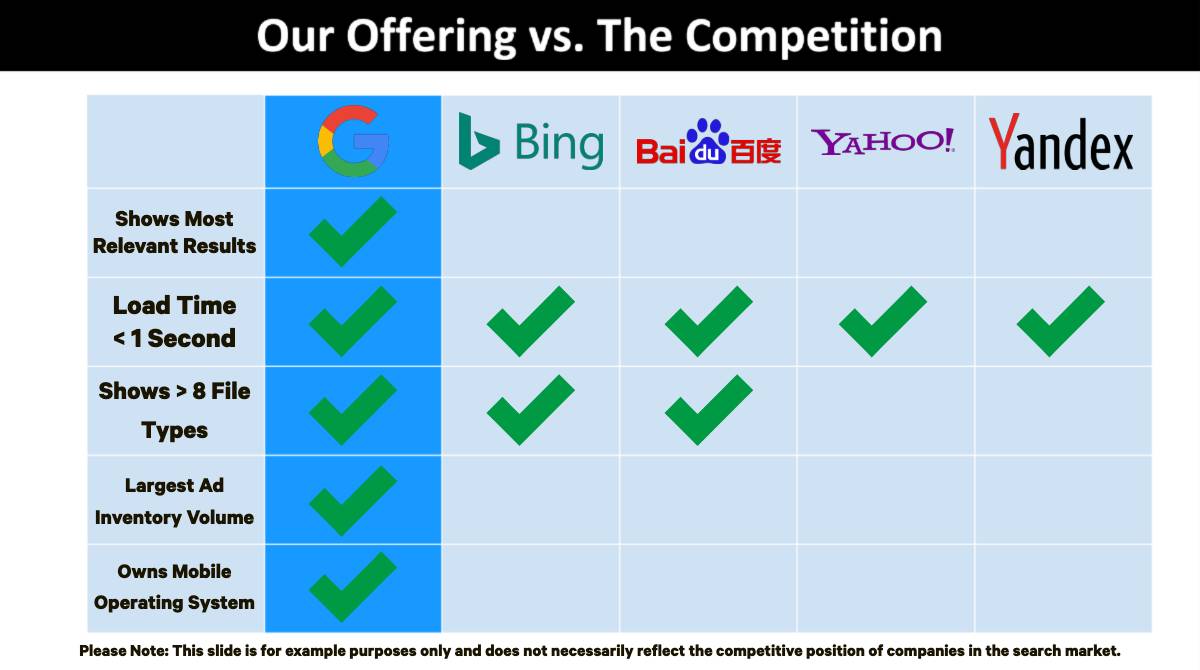
A feature table works when buyers compare products across specific capabilities. Use it carefully. Too many checkmarks make the slide look like a software pricing page after drinking espresso. Focus on five to seven features that truly affect purchase decisions.
Also, be fair. If a competitor has a strong feature, acknowledge it. Honest comparison builds trust. A deck where your product has every checkmark and every competitor has the emotional range of a potato will not pass serious investor scrutiny.
The Market Map
A market map works well in crowded categories. Group companies by segment, customer type, workflow, or technology layer. This helps investors understand where you fit. It is especially useful in SaaS, fintech, AI, cybersecurity, healthcare technology, and developer tools, where categories can become alphabet soup very quickly.
The “Old Way vs. New Way” Slide
Sometimes the strongest competition is not another startup. It is the old way of doing things. In that case, compare the current workflow with your new workflow. Show what customers do today, why it is painful, and how your product changes the economics or experience.
This format works well when your startup is creating a new category or replacing manual work. But be careful: “new category” does not mean “no competition.” It means you must explain the customer behavior you are replacing.
How Many Competitors Should You Mention?
For a typical pitch deck, mention the top five to eight competitors or alternatives. If the market is extremely crowded, group competitors by category and highlight the most significant players. Significance does not always mean revenue. It can mean brand recognition, investor awareness, customer overlap, technical similarity, or strategic threat.
If you are pitching a CRM startup, investors will expect you to know Salesforce, HubSpot, and other major players. If you are pitching an AI coding tool, they will expect you to understand GitHub Copilot and the broader developer workflow. If you omit obvious names, investors may wonder whether you are hiding them or simply missed them. Neither option is exactly a confetti moment.
At the same time, do not spend ten minutes narrating the biography of every competitor. Your deck is not a documentary series. Your job is to orient the investor quickly and return the focus to your insight.
What Not to Do When Talking About Competition
Do Not Say “We Have No Competition”
This is the classic mistake. Every company has competition for attention, budget, time, behavior, or internal resources. Even if your product is novel, customers can choose to keep doing nothing. “Do nothing” is often the most stubborn competitor in enterprise SaaS. It has no website, no sales team, and somehow an incredible close rate.
Do Not Trash Competitors
Investors want confidence, not insecurity wearing a blazer. If you spend too much time mocking competitors, it can make you look defensive. Respect strong companies. Explain where they are good, where they are limited, and where the market is changing.
Do Not Use Fake Differentiation
“We are easier to use” is not enough unless you can prove it. “We use AI” is not enough unless the AI creates a measurable advantage. “We are cheaper” may be dangerous if it suggests weak margins. Strong differentiation is specific, durable, and linked to customer value.
Do Not Overload the Slide
A competition slide with 40 logos, 16 features, and 72 checkmarks is not strategic. It is a crossword puzzle with a Series A valuation. Keep the main slide clean. Move the extra analysis to the appendix.
How Competition Changes by Fundraising Stage
Pre-Seed
At pre-seed, investors know you may not have a fully built product or a mature go-to-market motion. They still expect you to understand the problem and the alternatives customers use today. Your competition discussion should focus on customer pain, market insight, and the wedge that gives you a starting point.
Seed
At seed, investors want sharper positioning. You should know the main competitors, explain why customers choose you, and show early evidence of differentiation. This might include pilot results, conversion rates, retention signals, faster deployment, stronger engagement, or customer testimonials.
Series A
At Series A, the bar rises. Investors want proof that your differentiation can scale. They will ask about sales cycles, win rates, churn, expansion, pricing power, and defensibility. Your competition slide should connect to your growth engine and long-term moat.
Specific Example: A SaaS Startup Competition Slide
Imagine you are building a SaaS platform that helps healthcare clinics automate patient intake. Your competition slide could compare four categories:
- Legacy electronic health record systems that include basic intake features but are clunky and slow to customize.
- Generic form builders that are flexible but not healthcare-native.
- Point solutions focused only on appointment reminders or document collection.
- Manual workflows using paper forms, phone calls, and staff follow-up.
Your positioning might be: “Healthcare-native intake automation for specialty clinics, live in under one week, integrated with existing systems, and designed to reduce front-desk workload.” That is much stronger than saying, “We are better than forms.” It tells investors who you serve, what pain you remove, and why your solution has room to win.
How Much Time Should You Spend Talking About It?
In a live pitch, spend about one to two minutes on the competition slide. That is enough to explain the market map and your winning angle. If investors want more, they will ask. That is good. Questions mean they are engaged.
Your spoken narrative might sound like this:
“This is a competitive market, and that is part of why we like it. Customers already spend money here, but existing tools were built for large enterprises and take months to deploy. We are focused on mid-market teams that need automation without a six-month implementation. Our wedge is speed, workflow depth, and native integrations with the tools this segment already uses.”
That short explanation does four things: it admits competition, validates market demand, identifies a customer segment, and explains differentiation. Beautiful. No tap dancing required.
The Real Goal: Turn Competition Into Investor Confidence
The best competition slides make investors feel smarter, faster. They reduce confusion. They show that you are not wandering into a crowded market with a backpack full of optimism and no map. They also show that you are honest. That matters because fundraising is not just about slides; it is about trust.
A strong founder can say, “Yes, there are big players here. Here is what they do well. Here is where customers are still underserved. Here is the wedge we are using. Here is the evidence that it is working. Here is how that wedge expands into a much larger company.”
That is the whole game. Not pretending competition does not exist. Not obsessing over competitors. Not turning your pitch into a roast battle. Just clear, confident positioning.
Extra Experience: Lessons From Real Pitch Conversations
In real fundraising conversations, competition usually comes up earlier than founders expect. Sometimes it appears during the first meeting. Sometimes it appears in the first five minutes. Sometimes an investor opens the deck, sees the category, and immediately says, “How are you different from X?” This is not a trap. It is an invitation to show that you understand the buyer’s world.
One common experience among founders is that the competition slide often becomes a credibility slide. Investors may not know every detail of the product yet, but they can tell whether the founder has spent serious time in the market. When a founder names the right competitors, explains their strengths fairly, and then identifies a precise gap, the conversation becomes more productive. The investor stops wondering, “Have they done the homework?” and starts asking, “Is this gap big enough to build a venture-scale company?”
Another lesson: customer language beats founder language. Founders often describe competition by product category. Customers describe it by pain. A founder might say, “We compete with workflow automation platforms.” A customer might say, “We are tired of copying data from one system into another every morning.” The second version is more powerful because it connects competition to actual behavior. In the best pitch decks, the competition slide reflects how customers think, not how analysts label software markets.
Founders also learn that investors respect nuance. If you say, “Our competitor is strong in enterprise, but weaker in fast onboarding for mid-market teams,” that sounds thoughtful. If you say, “Our competitor is bad,” that sounds like you spent eleven seconds on research and six of them were emotional. Nuance makes you look like a strategist. Blanket dismissal makes you look like someone who should not be left alone with a market map.
A useful exercise before pitching is to rehearse the hardest competition questions. Why can’t the incumbent build this? Why won’t a bigger platform bundle your feature? Why will customers switch now? What happens if pricing falls? Which competitor do you worry about most? What do customers use if they do not buy your product? If you can answer these calmly, your live pitch will feel much stronger.
It also helps to keep a “competitive intelligence” appendix. This does not need to be dramatic. Include a few backup slides with pricing notes, product screenshots, customer win/loss insights, and a deeper market map. You may never show them. That is fine. Their real value is preparation. When an investor asks a sharp question, you can answer with confidence instead of blinking like your Wi-Fi just disconnected from your brain.
The final experience-based lesson is simple: competition is not bad news. In many cases, competition proves the market exists. The opportunity is not to be alone. The opportunity is to be right about what changes next. New winners emerge when customer needs shift, technology improves, distribution changes, or incumbents become too slow to serve a growing segment. Your pitch deck should make that change obvious.
Conclusion
So, how much should you talk about the competition in a pitch deck? Talk about it clearly, briefly, and strategically. Give it one strong slide in the main deck, support it with appendix material, and use the discussion to prove three things: you know the market, you respect the alternatives, and you have a believable plan to win.
The competition slide is not a confession. It is not a weakness. It is not the part of the deck where joy goes to file paperwork. Done well, it is one of the cleanest ways to show investor-grade thinking. Be honest about the market. Be specific about your wedge. Be fair to competitors. Then bring the conversation back to your company’s momentum, customers, and future.
Note: This article is written for web publication and synthesizes real startup fundraising guidance in original language without copying source text.