

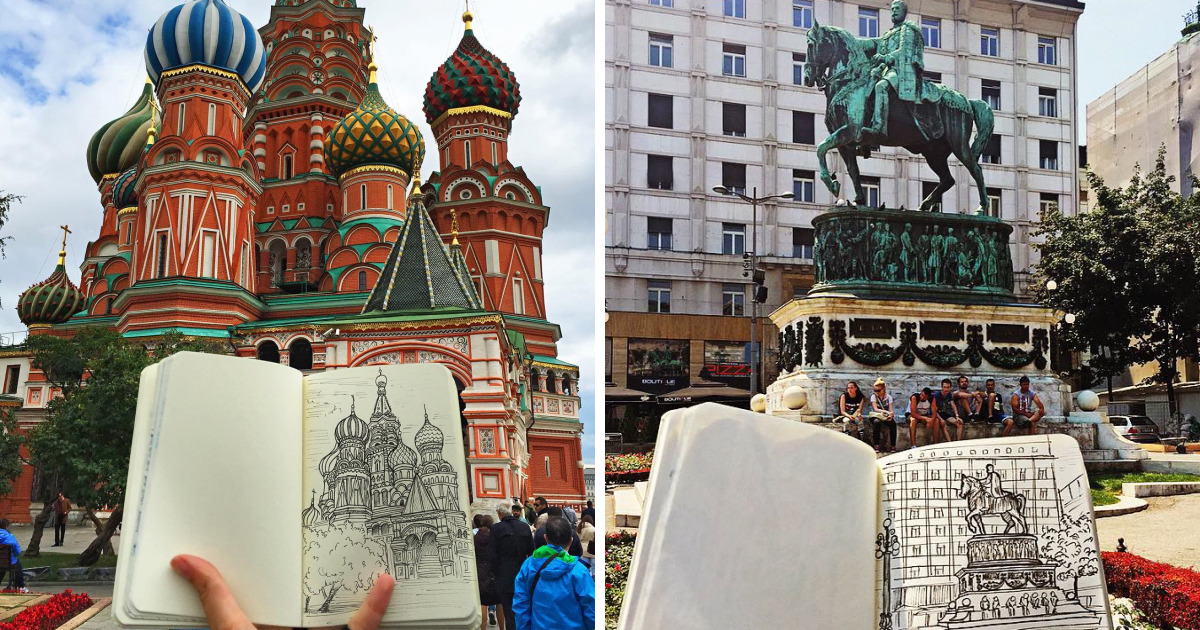
Some people travel for beaches, famous restaurants, or the noble pursuit of taking 417 nearly identical sunset photos. I travel because I want to draw what I find. A crooked balcony in Lisbon, a sleepy train platform in rural Japan, a red rock wall in Arizona, or a coffee cup sweating onto a café table can be enough to justify a journey.
Travel sketching changes the basic question of a trip. Instead of asking, “What should I see?” I begin asking, “What would I like to sit with long enough to understand?” That small shift turns travel from a race through attractions into a patient conversation with a place. The drawing may take ten minutes or two hours. It may be elegant, lopsided, colorful, or apparently completed during a minor earthquake. None of that matters as much as being present.
Organizations devoted to on-location drawing describe sketches as records of time and place, while museums, national parks, and cultural institutions use sketching and field journaling to strengthen observation. The tradition is old, but its appeal feels especially modern: a sketchbook offers a quiet alternative to traveling through a screen.
Why Drawing Gives Me a Reason to Go
A destination becomes more exciting when I imagine the page it might become. I do not need a world-famous landmark. In fact, landmarks can be surprisingly bossy. They arrive with expectations, crowds, souvenir stands, and at least one person holding a tablet above everyone’s head. An ordinary street corner gives me more freedom.
Historically, travelers have used sketchbooks to record architecture, landscapes, people, routes, and personal notes. The Library of Congress preserves travel sketchbooks by figures such as architect Richard Morris Hunt and amateur artist Benajah Jay Antrim, whose pages combine visual records with details about people, buildings, nature, and daily movement. Those collections show that a sketchbook can be more than a portfolio; it can become a portable archive of how a traveler experienced the world.
A Sketch Sees What a Camera Can Miss
Drawing Forces Me to Stay Longer
A photograph can be made in a fraction of a second. A drawing requires negotiation. Where does the roofline begin? Which shadow is important? Why does that window look normal in real life but ridiculous on paper? While answering those questions, I notice chipped paint, uneven stones, laundry moving in the wind, traffic patterns, overheard conversations, and the way afternoon light changes a wall from gray to lavender.
This is why the finished sketch often holds more memory than its technical quality would suggest. Looking at an old page can bring back the temperature, the smell of food nearby, the sound of bells, and the stranger who leaned over to say, “Very nice,” before the drawing had reached the stage where kindness was reasonable.
It Replaces Collection With Connection
Fast travel can feel like collecting proof: I was here, I saw this, I stood in line for that. Sketching replaces the checklist with a relationship. For twenty minutes, a bridge is not an item on an itinerary. It is a structure with weight, rhythm, history, and a suspicious number of arches.
Smithsonian programs encourage “slow looking,” and its natural-history educators note that drawing can reveal details that may be overlooked or poorly captured digitally. The National Park Service similarly promotes nature and travel journaling as a way to observe and record a place. The point is not that cameras are bad; cameras are wonderful. The point is that drawing makes looking active.
Imperfection Makes the Memory Personal
A photograph usually records what stood in front of the lens. A sketch records what caught the artist’s attention. I may enlarge a café awning because I loved its stripes, simplify a crowded plaza, or accidentally tilt a tower until it appears emotionally exhausted. These choices make the page personal.
Travel drawing becomes more enjoyable when I stop treating accuracy as a moral virtue. A loose sketch can communicate heat, noise, speed, and mood better than a careful architectural rendering. Urban sketchers often emphasize direct observation and truthful storytelling, but truth does not require drawing every brick. It requires responding honestly to the scene.
How I Choose Places Worth Drawing
Architecture With Character
Grand monuments are obvious subjects, but I look for buildings that show evidence of time: patched walls, mismatched shutters, hand-painted signs, repaired roofs, and additions that appear to have been approved by someone’s confident uncle. These details reveal how people adapt a place rather than merely occupy it.
Landscapes With Layers
Natural scenery becomes easier to sketch when I divide it into foreground, middle ground, and background. A branch, fence, or boulder can anchor the foreground. Trees, water, or buildings can organize the middle distance. Mountains and sky complete the background. National Park Service field-journaling programs teach similar landscape concepts, including atmospheric perspective, because depth is easier to understand when the scene is treated as a series of overlapping layers.
Ordinary Places Where Life Happens
Markets, bus stops, laundromats, ferry terminals, neighborhood cafés, and public squares often produce the strongest travel pages. They provide human scale. A famous palace may explain a country’s history, but a grocery counter can explain what people eat on a Tuesday.
The Lightweight Travel Sketching Kit I Actually Use
The best kit is not the most impressive one. It is the kit I am willing to carry all day. Heavy supplies turn inspiration into a shipping problem, so I keep things simple:
- A small sketchbook that opens flat
- One waterproof fineliner or fountain pen
- A mechanical pencil and compact eraser
- A travel watercolor palette with a limited range
- One water brush or small round brush
- A few clips to control pages in the wind
- A small cloth or paper towel
Outdoor artists often recommend working with portable materials and using a reference photo only when time, weather, or conditions prevent finishing on location. Getty programs likewise present sketching as an accessible practice for casual visitors as well as experienced artists. The lesson is reassuring: useful tools matter, but open eyes and regular practice matter more.
How to Draw Without Letting Drawing Ruin the Trip
Use the Ten-Minute Rule
Not every scene deserves a full watercolor production complete with dramatic sighing. When traveling with other people, I often set a ten-minute limit. I choose one focal point, draw the largest shapes, add a few dark values, and stop. Speed sketching encourages focus, spontaneity, and confidence, and it is especially practical when companions have interests beyond watching ink dry.
Invite Companions Into the Process
I explain what I want to draw and how long it will take. Then I choose locations where everyone can enjoy something: a café, park bench, museum courtyard, scenic overlook, or market. Sometimes a companion reads, drinks coffee, explores nearby, or becomes an unwilling figure model by standing still for almost seven seconds.
Group sketching can also turn strangers into friends. Urban Sketchers chapters around the world organize on-location gatherings where people compare interpretations of the same scene and learn from one another. The social side is important because drawing in public feels less intimidating when everyone nearby is also wrestling with perspective.
Accept Weather, Crowds, and Chaos
Wind flips pages. Rain decorates watercolor before permission is granted. Crowds block the subject, buses park directly in front of the most beautiful façade, and curious children ask devastatingly specific questions about proportion. These are not interruptions to travel sketching; they are part of it.
Respectful Sketching Matters
Drawing in public is usually welcome, but the sketchbook is not a magical permission slip. I avoid obstructing paths, entrances, worship, business activity, or emergency access. I ask before making a recognizable portrait of someone at close range, especially children. In museums, I check policies because some institutions limit materials, sketchbook sizes, locations, or use of wet media. The Smithsonian American Art Museum, for example, permits sketching only in designated collection spaces and allows dry media under stated size restrictions.
In natural areas, I work from durable surfaces, stay on established paths where required, pack out every scrap, and avoid disturbing plants or wildlife. A beautiful drawing is not beautiful enough to justify trampling a fragile area. Respect also includes cultural awareness: clothing, sacred spaces, ceremonies, private property, and local customs deserve attention before I settle down with a pen.
Building a Visual Travel Journal
A strong travel sketchbook includes more than finished drawings. I add dates, place names, ticket stubs, color swatches, food labels, overheard phrases, tiny maps, and notes about weather or sound. The National Park Service describes travel journals as valuable records of adventures, while historical collections demonstrate how written and visual observations can preserve social and cultural details across generations.
Travel can also change an artist’s practice. Getty materials on traveling artists highlight how journeys expose people to different traditions and knowledge, while National Endowment for the Arts research has linked international artistic experiences with professional, creative, and personal growth. New colors, patterns, materials, visual rhythms, and ways of organizing space can enter the sketchbook and follow the traveler home.
Why the Drawing Is Worth More Than a Perfect Image
The value of a travel sketch is not measured by realism. It is measured by attention. A page proves that I paused, looked, made choices, and allowed a location to affect me. That process creates a form of ownership without possession. I do not take the street, mountain, doorway, or stranger home. I take home a record of the time I spent noticing.
Field Notes: Experiences That Keep Me Traveling
One of my favorite imagined pages begins before sunrise in Venice. The famous canals are quiet, delivery boats are working, and the stone buildings appear to be waking reluctantly. I choose a narrow bridge rather than a grand palace. My first lines are cautious, but the scene refuses to stay still. A boat passes and sends reflections wobbling across the water. A worker rolls a cart over the bridge, producing enough noise to wake several centuries. By the time tourists arrive, I have drawn only half the windows, yet the page feels complete because it contains the city’s early-morning rhythm.
In Kyoto, I sit near a small neighborhood shrine after rain. The vermilion structure is bright against wet stone and dark leaves. I begin with the gate, but soon the puddles become the real subject. They reflect pieces of red, gray, and green, turning the ground into a second, less organized painting. An elderly man pauses, studies the page, points at a line, and laughs. I do not know whether he approves of the drawing or has identified a serious structural problem. Either way, we share the moment.
At the Grand Canyon, scale defeats me immediately. The landscape is too wide, too deep, and far too confident. Trying to draw everything produces a page that resembles a wrinkled blanket. I start again with three shapes: a dark foreground ledge, a middle band of cliffs, and a pale distance. Once I stop attempting to explain the entire canyon, the sketch begins to breathe. A raven lands nearby and receives a guest appearance in the lower corner, looking more anatomically successful than the geology.
Lisbon teaches me that straight lines are optional. Streets climb, rails curve, tiles repeat, laundry hangs, and yellow trams squeeze through spaces that appear narrower than the trams themselves. I sketch from a café table and let the buildings lean. The page becomes more truthful after I stop correcting it. The city feels balanced not because everything is level, but because everything seems accustomed to the slope.
In New Orleans, sound affects the drawing. Music travels down the street before the musicians appear. I use loose, repeated marks for balcony railings and quick figures for people gathering near a corner performance. A careful rendering would take hours, but the scene demands speed. The final sketch is energetic, incomplete, and slightly sticky from something that landed on the table. It remains one of the pages I remember most clearly.
These experiences explain why drawing is my reason to travel around. The sketchbook gives each journey a purpose while leaving room for surprise. It encourages me to wake early, walk farther, talk to strangers, notice ordinary corners, and remain in places I might otherwise pass. I return with fewer perfect images and more specific memories. That is a trade I will accept every time.
Conclusion: Travel Far, Look Slowly, Draw Honestly
Drawing the places I visit turns travel into an active creative practice. It slows down observation, strengthens memory, makes ordinary scenes meaningful, and transforms mistakes into personal history. A small sketchbook can hold architecture, landscapes, meals, delays, weather, humor, and human encounters without requiring perfect technique.
The next trip does not need to be exotic. Start with a nearby street, park, station, or café. Sit safely, choose one subject, draw the largest shapes, add a few notes, and stop before perfection begins making unreasonable demands. The goal is not to reproduce the world exactly. The goal is to meet it more attentively.
Note: Always follow local rules, museum policies, private-property boundaries, and Leave No Trace principles when sketching on location.