

Three miles down, sunlight doesn’t just fadeit gives up entirely. Down there, the ocean is a cold, pressurized
archive, where history isn’t stored in climate-controlled boxes but in twisted steel, collapsed flight decks,
and the occasional “how is that still there?” detail that makes archaeologists grin like kids at a dinosaur museum.
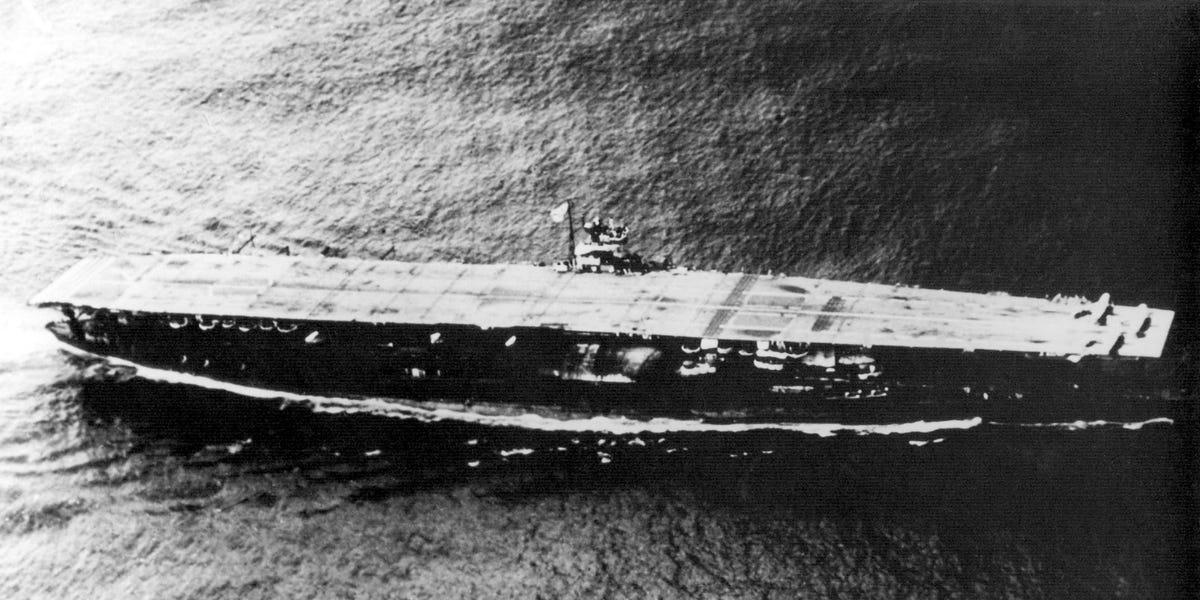
That’s exactly why the recent footage of AkagiJapan’s legendary World War II aircraft carrierhit so hard.
Because Akagi isn’t just another shipwreck. It’s a headline ship from the Pacific War: flagship of Japan’s mobile carrier
striking force, participant in the attack on Pearl Harbor, and one of the four carriers lost in the Battle of Midway.
And now, thanks to deep-sea explorers and robot submersibles with better camera skills than most of us, Akagi has been
filmed in vivid detail in its final resting place. The wreck remains undisturbedbut the story it tells is suddenly clearer.
Akagi 101: Why This Carrier Became a Legend
From treaty paperwork to floating airfield
Akagi’s origin story begins with a twist: it was originally planned as a battlecruiser, but shifting naval treaties
pushed Japan to convert unfinished hulls into aircraft carriers. The result was a fast, powerful flattop that helped define
carrier warfare in the Pacific. In other words, Akagi was born from international fine printand went on to rewrite
the battlefield.
The “celebrity status” of an aircraft carrier
If WWII ships had social media, Akagi would’ve been verified. It served as a flagship for Japan’s carrier strike force
(the Kidō Butai), and took part in major early-war operationsmost famously the attack on Pearl Harbor on
December 7, 1941. Later came operations across the Pacific, including the Indian Ocean raid in spring 1942, before the ship
steamed toward the battle that would seal its fate: Midway.
The Battle of Midway: When the Ocean’s “Receipts” Changed Everything
Midway (June 4–7, 1942) wasn’t just another naval battleit was a hinge point. U.S. forces intercepted a Japanese plan
to seize Midway Atoll, and the resulting clash turned into a carrier-versus-carrier showdown that changed the balance
of power in the Pacific. In the span of a few catastrophic hours, Japan lost four fleet carriers, including Akagi.
Here’s the brutal elegance of carrier warfare: you can command the sea all you want, but if you lose the flight deck,
the ocean becomes very persuasive. Midway proved that “who sees whom first” matters. It also proved that a ship’s story
doesn’t end when it sinkssometimes it just waits 80 years for someone to bring a camera.
How Explorers Found Akagiand Finally Filmed It Clearly
Step one: locate the wreck (2019)
Before you can film a shipwreck, you have to find it. Akagi was located during a mapping survey in 2019, carried out by
Vulcan Inc. in partnership with the U.S. Navy’s Naval History and Heritage Command. In deep-ocean terms, “found it”
usually means sonar data, careful mapping, and the patience of a saint who’s okay with staring at squiggly lines
for a living.
Step two: bring in the robots (September 2023)
The breakthrough visual documentation came in September 2023, when Ocean Exploration Trust and partners conducted the
first visual survey of Akagi using a remotely operated vehicle (ROV) named Atalanta,
deployed from the exploration vessel Nautilus. The expeditionsupported through NOAA Ocean Exploration
partnershipswas part of a wider effort to explore the remote northwestern region of Papahānaumokuākea Marine National Monument,
a protected area that also happens to include WWII wreck sites.
Translation: this wasn’t “drop a GoPro and hope.” The team methodically surveyed the site over many hours, gathering
high-resolution video, still images, and the kind of data that lets researchers build photogrammetry models3D reconstructions
made from thousands of frames.
What the Footage Reveals on the Seafloor
Akagi’s condition: intact, but clearly scarred
Akagi rests in deep waterroughly 5 kilometers downinside Papahānaumokuākea Marine National Monument. The site is a protected
historic place and a war grave, which is important because it sets the tone: this is documentation, not treasure hunting.
The visual survey found Akagi largely intact but severely disarticulated and embedded in seafloor sediment. A major damaged
area aft of amidships appears consistent with bomb damage and internal explosions. Even after decades on the seafloor,
structural features still speak: the slope and breaks in the deck hint at where systems like exhaust structures once ran,
and damage patterns can be compared to battle accounts.
The moment that doomed her
Akagi’s last day wasn’t a tidy “sank heroically, roll credits” ending. During Midway, U.S. dive bombers attacked the carrier.
One of the strikesdelivered by a Dauntless piloted by Lt. Cmdr. Dick Besthit near the middle elevator area and helped trigger
a chain of explosions and fires. Once Akagi became inoperable, Japan scuttled the carrier on June 5, 1942, with torpedoes fired
from accompanying destroyers. The wreck’s damage offers physical clues that can be weighed against long-studied narratives.
Why Filming a Sunken WWII Aircraft Carrier Matters
Deep-sea archaeology beats guesswork
Historians have logs, survivor accounts, and after-action reports. Archaeologists have something extra: the ship itself.
High-definition footage and 3D models allow experts to ask new questionswhere fires burned hottest, how the superstructure
failed, what damage-control efforts might have looked like, and what evidence remains of the ship’s final hours.
Respect, not souvenirs
These wrecks are not theme-park attractions. They’re protected sites in U.S. waters, and the guiding ethic is clear:
nothing is removed. The only “take” is informationimages, video, measurements, and models that can be studied and shared
without disturbing the resting place of thousands.
The Bigger Picture: A Carrier Graveyard at Midway
Akagi is part of a much larger underwater story. The 2023 surveys also included detailed work on other Midway shipwrecks,
including the Japanese carrier Kaga and the U.S. carrier USS Yorktown. Seeing these sites
togetherthrough the lens of modern deep-sea technologyturns Midway from a textbook chapter into an observable landscape.
It’s history you can literally map.
And the location matters. Papahānaumokuākea is one of the world’s great marine protected areas, far from busy shipping lanes
and casual interference. That remoteness is part of why the wrecks remain undisturbedand why filming them is so difficult.
How Deep-Sea Filming Works (Without Crushing Your Gear Like a Soda Can)
ROVs: the underwater camera crews that don’t need oxygen
At depths around 5 kilometers, humans don’t divemachines do. ROVs like Atalanta are tethered to the ship above, piloted by
operators who manage thrusters, lights, cameras, and sometimes robotic arms (used for careful navigation, not collecting artifacts).
Visibility is limited, currents can be tricky, and even “a little bump” can ruin a fragile site or the mission. Precision matters.
Photogrammetry: turning video into a 3D time capsule
The footage isn’t just for dramatic screenshots. It can be processed into thousands of still images that overlap enough
for software to reconstruct geometry. In Akagi’s case, the documentation effort produced extensive video that was turned into
thousands of frames for modeling. The result: detailed 3D views that allow measurements, comparisons, and virtual “visits”
without physical disturbance.
What We Still Don’t Knowand What Future Surveys Could Answer
Even with the clearest footage ever captured, a shipwreck keeps secrets. Some questions are stubborn:
- Which areas show damage from bombs versus damage from internal explosions or scuttling torpedoes?
- How did fires move through hangars and compartments, and what does heat damage reveal about the timeline?
- What can the debris field tell us about structural failure and sinking dynamics?
- How will corrosion, biological growth, and seafloor sediment change the wreck over the next century?
The point isn’t to “solve” history like it’s a crime show. It’s to refine our understanding with physical evidenceespecially
when eyewitnesses are few and myths are many.
Conclusion: When the Ocean Finally Shows You the Receipts
Akagi’s story has always been big: a symbol of Japan’s early-war carrier dominance, a participant in Pearl Harbor,
and a casualty of Midway’s decisive reversal. But seeing the carrier againquiet on the seafloor, scarred and monumental
changes how the story lands. It’s no longer just strategy and dates. It’s steel, damage, and the unmistakable shape of a
ship that once launched history across the Pacific.
Explorers didn’t “rediscover” Akagi so we could gawk. They documented it so we could learnwith better tools, better optics,
and (ideally) better judgment about what war costs. And if a robot camera three miles down can help a new generation see
that clearly, that’s a pretty good use of high-definition.
Bonus: The Experience of Filming Akagi (Shipwreck Vibes, +)
Imagine working a job where your office view is the Pacific Ocean, your elevator goes down five kilometers, and your coworker
is a robot named Atalanta. That’s the basic vibe of a deep-sea expedition filming a sunken WWII aircraft carrier.
On the surface, the ship feels like a floating production studio: monitors everywhere, scientists leaning in like it’s the
season finale of a mystery series, and engineers doing the kind of calm problem-solving that makes regular people wonder
if they were assembled in a factory. The ROV team doesn’t “dive” in the traditional sensethey launch a machine, then pilot it
with joystick-level precision while managing lighting, camera angles, and navigation in a place where GPS is useless and the
environment is trying to crush everything you love.
Then comes the wait. Lowering an ROV to the seafloor takes time, and the ocean doesn’t care about your schedule. When the video
feed finally switches from inky nothingness to faint outlines, the room changes. People stop multitasking. Jokes pause mid-flight.
Someone inevitably says, “There it is,” like they’re spotting a mountain peak through clouds.
Filming Akagi isn’t like filming a reef. Reefs are chaotic and colorful; a carrier wreck is architecturestraight lines,
decks, compartments, and the eerie sense that you’re looking at a place built for thousands of humans… now occupied by sediment
and silence. The lights catch edges of metal and openings that once led to hangars. You see damage that doesn’t look “old” so much
as “decisive,” as if history’s punchline landed and never stopped echoing.
There’s also an emotional tightrope. Everyone knows this is a war grave. The goal isn’t to “get close for a cool shot.”
The goal is to document responsibly. That means slow passes, wide arcs, and constant attention to not stirring up sediment
that can obscure visibility or settle in ways that complicate future study. It’s careful workmore like scanning a priceless
manuscript than exploring a haunted house (even if the vibes sometimes whisper otherwise).
The most surreal part might be the collaboration. With telepresence, experts can weigh in from far away while the mission unfolds,
and the footage can be shared beyond the vessel in near real time. In practice, that means the wreck becomes a classroom,
a lab, and a memorial all at once. You’re watching history with people who have spent decades studying itand you can hear
their brains firing: identifying structures, debating damage patterns, connecting what the camera sees to what archives report.
And when the ROV finally rises back toward daylight, the expedition doesn’t really “end.” It just changes form. The real work
continues in data processing, photogrammetry, and analysisturning hours of footage into models and insights that can be revisited
without touching the site again. The wreck stays where it is. The understanding moves forward.
In a weird way, filming Akagi is both high-tech and deeply human. It’s about machines operating where people can’tbut also about
people trying to see clearly what happened, what it meant, and what it should mean now. And yes, it’s also about the universal joy
of finally getting the camera angle right after the ocean tried to ruin your whole day. Small wins matterespecially at the bottom
of the world.