

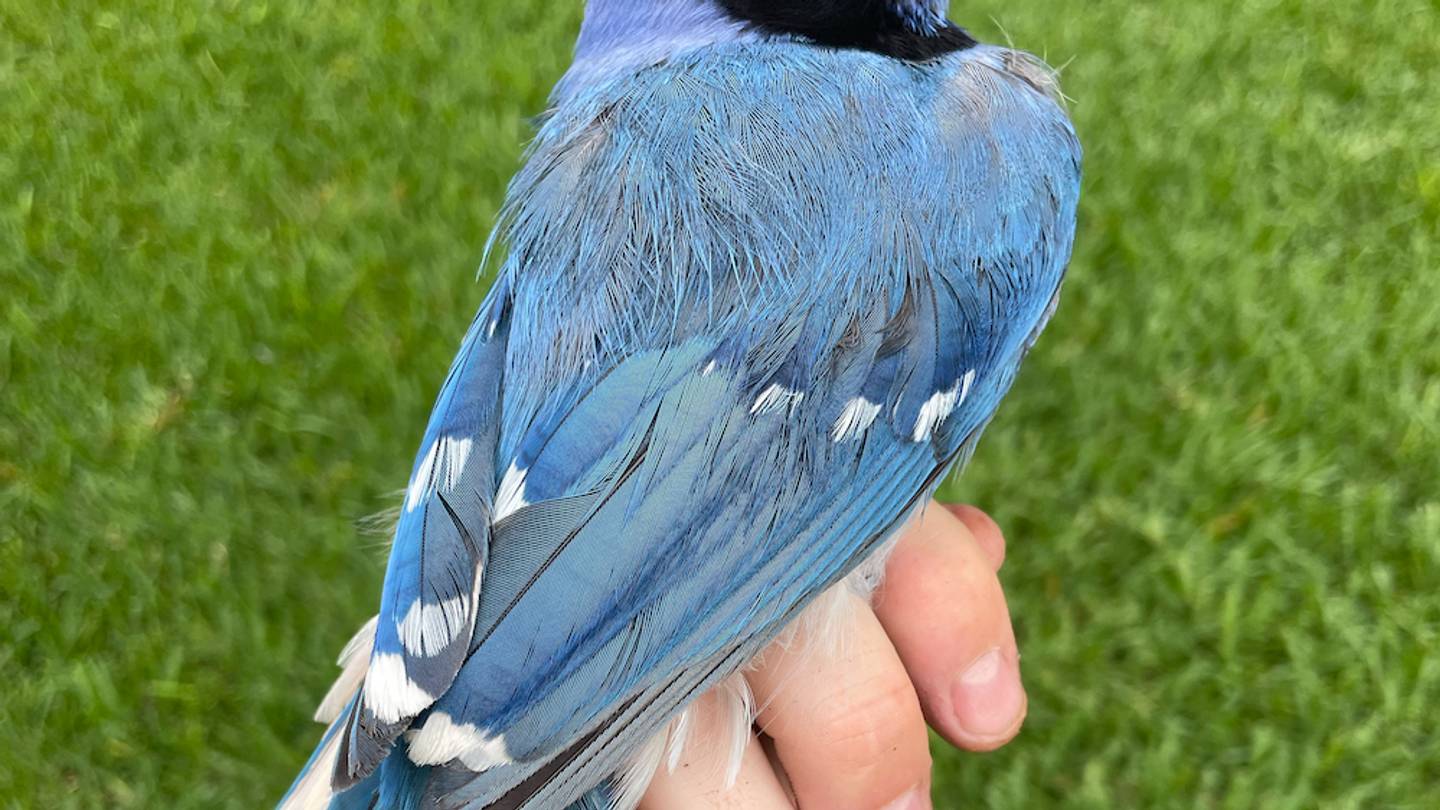
Texas has never been shy about producing wildlife headlines with a little extra flair. Armadillos cross highways like armored commuters, alligators lurk in golf course ponds, and now a backyard near San Antonio has delivered something that sounds like it escaped from a bird-themed comic book: a wild hybrid offspring of a Blue Jay and a Green Jay.
The bird has already earned an unofficial nickname among amused observers: the “grue jay.” Is that a scientifically approved name? No. Is it irresistible? Absolutely. More importantly, this striking blue-and-black bird may represent the first known wild hybrid between a Blue Jay and a Green Jay, two species separated by millions of years of evolution and, until recently, by geography.
Researchers from the University of Texas at Austin confirmed through genetic analysis that the unusual bird is the offspring of a female Green Jay and a male Blue Jay. That detail matters because it turns a curious backyard sighting into a meaningful case study in climate-driven range shifts, species overlap, and the surprising ways wildlife responds when the map starts changing.
A Backyard Sighting That Became a Scientific Surprise
The story began not in a remote jungle or a carefully guarded research site, but in a suburban yard near San Antonio, Texas. A homeowner noticed a bird that looked almost like a Blue Jay, but not quite. It had blue feathers, a white chest, and dark facial markings that seemed a little too dramatic for the usual neighborhood jay crowd.
The photo eventually reached Brian Stokes, a University of Texas at Austin graduate researcher studying Green Jays. At first glance, the bird looked unusual enough to warrant a closer look. It was not simply a scruffy Blue Jay having a bad feather day. It appeared to carry traits from two different jay species.
After visiting the property, researchers captured the bird with a mist net, collected a small blood sample, banded it, and released it unharmed. Genetic testing later confirmed the big reveal: this was a first-generation hybrid. Its mother was a Green Jay, and its father was a Blue Jay.
In other words, the bird was not a rumor, not a trick of lighting, and not the result of someone’s overexcited birding imagination after too much coffee. It was real.
Meet the Parents: Blue Jay vs. Green Jay
The Blue Jay: Loud, Smart, and Very Sure of Itself
The Blue Jay, known scientifically as Cyanocitta cristata, is one of the most recognizable birds in eastern North America. With its blue, white, and black plumage, prominent crest, and noisy calls, it has become a backyard celebrity. It is intelligent, social, adaptable, and perfectly willing to announce its opinions to the entire block.
Blue Jays are members of the corvid family, the same brainy group that includes crows, ravens, and magpies. They are known for complex social behavior, strong family bonds, and a talent for mimicry. Some even imitate hawks, which is either clever communication or the bird equivalent of yelling “shark!” at a swimming pool.
The Green Jay: Tropical Color With Texas Attitude
The Green Jay, Cyanocorax yncas, looks like nature spilled several paint jars and somehow made it elegant. In Texas, Green Jays are mostly found in the southern part of the state, especially in native woods, mesquite brush, and dense vegetation. Their plumage blends green, yellow, blue, black, and purple tones, making them one of the most colorful birds in the United States.
Green Jays are also social, vocal, and clever. They live in pairs or family groups, use a wide variety of calls, and are among the North American birds known to use tools. If Blue Jays are the loud neighborhood intellectuals, Green Jays are the tropical cousins who arrive wearing designer feathers and somehow know how to open the snack drawer.
Why This Hybrid Is So Unusual
Hybrid birds are not unheard of. In fact, hybridization occurs in a number of bird groups, especially when closely related species overlap. Ducks, gulls, hummingbirds, and warblers can occasionally blur species boundaries in ways that keep birders humble.
But this case is different. Blue Jays and Green Jays are not next-door cousins in evolutionary terms. Researchers estimate their lineages separated roughly seven million years ago. They also belong to different genera, which makes this pairing especially remarkable.
To put that in everyday terms, this is not like discovering that two similar dog breeds had puppies. It is more like finding out that two distant branches of the family tree met at a reunion, hit it off, and produced a bird with a very confusing ancestry test.
There was a known captive hybrid between these species produced decades ago, but the Texas bird is significant because it appears to be the first documented wild example. That makes the discovery valuable not just as a biological novelty, but as evidence of changing ecological relationships.
What Does the Hybrid Look Like?
The Texas hybrid resembles a Blue Jay at first glance, with a largely blue body and pale underside. But the more you look, the stranger it gets. The bird shows heavy black facial markings more reminiscent of a Green Jay, along with a less typical head shape and vocal traits that seem to borrow from both sides of the family.
Researchers also observed vocal behavior that suggested a mix of influences. It moved with Blue Jays and sounded somewhat like them, yet it also produced sounds associated with Green Jays. Imagine a bilingual bird raised in a neighborhood where everyone is loud, opinionated, and wearing dramatic feathers.
This blend of visual and behavioral traits helped researchers suspect hybrid ancestry before the DNA results confirmed it. In the world of bird identification, plumage can raise the question, but genetics gets to slam the gavel.
Climate Change May Have Helped Bring the Parents Together
The most important part of this discovery is not just that two colorful birds produced one extremely colorful offspring. The deeper story is about range expansion.
Historically, Green Jays in the United States were mainly limited to far South Texas, while Blue Jays were mostly associated with the eastern United States and reached only so far west. Their breeding ranges did not significantly overlap. If two species never meet, they cannot hybridize, no matter how charming their calls may be.
That geographic separation has changed. Green Jays have been moving northward, while Blue Jays have expanded westward in Texas. Around the San Antonio region, their ranges now overlap more than they once did. Scientists believe warming temperatures, shifting habitats, human-altered landscapes, and artificial food sources may all contribute to bringing these species into closer contact.
This is why researchers see the hybrid as more than a one-bird wonder. It may be an early example of how climate change and human development can rearrange wildlife communities, creating new meetings between species that were historically kept apart.
A “Grue Jay” Is Cute. The Science Is Serious.
It is easy to focus on the fun part of the story. A Blue Jay plus a Green Jay gives us a “grue jay,” and the internet gets a new mascot. But beneath the nickname is a serious ecological signal.
As species shift their ranges, they do not move across empty chessboards. They enter places where other species already live, feed, nest, compete, and communicate. Some encounters may be harmless. Some may lead to competition. Others may create hybrids. Still others may reshape local ecosystems in ways scientists cannot fully predict yet.
The Texas hybrid shows how climate change does not always appear as a dramatic disaster scene. Sometimes it appears as one strange bird in one backyard, quietly carrying the genetic evidence of a changing world.
Why Birders Matter in Discoveries Like This
One of the most delightful lessons from this story is that everyday observers matter. This discovery began with a person noticing something odd and sharing a photo. Without that moment, the bird might have gone unstudied. It could have flown two yards away, disappeared into the trees, and become just another missed clue in the natural world.
Modern birding platforms, social media groups, and community science tools such as eBird have changed the speed at which unusual wildlife observations can reach experts. A blurry backyard photo can now become the first step toward a peer-reviewed study.
That does not mean every odd bird is a scientific breakthrough. Sometimes a strange-looking bird is molting. Sometimes lighting does weird things. Sometimes the “rare species” is a plastic bag with ambition. But careful observation, good photos, and responsible reporting can make a real difference.
Could More Hybrid Jays Appear in Texas?
Possibly. Researchers are cautious because one bird does not automatically mean a trend. Still, the conditions that made this hybrid possible may continue. If Green Jays keep moving north and Blue Jays continue occupying overlapping areas, more encounters could occur.
Whether those encounters produce more hybrids is another question. Successful hybridization depends on behavior, timing, mate choice, survival, fertility, and many other factors. Birds are not simply genetic machines. They have songs, social structures, territories, preferences, and, apparently, occasional surprises.
The Texas hybrid was seen again after its initial capture, suggesting it survived in the wild for some time. That makes the case even more intriguing. Survival does not prove reproductive success, but it does show that the bird was not merely a short-lived accident.
What This Discovery Teaches Us About Evolution
Evolution is often described as slow, ancient, and almost museum-like. But the “grue jay” reminds us that evolution is also active, messy, and sometimes perched on a backyard fence.
Hybridization can introduce new genetic combinations into populations. In some cases, hybrids do not survive well or cannot reproduce. In other cases, hybridization may contribute to adaptation, especially in changing environments. Scientists study these cases carefully because they reveal how flexible or fragile species boundaries can be.
The Blue Jay-Green Jay hybrid does not mean a new species has suddenly appeared. That would require many more steps, including a stable breeding population. But it does show that reproductive barriers between long-separated species are not always absolute.
Nature, as usual, has declined to follow the neat categories humans made for it.
What Texans and Bird Lovers Can Do
For bird lovers in Texas, this discovery is an invitation to pay closer attention. Backyards, parks, brushlands, and suburban edges can all become observation points. Anyone who sees an unusual jay should take clear photos, note the location and date, observe behavior from a respectful distance, and share the sighting with reliable birding communities or researchers.
It is also important not to chase, trap, feed excessively, or harass unusual birds. A rare bird is not a celebrity who needs paparazzi. The best approach is patient observation and careful documentation.
Planting native vegetation, reducing pesticide use, keeping cats indoors, and supporting habitat conservation can also help birds thrive as landscapes change. The story of this hybrid may be unusual, but the broader need for healthy habitats is very ordinary and very urgent.
Personal Field Notes: What This Hybrid Reminds Us to Notice
Spending time watching birds has a way of training the eye to respect small differences. At first, a jay is just a jay. Then one day you notice the angle of the crest, the flash of white on a tail, the kind of call that sounds like a rusty gate arguing with a trumpet. Suddenly the ordinary backyard becomes a living field guide.
The Blue Jay-Green Jay hybrid story captures that feeling perfectly. It reminds us that discovery does not always arrive wearing a lab coat. Sometimes it lands on a fence, grabs a snack, and looks just strange enough for someone to say, “Wait a minute.” That moment of curiosity is the beginning of science.
For families, teachers, and young nature lovers, this story is a fantastic doorway into bigger questions. Why do animals live where they live? What happens when temperatures change? How do scientists know who a bird’s parents were? Why do some species mix while others do not? A single bird can open the door to genetics, climate science, ecology, geography, and conservation.
There is also a humbling lesson here. People often imagine nature as something distant, hidden deep inside national parks or tropical forests. But this discovery happened near homes, lawns, feeders, fences, and ordinary human spaces. The wild is not always “out there.” Sometimes it is two houses down, being ignored by everyone except the one person who noticed the bird looked a little odd.
Birdwatching also teaches patience. You may sit for an hour and see nothing but a squirrel making poor life choices near a feeder. Then a flash of blue appears, and the whole afternoon changes. The Texas hybrid is an extreme example, but every birder knows the smaller version of that thrill: the first warbler of spring, the owl you almost missed, the hawk that turns a quiet sky into a drama.
The practical experience is simple. Keep binoculars near a window. Learn the common birds first. Notice what belongs, because that is how you recognize what does not. Take photos when something seems unusual. Record dates and locations. Share observations responsibly. And above all, stay curious. Science needs trained experts, but it also benefits from ordinary people paying attention.
The “grue jay” may never become common. It may remain a one-of-a-kind Texas oddity, a feathered footnote in the long book of evolution. But its message is larger than one bird. The natural world is changing, species are responding, and some of the most important clues may appear in places we pass every day without looking closely.
So the next time a jay screams from a tree like it owns the neighborhood, give it a second look. It probably is just a Blue Jay being a Blue Jay. But then again, Texas has already shown us that sometimes the backyard bird is not just background noise. Sometimes it is history with wings.
Conclusion
The first known wild hybrid offspring of a Blue Jay and a Green Jay in Texas is more than a colorful curiosity. It is a vivid example of how climate change, shifting habitats, and human-altered landscapes can bring once-separated species into contact. Confirmed through genetic analysis, the bird carries traits from both parents and raises important questions about hybridization, adaptation, and the future of wildlife in a warming world.
Whether people call it a “grue jay,” a hybrid jay, or simply one of the strangest backyard visitors Texas has ever hosted, the discovery proves that nature still has surprises left. Some are beautiful. Some are funny. Some are warnings. This bird may be all three.