

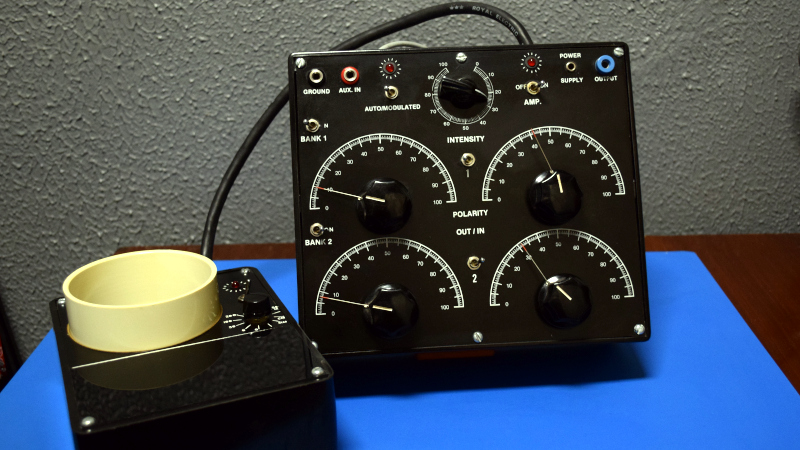
Note: This article is for electronics education, historical context, and critical analysis. A radionic analyzer should not be treated as a medical diagnostic or therapeutic device.
Introduction: When a Mystery Box Meets a Screwdriver
An analog radionic analyzer looks like the kind of device that wants you to whisper around it. There are knobs, switches, jacks, a sample area, a coil or two, and just enough vintage hardware to make the brain say, “Maybe this thing does something.” That, of course, is exactly why it is interesting. A good teardown does not begin with mockery. It begins with curiosity, a screwdriver, a camera, a multimeter, and the humble question: what is actually connected to what?
The title Teardown: Analog Radionic Analyzer sounds like a dive into obscure medical electronics, but the story is richer than that. It touches early 20th-century electrical quackery, the aesthetics of scientific-looking equipment, and the timeless power of a blinking LED to make a box feel important. It is part engineering puzzle, part history lesson, and part warning label for anyone who has ever been dazzled by knobs labeled with impressive words.
Inside the box, the drama is not that we find a hidden miracle. The drama is that we find ordinary parts doing ordinary things while the front panel suggests extraordinary claims. That gap between appearance and function is the real subject of the teardown.
What Is a Radionic Analyzer?
Radionics is a fringe practice built around the claim that living things, diseases, samples, or even remote subjects can be analyzed or influenced through special “frequencies,” “rates,” or energetic patterns. Historically, the idea is associated with Albert Abrams, an American physician whose early 1900s devices were marketed with impressive-sounding electrical language. His systems promised diagnostic and therapeutic powers far beyond what science could support.
That is why radionic devices often look like laboratory equipment while behaving more like props. They borrow the visual grammar of electronics: meters, dials, capacitors, coils, sockets, and polished panels. To a non-specialist, those parts can suggest precision. To an electronics technician, they invite a more grounded question: where is the signal path?
In a legitimate analyzer, such as an impedance analyzer, spectrum analyzer, or LCR meter, there is a clear chain of action. A known signal is generated. The device under test is connected. The response is measured, conditioned, converted, displayed, and calibrated. There are tolerances, reference standards, shielding concerns, and repeatable measurements. In many radionic instruments, by contrast, the story often falls apart once the cover comes off.
The First Look: The Theater of Analog Controls
The analog radionic analyzer has a compelling front-panel personality. It offers knobs that turn with satisfying resistance, toggles that click with authority, and terminals that seem to promise input and output. This matters because human beings trust interfaces. A heavy knob feels more “real” than a flimsy one. A metal case feels more serious than a plastic box. A labeled jack suggests a defined electrical function, even when the wiring behind it is not doing anything measurable in the way the label implies.
This is one of the great lessons of teardown culture: industrial design can create confidence before evidence arrives. The analyzer’s interface is designed to feel intentional. The user is invited to adjust, tune, select polarity, place a sample, and observe. That sequence resembles scientific work, but resemblance is not the same as measurement.
Once opened, the device becomes less mystical and more familiar. The key visible parts include air-variable capacitors, DPDT switches, wiring harnesses, a coil, an intensity potentiometer, indicator LEDs, and a small circuit board. These are real components. The question is not whether the parts exist; the question is whether they form a meaningful analyzer.
Inside the Box: Real Parts, Questionable Purpose
Variable Capacitors: Beautiful, Useful, and Miscast
The most eye-catching components are the variable capacitors. These are not junk. Air-variable capacitors are classic analog parts used in radio tuning, RF matching networks, oscillators, and calibration circuits. Their movable plates allow capacitance to change smoothly as the shaft turns. In the right circuit, they are elegant tools.
In this radionic analyzer, however, the capacitors appear less like members of a disciplined measurement circuit and more like prestigious stage props. They may be wired into banks and routed through switches, but the presence of adjustable capacitance alone does not create an analyzer. A variable capacitor is only meaningful when it participates in a defined circuit: perhaps a resonant LC network, an oscillator, a filter, or a calibrated bridge. Without that context, turning the knob changes an electrical condition, but not necessarily in a useful or interpretable way.
That distinction is crucial. Electronics is full of components that are powerful in the right design and decorative in the wrong one. A violin string belongs in music; stretched randomly across a lunchbox, it is just tension with ambitions.
DPDT Switches: Legitimate Routing, Vague Mission
The double-pole double-throw switches are also legitimate components. A DPDT switch can route two separate circuits between two possible paths. In practical electronics, that can be useful for polarity reversal, signal selection, redundancy, or switching paired lines together. In the analyzer, the switches appear to select between capacitor banks and ground connections, giving the panel a sense of configurable control.
Again, the problem is not that the switching is fake. The switches can be wired correctly and still fail to support the device’s larger claim. A switch is a traffic officer. It can direct cars left or right, but if the road ends in a duck pond, the traffic plan still needs work.
The Coil: A Familiar Symbol of “Energy”
Coils are common in real electronics. They can store energy in magnetic fields, form filters, tune radio circuits, create transformers, or act as inductors in oscillators. They also happen to look magical to people who associate wound wire with invisible forces. In radionic devices, coils often serve a symbolic role: they visually imply broadcast, resonance, vibration, or some other energetic process.
A coil in a box does not prove anything by itself. To understand it, you trace its connections, measure its inductance if needed, examine whether it is part of a resonant network, and observe whether a signal flows through it. In a teardown of this kind, a coil wrapped around a tube or bundled with lamp cord may be physically real but electrically underwhelming.
The LM3909N: The Star of the Blinking Show
One of the most revealing discoveries is the use of an LM3909N or similar LED flasher/oscillator circuit. The LM3909 was designed to flash LEDs with minimal external components, even from low-voltage battery supplies. That makes it a charming chip for indicators, toys, novelty circuits, and low-power flashers.
In the radionic analyzer, the presence of an LED flasher is telling. A blinking light can create the impression of activity. It says, “The machine is thinking.” In reality, a simple flasher only says, “A timing circuit is charging and discharging a capacitor.” That is not useless, but it is not subatomic analysis, remote diagnosis, or energetic broadcasting. It is a light doing its best to look busy.
Does the Analog Radionic Analyzer Actually Analyze?
From an electronics perspective, an analyzer must analyze something. It should compare, measure, detect, quantify, or transform input into meaningful output. The analog radionic analyzer does contain adjustable components, but the teardown evidence points toward a device whose measurable behavior is limited. The LEDs blink. Knobs alter capacitance or routing. Wires and coils may pick up stray noise. An oscilloscope may show low-level interference. But noise is not a result, and a flickering indicator is not a diagnosis.
This is where skeptical electronics becomes wonderfully boring. You do not need dramatic language to evaluate the box. You need continuity tests, voltage checks, component identification, signal tracing, and basic circuit theory. If the device claims to broadcast or detect subtle energies, the circuit should show how energy is generated, modulated, coupled, measured, and interpreted. If it does not, the claim remains marketing vapor wearing a lab coat.
One can be generous and say the analyzer is an adjustable passive network with an LED indicator. One can be less generous and call it a fancy box with theatrical wiring. The kinder version is still not a medical instrument.
Why Devices Like This Are So Persuasive
The analog radionic analyzer works best as an object lesson in persuasion. It shows how a device can borrow credibility from real science without practicing real science. It uses components that belong to legitimate electronics. It uses a panel layout that resembles laboratory control equipment. It uses language that sounds technical enough to discourage simple questions.
This persuasion is especially powerful when the subject is health. People dealing with illness, pain, anxiety, or uncertainty may be more vulnerable to confident claims. A device that appears precise can feel comforting. It offers ritual: place the sample, turn the knob, observe the light, record a “rate.” Ritual can be emotionally satisfying, but medicine and measurement require more than satisfaction. They require evidence.
That is why consumer-protection agencies and medical organizations have historically challenged electrical and frequency-based devices that promise to treat serious conditions without adequate proof. The danger is not only that the device may fail. The danger is that someone may delay proven care while trusting a box that mostly blinks.
Legitimate Electromagnetic Medicine Is Not Radionics
It is important not to oversimplify. Electricity, magnetism, radiofrequency energy, and electromagnetic fields do have legitimate medical uses. Pacemakers, MRI systems, electrosurgery, transcranial magnetic stimulation, certain pulsed electromagnetic field applications, and approved medical devices exist in real clinical contexts. They are designed, tested, regulated, and used for specific indications.
Radionics should not be confused with those fields. The difference is not whether electricity is involved. The difference is whether claims are supported by plausible mechanisms, calibrated output, clinical evidence, safety testing, and regulatory oversight. A device that uses scientific vocabulary is not automatically scientific. A device that uses a coil is not automatically therapeutic. A device that has a knob labeled “intensity” is not automatically controlling anything meaningful.
That distinction is one of the most useful takeaways from the teardown. Skepticism does not mean rejecting all technology. It means asking whether the claims match the circuit.
How to Approach a Teardown Like This
A careful teardown begins before the first screw is removed. Photograph the exterior. Record labels, connectors, switch positions, and any markings. If the device came with a manual, preserve it. Manuals for unusual instruments are often as revealing as the hardware because they explain what the maker wanted users to believe.
Next comes safety. Unknown electronics should be treated with caution, especially if they connect to mains power or contain capacitors. Check for stored charge. Avoid touching conductive areas unnecessarily. Use proper discharge tools, insulated probes, and common sense. Even a dubious device can contain a very real shock hazard.
After that, trace the circuit. Identify the power input. Follow the ground path. Check where each front-panel control goes. Look for active components, voltage regulators, oscillators, amplifiers, sensors, transformers, or microcontrollers. In a genuine analyzer, there should be a coherent path from input to output. In a radionic analyzer, the investigation may reveal disconnected symbolism: controls that change something locally but do not contribute to a meaningful measurement.
A multimeter is the first tool. An oscilloscope is the second. A component tester, LCR meter, and signal generator can help determine whether the box has any repeatable electrical behavior. The goal is not to “disprove magic” with sarcasm. The goal is to document what the hardware does.
What Makers Can Learn From the Analog Radionic Analyzer
For makers and electronics hobbyists, the analog radionic analyzer is strangely educational. It teaches component recognition. It shows how variable capacitors are physically built. It demonstrates switch routing. It offers a glimpse at older LED flasher design. It also illustrates how messy wiring, hot glue, vague grounding, and decorative coils can undermine credibility.
It also teaches ethics. Electronics knowledge gives people power. A person who can build a box with lights and dials can impress non-technical buyers. That power should be used responsibly. Selling a novelty gadget as a novelty is one thing. Selling a device with unsupported health claims is another. The difference is not merely legal; it is moral.
The best makers are not just clever. They are honest about what their creations do and do not do. A blinking LED is delightful. A blinking LED marketed as a disease detector is a problem.
Experience Notes: What a Teardown Like This Feels Like
The experience of examining an analog radionic analyzer is oddly theatrical. At first, the device invites you to believe it has secrets. The knobs feel deliberate. The labels suggest a hidden system. The sample well hints at an interaction between object and instrument. Even if you approach it skeptically, part of you expects a surprise. That is the fun of teardowns: every screw might open a chapter.
Then the cover comes off, and the mood changes. Instead of a dense, carefully engineered system, you may find open space, long wires, a simple PCB, a coil that looks more symbolic than functional, and components arranged with more drama than discipline. There is a moment of disappointment, but it is quickly replaced by fascination. The disappointment says, “That’s it?” The fascination says, “That’s exactly the point.”
Tracing the wiring becomes a conversation with the builder. Every solder joint is a sentence. Every unsupported claim on the panel is tested against the copper behind it. When a switch routes a capacitor bank, you can respect the physical work. When the route leads nowhere analytically useful, you begin to see the difference between construction and engineering. The box was built. That does not mean it was designed to measure what it claimed.
The most memorable part is often the blinking LED. A flashing indicator has a powerful psychological effect. It makes a device feel alive. On the bench, though, the illusion fades. You identify the flasher circuit, recognize the timing components, and realize the “activity” is just a tiny oscillator doing what tiny oscillators do. It is charming in the same way a toy lighthouse is charming. It flashes bravely, but no ships should navigate by it.
There is also a human side to the experience. Devices like this often come from estates, collections, storage rooms, or relatives who are trying to understand what someone spent money on. A teardown can feel like technical archaeology mixed with consumer advocacy. You are not just opening a box; you are opening a claim that may have affected real people. That gives the work weight.
The best approach is patient, respectful, and firm. Respect the object as history. Respect the craft where craft exists. Respect the people who may have believed in it. But do not respect unsupported claims merely because they are old, expensive, or wrapped in polished knobs. The bench is a place where stories meet measurements. When the measurements are thin, the story must be revised.
In that sense, tearing down an analog radionic analyzer is satisfying because it restores proportion. The device becomes smaller, not physically, but intellectually. It stops being a mysterious instrument and becomes a collection of ordinary parts. That is not a loss. It is clarity.
Conclusion: The Box Blinks, But It Does Not Explain Itself
The analog radionic analyzer teardown is more than a look inside an odd device. It is a reminder that technical appearance and technical function are not the same thing. Variable capacitors, DPDT switches, coils, potentiometers, and LED flashers are real electronic components, but real components do not automatically create real analysis.
As an artifact, the radionic analyzer is fascinating. As a piece of electronics, it is limited. As a medical device, it should not be trusted. Its value today is educational: it teaches us how to inspect claims, how to trace circuits, how to separate signal from theater, and how easily a blinking light can impersonate intelligence.
The lesson is simple enough to fit on the front panel: if a machine claims to measure invisible forces, open it up and look for the measurement. If all you find is wiring, capacitors, coils, and a cheerful LED flasher, enjoy the history, document the circuit, and keep your health decisions far away from the sample well.