

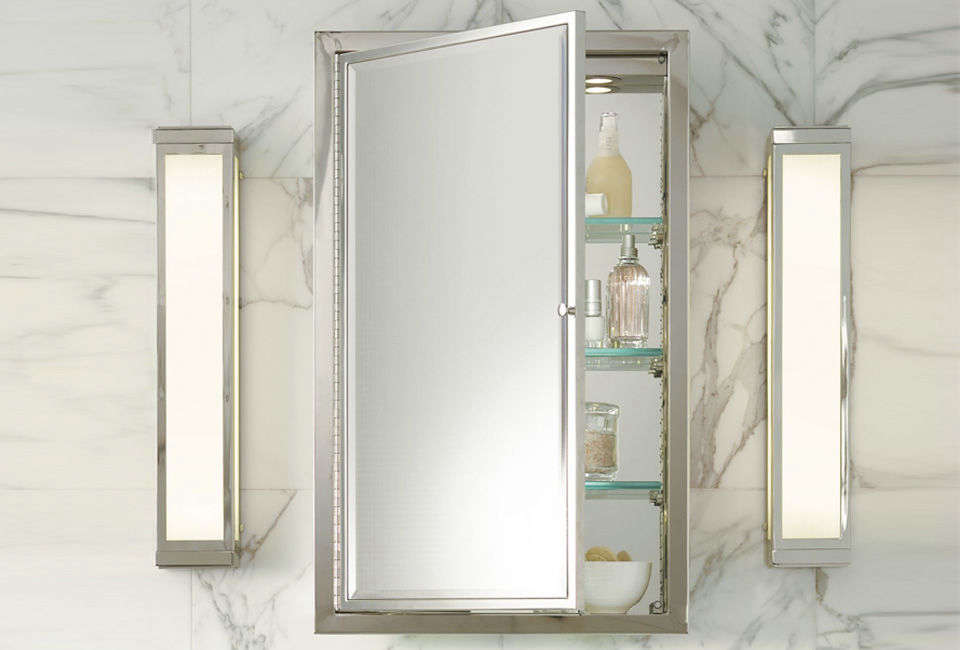
A framed lit inset medicine cabinet is what happens when a bathroom mirror, a storage cabinet, and flattering task lighting finally agree to work together. Installed partly or fully inside the wall, this fixture keeps toiletries within reach without leaving a bulky box hovering above the sink. A decorative frame finishes the edges, while integrated lighting helps with shaving, skin care, makeup, contact lenses, and those early-morning inspections that no one requested.
The phrase “Framed Lit Inset Medicine Cabinet” is also associated with a traditional Restoration Hardware design that became popular for its furniture-like metal frame, exposed hardware, recessed construction, and coordinated bathroom finishes. Although that particular product may be difficult to find today, its basic formula remains highly relevant: hide the storage in the wall, surround the mirror with a handsome frame, and put useful light where your face actually is.
Modern versions range from restrained, vintage-inspired cabinets to feature-packed LED models with dimming, anti-fog glass, interior outlets, USB charging, adjustable shelves, and soft-close doors. The trick is choosing features that improve your routine rather than turning the bathroom mirror into mission control.
What Is a Framed Lit Inset Medicine Cabinet?
A framed lit inset medicine cabinet is a mirrored storage cabinet installed within a framed wall opening. “Inset” generally means the cabinet box sits inside the wall cavity, while the door, mirror, and decorative frame remain visible. This is also commonly described as a recessed medicine cabinet.
The “lit” portion may refer to integrated LED strips around the mirror, illuminated side columns, a lighted frame, or internal lighting that turns on when the door opens. The frame can be made from aluminum, stainless steel, brass-finished metal, painted steel, or moisture-resistant wood.
How It Differs From a Surface-Mount Cabinet
A surface-mount medicine cabinet attaches directly to the finished wall. It is usually easier to install because the wall does not need to be opened, but the cabinet projects several inches into the room. In a narrow bathroom, that projection can feel surprisingly largeespecially when someone opens the door while another person is leaning over the sink.
An inset medicine cabinet requires more preparation. The installer must confirm that the wall cavity is deep enough and free from plumbing, electrical cables, vents, or structural obstacles. Once installed correctly, however, the cabinet has a cleaner profile and looks more like a framed mirror than a storage box.
Why This Design Still Works
It Provides Storage Without Visual Bulk
Bathroom countertops attract clutter with the enthusiasm of a refrigerator door collecting magnets. Toothpaste, moisturizers, razors, medicine bottles, cotton swabs, and six nearly empty hair products can quickly turn a calm vanity into a tiny drugstore clearance aisle.
A recessed medicine cabinet uses otherwise empty wall space to store those items. Because most of the cabinet sits between the studs, the room retains a more open appearance. This is particularly useful in powder rooms, apartment bathrooms, narrow primary baths, and any space where a deep wall cabinet would feel intrusive.
It Combines Three Bathroom Essentials
A well-designed framed lighted medicine cabinet functions as a mirror, storage unit, and task light. Combining those elements can simplify the wall above the vanity and reduce the need for separate accessories.
Integrated lighting is especially helpful when it appears along the sides of the face rather than only above the head. Overhead lighting can produce shadows around the eyes, nose, and chin. Vertical or perimeter lighting generally creates a more even view for grooming, although the cabinet should not automatically be treated as the room’s only light source.
It Can Fit Traditional or Modern Bathrooms
The word “medicine cabinet” may summon memories of a rattling metal box with three shelves and one door that never quite closed. Current framed designs are considerably more polished. A slim black frame works in contemporary bathrooms, warm brass suits transitional interiors, chrome complements classic plumbing fixtures, and a wood frame can soften a modern space.
The original framed lit inset style was appealing because it looked architectural rather than purely utilitarian. Visible hinges, metal borders, and coordinated finishes gave it the character of a permanent fixture instead of an afterthought screwed to the drywall.
Important Features to Compare
Cabinet Size and Rough Opening
Do not select a medicine cabinet by mirror dimensions alone. The visible frame, cabinet box, and required wall cutout may all have different measurements. Review the manufacturer’s specification sheet for the exact rough-opening width, height, and depth.
Common single-door sizes are approximately 16 to 24 inches wide and 24 to 36 inches tall, while wider two- and three-door cabinets can span a double vanity. The best width usually relates to the vanity and sink rather than simply filling every available inch of wall.
A cabinet that is slightly narrower than the vanity often looks balanced. For a double vanity, homeowners may choose one wide cabinet or two matching cabinets centered over individual sinks. Two cabinets create symmetry and separate storage, while one large unit provides a broader uninterrupted mirror.
Wall Depth
Many recessed cabinet boxes are close to four inches deep, although dimensions vary. Standard interior walls may provide enough room, but older homes, masonry walls, shallow partitions, and walls containing plumbing can complicate installation.
Measure the actual cabinet boxnot the front frameand inspect the proposed wall before ordering. Discovering a plumbing vent after the cabinet arrives is an excellent way to add suspense to a bathroom renovation, but not the enjoyable kind.
Lighting Quality
Look beyond the word “LED.” Useful specifications include brightness, dimming range, color temperature, color-rendering performance, controls, and whether the light is replaceable or integrated permanently into the fixture.
A color temperature around 2700K to 3000K creates a warm, comfortable appearance. Lighting near 3500K to 4000K looks cleaner and more neutral. Tunable-white cabinets allow users to switch between warmer and cooler settings. This can be practical when one person wants a relaxed evening glow and another wants bright grooming light that reveals every missed patch of shaving cream.
A high Color Rendering Index, often listed as CRI 90 or higher, can help skin tones, cosmetics, clothing, and finishes appear more natural. Even lighting across the face is generally more valuable than an extremely bright strip that creates glare.
Anti-Fog Function
Some LED medicine cabinets include a heated demister pad behind part of the mirror. When activated, it warms the glass enough to reduce condensation after a shower. This feature is convenient, but the demisted area may cover only a portion of the mirror.
Check whether the defogger operates independently from the light. Separate controls prevent the heating element from running whenever illumination is used, which is more efficient and gives the user better control.
Interior Outlets and Charging Ports
An interior electrical outlet can keep a rechargeable toothbrush, shaver, or trimmer plugged in while hidden from view. Some cabinets also offer USB ports. This is one of those small conveniences that becomes strangely difficult to surrender once experienced.
Electrical components in a bathroom must be installed according to applicable codes and the manufacturer’s instructions. Hardwired lighting, internal receptacles, and nearby water sources make professional electrical work a sensible investment. Local requirements can vary, so a licensed electrician should confirm circuit protection, grounding, switch placement, and permitted outlet locations.
Door Swing and Hinges
Confirm whether the door can be configured for left-hand or right-hand opening. Reversible installation is useful, but it should not be assumed. The open door must clear faucets, sconces, side walls, shelves, and nearby cabinet doors.
Soft-close hinges reduce slamming, while wide-opening hinges provide better access to the interior. Mirrored door backs and mirrored cabinet interiors allow the open door to function as an additional viewing angle, which can be useful for styling hair or checking the side of the face.
Adjustable Shelves
Tempered-glass shelves resist moisture and make spills easier to spot. Adjustable shelves are preferable because bathroom products rarely cooperate by arriving in matching heights. Measure tall bottles, electric toothbrushes, and grooming devices before deciding how many shelves are truly useful.
More shelves do not always mean more storage. Closely spaced shelves may create a collection of narrow compartments that fit dental floss beautifully but reject everything else.
Choosing the Right Frame Finish
The frame should relate to the bathroom’s broader finish palette, but it does not need to match every piece of hardware exactly. A thoughtful mix often looks more collected than a room where the faucet, towel ring, cabinet pull, shower trim, mirror, and wastebasket appear to have joined the same marching band.
Polished Chrome
Chrome reflects light and works well with traditional, Art Deco, and clean contemporary bathrooms. It pairs naturally with white tile, marble, cool gray finishes, and classic cross-handle faucets. Fingerprints and water spots may be more visible, so occasional polishing is part of the relationship.
Brushed Nickel or Stainless Steel
Brushed finishes are forgiving, versatile, and easy to coordinate. They suit transitional bathrooms and busy family spaces where no one wishes to polish the mirror frame before breakfast.
Matte Black
A black frame creates strong contrast against light tile or painted walls. It can give a recessed medicine cabinet the appearance of a slim picture frame. Repeating black elsewhere through lighting, hardware, or shower trim helps the choice feel intentional.
Brass and Bronze Tones
Warm metals add character and complement cream tile, natural stone, dark wood, and saturated wall colors. Compare samples in the actual bathroom because “brass” can range from pale champagne to deep antique gold.
Wood
A wood-framed medicine cabinet can resemble custom millwork and works especially well in vintage, craftsman, coastal, or furniture-inspired bathrooms. The finish must tolerate humidity, and edges should be sealed carefully to prevent swelling or discoloration.
Planning the Installation
Inspect the Wall Before Buying
Use appropriate detection tools and make a small exploratory opening when necessary to determine what is inside the wall. The desired location must be checked for studs, wiring, supply lines, drain lines, vent pipes, ductwork, and structural framing.
A recessed cabinet normally needs a rectangular framed opening. If a stud crosses the center of the proposed location, the opening may require new headers and blocking. Altering framing should be handled carefully, particularly when the wall may be load-bearing.
Coordinate Electrical Work Early
A lighted cabinet should be selected before rough electrical work is completed. Different models may require wiring at the top, side, rear, or a designated junction-box location. Guessing the wire location can result in patched drywall and language unsuitable for a family bathroom.
Decide whether the light will use a wall switch, touch control, motion sensor, or combination of controls. Also determine whether the cabinet needs constant power for a clock, memory function, outlet, or defogger.
Set a Comfortable Height
The cabinet should serve the people using the room while remaining visually aligned with the vanity. Consider the heights of the shortest and tallest regular users, the faucet, backsplash, countertop, ceiling, and any lighting fixtures.
Before cutting the wall, outline the full cabinet and mirror dimensions with painter’s tape. Stand at the vanity, open an imaginary door, and check sightlines. This inexpensive rehearsal catches many placement mistakes before they become rectangular holes.
Test the Door Clearance
A framed door may project farther than a frameless one. Confirm that it can open without striking a side wall, pendant, sconce, towel bar, or neighboring cabinet. For double installations, ensure the two doors do not collide.
Potential Drawbacks
The main disadvantage is installation complexity. A surface-mounted cabinet can sometimes be installed in an afternoon. An inset lighted medicine cabinet may involve demolition, framing, drywall repair, wiring, painting, caulking, and coordination among several trades.
Integrated LEDs are another consideration. They can last for years, but replacing a proprietary driver or light strip may be harder than replacing a standard bulb. Review the warranty and ask whether electrical components are serviceable.
Highly reflective interiors show toothpaste spots, fingerprints, and dust with remarkable honesty. Fortunately, glass shelves and aluminum interiors are usually easy to wipe clean. Less fortunately, they continue to require someone to do it.
Finally, built-in technology can age faster than the cabinet itself. Touch screens, speakers, clocks, and connectivity features may be exciting, but simple lighting, good hinges, replaceable parts, and durable construction often deliver more long-term value.
How to Style a Framed Lit Inset Medicine Cabinet
Allow the frame to relate to at least one other element in the room. A brass frame may echo the faucet or sconces; a black frame may connect with the shower enclosure; a wood frame may coordinate with the vanity.
Keep surrounding lighting visually simple if the cabinet already has illuminated edges. Decorative sconces can still work, but crowded fixtures may make a small wall feel busy. In larger bathrooms, recessed ceiling lights or a modest ceiling fixture can provide ambient illumination while the cabinet supplies focused task lighting.
Tile can run behind or around the cabinet frame. Planning the rough opening with the tile layout helps avoid tiny slivers at the edges. When the cabinet is installed over painted drywall, a carefully caulked perimeter gives the frame a built-in appearance.
Real-World Experience: What Living With One Is Like
The most noticeable benefit is not the lighting or even the polished frame. It is the disappearance of daily clutter. In a typical bathroom, frequently used products remain on the counter because putting them in a vanity drawer feels inconvenient. A medicine cabinet changes that behavior because the storage is directly behind the mirror. Open the door, take the item, close the doorcivilization restored.
Adjustable shelves become important almost immediately. A sensible arrangement might reserve the lower shelf for everyday dental and skin-care products, the middle for medicines and first-aid supplies, and the upper shelf for less frequently used items. Tall products usually need one generous compartment rather than several narrow shelves. Owners who arrange the shelves before loading the cabinet tend to use the space more effectively than those who simply begin stacking bottles and hope for architectural cooperation.
Integrated side lighting is especially pleasant on dark mornings. Unlike a bright ceiling light that announces the start of the day with the subtlety of an airport runway, dimmable mirror lighting can provide enough visibility without flooding the entire room. A warm setting works well at night, while a brighter neutral setting is more useful for shaving or applying makeup.
The anti-fog feature tends to feel optional during shopping and essential after the first hot shower. It is most useful when activated shortly before or during the shower. Users should remember that many demister pads clear only a central section, so the entire mirror may not become instantly spotless.
An interior outlet creates another small but meaningful improvement. Charging devices disappear behind the door, cords leave the countertop, and the vanity looks more organized. The experience is best when the shelf arrangement leaves enough room around plugged-in devices and prevents cords from being pinched by the door.
Installation day is where enthusiasm meets reality. A wall that appears empty may conceal a vent stack, electrical cable, horizontal blocking, or oddly spaced studs. In remodeling projects, experienced installers often inspect the wall before the cabinet is ordered or before tile work begins. That sequence avoids purchasing an expensive cabinet that cannot occupy the intended location without major changes.
Weight also surprises many homeowners. A large cabinet with multiple mirrored doors, glass shelves, aluminum construction, and electrical components can be awkward to lift. Removing the doors and shelves during installation may reduce the load if the manufacturer permits it. The cabinet must sit level and square; otherwise, door gaps may look uneven or hinges may not operate properly.
Once installed, the framed design generally feels more finished than a basic recessed mirror. The visible border creates definition, particularly against patterned tile or a strongly colored wall. Traditional metal frames develop the character of bathroom hardware, while thin modern frames almost disappear.
Cleaning is straightforward but frequent. Mirror edges near touch controls collect fingerprints, and the interior mirror reveals product residue that a dark cabinet might politely conceal. A soft microfiber cloth and mirror-safe cleaner usually handle the job. Abrasive products should be avoided on metal finishes, coated glass, and touch-control areas.
Long-term satisfaction usually depends on choosing durable fundamentals. Owners may enjoy Bluetooth audio or a digital weather display for a while, but they interact with the hinges, shelves, mirror, frame, and lighting every day. Smooth doors, reliable dimming, accessible storage, even illumination, and serviceable electrical parts matter more than a feature list long enough to require its own instruction manual.
For couples sharing a vanity, separate cabinets can reduce morning negotiations. Each person receives designated shelves, separate mirrors, and independent door access. One wide cabinet provides a grander visual effect, but opening a large mirrored door may temporarily block the other user’s reflection. Neither arrangement is universally better; the right one depends on routines, wall space, and whether the household prefers shared storage or clearly defended territory.
The strongest overall impression is that a framed lit inset medicine cabinet makes a bathroom feel intentionally designed. It hides practical storage behind an attractive mirror, places light where it is most useful, and saves space without demanding attention. Done well, it is the rare bathroom upgrade that looks elegant while quietly holding toothpaste, bandages, and the moisturizer someone bought because the label contained the word “radiance.”
Final Verdict
A framed lit inset medicine cabinet is an excellent choice for homeowners who want concealed storage, useful task lighting, and a polished focal point above the vanity. It is particularly valuable in smaller bathrooms, where wall depth can provide storage without sacrificing walking space.
Before purchasing, verify the rough opening, wall depth, door swing, electrical requirements, lighting specifications, frame finish, and replacement-part availability. Choose strong everyday featuresadjustable shelves, quality hinges, dimmable high-quality light, durable materials, and convenient interior powerbefore paying extra for technology that may not improve the routine.
Installation is more involved than hanging a standard mirror, but the finished result can look cleaner, function better, and keep the countertop remarkably civilized. That is a respectable achievement for an object primarily responsible for hiding floss and cold medicine.
Note: Product specifications, availability, electrical codes, and installation requirements vary by manufacturer and location. Confirm current documentation before ordering, and use qualified professionals for structural or electrical work.