

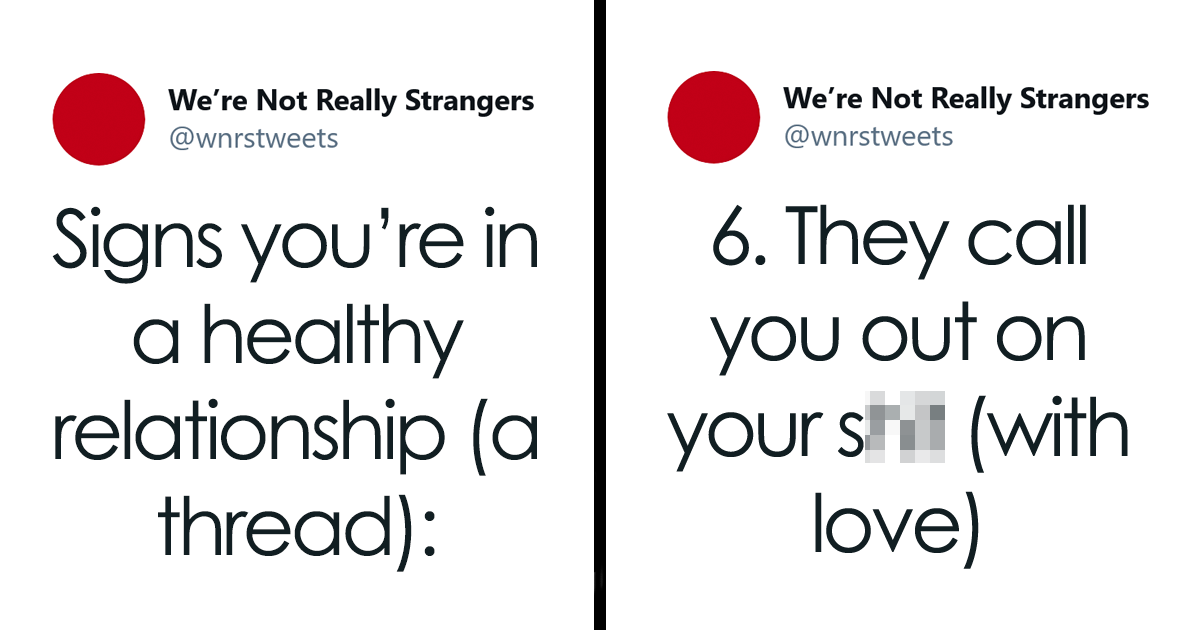
A viral tweet about healthy relationships did what the internet occasionally does best: it took something complicated, emotional, and slightly terrifying, then turned it into a simple checklist people could actually understand before finishing their coffee. The thread, shared by We’re Not Really Strangers, listed 11 signs that suggest a relationship is not just surviving, but actually good for the people in it.
And no, a healthy relationship is not one where nobody ever disagrees, nobody ever gets moody, and everyone communicates like a therapist with excellent lighting. Real relationships include awkward talks, bad timing, forgotten errands, emotional “I’m fine” moments, and at least one argument about where to eat. The difference is how two people treat each other through all of that.
The best healthy relationship signs are often surprisingly ordinary. You feel safe being honest. You can bring up your needs without preparing a courtroom defense. You do not need to decode someone’s mood like a secret government file. You grow, laugh, disagree, repair, and still feel like yourself.
Below are 11 indications of a healthy relationship inspired by that viral tweet, expanded with real relationship wisdom from psychologists, therapists, relationship educators, and everyday human experience.
1. Their Feelings Are Clear, Not A Mystery Puzzle
One of the first signs of a healthy relationship is emotional clarity. You are not constantly asking, “Do they like me, tolerate me, or are they just bored on a Tuesday?” Their care shows up in words, behavior, consistency, and effort.
Healthy love does not require detective work. Of course, no one communicates perfectly every second of the day. People get busy, tired, stressed, and occasionally weird because they skipped lunch. But in a solid relationship, the overall pattern is clear: they care, they show up, and they do not make you feel foolish for wanting reassurance.
What this looks like in real life
They tell you how they feel. They follow through. They do not disappear whenever things get serious. If they need space, they communicate it instead of leaving you to invent 47 dramatic explanations in your head.
2. You Love The Reality, Not Just The Potential
A relationship can look amazing in your imagination. In your head, they become more attentive, more honest, more emotionally available, and suddenly develop a passion for cleaning up after themselves. Lovely fantasy. Unfortunately, dating someone’s “future version” is like buying a house because the brochure says it might someday have walls.
A healthy relationship is one where the present version feels good enough to live in. You may still have goals, growth areas, and dreams together, but you are not surviving on the idea that everything will become wonderful once the other person changes completely.
Ask yourself: Do I enjoy who we are now? Or am I emotionally invested in a version of this relationship that does not actually exist yet?
3. Conflict Feels Constructive, Not Destructive
Healthy couples, friends, and partners disagree. The goal is not to avoid conflict forever; that would require either telepathy or one person silently swallowing every opinion until they emotionally turn into a houseplant.
The real sign of relationship health is whether conflict becomes a bridge or a wrecking ball. Constructive conflict focuses on the issue. Destructive conflict attacks the person. Constructive conflict says, “I felt hurt when that happened.” Destructive conflict says, “You always ruin everything.” See the difference? One invites repair. The other invites someone to mentally pack a suitcase.
Healthy conflict includes:
- Listening without planning a dramatic comeback
- Taking breaks when emotions get too heated
- Apologizing without adding “but you made me”
- Looking for solutions instead of scoring points
4. The Relationship Feels Good In Normal Circumstances
Some relationships only feel good on vacation, after a grand apology, during a perfect date night, or when nobody is under pressure. That is not necessarily stability; that is emotional Wi-Fi with one bar.
A healthy relationship does not require perfect conditions to feel safe. It can still feel warm on a regular weekday, during errands, while making dinner, or when both people are tired and wearing their least impressive sweatpants.
This does not mean every moment is magical. It means the relationship has a steady foundation. You do not need constant drama, expensive plans, or big romantic gestures to feel connected. Ordinary life is allowed to be ordinary, and somehow, that is where the relationship proves itself.
5. You Do Not Have To Hide Your Needs To Keep The Peace
If you feel like asking for basic respect will “start a fight,” that is not peace. That is emotional tiptoeing. In a healthy relationship, you can express needs, limits, hopes, and concerns without fearing punishment, mockery, or withdrawal.
Healthy communication includes saying things like, “I need more consistency,” “I felt ignored earlier,” or “I need time to myself tonight.” These statements are not attacks. They are maintenance. Relationships, like cars and houseplants, do better when people notice problems before smoke starts coming out.
Your needs should not have to shrink so the relationship can survive. A healthy connection has room for both people’s feelings.
6. They Can Call You Out With Love
A good partner or close friend does not blindly approve every choice you make. Sometimes, love sounds like, “I care about you, but that was not okay.” The key phrase is “with love.”
Being called out in a healthy relationship does not feel like humiliation. It feels like accountability wrapped in care. The person is not trying to win, shame you, or make themselves superior. They are helping you see something because they believe you can do better.
Healthy accountability sounds like:
- “I know you were upset, but that comment hurt me.”
- “I support you, but I do not think this choice matches your values.”
- “Can we talk about what happened instead of pretending it did not?”
It is not always comfortable. Growth rarely arrives wearing fuzzy slippers. But when accountability is kind, specific, and respectful, it strengthens trust instead of damaging it.
7. Your Growth Is Celebrated, Not Criticized
A healthy relationship gives you room to grow. Your partner does not act threatened because you found a new hobby, set a new goal, made new friends, or started becoming more confident. They do not treat your growth like an unpaid betrayal.
Instead, they cheer you on. They may not understand every dream you have, but they respect that it matters to you. Maybe they do not care deeply about your pottery class, coding project, gym routine, or new interest in making homemade pasta. Still, they care that you care.
Healthy love does not demand that you stay small so someone else can feel secure. It says, “Go become more yourself. I will be here, clapping slightly too loudly.”
8. You Like Who You Are Around Them
This one might be the quietest sign, but it is powerful. In a healthy relationship, you like your own reflection in the connection. You are not constantly anxious, defensive, jealous, dishonest, or smaller than usual. You feel more grounded, more honest, and more yourself.
Pay attention to the version of you that appears around someone. Do you become calmer? Kinder? More confident? More playful? Or do you become someone you barely recognize?
A healthy relationship will not magically fix every insecurity. That job is too big for another human being and frankly unfair to assign. But it should create a space where your better qualities have room to breathe.
9. Compromise Does Not Cost You Your Character
Every relationship requires compromise. You may watch a movie you would not choose, visit family when you would rather nap, or agree to a restaurant that serves kale with suspicious enthusiasm. That is normal.
But healthy compromise does not ask you to abandon your values, identity, friendships, goals, or self-respect. There is a major difference between adjusting and disappearing.
A healthy compromise says, “Let’s find a solution that respects both of us.” An unhealthy compromise says, “One person gets comfort, and the other person gets erased.”
Ask yourself:
- Can I still be honest about what matters to me?
- Do I feel pressured to violate my values?
- Are both people making adjustments, or just one?
If compromise consistently feels like self-betrayal, it is time to look closely at the pattern.
10. They Make You Feel Loved Even When You Feel Unlovable
Everyone has difficult days. Some days you feel charming and emotionally balanced. Other days you feel like a rejected raccoon in a hoodie. A healthy relationship does not depend on you being perfectly confident all the time.
When you feel insecure, sad, stressed, or embarrassed, a caring person does not use that vulnerability against you. They do not mock your feelings or act annoyed that you are human. They offer steadiness. They remind you that one hard day does not define you.
This kind of love is not about rescuing someone from every uncomfortable feeling. It is about being present without making the person feel like a burden.
11. You Feel Safe Being Fully Yourself
The final sign ties the whole list together: emotional safety. In a healthy relationship, you can be honest, silly, serious, ambitious, uncertain, excited, quiet, and imperfect. You do not feel like you are constantly auditioning for affection.
Emotional safety means your boundaries matter. Your voice matters. Your “no” matters. Your privacy, friendships, dreams, and opinions are respected. You are not controlled, belittled, isolated, or treated like a project.
That does not mean the other person agrees with everything you say or does everything you want. It means disagreements happen inside a container of respect.
Why The Viral Tweet Resonated With So Many People
The reason this viral tweet spread so widely is simple: people are hungry for plain-language signs of healthy love. Relationship advice often gets buried under dramatic dating rules, hot takes, and suspiciously confident people saying things like “never text first.” But the tweet focused on emotional experience. How does the relationship feel? Does it bring out honesty, growth, security, and peace?
That approach matters because many unhealthy patterns can look exciting at first. Intensity can be mistaken for love. Jealousy can be mislabeled as passion. Constant ups and downs can feel meaningful when they are really exhausting. A healthy relationship may feel less like fireworks every five seconds and more like finally being able to exhale.
Healthy does not mean boring. It means stable enough for joy to last.
Green Flags That Support These 11 Signs
Beyond the tweet, relationship educators often point to several core green flags: mutual respect, trust, honest communication, independence, equality, kindness, healthy conflict, and shared responsibility. These qualities work together like the behind-the-scenes crew of a good relationship. You may not always notice them dramatically, but without them, the whole production gets chaotic fast.
For example, trust helps emotional clarity feel believable. Boundaries make safety possible. Communication turns conflict into problem-solving. Kindness keeps hard moments from becoming cruel. Independence allows both people to remain whole, not glued together like two overcooked noodles.
When these elements are present, love becomes less about guessing and more about building.
Healthy Relationship Experiences: What These Signs Feel Like In Everyday Life
In real life, healthy relationships often reveal themselves in small, ordinary moments rather than movie-style speeches in the rain. One common experience is the relief of not having to over-explain your feelings. You say, “That bothered me,” and the other person does not immediately turn it into a debate tournament. They may ask questions. They may need time to understand. But they do not punish you for being honest.
Another experience is the comfort of consistency. You do not have to wonder which version of the person will show up today. Their mood may change, because everyone has moods, but their respect does not vanish. That consistency creates emotional breathing room. You stop spending all your energy monitoring the relationship and start actually enjoying it.
Healthy relationships also tend to make growth feel less lonely. Imagine telling someone, “I want to apply for a new job,” “I want to go back to school,” or “I want to change something about my life.” In a supportive relationship, the response is not jealousy, sarcasm, or subtle discouragement. It is curiosity. It is encouragement. It is sometimes practical help, like reviewing an application, making dinner while you study, or simply saying, “I believe in you,” at the exact moment your confidence decides to leave the building.
There is also the experience of peaceful independence. You can spend time with friends, enjoy hobbies, or take quiet time without the other person assuming it means rejection. This is huge. A healthy relationship does not require 24/7 emotional attendance. Both people can have full lives and still choose each other with warmth.
Conflict feels different too. In unhealthy patterns, arguments can feel like a storm with no shelter. In healthier ones, conflict may still be uncomfortable, but there is a shared understanding that the relationship is not a battlefield. You can pause, breathe, come back, apologize, explain, and repair. Nobody needs to “win” by making the other person feel small.
One of the most underrated experiences is laughter. Not performative, social-media-ready laughter, but regular, ridiculous, kitchen-counter laughter. The kind that happens when plans go wrong, someone mispronounces a word, or both people realize they are arguing about something completely unnecessary. Humor does not solve every problem, but it helps people stay human with each other.
Finally, a healthy relationship often feels like becoming more honest with yourself. You notice what you need. You recognize what you value. You learn how to apologize better, ask better questions, set clearer boundaries, and accept love without constantly questioning whether you deserve it. That is the quiet magic of a good connection: it does not complete you like a missing puzzle piece. It helps you remember that you were already a whole person, and now you have someone beside you who treats that wholeness with care.
Conclusion
The 11 indications from the viral tweet are not a rigid exam where your relationship must score 100 percent or be thrown into the emotional recycling bin. They are reflection points. They help you notice whether a connection is rooted in clarity, safety, respect, growth, honesty, and care.
A healthy relationship is not perfect. It is not conflict-free. It is not always photogenic. But it should feel emotionally safe more often than not. You should be able to speak honestly, grow freely, laugh naturally, disagree respectfully, and remain yourself.
If someone’s presence makes you feel calmer, braver, kinder, and more at home in your own life, that is worth noticing. And if you are building that kind of relationship with someone, do not take it for granted. Appreciate it, protect it, and keep doing the small things that make love feel safe in the first place.