

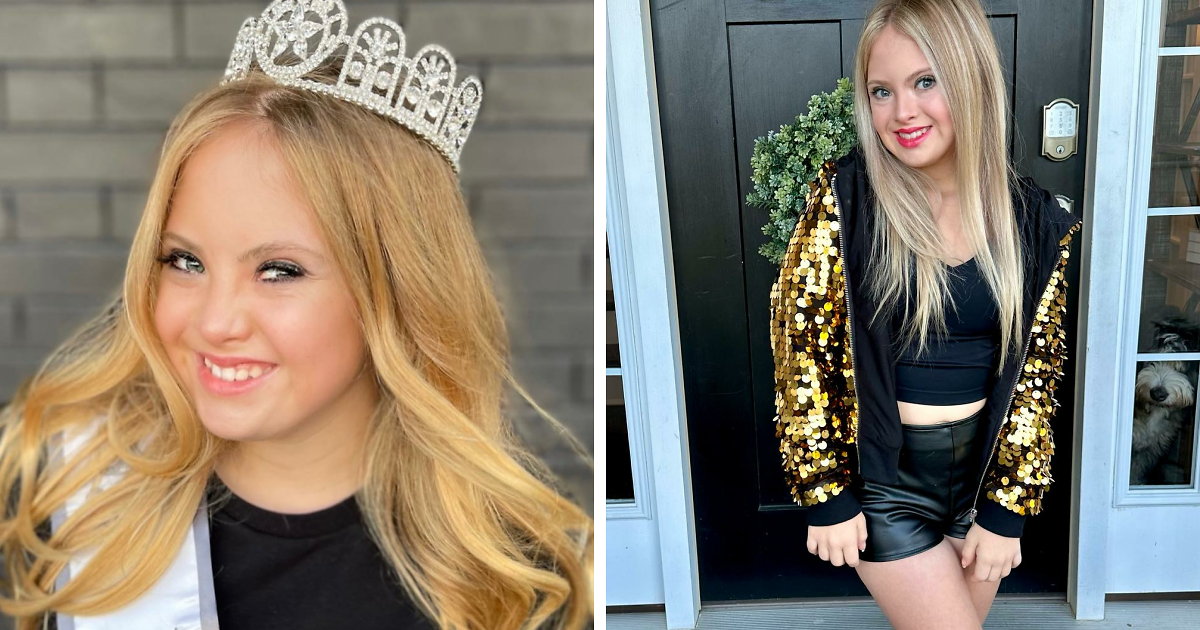
Every so often, a story walks onto a stage wearing heels, a sash, and the kind of confidence that makes the room sit up straighter. Kayla Kosmalski’s story is one of those moments. When the Middletown, Delaware teen was crowned Miss Delaware Teen USA 2024, she did more than win a title. She became the first contestant with Down syndrome to earn the crown, turning a state pageant into a national conversation about inclusion, ambition, beauty, and what happens when young people are given room to shine.
Kayla’s achievement matters because it is not a feel-good headline with a glittery bow slapped on top. It is the result of years of persistence, family support, public advocacy, school involvement, and a teenager who loves the stage enough to keep coming back. She had competed before. She had practiced. She had grown. And when her moment came, she owned it with grace, charm, and a smile powerful enough to make cynicism take a coffee break.
For readers searching for the story behind the headline “High School Student Breaks Barriers As First Miss Delaware Teen USA With Down Syndrome,” the heart of it is simple: Kayla Kosmalski did not ask the world to lower the bar. She stepped up to it, reached for it, and reminded everyone watching that inclusion is not charity. Inclusion is opportunity.
Who Is Kayla Kosmalski?
Kayla Kosmalski is a Delaware student, cheerleader, competitive swimmer, model, actress, disability advocate, and pageant titleholder. At the time of her Miss Delaware Teen USA win, she was a senior at Middletown High School, a school located in the growing community of Middletown, roughly south of Wilmington. Her biography reads like a calendar that forgot how to say no: school, pageant preparation, cheerleading, swimming, public appearances, advocacy, interviews, and community events.
But the most important thing to understand about Kayla is not her diagnosis. It is her drive. Down syndrome is part of her life, but it is not the entire story. Kayla has spent years showing that young people with disabilities can lead, compete, perform, study, advocate, and dream big in public. Her platform centers on acceptance and inclusion for people with disabilities, a message she has carried from local stages to national attention.
She began competing in pageants when she was just five years old. That early start matters. Pageant success is not just about a pretty dress or a well-timed wave. It involves interview skills, stage presence, discipline, confidence, preparation, and the ability to keep smiling even when the lights are hot enough to make your mascara consider early retirement.
A Historic Win in the First State
Kayla was crowned Miss Delaware Teen USA 2024 at the Laird Performing Arts Center at the Tatnall School. The title was especially meaningful because it came during her second time competing for the crown. That detail makes the story even better. She did not simply appear and magically win. She returned, improved, and proved that perseverance can be just as glamorous as a crown.
Her win made history because she became the first contestant with Down syndrome to win Miss Delaware Teen USA. In a pageant world often associated with narrow ideas of beauty, polish, and perfection, Kayla’s victory widened the lens. It showed that beauty can include difference, confidence can include vulnerability, and excellence can come from people who have too often been underestimated.
The Miss Delaware USA organization described her journey as inspiring and barrier-breaking. Her state director, Vincenza Carrieri-Russo, also emphasized that Kayla was representing more than herself. She was standing for people with Down syndrome and others who may be afraid to step outside their comfort zones. That is the larger message: when one person gets through a door, others begin to imagine themselves walking through it too.
Why This Moment Matters for Disability Inclusion
Down syndrome is the most common chromosomal condition diagnosed in the United States. According to the Centers for Disease Control and Prevention, thousands of babies are born with Down syndrome in the U.S. each year, and people with Down syndrome have different talents, strengths, personalities, and support needs. In other words, there is no single way to be a person with Down syndrome, just as there is no single way to be a teenager, a student, a performer, or a leader.
That is why Kayla’s visibility matters. Representation is not a decorative extra. It shapes expectations. A child who sees Kayla on stage may think, “Maybe I can do that.” A parent may think, “Maybe my child’s future is bigger than what I was told.” A school leader may think, “Maybe our programs should create more chances for participation.” Even a skeptical stranger may quietly reconsider what they assumed about disability.
Inclusion also changes the people doing the including. When schools, pageants, sports teams, theaters, and workplaces welcome people with disabilities as full participants, they become more creative and more human. They learn to value communication, flexibility, preparation, patience, humor, and courage. Those are not “special needs” values. Those are everyone-needs values.
From Local Crown to National Stage
After winning Miss Delaware Teen USA, Kayla advanced to represent Delaware at Miss Teen USA 2024. That national appearance made her the first contestant with Down syndrome to compete at Miss Teen USA. She did not win the national crown, but she received the Miss Congeniality award, an honor voted on by fellow contestants and often seen as a reflection of kindness, warmth, and the ability to connect with others.
Miss Congeniality was a fitting recognition. Kayla’s public message has never been about proving she is better than anyone else. It has been about showing that people with Down syndrome belong everywhere: in classrooms, on teams, in pageants, on college campuses, in careers, in media, and on stages where dreams are allowed to look a little sparkly.
Her national pageant experience also helped shift the story from “first” to “future.” Firsts are important, but they should not remain rare. The real goal is a world where the next contestant with Down syndrome is celebrated for her talent without everyone acting as if the stage itself might collapse from the radical idea of inclusion.
Kayla’s Advocacy Started Long Before the Crown
One reason Kayla’s pageant story has resonated so widely is that she was already an advocate before she became a titleholder. She and her family were connected to advocacy around the ABLE Act, a major law that allows eligible people with disabilities to save money in tax-advantaged accounts without automatically losing access to certain public benefits. In Delaware, the original legislation was known as Kayla’s Law.
That detail gives her crown deeper meaning. Kayla was not simply handed a platform after winning; she had already been using her voice. Her advocacy touches on financial independence, disability rights, public awareness, and the everyday dignity of being seen as capable. The crown amplified her message, but the message was already there.
ABLE accounts matter because many people with disabilities and their families face complicated financial rules. Saving for education, housing, transportation, health needs, technology, or future independence should not require a person to risk essential supports. Kayla’s connection to this issue helps connect the sparkle of pageantry to the substance of policy.
Breaking Beauty Standards Without Breaking Herself
The phrase “redefining beauty standards” can sound like something printed on a tote bag, but Kayla’s story gives it real weight. Traditional pageant culture has often rewarded a narrow version of beauty: polished, symmetrical, controlled, and familiar. Kayla’s win expands that definition without asking her to become someone else.
She brings her own energy to the stage. She is expressive, joyful, determined, and direct. She talks openly about confidence and about wanting people with Down syndrome to know they can do anything. That kind of self-belief is not manufactured. It is built over years of therapy, practice, encouragement, setbacks, and the stubborn decision to keep showing up.
There is also something refreshing about a teenager whose message is both simple and powerful: be kind, dream big, and do not let Down syndrome hold you back. It is not complicated, but it is hard to ignore. Sometimes the most effective advocacy does not arrive in a 40-page policy paper. Sometimes it arrives in a sash.
The Role of Family, School, and Community Support
No barrier-breaking student gets there alone. Kayla’s journey reflects the importance of family encouragement, inclusive school opportunities, community visibility, and mentors who understand that support is not the same thing as limitation. Her parents, teachers, coaches, pageant organizers, and peers all helped create an environment where her ambitions could grow.
For high school students with disabilities, support can take many forms. It may include speech therapy, physical therapy, academic accommodations, transportation help, social opportunities, accessible activities, or simply adults who say, “Yes, let’s try,” instead of “No, that sounds too hard.” That “yes” can change a life.
Kayla’s involvement in cheerleading and swimming is especially important. Sports and performance activities build teamwork, body awareness, discipline, resilience, and social confidence. They also put students with disabilities in visible roles where classmates can see their abilities in action. Inclusion becomes less of a slogan when everyone is counting the same beats, cheering for the same team, or trying not to forget the choreography.
What Parents and Educators Can Learn from Kayla’s Story
Kayla’s success offers practical lessons for families and schools. First, start with strengths. A student who loves music, performance, sports, art, animals, technology, or leadership should have chances to explore those interests seriously. Second, set expectations high while providing the support needed to reach them. High expectations without support can feel cruel; support without high expectations can become limiting. The magic happens when both work together.
Third, let students take visible roles. Many young people with disabilities are included quietly but not celebrated publicly. Kayla’s story shows why visibility matters. When a student with Down syndrome is a cheerleader, pageant contestant, speaker, actor, or ambassador, the community learns from her presence.
Finally, remember that confidence is a skill. It grows through repetition. Kayla competed, practiced, returned, and improved. The same is true for interviews, public speaking, reading, swimming, friendships, job skills, and college readiness. Nobody becomes confident by being kept safely offstage forever.
A New Kind of Role Model
Kayla Kosmalski is not inspirational because she has Down syndrome. She is inspirational because she uses her life to challenge low expectations. That distinction matters. People with disabilities do not exist to make others feel grateful. They deserve full lives, serious opportunities, and recognition for their actual work.
Her story is also a reminder that teenagers can be leaders right now. We often talk about young people as “future leaders,” which is polite but sometimes lazy. Kayla is already leading. She has advocated for disability rights, represented her state, competed nationally, continued her education, and used media attention to spread a message of acceptance.
For other students, her story says: your difference does not disqualify you. For adults, it says: examine the doors you control. For institutions, it says: inclusion should be built into the system, not added later like an emergency glitter patch.
Beyond the Headline: The Bigger Cultural Shift
Kayla’s pageant success is part of a broader shift in how America sees disability. More people with Down syndrome are appearing in fashion campaigns, television, film, public speaking, higher education, sports, entrepreneurship, and advocacy. These changes do not erase discrimination, but they do make old stereotypes harder to defend.
Media coverage plays a role here. A headline about the first Miss Delaware Teen USA with Down syndrome can introduce millions of readers to a new example of possibility. But the best coverage goes beyond surprise. It should ask what structures made success possible and what barriers still remain.
The next step is not only celebrating Kayla. It is creating more stages, classrooms, scholarships, internships, pageants, jobs, and leadership spaces where people with disabilities can participate fully. A true inclusive culture does not clap once and move on. It changes the invitation list.
Experiences and Reflections Related to Kayla Kosmalski’s Barrier-Breaking Moment
Stories like Kayla’s often make people think back to their own school experiences. Nearly every high school has a student who is underestimated before anyone really knows them. Sometimes it is a student with a disability. Sometimes it is a quiet student, a new student, a student learning English, a student from a low-income family, or a student whose confidence has not yet caught up with their talent. Kayla’s journey reminds us that the difference between being overlooked and being celebrated can be one opportunity, one mentor, or one brave decision to step forward.
Imagine a high school auditorium before a big event. The microphones squeak. Someone is panicking over a missing shoe. A teacher is trying to keep the schedule on track with the haunted expression of a person who has organized teenagers before. In that familiar chaos, students reveal who they are. Some lead quietly. Some crack jokes. Some freeze and then recover. Some surprise everyone. When a student like Kayla takes the stage, the experience is not only about her performance. It becomes a lesson for the entire room.
For students with Down syndrome, public performance can be especially powerful because it challenges assumptions in real time. A person may enter the room with a fixed idea of what Down syndrome means. Then they watch a confident teenager answer questions, walk the stage, smile at the crowd, and connect with people. Suddenly, the old assumption has a problem: reality. And reality, when it is wearing a crown, can be very persuasive.
Families who support children with disabilities often understand this deeply. They know the behind-the-scenes work that outsiders do not see: appointments, practice sessions, paperwork, transportation, pep talks, hard days, small wins, big fears, and the constant balancing act between protection and independence. A crown may be placed in one public moment, but the foundation is built over years. Kayla’s achievement honors not only her own courage but also the long, patient work of everyone who believed she deserved access to big dreams.
Teachers and coaches can also learn from this story. The most memorable educators are often the ones who spot potential before it is polished. They do not confuse “needs support” with “cannot succeed.” They create structure, give honest feedback, and make room for students to try. In a high school setting, that could mean encouraging a student to audition, join a club, apply for student council, try out for cheerleading, practice public speaking, or participate in a community event. These opportunities build identity.
There is also an important lesson for classmates. Inclusion is not only an adult policy. It is a daily student behavior. It looks like saving a seat, explaining a routine, cheering loudly, refusing to mock someone’s speech, partnering with someone in class, or treating a peer’s success as real success rather than a cute exception. Teenagers are powerful culture-setters. A school becomes more inclusive when students decide that kindness is not embarrassing and difference is not a reason to exclude.
Kayla’s pageant experience also gives young people a healthier model of ambition. She did not need to become perfect to be worthy of the stage. She needed preparation, courage, and authenticity. That is useful for every teenager living under the pressure of grades, social media, appearances, and comparison. Confidence does not mean never feeling nervous. It means walking forward anyway, preferably with good posture and maybe a little sparkle.
For communities, the takeaway is clear: create more chances for people with disabilities to be visible in ordinary and extraordinary places. Not just awareness days. Not just special assemblies. Real roles. Real competitions. Real leadership. Real applause. Kayla Kosmalski’s story is powerful because it shows what can happen when access meets ambition. The next Kayla may be sitting in a classroom right now, waiting for someone to say, “Yes, you belong on that stage.”
Conclusion: More Than a Crown
Kayla Kosmalski’s historic win as the first Miss Delaware Teen USA with Down syndrome is more than a pageant milestone. It is a story about visibility, advocacy, education, family support, and the power of refusing to shrink a dream to fit someone else’s expectations. She has shown that young women with disabilities can compete, lead, advocate, entertain, study, and inspire without being reduced to a diagnosis.
Her journey from high school student to state titleholder to national Miss Teen USA contestant is a reminder that barriers are not always broken with loud speeches. Sometimes they are broken with preparation, confidence, a steady walk across a stage, and a smile that says, “I belong here.” And she does.
For schools, parents, pageants, and communities across the country, Kayla’s story should not be treated as a once-in-a-generation exception. It should be treated as a challenge. Who else needs a chance? What doors are still too narrow? What assumptions are ready to retire? The crown is beautiful, but the bigger victory is the message it carries: people with Down syndrome can dream big, work hard, and shine brightly in every room they enter.