

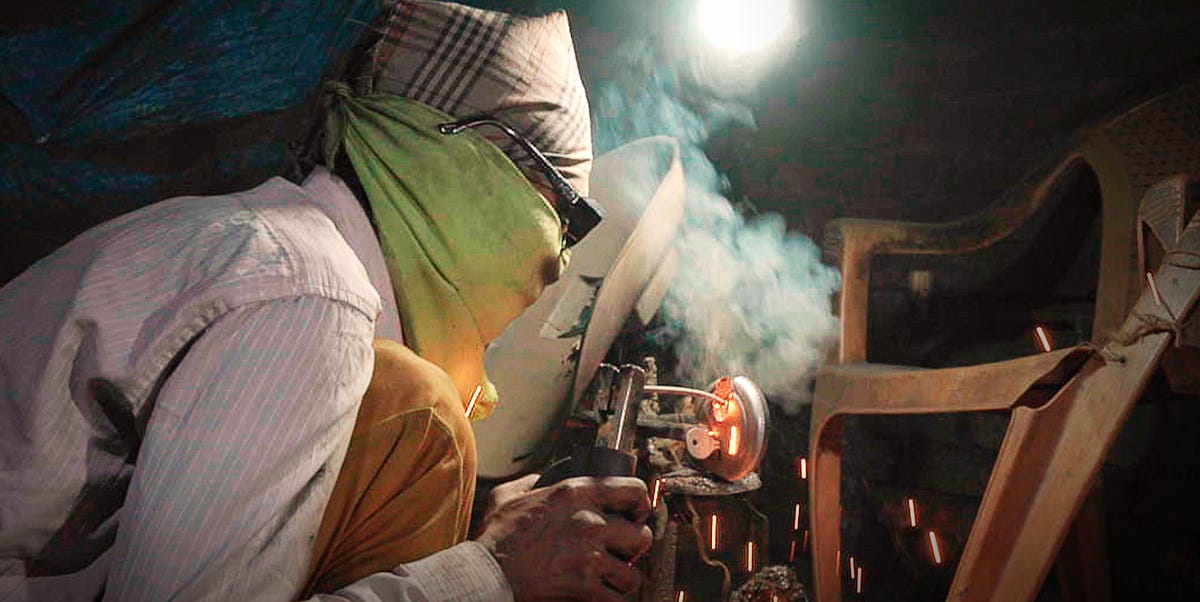
In Aligarh, India, the humble lock is not just a household object. It is a livelihood, a local identity, a family business, a soundscape, andon especially noisy morningsa percussion concert performed by hammers, grinders, files, and buffing wheels. While much of the world thinks of locks as anonymous items hanging in a hardware aisle, Indian artisans see them differently: as tiny machines that must be tough enough to guard a gate, smooth enough to satisfy a buyer, and cheap enough to survive a very competitive market.
The story of how Indian artisans grind out millions of locks each year begins in Aligarh, a city in Uttar Pradesh often called the “Land of Locks” or “Tala Nagri.” For generations, this city has supplied India with padlocks, door locks, bicycle locks, cabinet locks, multipurpose locks, decorative locks, and heavy gate locks. Some are produced in larger factories, but many still pass through small workshops, family-run units, and home-based workspaces where skill is measured not by a framed certificate, but by the confidence of a hand holding a file.
This is not a romantic fairy tale about brass and sparks. It is a real manufacturing ecosystem: fast, fragmented, ingenious, pressured, and deeply human. It is also one of the best examples of how traditional craftsmanship and small-scale industry can continue to survive in a world obsessed with automation, imports, digital locks, and next-day delivery.
Why Aligarh Became India’s Lock Capital
Aligarh’s lockmaking reputation did not appear overnight. The region’s metalworking culture developed over many decades, supported by skilled artisans, local trading networks, and demand from households, farms, shops, schools, warehouses, and government buyers. The modern lock industry is commonly traced to the late nineteenth century, when British-era commercial activity helped introduce organized lock production in the city. Over time, local makers adapted imported designs, improved them, copied what worked, rejected what did not, and created a practical manufacturing base that could serve the Indian market at scale.
That last phrase“at scale”is important. Aligarh does not make locks the way a luxury watchmaker makes watches, one masterpiece at a time while classical music floats in the background. The city makes locks in a high-volume, distributed network. A shackle may be shaped in one place, a brass body cast in another, levers prepared elsewhere, keys cut in a nearby unit, and final assembly handled by a worker who has performed the same motion thousands of times. It is part factory, part bazaar, part neighborhood economy.
The result is a city where locks are not merely products. They are part of the landscape. In many neighborhoods, raw castings, metal scraps, unfinished keys, polishing wheels, and cardboard boxes of completed locks move through narrow lanes like everyday traffic. Ask for a cup of tea, and someone may slide aside a tray of lock parts to make room. That is Aligarh: security hardware with a side of chai.
The Anatomy of an Aligarh Lock
A lock looks simple from the outside. That is the lock’s little trick. Inside, even a basic padlock depends on several parts working together with surprising precision. A typical lock may include the body, shackle, levers or tumblers, springs, rivets, keyhole plate, locking bolt, and key. Each part has to fit properly. If the spacing is off, the key sticks. If the lever is poorly shaped, the lock can fail. If the shackle is weak, the lock becomes decorative metal jewelry for thieves.
Brass, Iron, Steel, and Scrap
Many traditional Aligarh locks are associated with brass, commonly valued for its workability, corrosion resistance, and attractive finish. Brass is often described as a copper-zinc alloy, and in traditional lockmaking discussions, a 60 percent copper and 40 percent zinc composition is frequently mentioned. Makers may also use iron, steel, zinc alloys, recycled metal, and other materials depending on the type of lock and price point.
Recycled scrap has become an important part of the story. In a place where margins can be thin, wasting metal is not just bad for the planetit is bad business. Offcuts, shavings, and discarded pieces can be collected, sorted, melted, or resold within the local supply chain. The system is not always glamorous, but it is practical. Sustainability sometimes arrives wearing dusty sandals rather than a shiny green badge.
Sand Casting and Rough Shaping
For many handmade or semi-handmade locks, the process begins with casting. Molten metal is poured into molds to create the rough body of the lock. Sand casting remains valued because it is economical, flexible, and suitable for smaller batches. Once the casting cools, the rough lock body must be cleaned, trimmed, and shaped.
This is where grinding becomes more than a verb. Workers remove excess metal, smooth edges, open slots, refine surfaces, and prepare the body for internal components. The sound is sharp and constant: metal meeting wheel, wheel meeting patience. It is not a quiet trade. If locks could talk, the first thing they would probably say is, “Please give my artisan ear protection.”
How Artisans Turn Metal into Security
The lockmaking process in Aligarh often follows a division-of-labor model. One artisan may specialize in casting, another in shaping shackles, another in preparing levers, another in polishing, and another in assembly. This specialization allows high output without requiring every worker to master every step.
Step 1: Designing the Lock Type
Before production begins, makers decide what kind of lock is needed. A small suitcase lock has different requirements from a heavy gate lock. A decorative brass padlock aimed at tourists or gift buyers is different from a rugged lock for a warehouse shutter. Price also determines design. In mass-market hardware, every gram of metal and every second of labor matters.
Step 2: Casting or Cutting the Body
The body may be cast, pressed, machined, or assembled from metal pieces. In smaller workshops, artisans may work with basic machines and hand tools rather than fully automated production lines. The rough body must be strong enough to house the mechanism and resist everyday abuse. In India, “everyday abuse” can include monsoon humidity, dusty shopfronts, roadside gates, overenthusiastic key turning, and that one uncle who believes every stuck lock can be fixed by hitting it with something.
Step 3: Making the Shackle
The shackle is the U-shaped part that gives a padlock its familiar silhouette. It must be tough, properly bent, and accurately aligned with the lock body. A weak shackle defeats the purpose of the lock. A misaligned shackle frustrates the buyer. A beautiful shackle that does not close is, technically speaking, a very small sculpture.
Step 4: Preparing the Levers, Tumblers, and Springs
The heart of the lock is the mechanism. In many traditional lever locks, the key lifts or moves a set of levers into the correct position, allowing the bolt or shackle to release. These pieces are small, but they decide whether the lock opens smoothly or behaves like a stubborn goat. Workers must shape and place them with enough consistency that the key operates reliably.
Step 5: Cutting the Key
Keymaking is a craft within the craft. The cuts must match the internal arrangement of the lock. In lower-cost locks, the number of unique key combinations may be limited; in better locks, more variation improves security. The key must be strong enough not to bend easily, but precise enough to move the mechanism cleanly. A good key feels ordinary in the hand, which is exactly the point. The best engineering often disappears into convenience.
Step 6: Assembly by Hand
Final assembly brings the lock together. The body, levers, spring, bolt, shackle, rivets, and plates must be placed in order. Hand assembly remains common because small workshops can adjust quickly to different models and customer demands. A worker who has assembled thousands of locks can often sense a problem before testing it. The motion becomes muscle memory: place, tap, check, turn, close, repeat.
Step 7: Filing, Buffing, and Polishing
Now comes the “grind out” part in its most visible form. Filing removes imperfections. Buffing improves the finish. Polishing gives the lock its shine, whether bright brass, antique tone, chrome-like gleam, or a darker utilitarian look. A finished lock must look trustworthy. Consumers may not understand lever tolerances, but they absolutely judge shine. In hardware, sparkle sells.
Millions of Locks, Thousands of Small HandsBut Not the Wrong Kind
Any honest article about Aligarh’s lock industry must discuss labor conditions carefully. The city’s lock trade has historically included home-based work, casual labor, low wages, and concerns about child labor. Economic pressure pushed some families to involve children in tasks that should never be part of childhood. That reality has been documented over the years by researchers and labor observers, and it remains a serious ethical issue wherever informal supply chains make monitoring difficult.
At the same time, it is important not to flatten the entire industry into a single negative image. Many adult artisans are highly skilled workers trying to support families in a demanding market. Some workshops are modernizing. Some businesses are improving processes, branding, packaging, and quality control. Government programs, industry associations, and local entrepreneurs have also attempted to promote formalization, training, and better market access.
The future of the industry depends not only on how many locks Aligarh can make, but on how responsibly it can make them. A lock is supposed to protect value. The industry must also protect the people who create that value.
Why Handmade Locks Still Matter in the Age of Smart Security
Smart locks are growing in popularity, especially in urban apartments, hotels, offices, and premium homes. Fingerprint access, PIN codes, Bluetooth control, and app-based security all sound very futuristicuntil the battery dies and everyone suddenly remembers the beauty of a physical key.
Traditional mechanical locks still dominate many markets because they are affordable, repairable, familiar, and independent of electricity. A brass padlock does not need Wi-Fi. It does not require a firmware update. It will never send a notification saying, “Your gate is 3 percent unlocked.” For farms, shops, storage rooms, bicycles, trunks, cabinets, and outdoor gates, mechanical locks remain practical and trusted.
This is why Aligarh’s artisans continue to matter. They produce security products for everyday people, not only luxury buyers. Their locks protect grain stores, neighborhood shops, school cupboards, factory shutters, roadside stalls, rented rooms, toolboxes, and family trunks. In that sense, the industry is tied to ordinary life in a very direct way.
Challenges Facing Indian Lock Artisans
Aligarh’s lock industry has survived for generations, but survival is not the same as comfort. The sector faces intense pressure from several directions.
Competition from Low-Cost Imports
Cheaper imported locks have challenged local manufacturers for years. When buyers focus only on price, traditional producers struggle to compete. Some Aligarh businesses responded by modernizing machinery, improving designs, or shifting toward branded products. Others found themselves squeezed between rising input costs and bargain-hunting customers.
Rising Raw Material Costs
Metal prices can make or break small manufacturers. Brass, iron, steel, and zinc alloy costs influence everything from design thickness to final retail price. When raw materials rise, small workshops may have little room to absorb the increase. The customer still wants a cheap lock; the artisan still needs to eat; the spreadsheet quietly starts sweating.
Fragmented Production
The same distributed network that gives Aligarh flexibility can also create problems. Small units may lack access to modern testing equipment, formal credit, consistent branding, export documentation, or advanced packaging. Middlemen can control access to buyers and raw materials. Many artisans are excellent makers but not necessarily marketers, accountants, compliance specialists, and e-commerce photographers all at once. Frankly, nobody should have to be all those things before lunch.
Need for Better Branding
For decades, “Aligarh lock” itself carried strong recognition. But modern markets reward brands, warranties, certifications, packaging, and online reviews. A lock made by a skilled artisan can lose shelf space to a slicker-looking competitor if the branding feels outdated. The opportunity is clear: combine traditional craftsmanship with modern trust signals.
The Role of GI Recognition and Local Promotion
Aligarh locks have gained attention through geographical indication discussions and local product promotion efforts. Such recognition can help protect reputation, discourage imitation, and create a stronger identity for regional goods. It also gives marketers a story to tell: not just “buy this lock,” but “buy a lock from a historic manufacturing city known for this craft.”
Programs like One District One Product have also highlighted locks and hardware as a signature strength of Aligarh. These initiatives can help connect small producers to wider markets, training opportunities, trade fairs, digital platforms, and improved infrastructure. The impact depends on execution, but the direction is promising.
From Workshop Floor to Global Shelf
Aligarh’s lockmakers serve domestic markets across India and also participate in export networks. Buyers may come from neighboring countries, hardware distributors, construction suppliers, retailers, and project contractors. Export growth requires consistency, documentation, packaging standards, quality testing, and the ability to meet buyer expectations repeatedly.
This is where the industry’s next chapter may be written. The world does not merely need cheap locks; it needs reliable locks at fair prices. Aligarh has the skills. What it needs is stronger design development, worker protection, better machinery where appropriate, and smarter branding that helps artisans capture more value instead of surrendering it to intermediaries.
Lessons from the Lockmakers of Aligarh
The first lesson is that manufacturing is not always clean, silent, and robotic. Sometimes it is crowded, noisy, improvised, and still remarkably effective. The second lesson is that skill can live in repetition. A worker filing a lock body for the ten-thousandth time is not doing “simple” work. He or she is performing a physical calculation: pressure, angle, texture, speed, and judgment.
The third lesson is that tradition survives when it adapts. Aligarh cannot depend forever on nostalgia. Customers want stronger locks, better finishes, smoother keys, attractive packaging, and fair prices. Some want smart features. Others want handmade authenticity. The winners will be the businesses that respect the old craft while upgrading the parts that need upgrading.
Experience Notes: What This Craft Teaches Buyers, Makers, and Curious Readers
To understand how Indian artisans grind out millions of locks each year, imagine standing at the edge of a small Aligarh workshop. The first thing you notice is not the finished product. It is the rhythm. A hammer taps. A grinder screams. Someone tests a key. A buffing wheel throws a dull piece of brass into a quick flash of gold. Another worker sorts parts into piles that look chaotic to outsiders but perfectly logical to the people who live inside that system.
The experience teaches you that a lock is not born secure. It becomes secure through dozens of small decisions. How thick should the body be? How clean is the casting? Did the lever seat properly? Does the key turn without scraping? Is the shackle hardened enough for its intended use? Is the finish only pretty, or does it help resist corrosion? Every answer affects trust.
For buyers, the lesson is simple: do not judge a lock only by weight or shine. A heavy lock can still have a weak mechanism. A shiny lock can still use poor internal parts. A good lock feels smooth, closes firmly, and comes from a maker or seller willing to stand behind it. For outdoor use, corrosion resistance matters. For gates and shutters, shackle strength matters. For cabinets, smooth operation may matter more than brute force. Buying the right lock is a little like choosing shoes: the fancy one is useless if it fails on the first rainy day.
For makers, Aligarh’s experience shows the value of specialization. One person does not need to do everything. A strong local cluster allows different workshops to focus on different tasks, creating speed and flexibility. But the same system also needs coordination. Without quality standards, one weak component can damage the reputation of the entire product. A lock is only as reliable as its least careful part.
For entrepreneurs, the opportunity is larger than the object itself. Aligarh locks can be sold as affordable hardware, but also as heritage products, craft gifts, architectural accessories, and export-ready security goods. Better storytelling, product photography, packaging, online listings, and quality certification could help small manufacturers reach customers who care about both function and origin. People love objects with a storyas long as the object also works.
For policy makers and industry supporters, the experience is a reminder that traditional manufacturing clusters need more than slogans. They need safe workplaces, adult skill training, credit access, testing labs, design support, market linkages, and serious enforcement against exploitative labor. Protecting a craft means protecting the craftsperson, not just celebrating the product during trade fairs.
And for anyone who has ever locked a gate without thinking about it, Aligarh offers a humbling detail: behind that small click may be a long chain of human effort. Someone melted metal. Someone shaped it. Someone filed it smooth. Someone cut the key. Someone assembled the mechanism. Someone polished the body until it looked ready to guard a life’s worth of ordinary treasures. The lock may be small, but the world behind it is enormous.
Conclusion
Indian artisans grind out millions of locks each year because they are part of a manufacturing culture built on skill, speed, adaptation, and necessity. In Aligarh, lockmaking is not just an industry; it is a citywide habit refined over generations. The craft combines brass, iron, recycled scrap, hand tools, machines, family knowledge, market pressure, and stubborn resilience.
The future of Aligarh’s lock industry will depend on its ability to modernize without erasing its human skill. Better branding, ethical labor practices, improved quality control, and smarter access to domestic and global markets can help the city keep its title as India’s lock capital. After all, a good lock is a promise: what matters will be protected. For Aligarh’s artisans, the craft itself deserves the same promise.
Note: This article synthesizes publicly available information from reputable manufacturing, government, industry, labor, and craft-focused sources. No source links or citation markers are included in the article body so it can be published cleanly on the web.