

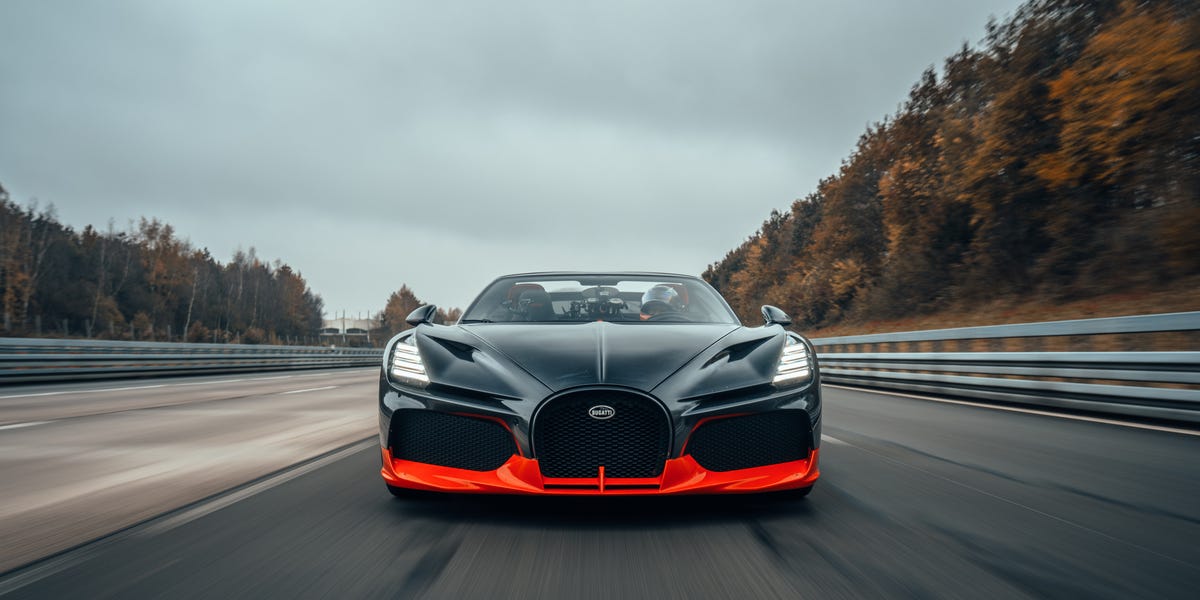
Driving 282 mph is already the sort of thing that makes physics clear its throat and ask, “Are you sure about this?” Doing it with no fixed roof is something else entirely. The Bugatti W16 Mistral did exactly that, reaching 453.91 km/h, or roughly 282 mph, and becoming the fastest open-top production car in history. It was not simply a Chiron with a haircut. It was a carefully reengineered roadster designed to survive, stabilize, breathe, cool, and roar at a speed where ordinary convertibles would be less “grand tourer” and more “expensive kite.”
The story matters because the Mistral represents the final roadgoing chapter for Bugatti’s legendary quad-turbocharged W16 engine. In an era rushing toward hybrid systems and EV torque monsters, Bugatti sent off its combustion masterpiece with a roofless speed record that feels almost theatrical. It is automotive opera, only the singer has 16 cylinders and the stage is a high-speed oval in Germany.
Why 282 MPH With the Roof Down Is So Difficult
At normal highway speeds, removing a roof mostly means messy hair, more noise, and possibly discovering that your favorite baseball cap was not emotionally committed to the relationship. At 282 mph, an open cockpit becomes an engineering war zone. Air does not gently flow over the car; it attacks every surface, dives into every opening, and tries to turn small turbulence into big instability.
A closed hypercar can use its roofline as a continuous aerodynamic surface. Air moves from the nose, over the windshield, across the roof, and toward the rear wing or diffuser in a more predictable pattern. A roadster interrupts that clean path. The missing roof creates a pressure disturbance over the cabin, adds drag, challenges cooling, and removes a structural element that normally helps a vehicle resist twisting forces.
That is why the Bugatti Mistral top speed record is more than a horsepower flex. Yes, 1,578 horsepower sounds like enough to tow a small moon, but power alone does not make a car stable. To hit 282 mph with its roof down, the Mistral needed aerodynamic balance, extreme structural rigidity, specialized tires, high-speed cooling, and a driver calm enough to treat 200 mph like the warm-up act.
The Power Source: Bugatti’s 8.0-Liter Quad-Turbo W16
At the heart of the W16 Mistral sits Bugatti’s 8.0-liter quad-turbocharged W16 engine, producing 1,600 PS, or about 1,578 horsepower. This engine is paired with a seven-speed dual-clutch transmission and permanent all-wheel drive. The layout matters because at this level, the problem is not only making power; it is putting that power into the pavement without turning the tires into smoke, confetti, or a strongly worded letter from Michelin.
The W16 engine’s character is different from the electric punch of modern EV hypercars. It builds enormous thrust with a deeply mechanical feel: four turbochargers, massive airflow demand, huge cooling requirements, and a soundtrack that sounds like a private airport having an emotional breakthrough. In the Mistral, this powertrain was not chosen merely because it was available. It was chosen because it was the ultimate expression of Bugatti’s combustion engineering.
Why the W16 Was Perfect for the Job
High-speed runs demand sustained power. A quarter-mile car can make shocking acceleration for a few seconds, but a top-speed machine must continue pushing through rising aerodynamic drag. Drag increases dramatically as speed climbs, meaning the final miles per hour require absurd amounts of energy. The Mistral’s W16 provided the deep reserve needed to keep accelerating after the speedometer had already wandered into private-jet territory.
The engine’s all-wheel-drive system also helped the car launch and maintain composure. At 282 mph, even small instability can become a very expensive problem. The Mistral needed traction not just at takeoff, but during the transition from banking to straightaway, where the car had to remain planted while the driver unleashed full power.
Aerodynamics: Making a Roofless Car Behave at Jet Speeds
Bugatti’s design philosophy is often described as “form follows performance,” and the Mistral is a rolling proof statement. Its bodywork is beautiful, but the beauty is not decorative fluff. Every intake, vent, scoop, headlight shape, and rear element serves the larger goal of airflow management.
The front end uses a wider, deeper horseshoe grille to feed the high-temperature radiator. The side intakes help serve the intercoolers, while the headlights are shaped to guide air through the front and out near the wheel arches. This reduces pressure buildup and helps the car cut through air more efficiently. In simple terms, the Mistral’s face is not just posing for posters; it is doing math at 282 mph.
The Roof-Mounted Air Scoops
One of the Mistral’s most dramatic features is its pair of roof-mounted air scoops positioned behind the occupants. They look like superhero shoulder armor, but they are highly functional. The W16 engine requires enormous airflow, and in an open-top car, feeding clean air to the engine becomes a serious challenge. These scoops help channel air toward the powertrain while also becoming part of the car’s rollover protection structure.
That dual purpose is key. A roadster must replace the strength normally provided by a roof. Bugatti engineered the scoops with carbon-fiber structures strong enough to support the vehicle in a rollover scenario. So yes, they are gorgeous. They are also working harder than most office employees on a Monday morning.
The X-Shaped Taillight Is Not Just Drama
The Mistral’s rear end features a striking X-shaped taillight design. It looks futuristic, almost like the car is leaving a sci-fi signature behind it. But Bugatti also uses that rear design to manage heat and airflow. The negative spaces around the X help vent air from cooling systems, creating pressure differences that improve the effectiveness of the cooling circuit.
At extreme speed, heat management is one of the hidden bosses in the game. The engine, turbochargers, transmission, brakes, and tires all generate brutal temperatures. If air cannot enter and exit efficiently, performance falls apart. The Mistral’s rear design helps the car breathe out as effectively as the front and side intakes help it breathe in.
Structural Rigidity: The Roof Is Gone, but Strength Is Not
Many convertibles feel less rigid than their coupe siblings because removing the roof weakens the structure. Engineers usually compensate by reinforcing the floor, sills, bulkheads, or windshield frame. That adds weight, and weight is the enemy of response, braking, and handling.
Bugatti could not simply saw the top off a Chiron and call it a Mistral. The company reengineered the monocoque and body structure so the roadster could maintain high stiffness without sacrificing performance. This matters because at 282 mph, a flexible chassis would create inconsistent aerodynamic behavior and reduce driver confidence. The faster the car goes, the more important tiny movements become.
Think of it like trying to shoot an arrow from a rubber bow. Technically, something may fly forward, but precision will not be your best friend. The Mistral needed the carbon-fiber structure to remain composed so the suspension, aero surfaces, and tires could do their jobs with predictable accuracy.
The Tires: Unsung Heroes at 4,000-Plus RPM
At 282 mph, tires become miracles of material science. They are not just round black things that keep the wheels from scraping. They are rotating pressure vessels dealing with monstrous centrifugal force, heat buildup, deformation, and load transfer. A normal road tire would not be invited to this party. It would faint in the driveway.
Bugatti’s top-speed machines rely on specially developed high-performance tires capable of handling extreme rotational speeds. During runs near or above 300 mph in related Bugatti development, tire engineering had to account for thousands of revolutions per minute and enormous force at the tread. For the Mistral, the tire package had to deliver stability, strength, and predictable behavior while still being suitable for a production road car.
Why Tire Confidence Changes Everything
When a driver is approaching 282 mph, confidence in the tires is not optional. The driver must trust that each tire will maintain shape, grip, and balance under stress. Even a tiny vibration can become alarming at that speed. That is why top-speed attempts involve meticulous preparation: tire inspections, warm-up laps, pressure checks, temperature monitoring, and a support team that treats details like sacred texts.
The Track: Why Papenburg Was the Right Place
The Mistral’s record run took place at ATP Automotive Testing Papenburg in Germany, a high-speed facility with long straights and banked corners. For a top-speed run, the location is almost as important as the car. You need enough straight-line distance to accelerate, enough run-off and braking space to slow down safely, and a surface smooth enough to avoid upsetting the vehicle at extreme speed.
The banked corner helped the Mistral enter the straight at high speed before the driver applied full power. This is crucial because acceleration from 180 mph to 282 mph is a different challenge than launching from zero. The car is already fighting enormous drag, so every bit of entry speed helps.
Top-speed runs are not casual blasts. They involve weather analysis, track preparation, safety crews, telemetry, and independent verification. The Mistral’s achievement was confirmed under official supervision, turning a spectacular number into a documented record rather than just a viral claim with dramatic music.
Andy Wallace: The Human Stability Control System
The person behind the wheel was Andy Wallace, Bugatti’s official test driver and a Le Mans winner. That experience matters. At 282 mph, the driver cannot be dramatic. Inputs must be smooth, precise, and minimal. A sudden steering correction or aggressive pedal movement could disturb the car’s balance.
Wallace’s job was not simply to “floor it.” He had to build tire temperature, manage the approach through the banking, apply power cleanly, read the car’s behavior, and remain calm while the cockpit filled with wind, sound, and pressure. In a closed car, speed can feel slightly insulated. In an open-top car, the environment is in your face, around your helmet, and probably trying to inspect your dental work.
Cooling: Keeping 16 Cylinders From Throwing a Tantrum
Extreme speed creates extreme heat. The W16 engine uses four turbochargers and produces immense power, which means it also produces immense thermal load. Cooling air must feed radiators and intercoolers while the bodywork still remains aerodynamically efficient. Too much cooling opening adds drag. Too little cooling risks power loss or component damage.
The Mistral solves this by separating airflow jobs. Different intakes serve different cooling needs, reducing compromise. The horseshoe grille feeds a major radiator, side intakes assist intercooling, and rear venting helps draw hot air away. This is one reason the car looks so sculptural: the shape is dictated by pressure, heat, and airflow.
How the Mistral Beat the Previous Open-Top Record
Before the Mistral, the Hennessey Venom GT Spyder held a major open-top speed benchmark at 265.6 mph. Bugatti did not merely edge past that figure; it stretched the category by more than 16 mph. In top-speed engineering, that is a huge gap. The faster you go, the harder every additional mile per hour becomes.
The achievement also continues Bugatti’s long record-setting tradition. The Veyron Super Sport, Veyron Grand Sport Vitesse, and Chiron Super Sport 300+ all helped establish the brand as a top-speed authority. The Mistral adds a roofless chapter to that story and gives the W16 engine a finale worthy of its reputation.
Why This Record Matters in the Hybrid and EV Era
Modern performance cars are changing quickly. Electric motors deliver instant torque. Hybrid systems fill power gaps and boost acceleration. Bugatti’s own future includes new engine architecture and electrification. That makes the Mistral feel like both a celebration and a goodbye party.
It is likely one of the last great combustion-only top-speed records from a traditional hypercar engine. That does not mean internal combustion is suddenly irrelevant, but it does mean the W16 Mistral belongs to a special moment in automotive history. It is a machine built at the edge of what gasoline engineering can achieve when cost, complexity, and sanity are all politely escorted out of the conference room.
The Experience: What 282 MPH With No Roof Must Feel Like
Imagine sitting low in the cockpit as the Mistral gathers speed. At first, it is fast in a familiar way. Then the numbers rise into territory most drivers only see in racing games with questionable physics settings. The wind becomes heavier. The engine note hardens. The road narrows visually. The car covers more than a football field every second, and your brain starts receiving information faster than it can file the paperwork.
With no roof, the sensation is more physical than in a coupe. You are not sealed away from the event; you are part of it. Air rolls over the windshield, past the cockpit, and into the scoops behind your head. The W16 is not somewhere behind you in the abstract. It is present, breathing, compressing, combusting, and shouting through the structure of the car.
What makes the Mistral impressive is not just that it reached 282 mph. It is that reports from the record program described the car as stable and composed. That is the ultimate compliment for a hypercar at this speed. Drama may sell posters, but calmness sets records.
500-Word Experience Section: Living With the Idea of the Bugatti Mistral
For most people, the Bugatti Mistral will never be a car they casually encounter at a grocery store, unless that grocery store sells truffle salt, private islands, and emergency replacement carbon fiber. But the experience of the Mistral still matters to enthusiasts because it changes how we think about automotive possibility. It is not just transportation. It is a demonstration that engineering can still feel emotional, irrational, and deeply human.
The first experience connected to the Mistral is visual. Even standing still, it communicates speed without needing cartoonish aggression. The wraparound windshield, deep horseshoe grille, roof scoops, and X-shaped rear lighting all suggest movement. It looks like wind shaped the car rather than a committee. That matters because great car design should explain purpose before the spec sheet arrives. With the Mistral, you can tell immediately that air is the main character.
The second experience is mechanical imagination. Car lovers understand that a 1,600-PS W16 is not just a number. It is a symphony of pistons, turbochargers, intercoolers, fuel delivery, exhaust flow, and thermal control. The Mistral makes those systems feel alive. In a world where speed increasingly comes from silent electric acceleration, the Mistral reminds us that combustion performance has texture. It vibrates, inhales, heats up, and sings. It has mood.
The third experience is the strange intimacy of open-top speed. Convertibles are usually associated with coastal drives, sunglasses, and pretending not to notice that your hair has become abstract sculpture. The Mistral turns the roadster idea into something more extreme. It suggests that open-air driving does not have to be relaxed; it can be brutally technical. That contrast is part of its magic. It combines the romance of a classic roadster with the precision of an aerospace project.
There is also a lesson for everyday drivers. No, your daily commuter does not need carbon-fiber rollover scoops or a top speed that threatens aircraft. But the Mistral shows how deeply connected vehicle systems are. Aerodynamics affects stability. Cooling affects power. Structure affects handling. Tires affect trust. Even in normal cars, the best driving experiences come from harmony, not one impressive number. A car with modest horsepower but balanced steering, braking, and suspension can feel better than a powerful car that behaves like a shopping cart in a thunderstorm.
Finally, the Bugatti Mistral experience is about legacy. It closes the W16 era with confidence rather than nostalgia. Bugatti did not quietly retire the engine after a press release and a commemorative keychain. It sent it to 282 mph with the roof down. That is gloriously unnecessary, which is exactly why enthusiasts care. The Mistral proves that car tech is not only about efficiency charts and software updates. Sometimes it is about chasing a number because the number seems impossible, then making it real through patience, testing, courage, and a frankly unreasonable amount of horsepower.
Conclusion
The Bugatti Mistral hit 282 mph with its roof down because every part of the car was engineered to solve a specific high-speed problem. The W16 engine supplied extraordinary power. The aerodynamics controlled airflow around an open cockpit. The carbon-fiber structure restored strength lost by removing the roof. The cooling system managed brutal heat. The tires survived extreme rotational forces. The track provided the space, and Andy Wallace provided the calm hands.
In the end, the Mistral is more than the world’s fastest open-top production car. It is a final salute to one of the most outrageous engines ever installed in a road car. It is proof that roofless driving can be elegant, terrifying, technical, and record-breaking all at once. Most convertibles let you enjoy the breeze. The Bugatti Mistral grabbed the breeze by the collar and took it to 282 mph.