

Let’s start with the good news: getting your FCC General Radiotelephone Operator License at home is absolutely doable. You do not need to sit in a beige classroom under a flickering light while someone hands you a pencil that barely works. Today, many candidates study on their own schedule, test through an approved Commercial Operator License Examination Manager (COLEM), and complete the licensing process without leaving the house.
If that sounds suspiciously convenient, it kind of is. But there is still real work involved. The FCC GROL is a serious commercial radio credential. It is meant for people who operate, adjust, maintain, or internally repair certain radiotelephone transmitters used in aviation, maritime, and related services. In other words, this is not a hobby badge. It is a career license.
Note: Always verify the latest COLEM pricing, remote-proctoring requirements, and current FCC filing rules before you pay. Those details can change, and nobody enjoys a surprise fee more than absolutely nobody.
What the FCC GROL Actually Is
The FCC General Radiotelephone Operator License, usually called the GROL, is a commercial operator license issued by the Federal Communications Commission. It is commonly required for people who repair or maintain FCC-licensed radiotelephone equipment in aviation and maritime settings. It can also matter in related technical roles where employers want proof that you understand radio law, safe operating practice, and core electronics.
The GROL is not the same thing as an amateur radio General license. That mix-up happens all the time because both use the word “General,” which is rude, frankly. The ham radio General license belongs to the amateur radio world. The GROL belongs to the commercial world.
Another important detail: the GROL is generally treated as a lifetime license once issued. That is one reason people like earning it early. You do the work once, and it can stay on your résumé for the long haul.
Who Usually Needs a GROL
You may need a GROL if your work involves aircraft communications equipment, marine radio systems, certain shipboard transmitters, or technical service roles that require legal authority to adjust or repair licensed radiotelephone equipment. Many avionics technicians pursue it. Marine electronics professionals do too. Some employers in public-safety radio, DAS, and related communications work also value it because it signals a solid baseline in radio systems and regulations.
You probably do not need it just to own a VHF marine radio, use common consumer communications gear, or work around electronics in a general sense. Plenty of electronics jobs do not require a GROL. But when a job posting specifically mentions FCC commercial radio licensing, this is usually the credential being discussed.
Can You Really Get It at Home?
Yes. The classic path used to feel more old-school: find a test location, show up in person, take the exam, and then deal with paperwork. That still exists. But several COLEMs and authorized exam providers now offer online or remote-proctored testing. That means you can study at home, schedule a remote exam, verify your identity, and take the required elements from your own computer.
The basic idea is simple. You prepare for the right exam elements, choose an approved testing organization, follow its home-testing rules, pass the exam, and then complete the licensing process through the FCC system or through a provider that submits your paperwork for you.
So yes, “at home” is real. It just still needs to be “at home, but professionally.”
Step-by-Step: How to Get Your FCC GROL at Home
1. Confirm that the GROL is the right license for your goal
Before you buy a prep course or book an exam, make sure the GROL matches the job or authority you need. The GROL requires Element 1 and Element 3. If your future role also involves ship radar or GMDSS maintenance, you may need additional elements later. That is not bad news. It just means you should know whether you are aiming for the base GROL only, or a GROL plus endorsements or related licenses.
For most people starting from scratch, the GROL is the foundation. Get that first. Then add anything else your employer or industry segment requires.
2. Get your FCC registration set up
You will typically need an FCC Registration Number (FRN). This is created through the FCC’s registration system and is used across FCC licensing workflows. Think of it as your official ID number in FCC land.
Do this early. It is fast, but not something you want to figure out five minutes before an exam or application deadline. Once your FRN exists, keep it somewhere safe with your login credentials. A password manager is a great idea. A mystery sticky note under your keyboard is less inspiring.
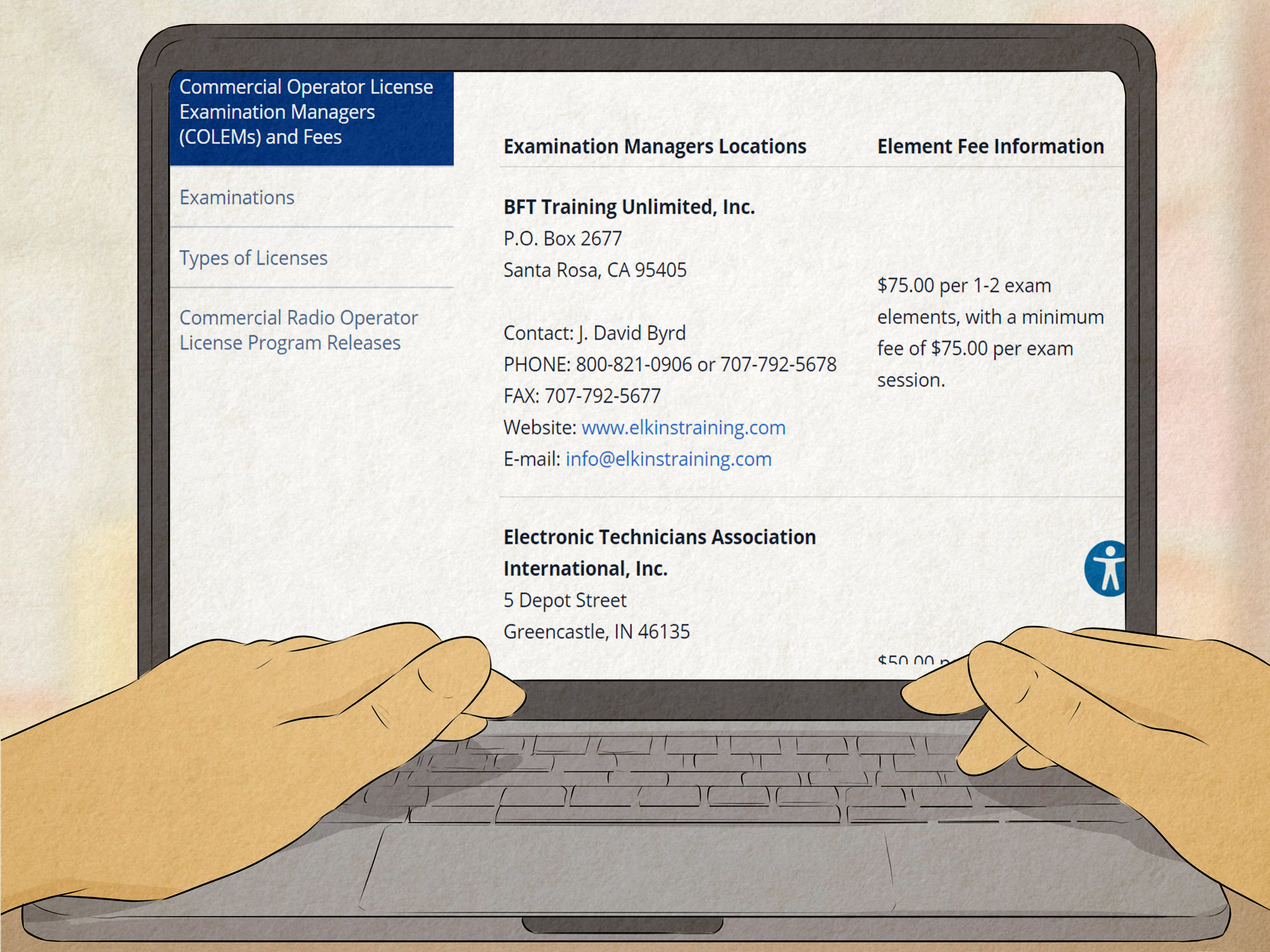
3. Choose a COLEM that offers remote testing
The FCC does not personally administer your GROL exam. Approved Commercial Operator License Examination Managers do. That means your at-home path depends on picking a COLEM or exam provider that supports online testing.
When comparing providers, look for these details:
- Whether remote-proctored testing is available for Element 1 and Element 3
- What equipment you need, such as a webcam, microphone, and stable internet
- Whether the provider files your FCC paperwork after you pass
- What the exam fee covers
- How retakes are handled if one element goes sideways
Pricing varies more than people expect. Some FCC-listed providers have recently shown basic test pricing in roughly the $75 to $80 range for one or two elements, while training companies that bundle prep, proctoring, and filing support may charge more. That does not automatically make the higher-priced option worse. It may simply include hand-holding, study materials, or filing help. Decide whether you want the cheapest path or the least annoying one.
4. Study the right way, not the dramatic way
The GROL is passable through self-study, especially at home, because the exam content is structured and predictable. You are not being asked to invent radio theory in your garage. You are being asked to demonstrate that you understand regulations, operating practice, and electronics fundamentals at a commercially useful level.
For the standard GROL, you need two written elements:
- Element 1: basic radio law and operating practice. The current exam format is 24 questions, and you need 18 correct to pass.
- Element 3: general radiotelephone topics, including electronics fundamentals and techniques used to adjust, repair, and maintain radio transmitters and receivers. The current format is 100 questions, and you need 75 correct to pass.
Element 1 is usually the easier lift because it focuses on rules, procedures, and operating knowledge. Element 3 is the real workout. It covers areas such as operating procedures, radio wave propagation, radio practice, electrical principles, circuit components, practical circuits, signals and emissions, and antennas and feed lines.
The smartest study plan is not glamorous:
- Download or review the current question pools and exam outlines.
- Use practice-test platforms and question drills.
- Focus heavily on weak areas instead of repeating what you already know.
- Take timed practice exams before booking your real one.
Many candidates use commercial prep books, online drilling tools, and practice platforms that mirror the question-pool format. This works well because the goal is not just abstract understanding. The goal is accurate recall under time pressure.
5. Set up your home exam space like a grown-up
Remote-proctored testing is convenient, but it comes with rules. Your provider may require a clean desk, webcam view of your room, microphone access, ID verification, and a computer that meets its technical requirements. Some systems are very specific about browser settings, extra monitors, phones, calculators, and even whether your desk contains innocent objects that somehow look suspicious at 8:00 a.m.
Set up your exam environment the day before:
- Use a reliable laptop or desktop, not a computer that behaves like it has emotional issues
- Test your webcam, microphone, and internet connection
- Clear your desk
- Close extra apps
- Have your photo ID ready
- Review the provider’s calculator and scratch-paper rules
The smoother your environment, the less brain power you waste on logistics.
6. Take and pass Element 1 and Element 3
On exam day, keep it simple. Read carefully. Do not rush the easy questions. Do not let one ugly electronics question wreck your rhythm for the next ten. Most people lose points not because the exam is impossible, but because stress makes them sloppy.
If you have been scoring comfortably above the pass line in practice, you are usually ready. A good benchmark is to aim above the minimum before test day rather than trying to pass by one heroic question. Passing by a mile feels exactly the same as passing by one point, except with less sweating.
7. Complete the FCC application step
After you pass, your next step is the licensing paperwork. In some cases, the COLEM or exam provider will file electronically for you. In other cases, you may need to submit your application through the FCC’s Universal Licensing System using FCC Form 605 and the proof-of-passing documentation issued after your exam.
This is where candidates sometimes stumble. They pass the exam, relax too early, and then get delayed by missing documents, wrong account details, or incomplete filing. Treat the application as part of the exam process, because it is.
Also remember that exam fees and FCC application handling are not the same thing. Your testing fee goes to the exam administrator. Your FCC filing step follows FCC rules, and the exact fee treatment can vary by filing type and current FCC schedule. Check the latest guidance before submitting.
8. Print and save your license
Once the FCC issues your GROL, save digital copies and store them somewhere obvious. Also print one for your records. Employers often want proof, and future you will be deeply unimpressed if present-day you makes it hard to find.
How Long It Usually Takes
If you already have an electronics background, you may be able to prepare in a couple of focused weeks. If you are newer to circuits, RF basics, and communications rules, give yourself a month or more of steady study. The at-home format helps because you can study in short, repeatable sessions instead of trying to absorb everything in one dramatic weekend of caffeine and regret.
A realistic pace for many candidates is 30 to 60 minutes a day on weekdays, plus one longer session on the weekend. That is enough to build real retention without frying your attention span.
Common Mistakes to Avoid
The first big mistake is confusing the GROL with amateur radio licensing. The second is underestimating Element 3. The third is assuming that “remote exam” means “casual exam.” It does not.
Other avoidable mistakes include booking the test before you are consistently passing practice exams, skipping the FRN setup until the last second, ignoring the provider’s room and equipment rules, and failing to confirm whether the testing company submits your paperwork or whether you need to file yourself.
In short: do not let the convenience of the home path trick you into being sloppy. The easier the logistics become, the more important your discipline becomes.
At-Home GROL Experience: What It Actually Feels Like
People who earn the FCC GROL at home usually go through the same emotional sequence, and it is almost funny how predictable it is. First comes curiosity. Then confusion. Then a brief period of thinking, “Wait, is this the ham radio General?” Then comes the realization that no, this is the commercial one, and now you need to learn the difference between radio law, feed lines, circuit behavior, and enough FCC procedure to stop guessing.
The home-study phase often starts out messy. Most candidates begin with too many tabs open, three different study plans, a prep book they half trust, and a strong desire for someone else to tell them exactly what matters. After a few days, the fog lifts. They realize that Element 1 is manageable and that Element 3 is where the real effort lives. That moment helps. Once you know where the weight is, the whole process becomes less intimidating.
One of the best parts of doing this at home is control. You can study before work, after dinner, or in those oddly productive weekend blocks when the house is quiet and your phone finally stops behaving like an overexcited raccoon. You can review circuit questions three times in a row without feeling rushed by a classroom pace. You can stop, repeat, drill, and test until the weak points become less weak.
But the home path also exposes your habits. If you are organized, it feels efficient. If you are a procrastinator with heroic optimism, it becomes a master class in self-sabotage. Nobody is standing over your shoulder saying, “Hey, maybe actually take the practice exam today.” You have to become your own coach. That is why candidates who build a simple routine usually do better than candidates who wait for a magical burst of motivation.
Then there is exam day. Remote-proctored testing feels modern, but emotionally it still feels like a test. You clean your desk like the proctor is coming over for dinner. You check your webcam twice. You wonder why your internet suddenly seems untrustworthy even though it worked perfectly yesterday. You place your ID nearby and start noticing every random object in the room as if it might personally disqualify you.
Once the exam begins, the experience becomes surprisingly normal. A question is still just a question. A pass line is still a pass line. The main difference is that you are sitting in your own space, which can either calm you down or make you too comfortable. The candidates who do best tend to treat their kitchen table like a testing center, not like the place where they also eat cereal and lose charging cables.
After passing, the mood changes fast. The pressure drops. The license suddenly feels real. A lot of people describe that moment not as fireworks, but as relief mixed with pride. It is the kind of win that makes your résumé stronger and your technical confidence sharper at the same time. You did not just memorize enough to get through a quiz. You learned a professional framework that connects regulations, electronics, RF practice, and real-world equipment work.
That is also why the GROL has a reputation for practical credibility. Even when an employer does not legally require it, people recognize what it represents. It says you took the time to understand the rules and the hardware. It says you can work through structured technical material without needing a classroom babysitter. And if you earned it at home, it also says you know how to manage your own learning, which is a useful professional skill in every industry, not just radio.
So yes, getting your FCC General Radiotelephone Operator License at home is convenient. But the experience is more than convenience. It is a very direct lesson in how modern technical credentialing works: self-paced study, remote verification, structured testing, and professional follow-through. No glamour. No magic. Just a smart credential earned the practical way.
Final Thoughts
If you want the simplest possible summary, here it is: getting your FCC GROL at home comes down to choosing the right COLEM, studying intelligently for Element 1 and Element 3, preparing your remote test setup, and finishing the FCC filing step without getting lazy at the end.
That is it. No mystery. No secret club. No radio wizard hiding in a basement to decide your fate.
For people in aviation, maritime, communications support, and electronics service roles, the GROL can be a genuinely useful credential with long-term value. And because the at-home path is now realistic, the barrier is lower than many people think. If you are willing to study consistently and handle the process like a professional, you can absolutely earn it from home.