

If you have ever played Pokémon Diamond or Pearl, you already know Sinnoh has a wonderful sense of humor. It gives you big dreams, cool evolutions, and then casually asks you to level up a team in a region where the pace can sometimes feel like a Bidoof jogging uphill. Unlike newer Pokémon games, Diamond and Pearl do not shower your whole party with easy experience. You have to earn your progress the old-fashioned way: smart battles, efficient routes, and just enough stubbornness to make your DS nervous.
The good news is that leveling up in Sinnoh does not have to turn into a full-time job. Once you know where to train, when to use the Vs. Seeker, and how to avoid wasting experience on random filler battles, the process becomes much faster. The real trick is not “grind harder.” It is “grind smarter,” which sounds like something a very serious Machoke would say while wearing reading glasses.
This guide walks you through 11 practical steps to level up faster in Pokémon Diamond and Pearl, whether you are preparing for the next Gym, catching up a newly added team member, or trying to turn a fragile little underdog into a league-ready monster.
Why Leveling Feels Slow in Sinnoh
Before jumping into the steps, it helps to understand why Diamond and Pearl can feel slower than other Pokémon games. The regional Pokédex is limited, some routes do not offer amazing wild experience, and many players rotate too many party members too often. That creates a classic Sinnoh problem: half your team is underleveled, your starter is overworked, and your patience is hanging on by one lonely HP point.
That is exactly why a good training plan matters. The best way to level up in Pokémon Diamond and Pearl is not one single secret location. It is a chain of smart habits that stack together until your whole team starts pulling its weight.
How to Level Up in Pokémon Diamond and Pearl: 11 Steps
Step 1: Commit to a Core Team Early
The fastest way to level up is to stop raising every interesting creature that blinks at you from the grass. Sinnoh is full of tempting options, but if you keep swapping Pokémon every other route, your experience gets spread too thin. Try to settle on a core team of four to six Pokémon by the midgame. That way, every battle actually builds momentum instead of funding a revolving door of half-trained experiments.
This does not mean you can never adjust your team. It just means you should stop treating your party like a talent show. A stable group levels faster because your resources, healing items, and trainer battles all go toward the same long-term payoff.
Step 2: Battle Every Trainer Before You Start Grinding Wild Pokémon
Trainer battles are usually the best experience value in the main story. They also give money, which matters because leveling efficiently often means buying healing items, Repels, and status cures so you can stay in the field longer. If you skip a bunch of trainers and then wonder why your team feels weak, congratulations: Sinnoh noticed.
In the early and midgame, your first job is simple. Clear every route thoroughly. Fight everyone. Pick up the items. Then move on. This keeps your levels healthy without forcing you into long grinding sessions. Wild Pokémon are useful, but they are usually the backup plan, not the star of the show.
Step 3: Get the Exp. Share as Soon as You Can
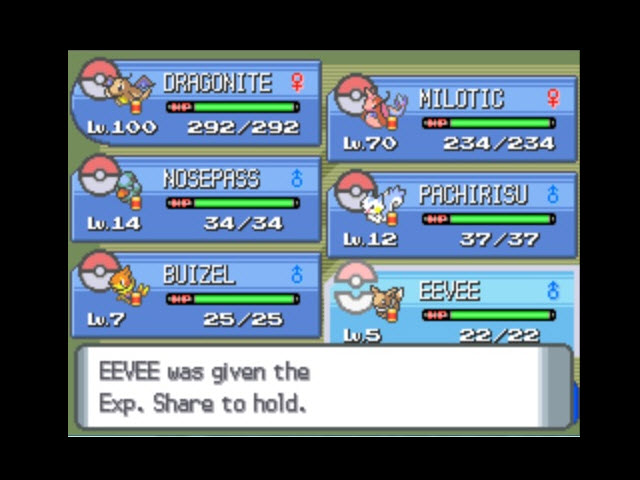
In Diamond and Pearl, Exp. Share is not a global feature. It is a held item, and that makes it incredibly valuable. Once you get it, weaker Pokémon can gain experience without needing to survive a full battle on the front lines like tiny unpaid interns.
Use Exp. Share whenever you add a low-level Pokémon to your team or when one party member falls behind. It is especially useful for awkward Pokémon that evolve late, have bad early moves, or feel like they were designed specifically to test your patience. If a Pokémon is weak now but strong later, Exp. Share helps bridge that ugly middle phase.
Step 4: Master the Switch-Train Method
Before you get Exp. Share, or even after, switch training is still one of the most effective ways to raise weaker Pokémon. Put the underleveled Pokémon in first, start the battle, then immediately switch to something strong that can finish the fight safely. The weaker Pokémon still gets experience, and you avoid watching it get folded by a random Golbat.
This method works best against trainers whose teams you can predict. It is slower than using Exp. Share, but it is reliable. It also helps friendship-based evolutions, since the Pokémon is still being used actively rather than sitting in the back like a decorative sandwich.
Step 5: Use the Vs. Seeker Instead of Mindless Wild Grinding
If you are not using the Vs. Seeker, you are leaving free experience on the table. This item lets you rebattle trainers, and that is one of the biggest leveling advantages in Diamond and Pearl. Trainers usually give better experience than wild Pokémon, and rematches are much faster than running in circles hoping the grass decides to be generous.
The trick is to find clusters of trainers with strong Pokémon and easy matchups for your team. Recharge the Vs. Seeker by walking, use it again, and repeat. This creates a tidy little experience loop that feels much better than endless random encounters. In other words, let the trainers do the grinding for you.
Step 6: Use the Best Midgame Spots for Your Current Level
Good leveling is all about matching your team’s level to the right part of Sinnoh. In the midgame, daily double battles at the Seven Stars Restaurant near Valor Lakefront can be excellent because double battles speed things up and reward smart offensive play. Routes around Solaceon, Veilstone, and the approach to Pastoria are also solid when your team is still finding its footing.
Later, Route 222 becomes one of the most famous grinding spots in the game for a reason. With the Vs. Seeker, some trainers there can be rebattled for strong experience payouts, especially the ones using high-value Water-types like Gyarados. If you have a good Electric move, that route starts feeling less like training and more like profitable yard work.
Step 7: Train at Victory Road Before the Pokémon League
When your team is getting ready for the Elite Four, Victory Road is one of the best places to grind. The wild Pokémon are stronger, the experience is much better than earlier caves, and the area naturally prepares you for the kind of levels you need before the League.
This is the moment to stop being casual about levels. If your team is struggling in the low 40s, do not march into the League full of hope and vibes. Spend some time in Victory Road. Take advantage of type matchups, keep your healing stocked, and use the area to get your team into proper fighting shape. It is a brutal cave, but it is a useful brutal cave.
Step 8: Hunt a Lucky Egg If You Want Serious Efficiency
Lucky Egg is one of the best leveling items in the game because it boosts experience gained in battle. If you manage to get one from Chansey, leveling becomes noticeably smoother. It is not required, but it absolutely helps, especially for Pokémon that need a lot of catching up.
The catch, of course, is that getting a Lucky Egg is its own little side quest. That is Sinnoh for you: even the shortcut has a side hustle. Still, if you plan to train multiple team members, raise a postgame squad, or push something to a much higher level, the time spent getting Lucky Egg can pay for itself.
Step 9: Save Rare Candies for Smart Moments, Not Lazy Ones
Rare Candies are great, but they are best used with purpose. Do not blow all of them the second you find them just because one Pokémon is annoyingly close to evolving. Save them for specific situations: pushing a Pokémon to an important evolution level, finishing off a late grind, or fixing one awkward gap before a major fight.
Used well, Rare Candies save time. Used badly, they disappear in five seconds and leave you staring at the screen like you just ate all the emergency snacks on day one of a road trip. Think of them as tools, not a lifestyle.
Step 10: Rechallenge the Elite Four After Becoming Champion
Once you have beaten the Pokémon League, the Elite Four becomes one of the best ways to level higher-level Pokémon. The experience gains are substantial, the battles are concentrated, and the rematches help train serious endgame teams much faster than wandering through ordinary routes.
This is also where Exp. Share shines again. If one Pokémon is already strong and another is lagging behind, the Elite Four can power-level the weaker one in the background. Just make sure you can reliably win. Nothing slows leveling down like wiping out halfway through and realizing you have been donating Full Restores to your own poor planning.
Step 11: Move to the Battle Zone and Postgame Routes
After the main story, the Battle Zone opens up some of the best training in the game. Areas such as the Fight Area, Route 227, Route 228, and nearby postgame routes feature stronger trainers and wild Pokémon, making them ideal for leveling teams beyond the main-story curve. These places are where you go when your team has graduated from “beating Gym Leaders” to “bullying the level curve for fun.”
Postgame routes are especially useful if you are building a fresh team for the Battle Tower, evolving late-game captures, or preparing for rematches. At that point, the training stops feeling like survival and starts feeling like optimization. Sinnoh still makes you work, but now at least the rewards are worth the sweat.
Extra Tips to Make Every Battle Count
Even with the best training spots, efficiency matters. Try to lead with the Pokémon you actually want to level. Use super-effective attacks to end fights quickly. Keep your move sets updated so your team is not dragging around weak old attacks three badges past their expiration date. Give useful held items to the right Pokémon. And whenever possible, avoid unnecessary backtracking that breaks your training rhythm.
Also, watch out for a classic mistake: overleveling one star player while the rest of your team turns into backup dancers. A balanced party is usually better than one overgrown ace and five emotional support Pokémon. Diamond and Pearl punish uneven teams more than people remember, especially near the end.
Final Thoughts
If you want to level up fast in Pokémon Diamond and Pearl, the formula is straightforward: build a stable team, fight all trainers, get Exp. Share, abuse the Vs. Seeker, use route-specific grinding spots, and move up to Victory Road and the Elite Four when your levels demand it. Add a Lucky Egg if you can, sprinkle in Rare Candies intelligently, and use the postgame Battle Zone once it opens.
Most importantly, do not treat leveling like punishment. In Sinnoh, training works best when it is woven into your adventure instead of separated from it. Done right, your team grows naturally, your strategy improves, and the grind shrinks from a giant headache into a manageable routine. It may never be effortless, but it absolutely can be efficient. And in Pokémon Diamond and Pearl, efficient is beautiful.
Trainer Experience: What Leveling Up in Sinnoh Actually Feels Like
One of the most memorable things about leveling in Pokémon Diamond and Pearl is that it feels personal. In some later Pokémon games, your whole party levels so smoothly that progress can feel automatic. Sinnoh does not work that way. Every strong Pokémon on your team usually has a story attached to it. You remember when it struggled, when it learned the move that finally made it useful, and when it stopped being “the one I am trying to raise” and became “the one carrying this whole cave on its back.”
That is why so many players remember the Diamond and Pearl grind with equal parts frustration and affection. You do not just end up with a level 55 Staraptor or a fully evolved Luxray. You remember the route where it finally started one-shotting things. You remember the trainer who kept wrecking your team until you came back stronger. You remember the exact moment your Gabite stopped feeling like a project and started feeling like a problem for everybody else.
The experience is even stronger when you are raising a Pokémon that starts out weak. Maybe it is a Riolu that needs friendship and patience. Maybe it is a newly caught Swinub you decided to add way too late. Maybe it is a Gible you found and immediately loved, despite the fact that it still hits like a damp pool noodle at first. Diamond and Pearl are really good at making those growth arcs feel earned. You do not blink and suddenly have a powerhouse. You build one.
There is also something oddly satisfying about discovering your own favorite grinding loop. Some players love the restaurant double battles. Others swear by Route 222. Some treat Victory Road like a second home and probably know every Golbat in the cave by name. Once you find the place that matches your team, the grind becomes less annoying. It turns into rhythm. Battle, heal, rebattle, level up, evolve, repeat. It is simple, but it works.
And then there is the best part: seeing all that effort pay off in the Elite Four. Few feelings in the series are as satisfying as walking into the League with a team that used to struggle and realizing they are finally ready. The same Pokémon that barely survived random trainers a few hours ago are now sweeping major fights, surviving huge hits, and proving that all that training actually mattered.
That is the charm of Sinnoh. The road can be slow. The grinding can be stubborn. But when your team finally clicks, it feels fantastic. Pokémon Diamond and Pearl do not hand you strength for free. They make you raise it, battle by battle, level by level, until your team feels truly yours. And honestly, that is a big reason fans still love these games. The leveling journey may be a little rough around the edges, but it gives your victories more weight. In Sinnoh, growth is not just a mechanic. It is part of the adventure.