

Note: This guide follows the classic arrow-making workflow shared by RuneScape and Old School RuneScape. Exact XP values, economy, and some unlock levels can vary by version, item tier, and updates.
If you have ever stared at your empty quiver in RuneScape and thought, “I should really stop buying everything like a medieval billionaire,” welcome. Making arrows is one of the oldest, simplest, and most satisfying crafting loops in the game. It ties together Woodcutting, Fletching, and sometimes Smithing, and it gives you that nice “I made this myself” feeling that every MMO player secretly loves.
The good news is that arrow-making is not complicated. It is basically a tiny production line: cut logs into shafts, add feathers, then attach arrowheads. That is it. No ancient ritual. No dragon negotiations. No paperwork from Varrock City Hall. Once you understand the process, you can make arrows for training, for profit, or just because clicking the same thing 600 times in a row somehow becomes weirdly relaxing in RuneScape.
This guide breaks the whole process into five clear steps, explains the materials you need, and shows you how to avoid the beginner mistakes that turn a clean Fletching session into a bag full of almost-useful junk.
What You Need Before You Start
Before you start making arrows, gather the basic materials. The exact arrow type changes with the metal you choose, but the general recipe stays the same.
- A knife to cut logs into arrow shafts
- Logs, usually regular logs for basic shafts
- Feathers to turn shafts into headless arrows
- Arrowheads or arrowtips for the final arrow type
- Optional: bars and a hammer if you want to smith your own arrowheads instead of buying them
If you are playing efficiently, you can buy most of these from the Grand Exchange or relevant shops. If you are playing like a true resource-goblin, you can gather them yourself. Cut the logs, collect feathers from chickens or shops, and smith your own arrowheads. RuneScape supports both playstyles: the “time is money” player and the “I will personally manufacture every paper clip in this kingdom” player.
Step 1: Cut Logs Into Arrow Shafts
The first step is turning logs into arrow shafts. Use a knife on your logs and select the arrow shaft option. This creates the wooden base for your arrows. Think of arrow shafts as the pasta of the recipe: not glamorous, but nothing happens without them.
For most players, regular logs are the usual starting point. They are easy to get, cheap to buy, and ideal for mass production. This is also one reason arrow-making is so beginner-friendly. You do not need rare ingredients or an elite skilling setup. You just need wood, a knife, and the willingness to click like you are trying to wake up your mouse.
If your goal is speed, bank a large number of logs and work in a place with a nearby bank. If your goal is self-sufficiency, cut the logs yourself and treat the process as part of a larger skilling chain. Either way, this step is where your future arrows begin.
Helpful tip
Keep your inventory simple. Logs and knife only. The less clutter you carry, the easier it is to process materials quickly without accidentally clicking the wrong item and wondering why your character is holding fish instead of lumber.
Step 2: Add Feathers to Make Headless Arrows
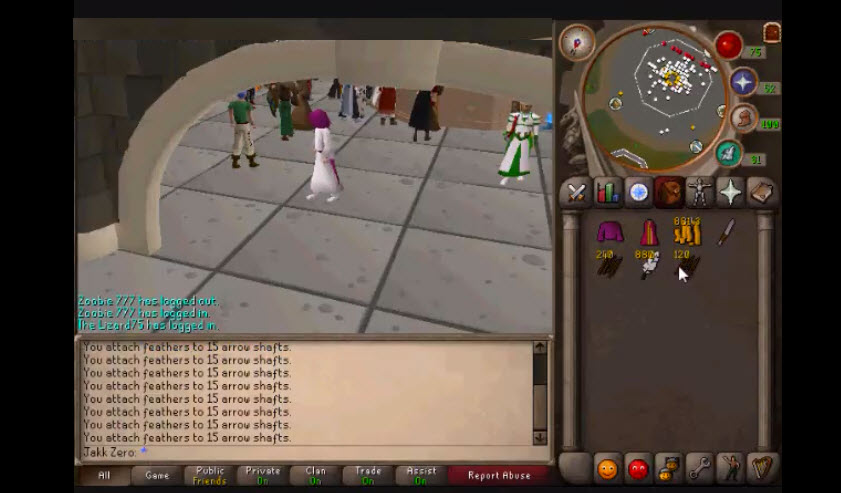
Once you have arrow shafts, use feathers on them to create headless arrows. These are exactly what they sound like: arrows that look like they are halfway dressed for work. They have a shaft and flights, but no metal tip yet.
This step is important because you cannot skip straight from shaft to finished arrow. The feathers come first. In other words, RuneScape insists on proper arrow etiquette. No featherless chaos allowed.
Headless arrows are also useful because they are a common checkpoint in the crafting chain. Many players buy or sell them directly, especially when they want to split the process into fast stages. If you are training Fletching, this can be a handy way to pace your materials and your budget.
At low levels, this step feels wonderfully straightforward. There are no complicated menus, no puzzle mechanics, and no surprise boss fight. You click feathers onto shafts, produce a batch, and keep going. It is classic RuneScape at its purest: repetitive, oddly soothing, and one step away from making you feel like a tiny medieval factory manager.
Step 3: Choose the Arrow Type You Want to Make
Before you attach arrowheads, decide what kind of finished arrow you want. Bronze arrows are the standard beginner choice because they are simple, accessible, and unlocked early. From there, higher metal tiers like iron, steel, mithril, adamant, and rune become available as your Fletching improves.
The important thing to understand is that the arrowhead determines the final arrow. If you attach bronze arrowheads, you get bronze arrows. If you attach rune arrowheads, you get rune arrows. RuneScape does not do mystery crafting here. Thankfully, it is not one of those games where combining a feather and a stick somehow creates a sandwich.
When choosing a tier, think about your goal:
- For beginners: Bronze or iron arrows are easy to make and good for learning the process.
- For steady training: Steel and mithril often feel like a natural progression.
- For stronger ammunition: Adamant and rune offer better combat value if your levels support them.
- For specific use cases: Some arrow types, such as broad arrows, are used for specialized training or Slayer-focused situations.
If you are writing your own skilling plan, it helps to view arrows as both ammunition and training materials. Sometimes the “best” arrow is not the strongest one. Sometimes it is simply the one you can make quickly, afford easily, and actually use.
Quick level mindset
Do not obsess over jumping straight to the fanciest arrow type. RuneScape rewards consistency. A player calmly making stack after stack of simple arrows often gets farther than the player who spends 30 minutes trying to optimize every coin, every click, and every oxygen molecule in the room.
Step 4: Get or Make Your Arrowheads
Now it is time for the metal tips. You have two main options: buy arrowheads or smith them yourself.
Buying arrowheads is faster and usually easier. If you want convenience, this is the route. Grab the tier you need from the Grand Exchange or a suitable shop and move on with your life like a sensible adventurer.
Smithing arrowheads is the more self-sufficient option. Use the correct metal bar on an anvil and smith it into arrowheads. This adds an extra step, but it can be rewarding if you enjoy managing your own supply chain or want to train more than one skill at once. It is also satisfying in that deeply RuneScape way where you turn raw ore into bars, bars into arrowheads, and arrowheads into ammo, all while pretending you are running a one-person defense contractor.
If you are an Ironman, this step matters even more. Making your own arrowheads can save trips, support long-term progression, and keep you from depending on store stock or market timing. If you are not an Ironman, you can still do it for fun, profit calculations, or the pure joy of not paying retail.
Step 5: Attach Arrowheads to Headless Arrows
This is the final step. Use your arrowheads on your headless arrows, and congratulations: you now have finished arrows. The exact arrow type depends on the arrowheads you used, but the crafting logic stays the same every time.
At this point, the entire process clicks into place. You started with raw logs and ended with usable ammunition. That is the beauty of Fletching. It is simple enough for beginners, scalable enough for serious training, and practical enough to remain useful even when you know the game inside and out.
Finished arrows can be used for Ranged combat, saved for later, sold, or mass-produced as part of a larger Fletching grind. If you plan on making a lot of them, organize your bank tabs, stock materials in bulk, and settle into a rhythm. Arrow-making is one of those RuneScape activities that feels much better once your setup is clean and your hands know the pattern.
Common Mistakes to Avoid
Even though arrow-making is straightforward, players still manage to turn it into a comedy sketch. Here are a few common mistakes:
- Forgetting the knife: No knife means no shafts. No shafts means no arrows. No arrows means your plan has the structural integrity of wet paper.
- Buying the wrong arrowheads: Double-check the metal tier before buying in bulk.
- Ignoring Fletching requirements: Higher-tier arrows need higher Fletching levels, so do not buy a mountain of rune heads at level 8 and then glare at them like they betrayed you.
- Overcomplicating the process: For most players, simple materials and simple batches work best.
- Mixing goals: Training, profit, combat prep, and self-sufficiency are not always the same thing. Decide what you want first.
Best Uses for Arrow-Making in RuneScape
Making arrows is useful for more than just saying you did it. It has real value in normal gameplay.
Training Fletching: Arrow-making is one of the cleanest ways to understand the skill and build early momentum.
Supplying your Ranged setup: If you use bows regularly, crafting your own ammunition can be convenient.
Supporting Ironman progression: Self-made arrows fit perfectly into the Ironman lifestyle of “I guess I live in this resource loop now.”
Managing cost: Depending on your version of the game and current prices, some arrow-making methods can help control spending or soften losses while training.
Combining skills: Woodcutting, Smithing, and Fletching work together beautifully here, which makes the activity feel more rewarding than a one-skill grind.
Should You Make Arrows or Just Buy Them?
That depends on what kind of player you are. If you only need a quick batch for combat, buying arrows is often the easiest move. If you enjoy skilling, want Fletching experience, or like maintaining your own supply, making arrows is absolutely worth it.
In many ways, this question captures the soul of RuneScape. Do you want efficiency right now, or do you want the long, satisfying route where every finished item feels earned? There is no wrong answer. There is only the answer that fits your mood, your goals, and how much caffeine you have in your system.
Final Thoughts
Making an arrow in RuneScape is refreshingly simple once you know the order: cut logs into arrow shafts, add feathers to make headless arrows, get the arrowheads you want, then combine everything into finished ammunition. That is the full loop.
It is one of those classic activities that never really stops being useful. Beginners can use it to learn Fletching. Veterans can use it to train efficiently, stockpile ammo, or keep an Ironman account running smoothly. And almost everyone can appreciate the strangely comforting rhythm of turning ordinary logs into something battle-ready.
So yes, arrow-making may not be the flashiest thing in RuneScape. It will not summon a boss. It will not unlock a dramatic cutscene. But it will quietly make you more self-sufficient, more efficient, and a little more dangerous. And honestly, that is a pretty good deal for a few logs, some feathers, and a lot of clicking.
Player Experience Notes: What Making Arrows in RuneScape Feels Like
One of the most enjoyable things about making arrows in RuneScape is how quickly the process goes from “What am I even doing?” to “I could do this for an hour while half-watching something in the background.” That is part of the charm. Arrow-making has a low barrier to entry, but it still feels productive. You start with materials that look unimpressive on their own, and a few minutes later your inventory has turned into neat stacks of usable ammo.
For many players, the early experience is surprisingly memorable. There is something satisfying about cutting your first logs into shafts and realizing the game is teaching you a miniature production system. It is not just crafting for the sake of crafting. It connects to combat, leveling, money management, and self-sufficiency. You are not making decorative nonsense for a village craft fair. You are literally assembling ammunition.
The rhythm also matters. RuneScape has always had activities that reward patience, and arrow-making fits perfectly into that tradition. The clicks are simple, the item flow is logical, and the progress is easy to measure. Every batch feels like visible movement forward. That makes the process feel calmer than some other skilling methods, especially for players who enjoy repetitive tasks that are easy to settle into.
There is also a nice psychological shift once you stop thinking of arrows as cheap store-bought supplies and start seeing them as products you can build at scale. Your relationship with the game changes a little. You look at logs differently. You notice feathers more. You start thinking in batches, inventories, and bank tabs. RuneScape has a funny way of turning ordinary players into very small, very determined industrial planners.
And then there is the practical side. When you make your own arrows, especially on a self-sufficient account, every finished stack feels useful. You are not just training a skill; you are feeding your future combat sessions. That gives the process a sense of purpose that some grind-heavy activities lack. Even when the clicks become repetitive, the result still feels meaningful.
So while making arrows may sound basic on paper, the actual experience is one of the reasons Fletching remains such a classic RuneScape activity. It is easy to learn, satisfying to repeat, and tied closely to the broader game. In other words, it is exactly the kind of humble, practical, oddly addictive system that RuneScape has always done well.