

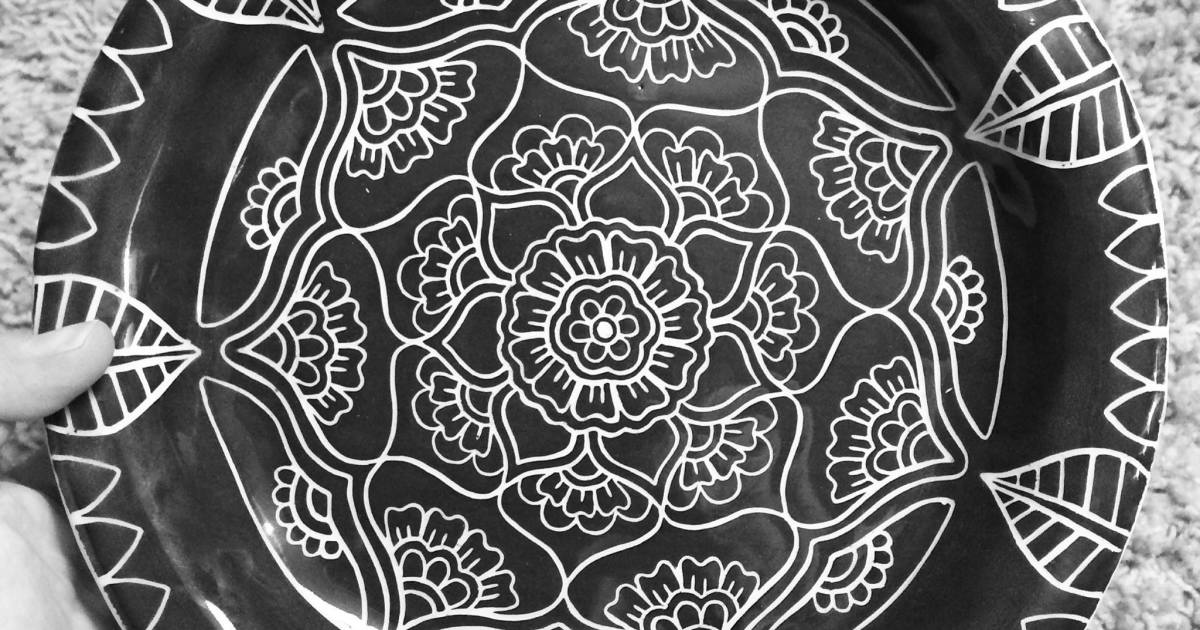
I have always loved drawing because it feels direct: pencil meets paper, line appears, confidence either arrives or runs away with dramatic little footsteps. But recently, I tried something that flipped the whole process upside down. Instead of building an image by adding marks, I experimented with sgraffito, a technique where you scratch through a top layer to reveal a contrasting layer underneath. In other words, I traded “draw a line” for “dig a line out.” It sounded simple. It was not. It was also ridiculously fun.
Sgraffito is often associated with ceramics, painting, plaster, and mixed-media art. The word comes from the Italian idea of scratching, and the method has been used for centuries on pottery, walls, panels, and decorative objects. Artists apply one surface over another, then remove parts of the top layer to expose color, texture, or clay beneath. Think of it as art’s version of a scratch card, except instead of winning five dollars, you win texture, contrast, and occasional hand cramps.
My goal was simple: Could sgraffito replace drawing as a way to create expressive images? I wanted to know whether scratching into a prepared surface would feel more freeing, more limiting, or just messier than ordinary sketching. The results surprised me. Sgraffito did not make drawing disappear; it made me think about drawing differently.
What Is Sgraffito?
Sgraffito art is a subtractive technique. Traditional drawing usually adds graphite, ink, charcoal, or pigment onto a surface. Sgraffito removes material from a surface. The artist creates a layered base, often with contrasting colors, and then scratches, carves, scrapes, or incises lines into the upper layer.
In ceramics, this often means applying colored slip or underglaze to leather-hard clay, then scratching through that coating to reveal the clay body below. In painting, it can mean dragging the end of a brush, palette knife, stylus, toothpick, or other tool through wet or semi-dry paint. On paper, artists can create a similar effect with oil pastels, crayons, ink, or acrylic layers.
The magic is in the contrast. A black top layer scratched away to reveal white underneath creates bold, graphic marks. A blue surface scratched into orange feels energetic. A red clay body peeking through white slip creates warmth and earthiness. Unlike a pencil line, which sits on top of the page, a sgraffito line feels embedded in the material. It has an edge, a groove, and a tiny sense of rebellion.
Why I Tried Sgraffito Instead Of Drawing
I started this experiment because my drawings were getting too careful. Every sketch began with good intentions and ended with me overworking the same eyebrow, branch, flower petal, or coffee mug handle until the paper looked tired. I wanted a technique that would force me to commit.
Sgraffito seemed perfect because it does not love hesitation. Once you scratch through a layer, the mark is there. You can sometimes adjust it, disguise it, or turn it into a decorative flourish, but you cannot truly erase it. This sounded terrifying, which usually means it is probably good for the creative muscles.
I also wanted more texture. Drawing can be beautifully textured, of course, but my usual pencil work was becoming too smooth. Sgraffito promised rough edges, carved marks, accidental sparks, and a handmade surface that looked alive. I wanted my art to stop behaving like it had carefully read the instruction manual.
The Materials I Used
For this experiment, I tested several beginner-friendly sgraffito methods. I did not start with a kiln because, sadly, my kitchen is not a ceramic studio and my oven has enough responsibilities reheating pizza.
Paper-Based Sgraffito
My first test used heavyweight mixed-media paper. I covered the paper with bright oil pastel colors, then layered a darker oil pastel over the top. After that, I used a wooden skewer, toothpick, and metal stylus to scratch designs through the dark layer. This method is affordable, fast, and great for beginners who want to try sgraffito drawing without investing in pottery tools.
Acrylic Paint Sgraffito
Next, I painted a colorful acrylic background and let it dry. Then I added a darker acrylic layer over it and scratched into the surface while the top paint was still damp. This created softer, more painterly marks than the oil pastel version. Timing mattered a lot. Scratch too early, and everything smears. Scratch too late, and you are basically trying to argue with plastic.
Ceramic-Inspired Practice Tiles
I also experimented with air-dry clay tiles as a ceramics-inspired option. I rolled small tiles, let them firm up, painted them with a contrasting surface color, and carved into them with a needle tool. While this did not behave exactly like fired ceramic sgraffito, it helped me understand why clay artists love the technique. The surface resisted just enough to make each line feel intentional.
The First Result: My Lines Became More Confident
The biggest surprise was how quickly my lines changed. With pencil drawing, I often sketch lightly, correct, redraw, correct again, and eventually negotiate peace with the image. Sgraffito gave me fewer chances to fuss. The line had to happen in one motion.
At first, this made my work look awkward. Some curves were wobbly. Some lines were too thick. One bird looked like it had just received bad financial news. But after a few attempts, the marks became bolder. I stopped trying to make perfect outlines and started thinking in movement.
Sgraffito rewards gesture. A quick scratch can suggest feathers, hair, grass, waves, tree bark, folds in fabric, or the little chaos of a city street. The marks felt energetic because they were physical. I was not just drawing a line; I was cutting a path.
The Second Result: Contrast Did Most Of The Heavy Lifting
In ordinary drawing, I often build contrast with shading. With sgraffito, contrast appears instantly when the lower layer shows through. That was incredibly satisfying. A single scratched line could glow against a dark surface. A cluster of marks could create highlights, texture, and rhythm without hours of blending.
This changed how I planned images. Instead of asking, “Where should I put dark lines?” I asked, “Where should light break through?” That small shift made the process feel fresh. It was less like sketching with a pencil and more like uncovering a hidden image.
For example, I made a simple night garden scene. The top layer was deep navy. Underneath were yellows, greens, and warm pinks. When I scratched flowers, stems, and firefly-like dots through the surface, the image immediately had a glowing quality. If I had drawn the same garden with colored pencils, it would have taken much longer to get the same sense of brightness.
The Third Result: Mistakes Became Part Of The Style
Sgraffito is not a technique for people who want total control. That is both the challenge and the charm. Tools slip. Lines widen unexpectedly. A scratch may reveal a color you forgot was underneath. Tiny flakes may appear along the edge of a mark. Sometimes the surface says, “Nice plan. Anyway, here is what we are doing.”
But many of these accidents looked interesting. A rough edge made tree bark feel more natural. Uneven scratches gave animal fur more life. Broken lines made water sparkle. In regular drawing, I might erase or hide those marks. In sgraffito, they often became the best parts.
This is one reason sgraffito works so well for expressive art, folk-inspired design, handmade pottery patterns, botanical illustrations, abstract textures, and decorative surfaces. It allows imperfection to look intentional. That is excellent news for artists and anyone whose hand occasionally behaves like it had too much coffee.
The Fourth Result: I Had To Think Backwards
The strangest part of sgraffito was the mental reversal. In drawing, I usually add dark marks to create outlines and shadows. In sgraffito, the scratched marks often become the lightest or brightest parts. This means the artist must plan the image almost in reverse.
If I wanted a white line, I had to bury white under another color first. If I wanted a red accent, the red needed to exist below the surface before I scratched. This made preparation more important. My best pieces came from layered planning: warm colors below, cool colors above, then scratch marks used to reveal the temperature underneath.
At the same time, overplanning made the work stiff. The sweet spot was preparing enough contrast to make the image work, while leaving room for discovery. Sgraffito is happiest when you give it a plan and then allow it to misbehave slightly.
Sgraffito Vs. Drawing: What Felt Different?
Comparing sgraffito with drawing helped me understand both techniques more clearly. Drawing is flexible, portable, and easy to revise. Sgraffito is tactile, bold, and harder to correct. Drawing often feels quiet and observational. Sgraffito feels physical and immediate.
Drawing Builds; Sgraffito Reveals
Drawing is additive. You place marks on a surface. Sgraffito is subtractive. You reveal what was already hidden. This difference affects the emotional tone of the process. Drawing can feel like construction. Sgraffito can feel like excavation.
Drawing Allows Soft Transitions; Sgraffito Loves Edges
Pencil, charcoal, and paint can create smooth gradients. Sgraffito tends to create sharper divisions. Even delicate scratches have a carved quality. This makes it excellent for pattern, texture, contrast, and graphic design.
Drawing Can Be Erased; Sgraffito Demands Commitment
This is the big one. Sgraffito makes you live with your decisions. That may sound strict, but it can actually be freeing. When erasing is not an option, you stop hovering nervously over the surface and start making marks with purpose.
Best Subjects For Sgraffito Art
After several experiments, I found that some subjects worked especially well with sgraffito. The technique loves images with strong silhouettes, repeated textures, and clear contrast.
Botanical Designs
Leaves, vines, flowers, seed pods, and grasses are perfect for sgraffito. Scratched lines naturally mimic veins, stems, thorns, and petals. A simple leaf can look elegant when carved through a dark top layer into a lighter color underneath.
Animals And Birds
Fur, feathers, scales, whiskers, and claws all benefit from scratchy texture. My owl experiment was one of the strongest results because the feather marks looked better when they were slightly irregular.
Abstract Patterns
Circles, waves, spirals, dots, crosshatching, grids, and geometric patterns are extremely satisfying in sgraffito. The technique has a natural decorative quality, which explains why it has appeared in ceramics, architectural ornament, and surface design for so long.
Night Scenes
Dark top layers with bright colors underneath make sgraffito ideal for stars, city lights, glowing windows, moonlit gardens, and dramatic landscapes. Scratching tiny highlights into a dark surface is almost unfairly fun.
Practical Tips For Trying Sgraffito
If you want to experiment with sgraffito technique at home, start simple. You do not need fancy tools. A toothpick, wooden skewer, old pen, palette knife, craft knife, paper clip, or the end of a paintbrush can create interesting marks.
Use Strong Color Contrast
The lower layer should contrast clearly with the top layer. Light under dark is the easiest combination, but complementary colors can also create exciting effects. Try yellow under purple, orange under blue, or pink under black.
Test Your Surface First
Every material scratches differently. Oil pastel feels waxy and smooth. Acrylic paint can drag or peel depending on timing. Clay offers resistance. Before making a finished piece, create a test strip and try different tools.
Vary Your Line Weight
Use thin scratches for delicate details and wider marks for highlights or bold outlines. Turning the tool at a different angle can change the character of the line. A sharp point creates precision; a blunt edge creates texture.
Do Not Over-Scratch Everything
This was my hardest lesson. Once scratching becomes fun, it is tempting to cover the entire surface with marks. Resist. Empty space gives the scratched areas more power. Let some parts stay quiet.
Common Mistakes I Made
My first mistake was using colors that were too similar. Dark green over dark blue looked moody in theory and nearly invisible in real life. My second mistake was pressing too hard. Aggressive scratching can tear paper, gouge clay, or create messy paint ridges. Sgraffito needs confidence, not violence.
I also learned that not every image translates well. Highly realistic portraits were difficult because the technique naturally creates bold, graphic marks. However, expressive faces, stylized figures, and decorative portraits worked much better. When I stopped trying to imitate pencil realism, the results improved dramatically.
Another mistake was skipping the planning stage entirely. Sgraffito loves spontaneity, but the underlayer matters. If the hidden colors are random, the revealed lines may not support the image. A little planning goes a long way.
What The Finished Pieces Looked Like
The final results looked more textured, energetic, and handmade than my usual drawings. The best pieces had a carved quality, almost like tiny prints or illustrated ceramic surfaces. They were not as polished as pencil drawings, but they had more personality.
One of my favorite results was a simple cat portrait. I used a warm orange underlayer and a black top layer. Scratching whiskers, fur lines, and eye highlights through the black created a dramatic image with very few marks. The cat looked mysterious, slightly judgmental, and frankly more confident than I felt while making it.
Another successful piece was an abstract landscape. I layered sunset colors underneath a dark purple surface, then scratched hills, stars, grasses, and winding paths through the top. The image had depth because the colors appeared in flashes rather than full coverage.
The weakest pieces were the ones where I tried too hard to control everything. Sgraffito does not want to be micromanaged. It wants rhythm, contrast, and a bit of trust.
Is Sgraffito Better Than Drawing?
No, but it is better at certain things. Sgraffito is not a replacement for drawing in every situation. If you want soft shading, careful realism, or easy revisions, drawing may be the better choice. But if you want texture, bold contrast, expressive lines, and a more physical art process, sgraffito is wonderful.
The real discovery was that sgraffito made me a better observer of line. Because each mark mattered, I became more selective. I stopped drawing every detail and started choosing the details that carried the image. That lesson transferred back into my regular sketching.
So, while I experimented with sgraffito instead of drawing, I did not abandon drawing. I came back to it with sharper instincts, looser hands, and a new respect for the power of subtraction.
Personal Experience: What I Learned From Scratching Instead Of Sketching
The most memorable part of this experiment was how quickly sgraffito changed my mood while making art. Drawing sometimes puts me in “fix-it mode.” I notice what is wrong, adjust it, notice another problem, adjust that, and suddenly a relaxing sketch has turned into a tiny courtroom drama. Sgraffito interrupted that habit. Because the technique gives fewer opportunities for correction, I had to stay present with the mark I was making.
At first, this felt uncomfortable. I wanted an undo button. I wanted a kneaded eraser. I wanted a small committee of art professors to reassure me that the crooked line was “expressive.” But after a while, the lack of control became the best part. I began to accept that each scratch had a job, even if it was not the job I originally assigned it.
One afternoon, I made a series of small square studies: a bird, a vase of flowers, a mountain, a face, and a messy abstract pattern that looked like jazz music after too much espresso. The bird was the first one that clicked. I scratched feather lines into a dark surface and watched the lighter colors underneath appear like little sparks. The image did not need much detail. A few confident marks created the body, wing, eye, and tail. It felt like drawing with a flashlight.
The vase of flowers taught me restraint. I scratched too many petals, too many stems, too many decorative dots, and eventually the whole thing looked like a botanical traffic jam. That piece reminded me that sgraffito is powerful because of contrast. If every inch is shouting, nothing sounds important. On the next version, I left larger dark areas untouched, and the flowers immediately looked more elegant.
The face study was the hardest. Human faces depend on subtle proportions, and sgraffito is not always subtle. My first attempt had one eye too high and a mouth that looked personally offended. Instead of throwing it away, I turned the portrait into a stylized mask. I added patterned hair, bold cheek lines, and decorative marks around the head. Suddenly the mistake became a style. That moment felt like the real lesson of the experiment: sgraffito encourages adaptation.
By the end, I noticed that my favorite results were not the neatest ones. They were the pieces that looked touched by a human hand. The little slips, rough edges, uneven grooves, and surprise color reveals gave the work energy. Sgraffito made me less obsessed with perfect outlines and more interested in visual rhythm. It reminded me that art does not always have to be polished to be compelling. Sometimes it only needs a sharp tool, a layered surface, and enough curiosity to scratch past the obvious.
Conclusion
Experimenting with sgraffito instead of drawing gave me a fresh way to think about line, texture, and creative confidence. The process was simple in concept but rich in results: layer colors, scratch through the surface, reveal what is hidden, and respond to what happens. It made my artwork bolder, rougher, brighter, and more alive.
For beginners, sgraffito is approachable because it does not require perfect drawing skills. For experienced artists, it offers a useful challenge because it demands commitment and restraint. Whether you try it on paper, paint, clay, or mixed media, the technique can help you loosen up and discover new visual effects.
My final verdict? Sgraffito did not replace drawing, but it did rescue my lines from overthinking. It gave me texture where I had been chasing perfection and surprise where I had been relying on routine. And honestly, any art technique that makes mistakes look stylish deserves a permanent spot on the creative table.
SEO Tags
Note: This article is written as original web-ready content based on established information about sgraffito history, materials, and technique, with no copied source text or unnecessary citation placeholders.