

Note: Remove citation markers before publishing if your CMS does not support them.
Every era has its villains. The 1990s had dial-up internet. The 2000s had low-rise jeans with commitment issues. And modern public life? It has loud speakerphone calls in places where peace and quiet should still be allowed to file taxes as dependents.
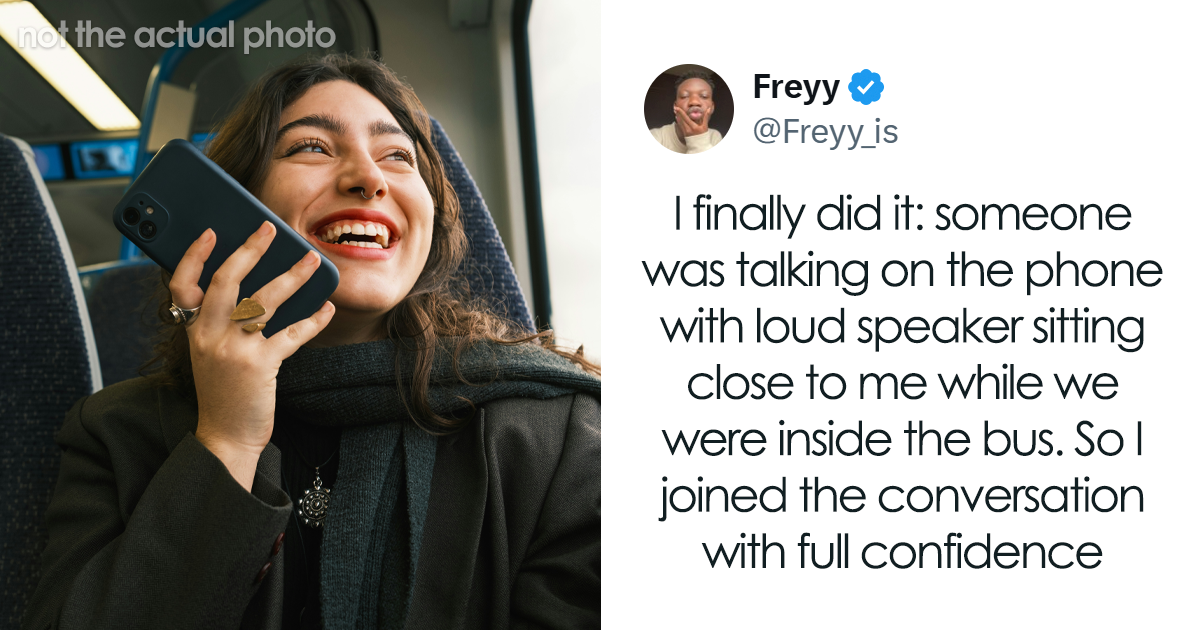
That is why one man’s dry, perfectly timed comeback to a stranger using speakerphone in public hit the internet like a tiny social grenade. The story was simple: a woman was talking loudly on speaker while sitting near him on a bus, he jumped into the conversation, and when she looked offended, he replied that he thought it was a group call because she had put it on loudspeaker for everybody. According to the post, she ended the call almost immediately. The internet, naturally, stood up and slow-clapped.
But this viral moment was bigger than one smart remark. It touched a nerve because public phone etiquette is one of those rare issues that unites people across age groups, transit systems, restaurants, airport lounges, and probably three-fourths of the coffee shops in America. Surveys, etiquette reporting, and behavioral research all point to the same thing: people really do not enjoy being unwilling extras in someone else’s phone call.
What Happened in the Viral “Group Call” Story?
The viral post that fueled this conversation appeared on X in October 2025. In it, the poster described sitting on a bus near a woman who was having a loud call on speaker. Instead of gritting his teeth and staring into the middle distance like a deeply inconvenienced commuter philosopher, he joined the conversation “with full confidence.” When the woman gave him a shocked look, he delivered the now-famous line about assuming it was a group call. She reportedly told the person on the other end that she would call back and ended the conversation.
The story was later amplified by internet culture coverage and by comment threads full of people sharing their own fantasies, near-misses, and successful acts of mild public pettiness. Even the headline’s popularity says something important: people did not just laugh because the comeback was funny. They laughed because it felt earned.
Why This Clapback Landed So Hard Online
It turned a private act into a public joke
Speakerphone in public is weird because it blurs the boundary between private and public behavior. A phone call is usually intimate, or at least semi-private. The moment somebody puts it on speaker in a shared space, the call becomes a performance whether everyone agreed to attend or not. That helps explain why the comeback worked: it simply pointed out the truth everyone else was already thinking. Reporting from Business Insider and The Washington Post has framed speakerphone and public FaceTime use as part of a broader breakdown in shared-space norms, especially in transit hubs, restaurants, and other crowded environments.
It felt like social enforcement, not random cruelty
People tend to forgive a sharp comeback when it looks less like bullying and more like a citizen’s arrest for bad manners. That is part of why readers responded so enthusiastically. In a similar Newsweek story from 2025, a man who confronted a shopper making a loud speakerphone call in a public line was widely applauded, and he described the habit as an increasingly common part of public life.
It reflected a frustration many people already have
This is not one of those internet debates where half the comments say “actually, I love hearing strangers discuss their cousin’s divorce in the cereal aisle.” YouGov found in 2024 that 72% of Americans say using speakerphone when others are around is unacceptable, and 79% say speaking loudly on calls is not okay. Older adults are even more strict about it. That means the viral post was not pushing against popular opinion. It was surfing directly on top of it.
Why Public Speakerphone Feels So Rude
Our brains dislike one-sided conversations
Research has long suggested that overhearing one half of a phone conversation can be more distracting than hearing both sides of a conversation in person. The American Psychological Association highlighted findings from researchers at Cornell showing that people are more distracted by one-sided cellphone conversations than by two-sided in-person ones. Psychology Today explained the logic in plain English: when your brain only gets half the conversation, it tries to fill in the missing pieces, which pulls attention away from whatever you were doing. In other words, public speakerphone is not only annoying. It is mentally clingy.
Phones can reduce the quality of human interaction
The issue is bigger than noise. Research summarized by Greater Good at UC Berkeley notes that conversations tend to be rated as lower-quality when smartphones are present, and people report less empathy and connection when phones are out in the open. Even when a phone is not actively hijacking the moment, it can still subtly signal that attention is divided and the people physically present are competing with a screen. That makes the speakerphone problem feel especially rude in shared spaces: it is not only loud, it broadcasts indifference.
Shared spaces depend on tiny acts of cooperation
A bus, train, airport gate, waiting room, or restaurant only works because strangers agree to a loose social contract: keep the chaos to a manageable level. The American Public Transportation Association says Americans took 9.9 billion public transit trips in 2019 and board public transportation 34 million times each weekday. In spaces used that heavily, courtesy is not decorative; it is infrastructure. That is why so many etiquette stories about transit mention the same repeat offenses: loud calls, blasting audio, bags on seats, and acting like a shared carriage is your private living room annex.
Was the Guy Right to Clap Back?
Morally? Many people would say yes. Strategically? That depends on the setting, the mood, and whether the person on speakerphone looks like they might respond with a scene worthy of three security guards and a Reddit post.
A useful thing about this viral moment is that it sits in the sweet spot between direct confrontation and comedy. He did not scream. He did not grab the phone. He did not launch into a TED Talk titled Public Spaces: A Primer for Adults. He used irony to expose the etiquette breach. That is a big reason the story felt satisfying rather than mean. Still, not everyone loves public shaming as a method, and even reaction threads around the viral post included some pushback from people who felt the delivery escalated things or added more noise to an already annoying moment.
Real-life etiquette experts usually recommend a calmer version of the same principle. In Newsweek’s airport story, etiquette expert Diane Gottsman said most people would prefer that loud talkers in public spaces keep their volume low and use earbuds. The lesson is not necessarily “mock strangers on buses.” It is closer to “remember you are not alone, and if someone ignores that fact, other people will notice.”
The Real Lesson: Modern Phone Etiquette Still Matters
The viral joke works because it highlights a rule that many people already accept but too few people follow. Good phone etiquette in public is not complicated, and it does not require a seminar, a monk’s discipline, or a Victorian governess hiding behind the recycling bin.
- Do not use speakerphone in shared public spaces unless there is a real need.
- If you must take a call, lower your volume and keep it brief.
- Use earbuds when possible, but remember that your side of the conversation can still be disruptive.
- Save long, emotional, or highly personal calls for private places.
- If you are traveling, assume everyone around you is already tired, overstimulated, and one bad ringtone away from becoming a poet of resentment.
That advice lines up with broader etiquette guidance from U.S. reporting on airports, trains, restaurants, and general phone behavior. The common thread is simple: shared environments work better when people treat privacy, volume, and attention as collective resources instead of personal accessories.
Why This Story Says Something Bigger About Internet Culture
Viral stories like this thrive because they compress a bigger cultural argument into one tiny, satisfying scene. We live in an era where people increasingly carry their private worlds into public space. Work calls happen at the gate. Family drama spills into the pharmacy line. Video chats pop up in the middle of train cars. Business Insider described public FaceTiming and speakerphone use as part of a broader shift in social norms over the past two decades, where technology can make people mentally exit the space they are physically still occupying. That diagnosis feels uncomfortably accurate.
At the same time, the internet loves low-stakes justice. It adores a comeback that is sharp enough to be memorable but clean enough to be printable on a mug. The “group call” line delivered exactly that. It transformed a universal annoyance into a punchline, and in doing so, it gave people something even better than outrage: permission to laugh at a social norm that clearly needs some repair.
Related Experiences That Make This Story So Relatable
One reason this story spread so fast is that it instantly unlocked a whole library of related public experiences. Readers did not treat it like a strange one-off incident. They treated it like yet another chapter in the long-running national saga of “Why is this person doing that on full volume right next to me?” And the examples are everywhere. People magazine recently highlighted a story about a woman at a four-star restaurant who was bothered by nearby diners using speakerphone during a meal. That setting matters. A restaurant is supposed to be a place where people can hear the people they actually came with, not a surprise bonus episode of someone else’s family logistics meeting.
Airports seem to be another hotspot. Newsweek covered an airport lounge encounter in which a woman asked another passenger to use headphones instead of taking a loud speakerphone call. The confrontation felt awkward, but the practical result was the same one people secretly hope for in these situations: the volume changed, the disruption dropped, and the room regained some dignity. The Washington Post has also advised travelers to find privacy for conference calls and to avoid booming conversations in crowded airport spaces, because planes and terminals are shared environments, not personal podcast studios.
Then there is the line-at-the-store or line-at-the-post-office version of the problem, which may be the purest expression of public speakerphone chaos. In Newsweek’s 2025 story about a shopper on speakerphone, the frustration came from the same source as the bus incident: people waiting in a confined space had no way to opt out. The offender had effectively turned a line of strangers into an unwilling audience. That is the detail many people recognize from their own lives. It is not only that the call is loud. It is that escape is impossible. You cannot mute a grocery line. You can only stand there and learn far too much about someone’s cousin, contractor, or child-care schedule.
Train etiquette stories tell a similar tale. Business Insider reported that etiquette guidance for train travel includes avoiding speakerphone and not acting like your seat area is a private kingdom. That advice sounds obvious, but its continued repetition suggests the behavior is common enough to need saying over and over again. Public transit is one of those environments where a little self-awareness goes a long way. The American Public Transportation Association’s numbers show just how many Americans move through these systems regularly. When millions of people share the same spaces every weekday, even small breaches in courtesy feel larger because they are repeated so often.
There is also a more emotional reason these stories keep resonating: they tap into the feeling that ordinary people are being asked to tolerate more public intrusion than they used to. Speakerphone use, loud videos, and public FaceTiming can make strangers feel as if their attention is being seized without consent. That helps explain why a witty comeback feels so satisfying. It is not merely about winning a tiny social skirmish. It is about restoring the idea that other people in the room still count. In that sense, the famous “group call” response was not just a joke. It was a miniature protest on behalf of everyone who has ever sat on a bus, in a lounge, or in a waiting room silently thinking, “Please. Just one indoor voice. I am begging.”
Final Thoughts
“I Thought It Was A Group Call” became viral because it captured a very modern tension: technology makes it easier than ever to broadcast yourself, while basic manners still ask you to remember the people around you. The guy’s comeback was funny, but it also worked as social commentary in one sentence. That is why the internet loved it. It was petty, yes. But it was petty with purpose.
And maybe that is the real takeaway. If your call is loud enough for strangers to know the plot, the cast, and the emotional stakes, do not be shocked when one of them starts acting like they got invited to the meeting.