

Note: This article is written in standard American English, formatted for direct web publishing, and includes only the HTML <body> section as requested.
In AI, bigger has been the favorite flex for a while. Bigger models, bigger clusters, bigger energy bills, bigger chances your laptop starts sounding like it is preparing for liftoff. Then along comes a different idea with a much calmer attitude: what if a neural network could be smaller, smarter, and more adaptable instead of just more enormous?
That is the promise behind liquid neural networks. These models are designed to handle changing information over time while using fewer parameters than many traditional deep learning systems. Instead of acting like a static stack of layers frozen in place after training, they behave more like a dynamic system, continuously updating their internal state as new data arrives. In plain English, they are built to think in motion.
The phrase “do more with less” is not marketing glitter here. It points to the actual appeal of liquid neural networks: smaller models, continuous-time reasoning, better adaptability in changing environments, and the potential for stronger performance in areas where speed, robustness, and efficiency matter more than raw model bulk. For robotics, time-series prediction, edge AI, and real-world control systems, that is a pretty big deal.
What Are Liquid Neural Networks, Exactly?
A liquid neural network is a type of continuous-time neural network. Instead of processing information in fixed, rigid steps only, it models how internal states evolve over time. The “liquid” part comes from the fact that the network’s behavior is not locked into one static setting. Its internal dynamics can shift depending on the input, which gives it a more flexible way to respond to changing conditions.
If a standard deep neural network is like a train running on a fixed schedule, a liquid neural network is more like a kayak on a river. It still has direction. It still obeys rules. But it adjusts continuously to the water, the rocks, and the current. One system is highly structured. The other is structured and responsive.
That responsiveness matters for tasks where the world refuses to sit still and behave politely. Think drone navigation, autonomous driving, industrial sensors, wearable health monitors, cybersecurity anomaly detection, and financial forecasting. These are all environments where the data changes over time and where yesterday’s pattern may not survive contact with today’s reality.
Why “Do More With Less” Is the Right Tagline
Traditional AI development often follows a simple rule: if the model struggles, throw more parameters at it until the problem becomes too expensive to ignore. Liquid neural networks take a different route. They aim to extract more useful behavior from compact architectures by improving how the model represents time, dynamics, and adaptation.
1. Fewer Parameters, Not Fewer Ambitions
One of the most talked-about benefits of liquid neural networks is that they can remain surprisingly compact. Instead of requiring millions or billions of parameters to track changing patterns, they focus on efficient internal dynamics. That does not mean they beat every large model at every task. It means they can punch above their weight in the kinds of sequential, time-dependent problems where the quality of the dynamics matters as much as the size of the model.
For teams building systems on drones, mobile devices, embedded hardware, or edge computing platforms, this is music to the ears. Smaller models usually mean lower memory use, faster inference, and less power consumption. That is how you move from “interesting demo” to “something we can actually deploy.”
2. Continuous-Time Thinking
Most everyday neural networks treat time as a neat row of discrete snapshots. That works well in many applications, but the real world is not a slideshow. It is a stream. Liquid neural networks are designed to handle that stream more naturally. They model how hidden states evolve in time, which can help them capture complex patterns in signals, events, and actions.
This makes them especially useful for time-series modeling and control tasks. When the input arrives irregularly, changes suddenly, or depends on what happened a split second earlier, continuous-time modeling becomes more than a neat math trick. It becomes practical engineering.
3. Adaptability Under Change
A lot of AI systems look brilliant right up until reality shows up wearing bad lighting, background noise, fog, motion blur, or a completely new environment. Liquid neural networks are interesting because they were built with changing conditions in mind. Their internal states can adjust more fluidly as inputs shift, which may help them remain useful outside the exact training conditions they saw before.
That is one reason they have drawn attention in robotics and autonomy. A robot, vehicle, or drone does not live in a clean benchmark. It lives in the chaos section of the store.
How Liquid Neural Networks Work Without Turning This Into a Calculus Ambush
Under the hood, liquid neural networks are tied to differential equations and dynamical systems. That sounds intimidating, but the idea is simple enough: each unit in the model has a state that changes over time, and that change depends on the input and the network’s current condition.
In classic neural networks, weights and activations do most of the visible work. In liquid models, the story includes something like a time-dependent internal flow. Some versions, such as Liquid Time-Constant networks, let the effective time constants change dynamically based on the incoming signal and the hidden state. This gives the model a way to react quickly to some patterns while staying smoother on others.
Later work on Closed-form Continuous-time models pushed this idea further by reducing some of the computational bottlenecks linked to numerical differential equation solvers. In other words, researchers tried to preserve the benefits of continuous-time reasoning while making the models easier and faster to train and run. Because apparently AI researchers also enjoy solving the problems caused by their earlier brilliant ideas. Respectfully.
Where Liquid Neural Networks Shine
Robotics and Autonomous Systems
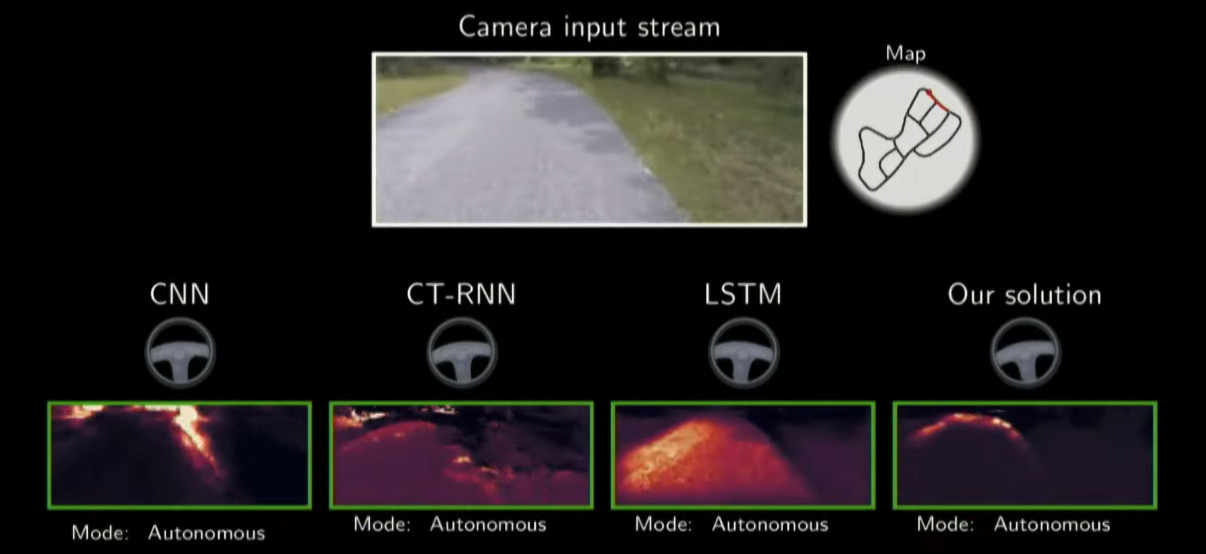
This is the flashy use case, and honestly, it earns the spotlight. Liquid neural networks have been used in autonomous navigation research, including drone systems that had to deal with unfamiliar environments. That matters because real-world autonomy is less about acing a carefully curated test and more about surviving weird conditions without making terrible decisions.
Compact, adaptive networks are attractive here because robots have limited onboard compute. They also need models that respond fast, remain robust under distribution shifts, and offer some interpretability. If a drone is heading toward a tree, “the model felt artistic today” is not an acceptable postmortem.
Time-Series Forecasting
Liquid neural networks also fit naturally into time-series tasks, where data unfolds over time rather than arriving as isolated snapshots. Healthcare monitoring, energy demand prediction, network traffic analysis, weather signals, and industrial sensor data can all benefit from models that handle temporal structure more gracefully.
In these settings, the network’s ability to update continuously can help it capture patterns that simpler static architectures might smooth over or miss entirely.
Edge AI
Edge AI is all about running models close to where the data is created, on local devices rather than distant cloud systems. That means efficiency is not optional. A model that needs massive memory and endless compute is not “edge ready.” It is “desktop drama.”
Because liquid neural networks can be relatively compact and adaptive, they are often discussed as a strong match for edge deployments. Smart cameras, wearables, industrial devices, and autonomous machines all benefit when a model can do useful work without demanding a miniature data center in its backpack.
Why Researchers and Engineers Find Them So Interesting
Liquid neural networks sit at a fascinating intersection of deep learning, neuroscience inspiration, dynamical systems, and efficient AI. They are not just trying to scale up existing architecture patterns. They are rethinking what a neural model should look like when the target environment is unstable, sequential, or safety-sensitive.
That has opened the door to several appealing qualities:
Better Robustness
When the environment shifts, these models may preserve performance better than some more rigid architectures. That does not make them invincible. It makes them worth serious attention in settings where change is guaranteed, not hypothetical.
Interpretability Potential
Compared with giant black-box systems, smaller continuous-time models can be easier to inspect and reason about. In high-stakes applications, that matters. Engineers, regulators, and domain experts usually prefer “we can analyze its behavior” over “the vibes were strong.”
Efficiency With Purpose
Efficiency is often treated like a side quest in AI. With liquid neural networks, it is much closer to the main plot. The goal is not just to make a smaller version of the same old thing. The goal is to build a model whose design is inherently suited to dynamic real-world data.
Are Liquid Neural Networks Better Than Transformers or Traditional RNNs?
Not across the board, and this is where the hype needs a little adult supervision.
Transformers remain dominant for many large-scale language and multimodal tasks because they scale well, benefit from massive training corpora, and have enormous ecosystem support. Traditional recurrent models and modern sequence architectures also remain useful in many production systems.
Liquid neural networks are not a universal replacement for everything that came before. They are better viewed as a specialized and powerful alternative for certain categories of problems, especially where temporal dynamics, efficiency, adaptation, and robustness matter more than brute-force scale.
That is actually good news. AI does not need one architecture to rule them all. It needs the right tool for the job. Sometimes the best answer is a giant foundation model. Sometimes it is a compact dynamical network that can run on-device and react in real time. Different jobs. Different tools. Fewer ego problems.
Challenges Liquid Neural Networks Still Face
They Are Not Yet Mainstream
Liquid neural networks are exciting, but they are still much less common than CNNs, transformers, and conventional recurrent architectures. That means fewer mature toolchains, fewer large-scale case studies, and a smaller talent pool of engineers who have deployed them in production.
Training Can Be More Specialized
Continuous-time systems can introduce additional complexity in model design and training. Researchers have made progress on making these architectures more practical, but they still demand stronger mathematical intuition than many plug-and-play deep learning recipes.
Benchmarks Still Need Expansion
For liquid neural networks to gain broader industry adoption, they need more evidence across more workloads. The early results are promising, especially in robotics and time-dependent tasks, but many organizations still want larger benchmark comparisons, cost analyses, and deployment stories before rewriting their infrastructure plans.
What “More With Less” Really Means for the Future of AI
The deeper lesson behind liquid neural networks is bigger than one architecture. It challenges the assumption that progress in AI must always come from stacking more layers, more parameters, and more compute. Sometimes progress comes from better structure. Better dynamics. Better fit between the model and the world it has to operate in.
That matters because the future of AI is not only in giant models running in giant data centers. It is also in small machines, mobile devices, autonomous robots, industrial sensors, and systems that need to respond right now, right here, with limited power and limited room for error.
In that future, liquid neural networks represent something refreshing: a smarter kind of efficiency. They suggest that a model can be compact without being simplistic, adaptive without being chaotic, and powerful without becoming absurdly bloated. In a field that often celebrates scale like it is a personality trait, that is a welcome shift.
Experiences Related to “Liquid Neural Networks Do More With Less”
One of the most interesting experiences people report when they first explore liquid neural networks is a mix of curiosity and skepticism. At first glance, the idea sounds almost too convenient: a smaller model that can adapt better, process time more naturally, and work well in changing environments. In AI, those claims usually come with a catch the size of a warehouse. But once you start reading the research or experimenting with implementations, the appeal becomes clearer.
A common experience for engineers is realizing that liquid neural networks force you to think differently about model design. If you are used to standard deep learning pipelines, where success often means stacking layers and tuning learning rates until the graph looks less terrifying, liquid models can feel like switching from building with bricks to shaping flowing water. You stop thinking only in terms of depth and width and start thinking about state, dynamics, time, and responsiveness.
That shift can be surprisingly energizing. Instead of asking, “How do I make this network bigger?” the better question becomes, “How do I make this network behave better?” That is a healthier design instinct, especially for teams working on robotics, sensors, wearable devices, or streaming data.
Another experience tied to this topic is the edge-AI perspective. For developers who have tried squeezing powerful models onto limited hardware, the usual process can feel like packing for a two-day trip with an elephant-sized suitcase. Liquid neural networks bring a different mood. The excitement comes from seeing an architecture that was built with compactness and adaptability in mind, rather than optimized first and shrunk later as an afterthought.
There is also an educational experience here. Liquid neural networks make people revisit old assumptions about intelligence in machines. Bigger is not always better. Static is not always stable. And a model that handles change gracefully may be more useful in the real world than one that posts a flashy score on a neat benchmark. That realization can be oddly liberating.
Of course, the experience is not all smooth sailing and elegant theory. Many people also discover that these models require patience. The math can be heavier. The intuition takes time. The tooling is less mature than mainstream architectures. You may not get the same comfort level you get from giant ecosystems built around transformers and standard sequence models. But that challenge is part of the attraction. It feels like working on a frontier rather than following a template.
For researchers, the experience often becomes one of intellectual satisfaction. Liquid neural networks connect machine learning with neuroscience, control theory, and dynamical systems in a way that feels less like trend-chasing and more like genuine scientific exploration. For practitioners, the experience is more practical: can this smaller model run efficiently, adapt fast, and survive contact with messy real-world data? When the answer starts leaning toward yes, interest grows quickly.
In that sense, the phrase “do more with less” becomes more than a slogan. It describes the emotional experience of discovering that efficient AI does not have to mean compromised AI. Sometimes less computation, less model bulk, and less architectural excess can create room for more agility, more clarity, and more real-world usefulness. That is a pretty satisfying trade.
Conclusion
Liquid neural networks are not hype-free magic, but they are one of the more compelling ideas in modern AI architecture. By combining compact design with continuous-time dynamics, they offer a strong alternative for real-time, sequential, and changing environments where efficiency and adaptability matter. They may not replace every large-scale model, but they point toward a future where AI systems become smarter by being better designed, not just bigger. And honestly, that is the kind of glow-up the field could use.