

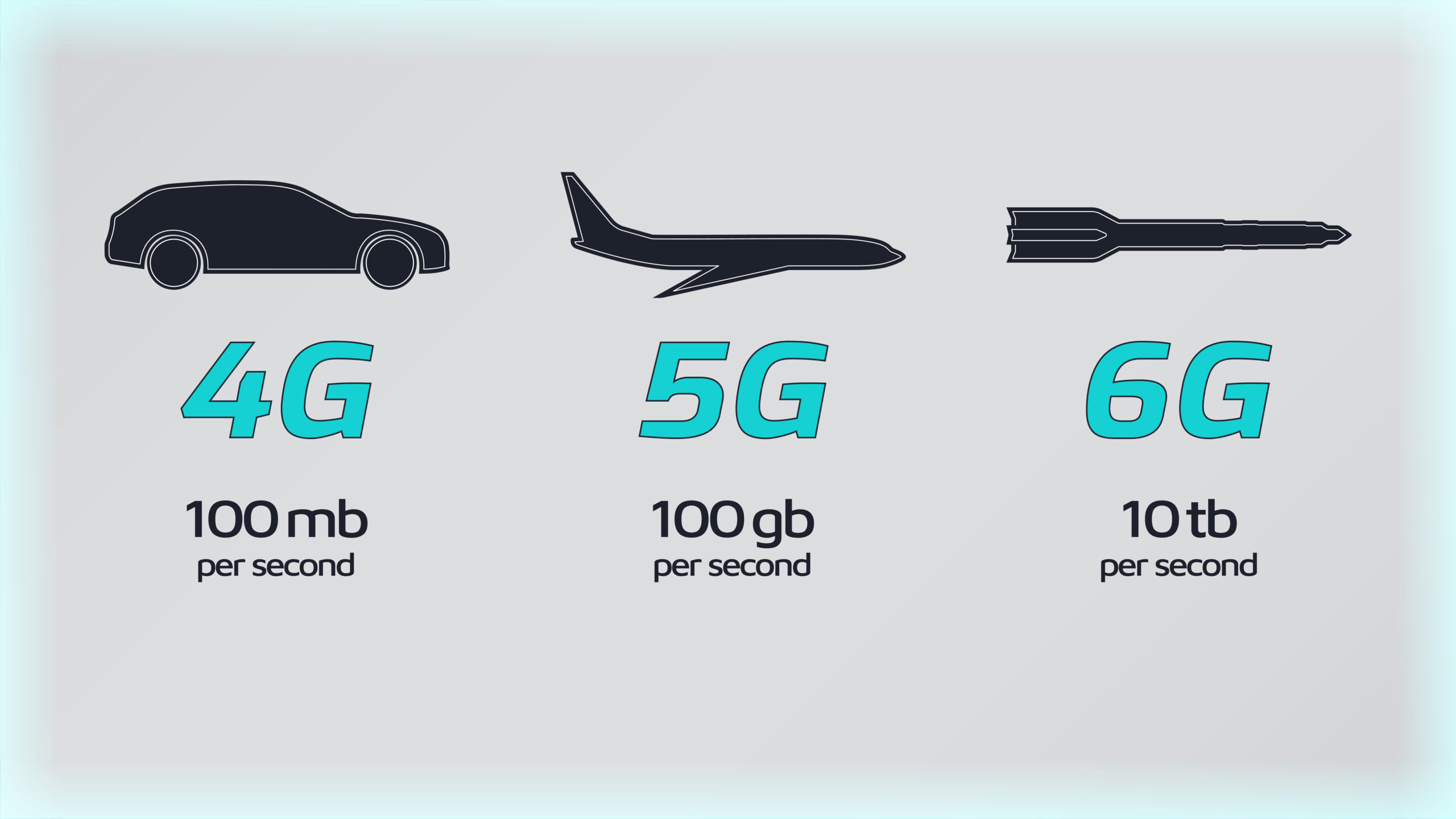
Wireless communication has evolved rapidly over the past few decades, with each new generation bringing significant improvements in speed, connectivity, and functionality. From 4G to 5G and the upcoming 6G, these technologies are shaping how we communicate, work, and interact with the digital world. Understanding their key differences helps you grasp the future of connectivity.
Overview of 4G, 5G, and 6G
- 4G (Fourth Generation): Introduced high-speed mobile internet, enabling smooth video streaming, mobile apps, and online gaming.
- 5G (Fifth Generation): Focuses on faster speeds, lower latency, and support for massive device connectivity.
- 6G (Sixth Generation): Still under development, expected to deliver ultra-fast speeds and intelligent, AI-driven networks.
Speed Comparison
One of the most noticeable differences between these generations is data speed:
- 4G: Up to 100 Mbps (mobile) and 1 Gbps (fixed)
- 5G: Up to 10 Gbps or higher
- 6G: Expected to reach up to 1 Tbps
This dramatic increase enables more advanced applications and seamless user experiences.
Latency (Response Time)
Latency refers to how quickly data is transmitted between devices:
- 4G: Around 30–50 milliseconds
- 5G: As low as 1 millisecond
- 6G: Near-zero latency (theoretical)
Lower latency is critical for real-time applications like gaming, autonomous driving, and remote surgery.
Connectivity and Capacity
Each generation improves the ability to handle connected devices:
- 4G: Supports thousands of devices per square kilometer
- 5G: Supports millions of devices, ideal for IoT
- 6G: Expected to support even higher density with intelligent network management
This is essential for smart cities and large-scale digital ecosystems.
Technology and Infrastructure
- 4G: Relies on traditional cell towers and LTE technology
- 5G: Uses small cells, beamforming, and massive MIMO
- 6G: Expected to integrate AI, terahertz frequencies, and satellite networks
Each step introduces more advanced and efficient communication methods.
Applications and Use Cases
- 4G: Mobile browsing, streaming, social media
- 5G: Smart homes, autonomous vehicles, augmented reality (AR)
- 6G: Holographic communication, extended reality (XR), advanced AI systems
The scope of applications expands significantly with each generation.
Energy Efficiency and Intelligence
- 4G: Moderate efficiency with limited automation
- 5G: Improved energy efficiency and smarter network management
- 6G: AI-native networks with highly optimized energy usage
6G is expected to be far more intelligent and adaptive than its predecessors.
Challenges and Limitations
- 4G: Limited capacity for modern data demands
- 5G: Infrastructure costs and coverage limitations
- 6G: Still in development, facing technological and standardization challenges
Each generation comes with its own set of hurdles to overcome.
Future Outlook
While 4G remains widely used and 5G continues to expand globally, 6G represents the next frontier of wireless communication. It will likely redefine how humans interact with technology, enabling innovations that are currently beyond imagination.
The differences between 4G, 5G, and 6G networks highlight the rapid evolution of wireless technology. From basic mobile connectivity to intelligent, high-speed ecosystems, each generation builds upon the last to create a more connected world. As we move toward 6G, the possibilities for innovation and transformation are virtually limitless.