

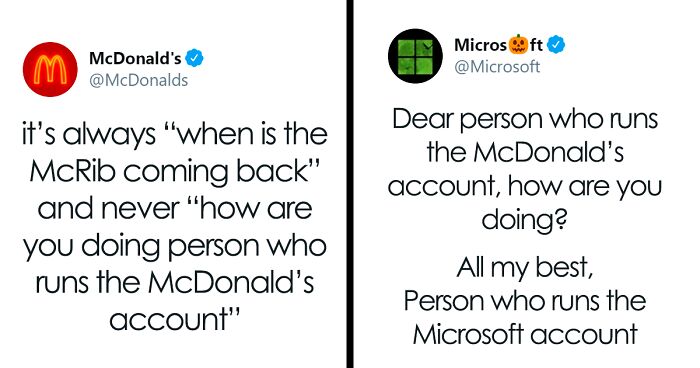
Every once in a while, the internet pauses its regularly scheduled chaos to do something surprisingly sweet. In October 2020, the official McDonald’s Twitter account posted a simple joke about how people always ask when the McRib is coming back but never ask how the person running the McDonald’s account is doing. It was funny, slightly dramatic, and extremely online. Naturally, the internet loved it.
But what turned the post from a quick social media joke into a memorable brand moment was what happened next. Microsoft replied as the “person who runs the Microsoft account,” asking the McDonald’s social media manager how they were doing. Soon, Xbox, Adobe, Target, HBO, Oreo, Facebook, IBM, Pizza Hut, Walmart, Walgreens, Zoom, and several other famous brand accounts joined the conversation. Some sent support. Some made jokes. Some used the opportunity to complain about their own most-asked questions. It became a full-blown support group for people hiding behind giant corporate logos.
On the surface, the exchange was just a wholesome Twitter thread. Underneath, it revealed something much bigger about modern marketing: brands are no longer just broadcasting polished ads. They are expected to sound human, respond quickly, join cultural moments, make jokes, provide customer service, and somehow never have a bad day. That is a lot to ask from one person with a password, a brand guide, and probably too many Slack notifications.
What Happened With the McDonald’s Twitter Account?
The original McDonald’s tweet worked because it took a familiar customer question and flipped it into a joke about emotional neglect. For years, customers have treated McDonald’s social media accounts like a public suggestion box for menu comebacks: bring back the McRib, bring back Snack Wraps, fix the ice cream machine, explain Grimace, release the secret sauce, and please do it before lunch.
The tweet playfully asked people to notice the human being behind the account. That small shift made the post instantly relatable. Anyone who has worked in customer service, content marketing, retail, restaurants, or any public-facing job understood the feeling. People want answers, products, updates, refunds, and jokes on demand. They rarely stop to ask whether the person answering them is running on coffee and vibes.
Microsoft’s reply gave the moment its spark. Instead of responding like a cold corporation, Microsoft leaned into the bit. The account wrote as another social media manager, not as a software empire. That made the conversation feel like two exhausted coworkers meeting in the break room of the internet.
Then other brand accounts arrived, and the thread became a kind of corporate group therapy session. Adobe joked about starting a social media manager support group. Xbox offered emotional backup. HBO nodded to the endless questions about upcoming shows. Oreo referenced its own product nostalgia. Second Life joined with a self-aware joke about people asking whether it still existed. Even entertainment and retail accounts jumped in, proving that every brand account has its own version of “When is the McRib coming back?”
Why the Tweet Went Viral
The post had the perfect ingredients for virality: humor, timing, relatability, and a tiny emotional truth. It was not trying too hard. It did not feel like a boardroom-approved campaign with twelve slides titled “Project Humanize The Burger.” It sounded spontaneous, which is exactly why people responded to it.
It Made a Massive Brand Feel Like a Person
McDonald’s is one of the most recognizable brands in the world. People do not usually imagine a tired social media manager behind the golden arches. They imagine fries, drive-thru windows, Happy Meals, and that one ice cream machine that may or may not be spiritually unavailable. The tweet pulled back the curtain just enough to remind followers that brand accounts are operated by real people.
That is powerful because modern audiences reward brands that feel present, responsive, and culturally aware. Consumers are used to being advertised to, but they are far more likely to engage when a brand sounds like it understands the room. McDonald’s did not need to explain its menu or push a coupon. It simply made a joke that matched the language of social media.
It Invited Other Brands Into the Joke
Brand-to-brand interaction is one of the strangest and most entertaining parts of internet culture. When done well, it feels like watching mascots at a party, except the mascots are legally approved and have quarterly engagement goals. The McDonald’s tweet gave other accounts an easy way to participate: ask how the person was doing, share their own pain, or make a playful complaint about customers asking the same question over and over.
That open invitation helped the thread grow. Each brand that responded brought its own audience, personality, and inside joke. Microsoft brought tech humor. Xbox brought gaming energy. HBO brought entertainment fandom. Oreo brought snack nostalgia. Walmart, Walgreens, Pizza Hut, and Zoom added more familiar voices. The conversation turned into a crossover episode no one scheduled but everyone watched.
It Was Funny Without Being Mean
A lot of brand humor on social media tries to be edgy, sarcastic, or aggressively casual. Sometimes it works. Sometimes it feels like a dad using slang he learned from a TikTok comment section. The McDonald’s tweet succeeded because it was gentle. It did not insult customers. It did not pick a fight. It simply exaggerated a common experience: being asked for things constantly while nobody checks in on you.
That made the joke easy to share. People could laugh without needing context, and brands could join without creating controversy. In a noisy feed, a low-stakes wholesome joke can travel surprisingly far.
The Hidden Work Behind Funny Brand Accounts
The McDonald’s moment also highlighted the reality of social media work. Running a major brand account is not just “posting tweets.” It is strategy, customer service, trend monitoring, crisis awareness, content writing, community management, reporting, approvals, analytics, and constant judgment calls. One post can become a win. One typo can become a meeting.
Social media managers often operate at the intersection of entertainment and support. They are expected to be witty when customers are joking, patient when customers are upset, quick when trends are moving, and careful when public conversations become sensitive. They need to know what the brand can say, what it should never say, and what it can say only if Legal has had lunch.
That pressure explains why the McDonald’s tweet resonated with so many people in marketing. Behind every playful post is a worker balancing creativity with risk. The best brand accounts look effortless because a lot of effort is hiding behind them.
Why Social Media Managers Feel Overlooked
Social media managers are often visible and invisible at the same time. Their work is public, but their names usually are not. Millions of people may see a post, but the person who wrote it may never be recognized outside their own team. When things go well, people praise the brand. When things go badly, everyone wants to know who approved the post.
That imbalance can make the job emotionally heavy. Social teams face constant feedback, and not all of it is friendly. They field complaints, jokes, demands, insults, praise, memes, and random questions that have nothing to do with the brand. They also have to keep up with platform changes, algorithm shifts, trending formats, new slang, brand safety concerns, and leadership expectations.
The McDonald’s tweet gave that invisible labor a public face. It reminded audiences that even the funniest brand posts are written by people doing a job. And sometimes those people would enjoy being asked how their day is going before being asked to resurrect a limited-time sandwich.
What Brands Can Learn From the McDonald’s Moment
The biggest lesson is not “be random on Twitter and hope Microsoft replies.” That strategy is about as reliable as ordering fries and promising yourself you will not eat them in the car. The real lesson is that great social media depends on human understanding.
1. Build a Brand Voice That Can Actually Talk
A strong brand voice is not just a list of adjectives like “fun,” “bold,” and “authentic.” It needs enough flexibility to respond to real conversations. McDonald’s has spent years developing a playful, fan-aware tone that lets it talk about menu nostalgia, pop culture, and customer jokes without sounding lost.
Brands that want similar results need to define how they speak in everyday moments, not just campaign launches. Can the brand joke? Can it be sincere? Can it admit when customers are being funny? Can it reply without sounding like a press release wearing sneakers? Those answers matter.
2. Let Social Teams Be Creative, But Give Them Guardrails
The best real-time social posts usually come from teams that have both trust and structure. Social media managers need room to react quickly, but they also need clear rules. What topics are off-limits? What tone fits the brand? When does a post need approval? Who handles escalations? Without guardrails, speed becomes risky. With too many guardrails, the brand sounds like a parking sign.
McDonald’s viral post felt natural because it matched the platform and the brand’s established personality. It was playful, not reckless. That balance is what every brand should aim for.
3. Understand That Social Media Is Customer Experience
For many consumers, social media is the first place they go to ask questions, complain, praise, compare, and decide whether a brand feels worth their attention. A brand’s reply can shape perception just as much as an ad campaign. Fast, helpful, and human interaction matters.
The McDonald’s thread was not customer service in the traditional sense, but it still improved brand experience. It made followers feel entertained and included. It gave the brand a warmer personality. It created a moment people wanted to share.
4. Humor Works Best When It Comes From Truth
The tweet was funny because it was based on a real pattern. People do ask McDonald’s about the McRib constantly. People do forget that brand accounts are run by humans. Social media managers do feel underappreciated. Humor rooted in truth lands better than humor invented only to chase engagement.
That is an important point for brands trying to be funny online. The goal is not to sound like a comedian. The goal is to notice something your audience already understands and say it in a way that feels fresh.
The Rise of Brand-to-Brand Conversations
Brand-to-brand conversations have become a recognizable part of social media culture. Wendy’s helped popularize the sharp, personality-driven fast-food account. MoonPie, Netflix, Duolingo, Steak-umm, and other accounts have shown that people will follow brands for entertainment, not just deals. McDonald’s has taken a softer and broader approach, often leaning into fan culture, menu nostalgia, and relatable humor.
These interactions work because they transform brands into characters. A customer may not care about a product announcement, but they may stop scrolling when two huge companies behave like coworkers teasing each other in public. That said, there is a fine line between charming and forced. Audiences can smell fake relatability faster than fries disappear from a shared bag.
The McDonald’s support thread worked because participation made sense. Every brand account has a person behind it. Every social media manager has repetitive questions. Every large company has customers asking for something that may not be up to the social team. The joke was universal enough for brands to join without looking desperate.
Why Authenticity Still Matters
Authenticity is one of the most overused words in marketing, but the concept still matters. Audiences do not expect brands to become their friends. They understand that companies sell things. What they do expect is honesty, relevance, and a tone that does not insult their intelligence.
The McDonald’s tweet did not pretend the brand was a person in a literal sense. It simply acknowledged the person operating the account. That subtle distinction made it feel more honest. It was not “the burger has feelings.” It was “someone is managing this conversation, and they are part of the internet too.”
That kind of transparency can make a brand more likable. It reminds people that social media is not just logos shouting into a void. It is a public space where humor, service, entertainment, and community overlap.
The Business Value of a Wholesome Viral Moment
A viral tweet does not automatically sell millions of burgers. Social media success is rarely that simple. However, moments like this can create brand affinity, cultural relevance, and earned attention. They keep a familiar brand in the conversation without relying on a traditional advertisement.
For McDonald’s, the thread reinforced several useful associations: the brand is self-aware, playful, culturally fluent, and connected to its fans. For the other brands that joined, it was a chance to show personality in a low-risk environment. Nobody needed a huge production budget. Nobody needed a celebrity campaign. The currency was timing, wit, and empathy.
That is why social media teams matter. They create small moments that can scale into huge visibility when the timing is right. A single post can remind millions of people that a brand exists, has a voice, and understands the internet’s weird little rituals.
Experience-Based Takeaways: What This Moment Feels Like From the Social Media Side
Anyone who has worked around social media management can recognize the emotional rhythm behind the McDonald’s tweet. The job often looks glamorous from the outside because the output is public and sometimes funny. But the day-to-day experience is usually a mix of planning calendars, checking comments, answering repeated questions, rewriting captions, watching analytics, and trying not to panic when a scheduled post suddenly feels wrong because the news cycle changed.
Imagine sitting down to manage a brand account in the morning. You open the inbox and see dozens or hundreds of mentions. Some people love the brand. Some are angry. Some are confused. Some are tagging the account into memes that make absolutely no sense until you spend ten minutes decoding them. Meanwhile, your team needs a post for a campaign, leadership wants performance numbers, customer service needs help routing complaints, and someone in another department has asked whether you can “make it go viral.” Ah yes, the famous “go viral” button, located right beside the “double engagement by Friday” button.
That is why the McDonald’s moment felt so honest. It captured the strange loneliness of being extremely visible but personally unseen. People interact with the brand, not the person. They ask for products, answers, discounts, fixes, updates, and jokes. The social media manager becomes the voice of a company but often receives very little direct acknowledgment as a worker.
From an experience standpoint, the best social media teams are the ones where managers are trusted, supported, and protected. Creativity improves when people are not constantly afraid of being blamed. Customer care improves when teams have enough resources. Humor improves when the person writing the post understands both the audience and the brand’s boundaries. A viral post may look spontaneous, but it usually comes from a culture that allows smart people to make smart calls quickly.
The McDonald’s thread also shows why empathy is useful in marketing. The tweet did not ask customers to stop loving the McRib. It did not complain harshly. It simply joked about wanting a little human recognition. That soft emotional signal opened the door for other brands and regular users to respond kindly. It became a reminder that even in a marketplace full of logos, dashboards, and engagement metrics, people still respond to people.
For smaller brands, the lesson is especially practical. You do not need a massive following to sound human. You can answer comments with warmth. You can acknowledge repetitive questions with humor. You can set boundaries without sounding robotic. You can let your audience see a little personality, as long as it fits your brand and respects the customer.
For larger brands, the lesson is about investing in the people behind the account. If social media is where customers complain, celebrate, joke, discover, and decide what they think of you, then the person managing that space is not “just posting.” They are shaping public perception in real time. Ask how they are doing. Give them tools. Give them backup. And maybe, once in a while, give them nuggets.
Conclusion
The viral McDonald’s Twitter moment was funny because it was simple, but it lasted because it was true. Customers often see brand accounts as vending machines for answers and entertainment. The tweet gently reminded everyone that there is a real person behind the logo, typing the jokes, reading the replies, and trying to keep the brand voice alive without accidentally starting a meeting with Legal.
When Microsoft and other famous brand accounts responded, the conversation became more than a meme. It became a snapshot of modern social media marketing: human, fast, collaborative, self-aware, and occasionally fueled by fast food nostalgia. For marketers, it remains a great example of how authenticity, humor, and empathy can create a moment people actually want to join.
So yes, people still want to know when the McRib is coming back. But the next time you tag a brand account with a question, it might not hurt to ask the person behind the keyboard how they are doing, too.