

Sand has always had range. It can become a beach, a desert, a castle that collapses when your cousin pokes it, or a mold for molten metal. But thanks to a clever polymer discovery, sand can now do something far more impressive: become a 3D-printed structure with serious strength. We are not talking about “nice for a science fair” strength. We are talking about printed silica sand parts that can outperform conventional sand-binder systems and open new doors for tooling, casting, construction concepts, and advanced manufacturing.
The headline sounds almost suspiciously simple: add a polymer, print sand, make it strong. In reality, the breakthrough is a neat chemistry-meets-manufacturing story. Researchers at Oak Ridge National Laboratory developed a polyethyleneimine, or PEI, binder that helps silica sand particles stick together more effectively during binder jet additive manufacturing. The result is a printed sand material that is stronger, more versatile, and easier to shape into complex forms than many traditional alternatives.
For manufacturers, engineers, foundries, and anyone who has ever wished sand could behave less like sand, this discovery matters. It suggests that low-cost feedstocks such as silica sand can be transformed into high-performance structures through smarter binder chemistry. In plain English: the glue got better, and the sand suddenly started acting like it had been going to the gym.
What Makes 3D-printed Sand So Interesting?
3D-printed sand is not the same thing as scooping beach sand into a hobby printer and hoping for architectural greatness. The process usually involves binder jetting, an additive manufacturing method where a printer spreads a thin layer of powder, deposits a liquid binder in selected areas, then repeats the process layer by layer until a 3D shape forms.
In sand printing, the powder is commonly silica sand or another casting-friendly aggregate. The binder acts like the invisible handshake between the grains. It connects particles only where the digital design requires solid material, while loose sand remains unbound and can be removed later. This makes it possible to create intricate molds, cores, tooling, and parts without carving, machining, or assembling many separate pieces.
Why Binder Jetting Fits Sand So Well
Binder jetting is especially attractive for sand because it does not require melting the material. That is a big deal. Silica sand has a high melting point, and using lasers or heat-based methods would be expensive and complicated. Binder jetting avoids that drama by using chemistry instead of brute force.
The method is also scalable. Industrial sand printers can produce large molds and complex internal cores for metal casting, including parts used in automotive, aerospace, energy, and heavy-equipment manufacturing. A traditional sand mold often needs patterns, core boxes, draft angles, parting lines, and a fair amount of foundry wizardry. A 3D-printed sand mold starts with a CAD file and goes straight to production, which reduces tooling time and allows faster design changes.
The Polymer Discovery: PEI as the Strength Booster
The star of this story is polyethyleneimine, usually shortened to PEI. This polymer is useful because of its chemical structure, particularly its amine groups, which can interact strongly with silica sand surfaces. Those interactions help the binder hold sand grains together more effectively than many conventional binders.
In the Oak Ridge research, PEI was tailored for binder jet printing. That means the polymer was not chosen only because it sounded impressive in a lab meeting. It needed the right viscosity, solubility, and printability for inkjet-style deposition. A binder that is too thick can clog or print poorly. A binder that is too weak creates fragile parts. The sweet spot is a formulation that flows like a printable liquid but cures into a strong bridge between grains.
The results were remarkable. Printed silica sand parts made with the PEI binder reached flexural strength levels that doubled the performance of conventional binder systems in the study. Even more interesting, the parts could be strengthened further through secondary infiltration with cyanoacrylate, a fast-reacting adhesive material many people know by its more dramatic household personality: super glue.
Why the Strength Increase Matters
Binder-jetted parts often begin life as “green parts,” meaning they are printed and cured but still porous and relatively delicate compared with fully dense materials. This porosity is not automatically bad. In fact, it can be useful because it allows another material to infiltrate the structure and fill internal gaps.
With the PEI-bonded sand, researchers showed that infiltration could dramatically improve strength. The PEI binder created a strong starting structure, and the additional infiltrating material used the remaining pore network to form a tougher composite. The lesson is not simply “add glue.” The real lesson is that the binder chemistry, pore structure, and post-processing step can work together like a tiny manufacturing orchestra. Nobody is playing the tuba too loudly; everyone has a job.
A Tiny Sand Bridge With a Big Message
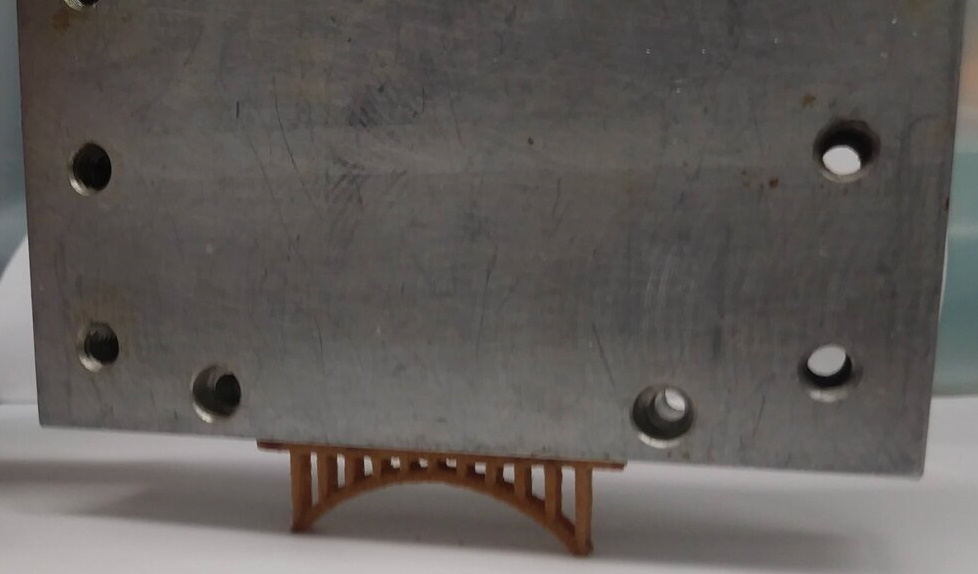
One of the most memorable demonstrations from the research was a 3D-printed sand bridge measuring just 6.5 centimeters. Despite its small size, the bridge could hold hundreds of times its own weight. That kind of demonstration is useful because it turns a technical material result into something people can picture immediately.
A small bridge is not the same as a highway overpass, of course. Nobody should read this and immediately replace civil engineering with a bucket of sand and optimism. But the demonstration shows how geometry and materials can work together. Additive manufacturing allows structures to be designed with curves, voids, channels, ribs, arches, and internal features that would be difficult or costly to make with traditional methods.
In other words, the strength is not only in the material. It is also in the design freedom. A stronger binder lets engineers trust more ambitious shapes. More ambitious shapes can reduce weight, improve airflow, guide molten metal, support tooling, or create forms that look impossible until the printer casually produces them.
Real-world Applications for Super-strong 3D-printed Sand
The most immediate applications are likely in manufacturing rather than consumer products. Nobody is rushing to sell PEI sand coffee mugs at the mall. The strongest use cases are in areas where complex geometry, fast iteration, and low tooling costs matter.
1. Metal Casting Molds and Cores
Sand casting is one of the oldest manufacturing methods in the world, but 3D printing gives it a modern upgrade. Foundries use sand molds and cores to shape molten metal. Traditional cores can be difficult to make when internal channels are twisted, thin, or highly customized. With binder jetting, cores can be printed directly from digital models.
Stronger printed sand could help these molds and cores survive handling, transportation, assembly, and the stresses of casting preparation. Complex one-piece cores may also reduce assembly steps and improve dimensional accuracy. For industries that cast engine parts, pump housings, turbine components, manifolds, or custom replacement parts, that is a serious advantage.
2. Tooling and Dies
Tooling is the quiet hero of manufacturing. It rarely gets the spotlight, but without tooling, most products would remain fancy drawings on a screen. Strong 3D-printed sand composites could be used to create tools, dies, and fixtures faster than traditional fabrication methods.
Because silica sand is relatively inexpensive and widely available, the economics can become attractive for short-run production, prototyping, and customized tooling. Instead of machining a complex tool from solid material, manufacturers could print a near-net-shape sand structure and reinforce it through infiltration.
3. Lightweight Structural Concepts
The PEI binder research also hints at future possibilities in lightweight structural design. Additive manufacturing can create lattice structures, cellular forms, and internal reinforcement patterns that use less material while preserving strength where it matters.
This does not mean 3D-printed sand will replace steel beams next Tuesday. Materials used in construction or structural systems must pass strict testing, codes, durability requirements, moisture studies, fire evaluations, and long-term performance reviews. Still, the research points toward a future where mineral-based printed composites may become more capable, especially in nontraditional or specialized applications.
4. Sacrificial and Washout Tooling
One of the clever features of the PEI system is water solubility. A strong printed structure that can later be washed out is useful when the printed sand acts as temporary tooling. For example, a printed sand form might help shape a composite, ceramic, or metal component, then be removed without aggressive mechanical breaking.
Sacrificial tooling sounds dramatic, like the tool heroically gives its life for the final part. In practice, it means engineers can create internal shapes that are hard to reach after production. A washable sand-based tool could make it easier to manufacture hollow parts, internal channels, or complex cavities.
Why Chemistry Is the Secret Sauce
The breakthrough is a reminder that additive manufacturing is not only about machines. Printers get the photos, but materials do much of the heavy lifting. A faster print head is great, but if the binder is weak, the final part will still disappoint everyone at the inspection table.
PEI works because it improves the interface between polymer and sand. In composite materials, interfaces are often where success or failure begins. If two materials touch but do not bond well, the structure can crack, crumble, or fail under load. If the interface is strong, stress transfers more effectively through the part.
Think of it like building a brick wall. The bricks matter, but the mortar matters too. Sand grains are the bricks. The polymer binder is the mortar. PEI appears to bring better “mortar behavior” to the microscopic world of silica particles.
How This Compares With Traditional Sand Binders
Traditional foundry sand binders include furan, phenolic, inorganic, and other systems, depending on the process and casting requirements. Many of these binders are proven, widely used, and effective for specific jobs. The PEI discovery does not erase decades of foundry knowledge. Instead, it adds a new option to the materials toolbox.
Conventional binders can face limitations in green strength, handling durability, print clarity, environmental behavior, or post-processing flexibility. PEI stands out because it combines printability, strong interaction with silica, reactive infiltration potential, and washout capability. That combination is what makes the discovery more than a simple strength improvement.
In manufacturing, a material rarely wins because of one number. It wins because the full package works: cost, strength, processing speed, reliability, safety, storage, equipment compatibility, environmental requirements, and final part performance. PEI-based sand printing looks promising because it touches several of those points at once.
Challenges Before Wider Adoption
Every exciting material discovery must eventually walk through the less glamorous hallway of scale-up. Lab results are important, but industrial adoption requires repeatable processing, quality control, supply chain stability, printer compatibility, operator training, and cost analysis.
Print Reliability
Binder jetting depends on consistent droplet formation and predictable binder penetration into the powder bed. If the binder spreads too far, details blur. If it does not penetrate enough, layers may not bond properly. A strong binder still needs to behave politely inside a print head, which is a tiny place with very little patience for bad fluid dynamics.
Post-processing Time
Secondary infiltration can create impressive strength, but it also adds a process step. Manufacturers must decide whether the extra strength is worth the added time, material, and workflow complexity. For high-value tooling or demanding applications, the answer may be yes. For simple molds, a conventional binder may still be more practical.
Environmental and Safety Review
Any new binder system must be evaluated for workplace safety, emissions, disposal, washout water handling, and compatibility with existing foundry practices. A material that performs well mechanically still needs to fit responsibly into real manufacturing environments.
Why This Discovery Matters for the Future of Additive Manufacturing
The broader message is that additive manufacturing is entering a materials-first era. Early 3D printing conversations often focused on the machine: nozzle size, build volume, speed, and resolution. Those still matter, but the next wave of progress increasingly depends on chemistry, powder science, binders, infiltrants, and process control.
Strong 3D-printed sand is a perfect example. Sand is cheap and ordinary. The printer is powerful but not magical. The polymer binder is what changes the story. By tuning the chemistry, researchers transformed a familiar material into something with surprising performance.
This has implications far beyond sand. The same mindset can apply to ceramics, metals, recycled materials, construction minerals, bio-based fillers, and hybrid composites. If scientists can design binders that connect particles more intelligently, additive manufacturing can use a wider range of feedstocks and produce stronger, cheaper, more sustainable parts.
Experience-based Insights: What Working With 3D-printed Sand Teaches You
Anyone who has spent time around 3D printing knows that the brochure version and the shop-floor version are rarely identical twins. The brochure says, “Print complex parts directly from CAD.” The shop floor says, “Yes, but first clean the build area, check the powder, verify the binder, control humidity, calibrate the machine, and do not sneeze near the green part.” That is not a criticism. It is manufacturing being manufacturing.
3D-printed sand teaches a valuable lesson: strength begins before the part exists. It starts with the digital model, the sand grain size distribution, the binder chemistry, the layer thickness, the print saturation, the curing cycle, and the way the part is removed from the powder bed. A great design can still fail if the process is sloppy. A simple design can perform beautifully if the material system is dialed in.
In practical terms, the handling stage is often where people first appreciate the value of stronger binders. Freshly printed sand parts can include delicate walls, thin ribs, deep channels, and fragile overhang-adjacent features. Even when the printer does its job perfectly, depowdering and moving the part can become a nervous little ballet. Stronger green strength makes that ballet less terrifying. The technician still needs care, but the part feels less like a cookie made of engineering anxiety.
Another experience-based insight is that complexity should have a reason. Because 3D printing allows wild internal shapes, designers sometimes get tempted to add complexity simply because they can. In sand casting, every curve, channel, and core feature should serve a purpose: better metal flow, reduced turbulence, improved cooling, lower weight, fewer assemblies, or easier post-casting cleanup. Design freedom is powerful, but it should be guided by function, not decorative chaos.
The PEI binder discovery also highlights the importance of post-processing strategy. Infiltration can turn a porous sand form into a much stronger composite, but it must be planned from the beginning. Wall thickness, pore structure, access points, curing behavior, and dimensional tolerance all matter. If a team treats infiltration as an afterthought, results may vary. If it is designed into the workflow, it becomes a strength multiplier.
For foundries, the most exciting practical benefit may be iteration speed. Traditional tooling changes can be expensive and slow. With sand binder jetting, a design update can begin in software and move quickly toward a new printed mold or core. That speed is useful for prototypes, replacement parts, short production runs, and difficult castings where the first design is rarely the final answer. In the real world, iteration is not a luxury. It is how good parts survive contact with physics.
Finally, this topic teaches humility. Sand looks simple, but at industrial scale, it becomes a sophisticated material system. Polymer binders look like supporting actors, but they can decide whether a printed part crumbles or carries hundreds of times its own weight. The discovery of a stronger PEI binder is exciting because it reminds us that innovation does not always require exotic ingredients. Sometimes it requires looking at an ordinary material, asking a better chemistry question, and giving sand the right partner.
Conclusion
The discovery of a PEI polymer binder for 3D-printed sand is more than a fun materials-science headline. It shows how carefully designed chemistry can unlock new performance from low-cost, familiar materials. By improving the bond between silica sand grains, the polymer enables stronger green parts, better post-processing potential, and more ambitious printed geometries.
For industries that rely on molds, cores, tooling, and complex manufacturing workflows, stronger 3D-printed sand could reduce lead times, simplify design changes, and support shapes that traditional methods struggle to produce. The technology still needs careful process control, safety review, and application-specific testing, but the direction is clear: additive manufacturing is becoming smarter because its materials are becoming smarter.
Sand may still make excellent beaches and questionable vacation souvenirs, but with the right polymer, it can also become a high-performance manufacturing material. Not bad for something that usually gets stuck in your shoes.
Note: This article is written for educational and SEO publishing purposes. Industrial use of 3D-printed sand composites should always involve professional engineering validation, material testing, process qualification, and safety compliance.