

On June 6, 1944, before much of the world had finished its first cup of coffeeor, more accurately, before many people even knew history had changedAllied forces began landing on the beaches of Normandy, France. The day became known simply as D-Day, a name so short it almost hides the size of what happened. Nearly 160,000 Allied troops crossed the English Channel by sea and air. Thousands of ships, landing craft, aircraft, engineers, medics, sailors, paratroopers, infantrymen, commanders, and support crews were pulled into one enormous, terrifying mission: break open Nazi-occupied Western Europe and begin the liberation of a continent.
Seventy-five years later, in 2019, the anniversary of the Normandy landings became more than a history lesson. It was a final, fragile opportunity to hear directly from many of the veterans who had survived the beaches, the hedgerows, the field hospitals, and the memories. By then, the young soldiers of 1944 were men in their 90s and beyond. Their voices were softer, their steps slower, but their stories still carried the weight of thunder.
Remembering Normandy is not about turning war into legend or polishing grief until it shines too brightly. It is about honoring the lives lost, recognizing the lives saved, and understanding how ordinary peoplemany barely older than high school seniorswere asked to do something so difficult that the world still pauses to say thank you.
What happened on D-Day?
D-Day was the opening assault of the Normandy campaign, part of the larger Allied plan known as Operation Overlord. The seaborne landing phase was called Operation Neptune. Allied troops from the United States, Britain, Canada, and other nations landed across five beaches: Utah, Omaha, Gold, Juno, and Sword. Each beach had its own geography, defenses, and horrors. Omaha Beach, where American forces faced some of the fiercest resistance, became one of the most haunting names in military history.
The invasion was not a spontaneous sprint across the Channel. It was the result of years of planning, deception, training, logistics, and, yes, weather anxiety. General Dwight D. Eisenhower, the Supreme Allied Commander, had to make the final call under miserable conditions. A delay had already pushed the invasion from June 5 to June 6. Imagine planning the largest amphibious operation in history and then having to argue with the sky. Weather, tide, moonlight, enemy defenses, and the readiness of millions of troops all mattered.
When the operation began, airborne troops dropped behind enemy lines in darkness. Many landed far from their intended zones, scattered across fields, marshes, and villages. Naval forces bombarded German positions. Landing craft carried men toward the beaches under fire. Some soldiers drowned under the weight of their equipment before they ever reached land. Others fought through mines, barbed wire, artillery, and machine-gun fire. The word “beach” usually suggests towels, sunscreen, and someone losing a flip-flop. On D-Day, it meant survival by inches.
The lives lost in Normandy
The human cost of D-Day was staggering. Allied casualties on June 6 have often been estimated at more than 10,000 killed, wounded, missing, or captured. American casualties were especially heavy at Omaha Beach, where the first waves encountered devastating resistance. Exact numbers vary among historians because battlefield reports were chaotic, units were scattered, and many losses were not immediately recorded. But the uncertainty of the numbers does not reduce the certainty of the sacrifice.
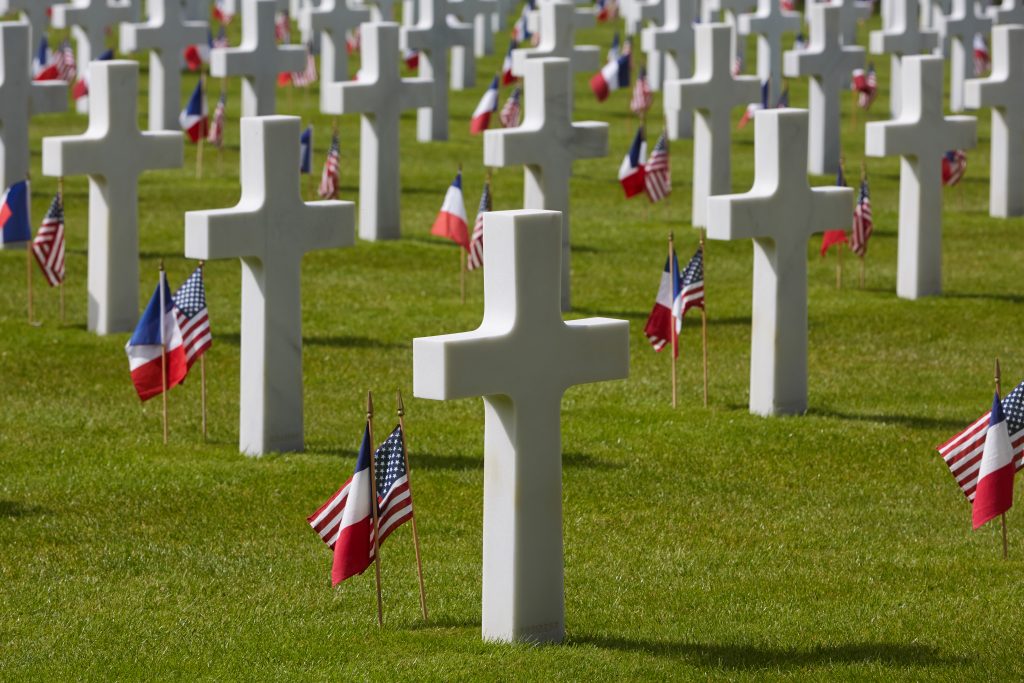
At the Normandy American Cemetery in Colleville-sur-Mer, rows of white crosses and Stars of David stand above Omaha Beach. Nearly 9,400 American war dead are buried there, and the names of many more missing are carved into memorial walls. The cemetery is not simply a place where history is stored. It is a place where silence does the talking. Visitors often describe the same experience: first, the beauty of the site; then, almost instantly, the realization that the beauty is built around loss.
Many of the dead were young. Some had never voted. Some had never married. Some had letters in their pockets, family photographs in their helmets, or jokes they planned to tell when they got home. They came from farms, cities, reservations, suburbs, mills, and small towns whose names rarely appear in history books. In Normandy, they became part of a story larger than any one hometownbut the grief remained personal. Every headstone marks a family that waited, hoped, and then learned the knock at the door was not bringing good news.
The lives saved by courage, medicine, and stubborn hope
The title of remembrance must include not only those who died but also those whose lives were saved. D-Day was a battle of bullets and bombs, but it was also a battle of bandages, morphine, stretchers, plasma, and raw human nerve. Medics, Navy corpsmen, surgeons, nurses, litter bearers, and aid-station teams worked under conditions that would make a modern emergency room look like a luxury resort with excellent lighting.
One of the most powerful examples is Waverly B. Woodson Jr., a young African American medic serving with the 320th Barrage Balloon Battalion. Wounded during the landing, he continued treating others for hours under fire. His story has received renewed attention because it shows how battlefield heroism often happened without cameras, speeches, or fair recognition. Woodson’s service also reminds us that Black American troops fought for democracy overseas while facing segregation and discrimination at home. History, like people, can be complicated and still demand respect.
Another unforgettable figure is Charles Norman Shay, a Penobscot medic who landed at Omaha Beach and rescued wounded soldiers from the surf. He later became a guardian of D-Day memory in Normandy, helping ensure that Native American contributions to the invasion were not forgotten. His courage was not the loud kind. It was the repeated decision to go back into danger because someone else was still breathing.
Then there were men like Ray Lambert, a U.S. Army medic at Omaha Beach, who treated the wounded even after being injured himself. Stories like these help widen our understanding of what “saving lives” means. It was not only the grand strategy of opening a second front in Europe. It was also one medic pressing a bandage against a stranger’s wound, one sailor pulling a soldier out of the water, one paratrooper holding a crossroads long enough for others to move, one engineer clearing a path through obstacles while the beach erupted around him.
Why Normandy mattered to the world
D-Day did not end World War II. The fighting in Normandy continued for weeks, and the liberation of France took many more battles. Nazi Germany did not surrender until May 1945. But the Normandy invasion created the foothold the Allies needed in Western Europe. It forced Germany to fight on multiple fronts, strengthened the momentum toward liberation, and showed occupied nations that the promise of freedom was no longer only a rumor whispered in the dark.
The success of D-Day depended on alliance. Americans, British, Canadians, Free French forces, and service members from many other nations played essential roles. The invasion also depended on people who never landed on the beaches: factory workers, codebreakers, meteorologists, nurses, resistance fighters, merchant mariners, railway saboteurs, and families who endured years of wartime uncertainty. Normandy was a military operation, but it was also a massive human network held together by purpose.
That is one reason the 75th anniversary mattered so deeply. It was not just a ceremony for veterans. It was a reminder that democracy is not self-maintaining. It does not run like a dishwasher where you press “normal cycle” and wander off. It requires attention, sacrifice, courage, and sometimes the willingness of free nations to act together when tyranny grows hungry.
Remembering the veterans at the 75th anniversary
In 2019, ceremonies in Normandy, Britain, and the United States brought together veterans, world leaders, military families, historians, students, and ordinary visitors. The mood was solemn, grateful, and unusually urgent. Everyone knew time was thinning the ranks of those who could say, “I was there.” A veteran who had once leapt from aircraft or stormed through surf might now need help standing for applause. That contrast made the anniversary even more moving.
Many veterans did not speak of themselves as heroes. This was almost a theme of the Greatest Generation: do something astonishing, save lives under fire, help defeat fascism, then shrug and say, “We just did our job.” It is admirable, though frankly inconvenient for writers trying to describe heroism. Their humility does not make their actions smaller. It makes the rest of us lean closer.
For families, the 75th anniversary offered a bridge between private memory and public history. Grandchildren and great-grandchildren walked beaches their relatives had crossed under fire. Some carried medals. Some carried photographs. Some carried questions that could no longer be answered. That is the bittersweet work of remembrance: we preserve what we can, admit what we do not know, and refuse to let silence erase the cost.
The role of ordinary people in extraordinary history
One danger of remembering D-Day is making it seem inevitable. We look backward and see the Allied victory, the liberation of Paris, the defeat of Nazi Germany, and the postwar order that followed. But the men in the landing craft did not have the luxury of hindsight. They had seasickness, fear, wet uniforms, heavy packs, and orders. They did not know whether the invasion would succeed. Eisenhower even prepared a message accepting responsibility in case it failed.
That uncertainty makes their courage more meaningful. Courage is not confidence with a brass band. Courage is fear that keeps moving. The soldiers who stepped into the surf at Normandy were not marble statues. They were human beings with nerves, doubts, and a powerful interest in living. The fact that they went forward anyway is why the world remembers them.
The same is true of the civilians of Normandy. French towns and villages paid a terrible price during the invasion and the campaign that followed. Bombardments, displacement, destroyed homes, and civilian deaths were part of the liberation story. To remember Normandy honestly, we must honor not only military sacrifice but also the suffering of civilians caught between occupation and freedom. Liberation was joyous, but it was not painless.
How to remember D-Day without turning it into a slogan
Good remembrance requires more than posting a flag once a year. It asks us to learn names, read letters, visit archives, listen to oral histories, and teach younger generations that freedom has a price tag history keeps trying to show us. The Library of Congress Veterans History Project, museum collections, cemetery records, and military archives preserve thousands of voices and documents. These resources help rescue D-Day from becoming a flat textbook paragraph.
Parents and teachers can make Normandy real by focusing on individual stories. A teenager may not immediately connect with “amphibious invasion logistics,” which sounds like a phrase designed to make coffee nervous. But tell that same student about a medic treating wounded men for 30 hours, a paratrooper landing in the wrong field, or a family receiving one final letter, and history begins to breathe.
Remembering also means resisting the temptation to romanticize war. D-Day was necessary, but it was not glamorous. The goal of honoring veterans is not to make battle look attractive. It is to understand what was demanded of them, what they gave, and why preventing such horrors matters. The best tribute to those who fought is not a hunger for more war. It is a serious commitment to peace, liberty, and moral courage.
What Normandy still teaches us
Normandy teaches that alliances matter. It teaches that preparation matters. It teaches that leadership matters, especially when no option is clean or easy. It teaches that young people are capable of astonishing bravery and that societies should be very careful about the causes for which they ask the young to risk everything.
It also teaches that memory is a duty. The veterans of D-Day carried memories many could barely speak aloud. Some returned to Normandy decades later and found gratitude waiting for them in the villages and cemeteries of France. Others never returned. Some never left. The anniversary ceremonies, the cemetery visits, the oral histories, and the quiet family conversations all form part of a larger promise: the lives lost will not become anonymous, and the lives saved will not be taken for granted.
Seventy-five years after the landings, the world paused because Normandy was not only about a battle. It was about the fragile line between tyranny and freedom, despair and rescue, death and survival. That line was held by people who were cold, frightened, brave, wounded, determined, and young. Their story deserves more than applause. It deserves attention.
Experience reflection: standing with memory in Normandy
To understand Normandy as an experience, imagine arriving not as a soldier, but as a visitor with dry shoes, a full stomach, and the strange privilege of safety. The first thing that may surprise you is how peaceful the beaches look. The tide moves in and out as if nothing terrible ever happened there. Children may run near the water. Grass bends in the wind. The sky can be ridiculously blue, almost rude in its beauty. And then you remember what happened on that sand, and the landscape changes without moving.
At Omaha Beach, distance becomes emotional. The stretch from the waterline to the bluffs does not seem abstract anymore. You picture men leaving landing craft under fire, some falling immediately, others pushing forward because stopping was not really an option. The beach is wide enough to make you feel exposed even in peacetime. In wartime, under machine-gun fire, it must have felt endless. That is when the word “courage” stops sounding decorative.
At the Normandy American Cemetery, the experience becomes quieter. The rows of white markers create a kind of visual rhythm, beautiful and devastating at the same time. You may notice a name, then a state, then a date. One marker becomes one person. Then you look up and see thousands more. The mind tries to understand the scale, but the heart usually gets there first. Visitors often lower their voices without being told. Even the wind seems to behave with respect.
What stays with many people is not only sadness, but gratitude mixed with responsibility. Gratitude says, “They gave so much.” Responsibility asks, “What will we do with what they preserved?” That question follows visitors away from the cemetery, into museums, churches, villages, and cafés where photographs of veterans still appear in windows. Normandy is not frozen in 1944. It is alive, and that makes its memory stronger. People live there, farm there, study there, and welcome strangers who come to remember.
The most powerful experiences are often small. A child placing a flag beside a grave. A veteran touching the sand. A family reading a letter from someone who never came home. A guide explaining that a quiet lane was once a battlefield. These moments do not need dramatic music. They already contain enough truth.
Remembering the lives lost and lives saved in Normandy means allowing the past to interrupt our comfort. It means standing in a peaceful place and recognizing that peace was purchased by people who did not know whether they would survive the morning. It means honoring medics who saved strangers, soldiers who carried friends, sailors who kept landing craft moving, pilots who crossed dangerous skies, and civilians who endured the cost of liberation. Above all, it means refusing to let D-Day become merely a date. Normandy is a warning, a lesson, and a promise. The warning is that freedom can be threatened. The lesson is that courage can answer. The promise is that memory, faithfully kept, can still save something in us.
Conclusion
Remembering Normandy 75 years later is not an exercise in nostalgia. It is an act of moral attention. D-Day reminds us that history is shaped not only by generals and maps but by medics, privates, sailors, nurses, civilians, and families who carry the cost long after the headlines fade. The lives lost in Normandy deserve names, not numbers alone. The lives saved deserve recognition, too, because survival on June 6, 1944, often depended on the courage of someone willing to crawl, lift, treat, guide, or return under fire.
The beaches of Normandy are peaceful now, but their silence is not empty. It speaks of sacrifice, alliance, grief, rescue, and responsibility. The 75th anniversary gave the world a chance to listen while some of the last living witnesses were still among us. Our task now is to keep listening, keep learning, and keep teaching. The best way to honor D-Day is not only to remember what happened, but to protect the values for which so many riskedand gavetheir lives.
Note: This article is based on documented historical information from reputable U.S. sources, including national museums, government archives, military history records, veterans’ oral-history collections, public broadcasting reports, and battlefield memorial resources. No source-link markup or citation placeholders have been inserted so the HTML remains clean for web publishing.