

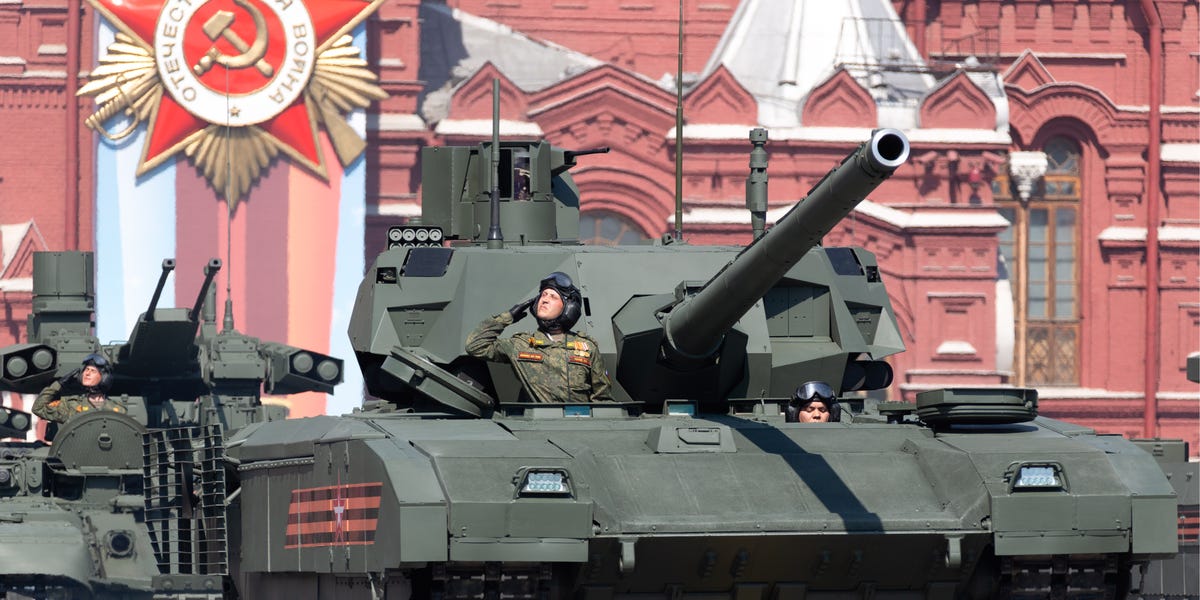
Russia’s T-14 Armata tank has been called many things: a next-generation main battle tank, a prestige weapon, a technological leap, and, depending on who is talking, either the future of armored warfare or the most expensive parade guest in Moscow. The truth is less dramatic than a defense expo brochure, but far more interesting. Russia has field tested the Armata under real-world conditions, including reported trials in Syria and limited use or testing connected to the Ukraine war, yet the tank’s path from prototype superstar to everyday battlefield workhorse remains complicated.
The Armata matters because it is not just another upgrade of a Soviet-era design. Unlike the T-72, T-80, or T-90 families, the T-14 was built around a new concept: an unmanned turret, a protected crew capsule, digital systems, active protection, and a modular heavy tracked platform. In theory, that gives Russia a modern tank designed for a battlefield crowded with anti-tank missiles, drones, precision artillery, and sensors. In practice, theory has a bad habit of meeting mud, maintenance crews, production budgets, and the occasional drone with a grudge.
What Is the T-14 Armata?
The T-14 Armata is Russia’s most ambitious main battle tank program in decades. Publicly unveiled during the 2015 Victory Day parade, it was presented as a clean-sheet design rather than a modernization of an older platform. Its most famous feature is the unmanned turret, which separates the three-person crew from the ammunition and main gun. The crew sits in an armored capsule inside the hull, a layout intended to improve survivability if the turret is hit.
The tank is built on the broader Armata universal tracked platform, which was also intended to support other armored vehicles, including heavy infantry fighting vehicles and recovery vehicles. That modular idea sounds tidy on paper, like using the same phone charger for every device in the house. In military procurement, however, “tidy” often becomes “expensive, delayed, and requiring another committee.”
Why Field Testing the Armata Matters
Field testing is where a weapons system leaves the showroom and starts sweating. A tank can look excellent during a parade, a controlled trial, or a promotional video, but combat-like conditions reveal different truths. Dust gets into sensors. Heat stresses engines. Crews discover that a maintenance hatch is located exactly where no human hand wants it to be. Electronics that behaved politely at the factory may become temperamental in the field.
Russia has used overseas deployments, especially in Syria, as a proving ground for new military systems. Reports in 2020 said the T-14 Armata had been sent to Syria for testing under field conditions. That did not necessarily mean the tank was charging across the desert like an action-movie extra. It more likely meant Russia wanted to observe how the platform behaved outside a domestic test range, including how its mobility, sensors, communications, climate tolerance, and logistics performed in a less forgiving environment.
The Syria Test: Real Conditions, Limited Clarity
The reported Syria testing gave the Armata program a useful talking point: the tank had been tested beyond Russia’s borders. But the details remained limited. Public reporting did not clearly establish whether the T-14 saw direct combat, how many vehicles were involved, or what exact lessons engineers collected. That uncertainty is important. “Field tested” does not automatically mean “combat proven.” It can mean anything from operating near a conflict zone to running selected trials in harsh terrain.
Still, even limited field testing can be valuable. Syria offered heat, dust, rough roads, and a battlefield environment where Russia could observe modern threats. For a new tank packed with electronics, cameras, sensors, and automated systems, that kind of environment is a serious exam. A parade route tests whether a vehicle can move in a straight line while everyone salutes. A real operating environment tests whether the vehicle can keep working after the saluting stops.
Ukraine and the Armata Question
The Russia-Ukraine war turned the Armata question into a larger debate: if the T-14 is so advanced, why has it not appeared widely in combat? Russian state-linked reporting in 2023 claimed that Armata tanks had been used to fire on Ukrainian positions but had not taken part in direct assault operations. Other reporting suggested limited deployment followed by withdrawal. Later comments from Russian defense-industry leadership emphasized cost and practicality, with the T-90 family described as a more efficient option for current needs.
This is where the Armata story becomes less about a single tank and more about wartime economics. Modern warfare punishes expensive equipment quickly. A tank that costs several times more than an upgraded T-72 or T-90 must deliver a major advantage to justify its use. If commanders fear losing a rare and symbolic vehicle to artillery, mines, drones, or anti-tank missiles, they may keep it away from the most dangerous sectors. No military wants its “future of armored warfare” turned into a viral wreck photo by lunchtime.
Key Features of the Armata Tank
Unmanned Turret
The unmanned turret is the T-14’s headline feature. By moving the crew into the hull, the design aims to reduce crew exposure and improve survivability. This differs from traditional Russian tanks, where ammunition storage and crew spaces have often created serious vulnerabilities. The concept is bold, but it also increases dependence on cameras, sensors, digital controls, and automated loading systems.
Armored Crew Capsule
The crew capsule is designed to protect the commander, gunner, and driver in a heavily armored compartment. In theory, this gives the crew a better chance of survival if the turret is damaged. It also reflects a broader global trend: modern armored vehicle design increasingly treats crew protection as a central requirement, not a luxury feature.
Active Protection System
The T-14 is associated with the Afghanit active protection system, which is intended to detect and counter incoming threats such as anti-tank guided missiles and rockets. Active protection is one of the most important developments in armored warfare because traditional armor alone is no longer enough. The modern battlefield is full of weapons designed specifically to make tanks have a very bad afternoon.
125mm Main Gun
The Armata carries a 125mm smoothbore main gun, paired with an autoloader. Russia has also discussed potential future upgrades, but the current public focus remains on the 125mm system. The gun is part of a broader package that includes fire-control systems, optics, and onboard electronics. In a tank, the gun matters, but the ability to find, track, and hit targets under stress matters just as much.
Why Russia Has Not Mass-Deployed the T-14
The biggest challenge facing the Armata is not whether it looks impressive. It does. The challenge is whether Russia can build it in useful numbers, maintain it in combat, train crews and mechanics, and justify its cost during a grinding war. Reports over the years have pointed to production delays, technical challenges, and cost concerns. This is not unusual for advanced armored vehicles, but it is especially difficult when a country is also trying to replace battlefield losses at scale.
Russia’s current armored strategy appears to favor upgraded and refurbished tanks that can be produced or restored more quickly. The T-72, T-80, and T-90 families are familiar to Russian crews, easier to support, and already integrated into military logistics. They may not offer the same futuristic architecture as the Armata, but they are available. In war, available equipment often beats perfect equipment still waiting for its software update.
The Drone Problem
Any discussion of the Armata must include drones. The war in Ukraine has shown that tanks now operate under constant observation and attack from small unmanned systems. First-person-view drones, loitering munitions, artillery spotting drones, and sensor networks have changed the armored battlefield. Even advanced tanks can be vulnerable if they are spotted, tracked, immobilized, or attacked from above.
This does not mean the tank is dead. That phrase appears every few years, usually right before another army buys more tanks. But it does mean tanks need better protection, electronic warfare support, counter-drone systems, infantry coordination, engineering support, and camouflage. A tank is no longer a lone steel beast. It is part of a larger battlefield ecosystem. Without that ecosystem, even a very expensive machine can become an armored piñata.
Armata vs. T-90: Prestige or Practicality?
The T-90M has become more relevant to Russia’s current war effort than the T-14 because it is practical. It is modernized, available in greater numbers, and easier to support than a low-rate next-generation platform. The Armata may be more advanced in design philosophy, but the T-90 fits the urgent need for replacement vehicles and battlefield continuity.
This is the classic defense procurement argument: should a military buy a smaller number of advanced systems or a larger number of proven systems? The answer depends on the mission, the budget, and the threat. In Russia’s case, heavy armored losses and the need for rapid production have made the practical option more attractive. The Armata remains a symbol of technological ambition, while the T-90 remains the tank Russia is more likely to send into hard fighting.
What the Field Tests Reveal
Field tests reveal that the Armata is real, but they do not prove it is ready for mass combat deployment. The tank has moved beyond mock-up status, and Russia has invested years in developing its systems. However, public evidence suggests the platform remains limited in number and carefully managed. The Armata seems less like a standard battlefield tool and more like a high-value experimental asset.
That does not make it irrelevant. Technologies tested on the T-14 may influence future Russian armored vehicles. Its crew capsule, unmanned turret, digital architecture, and protection systems point toward where tank design is heading. Even if the Armata itself never becomes common, its ideas may survive in later platforms. Sometimes a weapons program changes the future not by entering mass service, but by teaching engineers what works, what breaks, and what costs too much.
How the Armata Changes the Conversation About Modern Tanks
The Armata forces analysts to think beyond simple armor thickness and gun size. Modern tanks are judged by survivability, sensor integration, networking, crew protection, mobility, repairability, and cost. A tank that cannot be produced at scale may have limited strategic value, no matter how advanced it looks. A tank that cannot survive drones, mines, artillery, and electronic warfare will struggle no matter how glossy the brochure is.
The T-14 also shows that innovation is risky. Moving to an unmanned turret can improve crew safety, but it creates dependence on electronic vision systems. Adding active protection can improve survivability, but it increases complexity and maintenance demands. Building a new platform can unlock future upgrades, but it requires new supply chains and training pipelines. In short, the Armata is not just a tank. It is a rolling reminder that every breakthrough brings homework.
Experience Section: Lessons From Watching the Armata Story Unfold
Following the Armata story feels a little like watching a highly advertised gadget launch that never quite reaches store shelves. The product looks exciting. The early demonstrations are polished. The feature list is long enough to make competitors nervous. Then come the delays, the production questions, the price discussions, and the quiet realization that making one impressive machine is very different from making hundreds of reliable machines during wartime.
One practical lesson from the Armata experience is that battlefield credibility cannot be declared; it has to be earned. A tank may have an unmanned turret, advanced protection, and a futuristic layout, but soldiers and commanders judge equipment by simpler standards. Does it start? Can it be repaired quickly? Are spare parts available? Can crews train on it regularly? Can it survive the messy, unfair, noisy reality of combat? These questions are not glamorous, but they decide whether a weapon becomes a mainstay or a museum piece with good public relations.
Another lesson is that modern armored warfare has become brutally transparent. In earlier decades, a new tank could be tested, deployed, or hidden with far less public scrutiny. Today, satellites, drones, smartphones, open-source investigators, and battlefield videos create a crowded information environment. If a rare tank appears near a war zone, people notice. If it disappears, people notice that too. The Armata’s limited visibility has become part of its story because absence now speaks almost as loudly as presence.
There is also a lesson about cost. Expensive military technology is not automatically bad. Advanced systems often cost more because they solve difficult problems. But wartime production rewards equipment that can be built, repaired, and replaced. If a country is losing armored vehicles quickly, it may choose “good enough and available” over “excellent but rare.” That choice may sound boring, but logistics has been ruining dramatic plans since humans first tried to move heavy objects with other humans yelling nearby.
For defense observers, the Armata is useful because it separates marketing from military reality. The tank includes serious design ideas that deserve attention, especially crew protection and unmanned turret architecture. At the same time, its limited deployment shows that advanced design does not guarantee operational success. The future of tanks will likely include more automation, better sensors, active protection, drone integration, and electronic warfare defenses. But every future tank will still face old questions: Can it be produced? Can it be maintained? Can crews trust it? Can commanders risk losing it?
The Armata’s field testing, therefore, is not a final verdict. It is a chapter. Russia has shown that it can create a modern tank concept with ambitious features. It has not yet shown that the T-14 can become a widely used battlefield platform. Until that happens, the Armata will remain both impressive and unresolved: a tank that points toward the future while struggling with the present.
Conclusion
Russia field testing the new Armata tank is significant, but not because it instantly changes the balance of armored warfare. The T-14 Armata represents a major design departure from older Russian tanks, with its unmanned turret, protected crew capsule, active protection ambitions, and digital systems. Its reported testing in Syria and limited references connected to Ukraine show that Russia has sought real-world feedback on the platform.
Yet the Armata’s biggest challenge is not publicity. It is practicality. High cost, production complexity, uncertain combat readiness, maintenance demands, and the drone-heavy battlefield all complicate its future. For now, Russia appears more dependent on upgraded T-72, T-80, and T-90 tanks than on large numbers of T-14s. The Armata may still influence future tank design, but its legend has already met the stubborn realities of war, industry, and budgets. As military lessons go, that one comes with tracks, armor, and a very large invoice.
Note: This article is based on public defense reporting, open-source military analysis, and widely reported statements about the T-14 Armata program. It avoids classified claims and focuses on publicly available information suitable for general readers.