

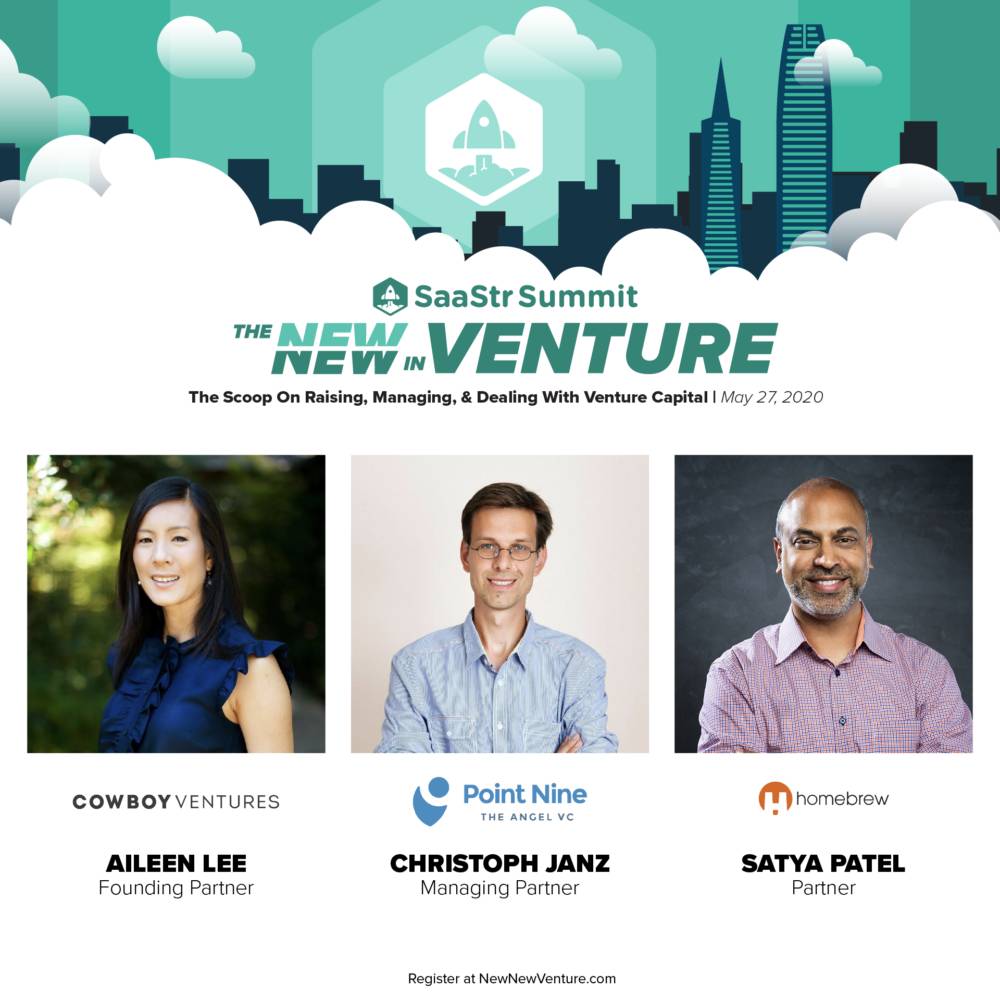
Editorial note: SaaStr originally announced the New New in Venture Virtual Summit for May 27, 2020. The event has since concluded, so this article examines its standout sessions, historical context, and lessons that remain valuable for SaaS founders and venture investors.
What happens when venture capital suddenly trades conference rooms, airport lounges, and suspiciously expensive coffee for a day of video calls? SaaStr’s New New in Venture Virtual Summit set out to answer that question during one of the most uncertain periods the startup industry had ever experienced.
The free, one-day event was designed around two tracks and promoted to an audience of more than 10,000 attendees. Its agenda brought together leading venture capitalists, SaaS operators, and technology executives to discuss startup fundraising, seed investing, remote work, corporate responsibility, and the practical mechanics of scaling a software company.
Although the summit emerged from the disruption of 2020, its central questions have not gone stale. Founders still want to know when to raise capital, what investors look for, how to manage growth, and whether the latest market correction is a disaster or merely venture capital wearing one of its dramatic hats.
Why the New New in Venture Summit Mattered
In early 2020, familiar fundraising routines disappeared almost overnight. Founders could no longer assume that a warm introduction would lead to an office meeting, a partner dinner, and several weeks of relationship building. Investors had to evaluate teams through screens while deciding how much capital to reserve for existing portfolio companies.
The uncertainty was genuine, but the venture market did not simply shut down. Later PitchBook and National Venture Capital Association data showed that the U.S. venture industry remained resilient during 2020. Investment and venture-fund fundraising reached record levels, yet the headline numbers concealed a more concentrated market. Late-stage companies attracted a particularly large share of the money, while less established startups often faced greater scrutiny.
That uneven environment made the SaaStr venture capital summit especially timely. It addressed both sides of the table: investors trying to make decisions without reliable forecasts and founders wondering whether their next pitch would receive a term sheet or a polite email containing the phrase “circle back.”
The Awesome SaaStr Sessions Founders Wanted to See
Unicorns and Decacorns: What Changed and What Did Not
Founders Fund General Partner Keith Rabois joined SaaStr founder and CEO Jason Lemkin for a discussion about unicorns, decacorns, and the characteristics of companies capable of reaching enormous scale.
The session’s underlying issue was bigger than valuation. In a turbulent market, founders needed to distinguish temporary changes in pricing from durable investment principles. Investors might adjust check sizes, ownership targets, or valuation expectations, but exceptional founders, large markets, and products with strong customer demand remained attractive.
Rabois has long emphasized the importance of founder quality. A post-event recap noted that he placed extraordinary weight on the founding team when making investment decisions. He also offered a useful lesson for founders without a warm introduction: an excellent cold email can work when it is concise, distinctive, and supported by a strong deck. In other words, “Please see attached” needs to carry considerably more weight than usual.
Adjusting Your Sails in Choppy Waters
Portag3 Ventures partner Chris O’Neill focused on lessons from previous downturns and corporate turnarounds. The nautical title was appropriate because founders in 2020 could not control the storm; they could only stop pretending the spreadsheet was weatherproof.
The most useful downturn advice begins with an honest assessment of cash, customers, and strategic priorities. Leaders need to know which expenses support the company’s core advantage, which projects can wait, and which customer segments remain healthy. Blind cost cutting can damage a business just as quickly as undisciplined spending.
Strong operators also plan through scenarios rather than betting everything on one forecast. A base case, downside case, and severe case give management teams predetermined actions to take when revenue, churn, or fundraising conditions change. This turns uncertainty into a sequence of decisions instead of a daily panic festival.
Business as a Force for Good: COVID-19 and Beyond
This conversation featured Twilio SendGrid CEO Sameer Dholakia, Puppet CEO Yvonne Wassenaar, and Pledge 1% CEO Amy Lesnick. The published session also included Bain Capital Ventures partner Ajay Agarwal.
The discussion explored how companies could support employees, customers, and communities while protecting their own long-term stability. Corporate impact was presented as an operating responsibility rather than a decorative paragraph buried near the bottom of an annual report.
Pledge 1% encourages businesses to dedicate a portion of their product, employee time, profit, or equity to social impact. That flexible model is particularly relevant to software companies. A startup may not have a giant philanthropic budget, but it can offer technology, specialized knowledge, volunteer hours, or access to organizations that urgently need them.
The broader lesson is that values become credible when they influence resource allocation. Employees and customers notice whether a company’s stated purpose survives the first difficult quarter.
How COVID-19 Changed the Future of Work
Basis Set Ventures Managing Partner Lan Xuezhao addressed one of the summit’s most immediate questions: Was remote work a temporary emergency response or the beginning of a structural shift?
Later research confirmed that the pandemic accelerated trends already forming around distributed teams, digital collaboration, e-commerce, and workplace automation. McKinsey estimated that the number of workers who might need to change occupations could rise significantly because of pandemic-driven changes.
For SaaS founders, the opportunity extended beyond selling another video-meeting feature with a cheerful gradient. Distributed organizations needed better tools for onboarding, security, workflow management, asynchronous communication, performance measurement, and employee well-being.
Remote work also altered startup recruiting. Companies could reach talent outside traditional technology hubs, but access to a larger labor pool did not eliminate management problems. Leaders still needed clear documentation, intentional communication, measurable goals, and a culture that could survive without everyone sharing the same snack cabinet.
The Inside Scoop on Seed Investing With Aileen Lee
Cowboy Ventures founder Aileen Lee joined Jason Lemkin to explain what changesand what stubbornly refuses to changein seed investing. Lee is widely known for popularizing the venture-capital use of the term “unicorn,” making her an especially fitting guide to startup potential and investor expectations.
Her framework for evaluating early-stage opportunities emphasized four areas: people, product, potential, and plan. The team must be capable and resilient. The product must solve a meaningful problem. The market must support a substantial outcome. Finally, the founders need a credible plan, even if everyone understands that an early startup plan is less a stone tablet and more a well-researched opening argument.
The session also highlighted a counterintuitive feature of downturns: difficult periods can produce excellent companies. Talented people reconsider their careers, persistent customer problems become impossible to ignore, and founders learn to operate with discipline from day one.
The Cadence: Turning a SaaS Startup Into an Army
Craft Ventures General Partner David Sacks examined the organizational chaos that often appears when a SaaS startup grows from roughly 50 to 500 employees. At that scale, heroic improvisation stops being charming and starts missing revenue targets.
The Cadence operating model synchronizes two major systems. The sales and finance cycle covers forecasts, pipeline inspections, quotas, and quarterly closing. The product and marketing cycle coordinates development, releases, and launches. By connecting these systems through a predictable quarterly rhythm, teams gain shared milestones and a clearer understanding of what must happen next.
Cadence does not mean replacing creativity with meetings about meetings. It means reducing preventable confusion so employees can use their creativity on customers and products. A disciplined operating rhythm is especially important for distributed teams, where hallway conversations can no longer patch every hole in the process.
Fundraising During a Pandemic
Another highly rated New New in Venture session came from Point Nine Capital Managing Partner Christoph Janz. His advice included targeting the most promising investor leads, preparing excellent due-diligence materials, anticipating pandemic-related customer risks, and making remote evaluation easier.
Virtual fundraising raised the standard for documentation. A compelling deck remained important, but founders also benefited from an organized data room, a clear FAQ, transparent metrics, and an explanation of how the crisis affected retention, payment schedules, sales cycles, and cash requirements.
What These Venture Capital Sessions Had in Common
Despite their different subjects, the sessions returned to several shared principles.
- Quality still matters: Market conditions change more quickly than the fundamental value of a strong team solving a painful problem.
- Cash creates choices: A healthy runway lets founders negotiate thoughtfully instead of accepting the first available deal under pressure.
- Transparency builds confidence: Investors do not expect perfect numbers during a crisis, but they do expect founders to understand those numbers.
- Operating systems beat heroics: Clear rhythms, responsibilities, and metrics make scaling more predictable.
- Purpose must be operational: Corporate values matter when they guide decisions affecting employees, customers, and communities.
- Disruption creates openings: New behavior produces new customer needs, and startups are often quicker than incumbents to address them.
How Founders Can Apply the SaaStr Lessons
Watching a venture capital summit should produce more than a page of inspirational quotes and three browser tabs that remain open until the laptop begs for mercy. Founders can convert the lessons into a practical operating review.
- Recalculate runway. Build realistic revenue, hiring, churn, and fundraising scenarios. Decide in advance what actions each scenario triggers.
- Strengthen the fundraising narrative. Explain the customer problem, evidence of demand, competitive advantage, market potential, and intended use of capital.
- Upgrade investor materials. Prepare the deck, financial model, cap table, cohort data, pipeline analysis, and frequently asked questions before outreach accelerates.
- Establish a company cadence. Align product releases, marketing launches, sales targets, hiring plans, and board reporting around a shared rhythm.
- Document remote operations. Clarify how decisions are made, where information lives, and how teams communicate asynchronously.
- Define measurable impact. Choose a social commitment that matches the company’s resources and make someone accountable for it.
A Founder’s Experience: Turning a Virtual Summit Into Real Decisions
Consider the experience of a composite SaaS founder preparing for a virtual event like New New in Venture. Her company has approximately $1.5 million in annual recurring revenue, 20 employees, and enough cash for nine months. Pipeline has weakened, two customers have requested payment extensions, and the board keeps asking whether the business should raise now or wait.
Before the summit, she creates a simple worksheet with three columns: question, current assumption, and decision. This small step changes the event from passive entertainment into a working session. Her questions include how seed investors evaluate risk, what evidence supports a remote raise, and which expenses should be protected during a downturn.
The Aileen Lee discussion pushes her to review the company through the four-part lens of people, product, potential, and plan. The team is experienced and customers like the product, but the market story is too broad. “Software for every modern business” sounds impressive until someone asks which modern business. She rewrites the pitch around a specific group of customers with an urgent compliance problem.
The Keith Rabois session changes her outreach strategy. Instead of sending 80 generic messages, she identifies 20 investors with relevant portfolios and writes concise emails explaining the company’s traction, insight, and reason for contacting each firm. The messages are shorter, but they require more work. That is usually how good communication behaves.
From Christoph Janz, she takes the importance of making remote diligence easy. Her team organizes the data room, adds monthly recurring revenue movements, documents customer concentration, and writes an FAQ covering churn, cash, and pandemic exposure. One investor later says the company is unusually prepared. The compliment is pleasant; the faster diligence process is even better.
The Cadence session exposes an internal operating problem. Product works in monthly sprints, marketing launches whenever assets are ready, and sales learns about new features through customer questions. The founder introduces a quarterly release calendar with a product milestone, marketing launch, sales-enablement deadline, and pipeline review. Nothing magical happens on Monday morning, but missed handoffs begin to decline.
The future-of-work conversation leads to a remote-management audit. The company has many communication tools but no reliable communication system. Important decisions are scattered across chat messages, calls, and documents named “Final_v7_REAL.” Leadership creates a decision log, defines response-time expectations, and shifts routine status updates to an asynchronous format. Meetings become shorter because attendees no longer spend the first 20 minutes reconstructing history.
Finally, the business-as-a-force-for-good session encourages the company to offer its product and employee expertise to a small group of nonprofit organizations. The initiative is limited enough to manage and meaningful enough to measure. It also gives employees a concrete way to contribute during an unsettling period.
By the end of the experience, the founder has not discovered a secret fundraising button. She has something more useful: clearer numbers, a sharper story, better operating discipline, and a list of decisions with owners and deadlines. That is the real value of a strong SaaS event. A great session does not merely make the audience nod; it makes Monday morning look different.
Conclusion: The “New New” Was Really About Adaptation
SaaStr’s New New in Venture captured a moment when founders and investors had to rebuild familiar processes in real time. Its strongest sessions went beyond predictions. They explored the durable mechanics of seed investing, SaaS fundraising, resilient leadership, remote work, corporate impact, and organizational scale.
The market has continued to evolve, but the essential founder playbook remains recognizable: understand the customer, protect runway, communicate honestly, create an operating cadence, and make fundraising easy to evaluate. Venture capital will always contain uncertainty. The founders who handle it best are rarely those with perfect forecasts; they are the ones prepared to adjust when the forecast laughs and leaves the room.