

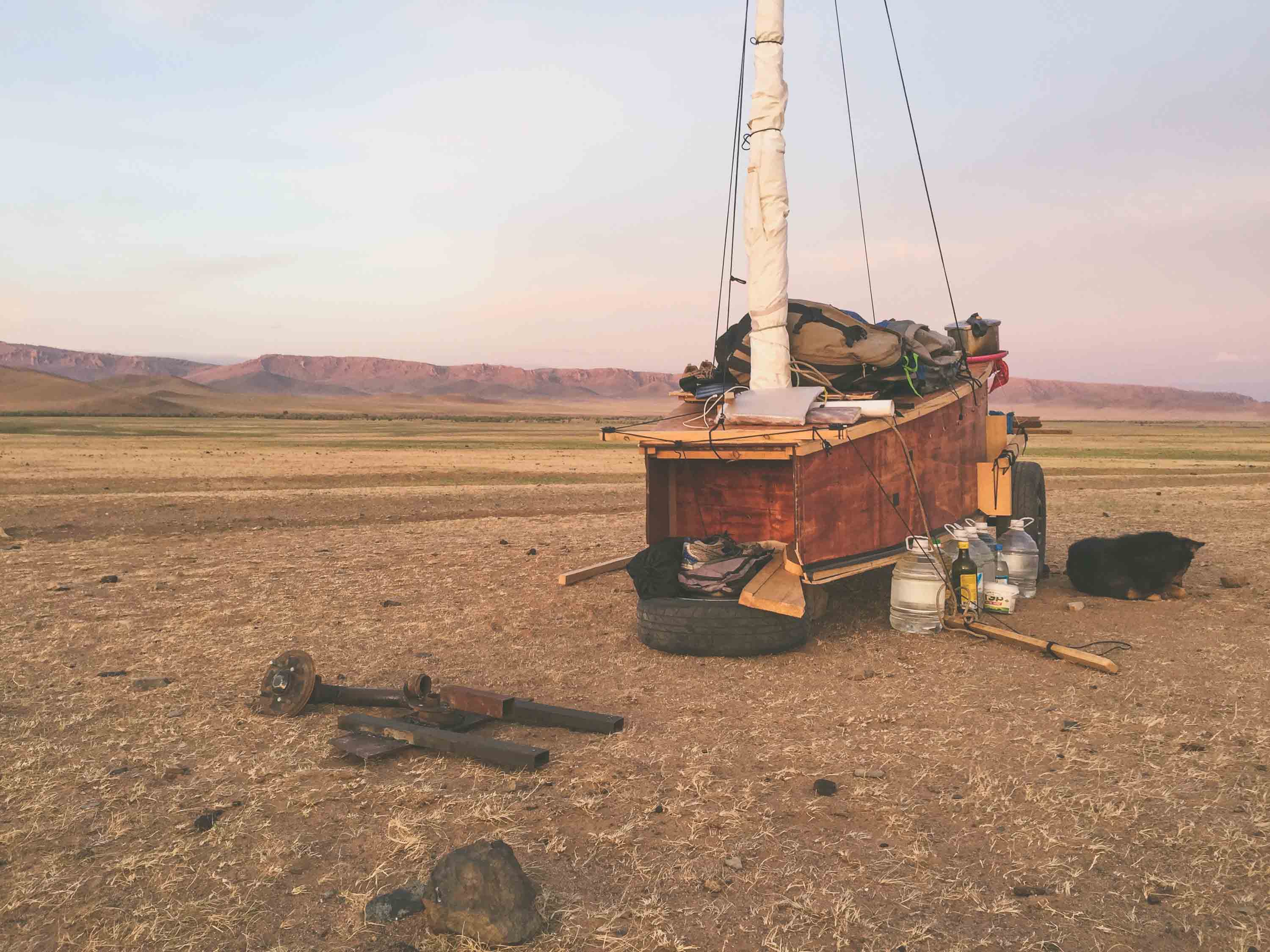
Sailing The High Steppes sounds like a phrase invented by a poet who got lost between a marina and a horse pasture. Yet it describes something wonderfully real: using wind, wheels, nerve, and a suspicious amount of optimism to cross open grassland where there is no ocean in sight. Instead of whitecaps, there are waves of grass. Instead of a harbor, there is the horizon. Instead of a salty old captain yelling about the mainsail, there may be a curious goat judging your engineering choices.
The idea became especially memorable through the story of Falcon Riley and Amber Word, who traveled across the Mongolian countryside in a homemade land-sailing vessel called Moby. Their craft was not a sleek carbon-fiber racing machine built by a laboratory full of aerodynamic wizards. It was a practical, plywood-heavy, wind-powered cart that proved a simple point: adventure does not always need a motor. Sometimes it needs a sail, a flat place, a patient attitude, and enough tools to convince bolts to behave.
But this story is bigger than one quirky vehicle. It opens the door to land sailing, the geography of Mongolia, the culture of the steppe, the challenges of remote travel, and the strange joy of moving with the wind in a place where roads are suggestions and distance has a sense of humor.
What Does “Sailing The High Steppes” Mean?
At its simplest, sailing the high steppes means crossing elevated grassland using wind power instead of an engine. A steppe is a dry, grassy plain, often found in temperate regions with cold winters, warm summers, and relatively low rainfall. Mongolia is one of the world’s great steppe landscapes, a country of vast horizons, semi-arid grasslands, mountains, desert margins, and open country that can make a person feel both tiny and unusually dramatic.
Traditional sailing depends on water. Land sailing borrows the same basic ideacapture wind with a sail, convert it into forward motion, steer carefully, and try not to look too surprised when it worksbut places the whole operation on wheels. The craft may be called a land yacht, sail cart, sand yacht, or land-sailing vessel. In casual conversation, “that wheeled thing with a sail” also works, though it may hurt the feelings of serious land sailors.
Mongolia makes the concept feel almost mythic. The country is landlocked, yet its grasslands create the impression of an inland sea. The terrain rolls and opens, the sky dominates everything, and the wind can become both transportation system and travel companion. Sailing there is less about speed records and more about learning how landscape, weather, design, and patience all negotiate with one another.
The Real Adventure Behind the Idea
Falcon Riley and Amber Word’s Mongolian land-sailing journey captured attention because it blended do-it-yourself engineering with old-fashioned exploration. Their vessel, Moby, was built mostly from plywood and designed as a small, towable, wind-powered home on wheels. Fully loaded, it weighed roughly 500 pounds, yet it could still be pulled by hand when the wind refused to clock in for work.
Over 46 days, the pair covered more than 300 kilometers across the countryside. On one especially windy day, they managed about 70 kilometers. That single-day distance is the kind of number that makes the whole project seem brilliant. The remaining days remind us that adventure travel is often 20 percent triumph, 30 percent problem-solving, and 50 percent staring at the weather like it owes you money.
A Journey Built on Experimentation
The genius of the trip was not that everything worked perfectly. It was that the travelers accepted imperfection as part of the plan. Mechanical issues, terrain problems, unpredictable wind, and the simple reality of moving through remote country all shaped the journey. Unlike a polished expedition with matching jackets and a drone crew, this felt like the kind of adventure people dream up in a workshop, test in the real world, and improve one “well, that was interesting” moment at a time.
That spirit is central to land sailing. A sail cart does not need to be luxurious to be fascinating. It needs to be light enough to move, strong enough not to disassemble itself in protest, stable enough to stay upright, and simple enough to fix when the nearest hardware store is somewhere beyond the next three horizons.
How Land Sailing Works
Land sailing works by using a sail to capture wind and create forward force. The wheels reduce friction compared with dragging across the ground, allowing the vehicle to move efficiently over hard, flat surfaces. The pilot steers with pedals, hand controls, or a simple mechanical linkage, depending on the design. Just like a sailboat, a land yacht does not always need the wind directly behind it. With the right sail angle and steering, it can travel across the wind and sometimes make progress in directions that seem mildly magical to anyone who slept through physics class.
The best surfaces are broad, open, and firm: dry lake beds, beaches at low tide, salt flats, airfields, desert plains, and hard-packed grassland. Mongolia’s steppe is not a perfect racetrack. It includes ruts, stones, soft ground, animal trails, sudden slopes, and patches that look friendly until a wheel announces otherwise. That makes the high steppe less like a controlled land-sailing venue and more like a giant outdoor exam with no answer key.
Why Wind Power Feels Different on Land
On water, sailors expect the boat to lean, drift, and respond to waves. On land, the wheels provide a different kind of feedback. Movement can feel immediate, raw, and surprisingly quick. The craft accelerates when the wind fills the sail, slows when the surface changes, and demands attention when gusts arrive. It is sailing with fewer splashes and more dust.
That dust matters. The Gobi and its surrounding landscapes are known for wind-shaped conditions, spring dust storms, and dry terrain. A land sailor in Mongolia is not just reading wind direction; they are reading sky color, surface texture, cloud movement, and the mood of the landscape. In other words, the land has opinions.
Why Mongolia Is Such a Powerful Setting
Mongolia is not merely a backdrop for a quirky travel story. It is the reason the story has emotional weight. The country’s landscape combines steppe, desert, mountain, forest-steppe, and high plains. In central Asia, mountain peaks rise above open grasslands, while the Gobi region includes everything from bare rock and sand to grassy steppe. The result is a place that feels both spacious and severe.
Mongolia’s climate is famously continental. Winters can be brutally cold, summers are short, and weather can change quickly. The country also enjoys many clear, sunny days, which sounds cheerful until one remembers that clear does not always mean gentle. Sandstorms, hailstorms, blizzards, and sudden temperature shifts are part of the environmental personality. Mongolia is beautiful, but it does not do customer service.
The Steppe as a Living Landscape
The Mongolian steppe is not empty, even when it looks empty to outsiders. It is pasture, pathway, memory, and home. Nomadic and semi-nomadic herding traditions have shaped life here for centuries. Families move with livestock, follow seasonal grazing patterns, and live in portable dwellings known as gers. Horses, sheep, goats, cattle, camels, and yaks are not decorative scenery; they are part of the region’s economy, identity, and daily rhythm.
Traveling through this landscape by sail cart creates an unusual contrast. The vessel feels experimental and modern, yet the methodmoving with natural forces, adjusting to weather, respecting distancefits surprisingly well into a place where mobility has long been a survival skill. A land sailor may arrive with plywood, wheels, and a mast, but the steppe has been teaching lessons in movement long before anyone tightened a sail line.
The Engineering Charm of a Homemade Land Yacht
The craft at the center of Sailing The High Steppes was charming partly because it was not overdesigned into boredom. Plywood may not sound glamorous, but it is workable, repairable, and accessible. For a journey through remote country, those qualities matter more than showroom shine. A sophisticated machine can be impressive; a repairable machine can save the day.
A good expedition land yacht needs several things: a stable wheelbase, a sail that can be controlled in gusts, storage for supplies, a frame that can handle vibration, and a system for towing or pushing when conditions fail. Weight is the constant enemy. Every extra pound asks the wind to work harder. But too little strength invites breakdowns. The design challenge is a balancing act between “light enough to move” and “solid enough not to become modern art.”
Speed Is Not the Whole Story
Competitive land sailing can be extremely fast on ideal surfaces. But crossing the Mongolian countryside in a self-built vessel is not the same as racing on a prepared dry lake bed. The goal is not simply top speed. It is endurance, adaptability, and experience. Covering 70 kilometers in one windy day is impressive, but the slower days may reveal more: how the craft handles rough ground, how travelers manage supplies, and how patience becomes a piece of equipment.
That is why this adventure resonates. It does not sell land sailing as effortless. It shows it as possible, which is far more interesting. Effortless stories are forgettable. Possible stories make people look at plywood differently.
Travel Lessons from the High Steppes
Anyone inspired by Mongolia land sailing should understand that remote travel requires serious planning. Mongolia’s countryside can be far from fuel, medical help, repair shops, and reliable cell service. Weather is unpredictable, roads outside major cities can be rough, and distances can be deceptive. A location may look close on a map while still requiring hours of careful travel.
For ordinary travelers, this means working with experienced local guides, carrying proper supplies, respecting weather warnings, and avoiding the fantasy that “remote” is just a prettier word for “easy.” For land sailors, the checklist grows longer: spare parts, repair tools, navigation equipment, emergency communication, water, layered clothing, sun protection, dust protection, and a realistic plan for what happens when the wind quits or becomes too strong.
Respect Comes Before Adventure
The steppe is not an empty playground. It is home to herding families, livestock, sacred sites, archaeological remains, and fragile grassland ecosystems. Responsible travel means asking permission before crossing private or actively used grazing areas, keeping distance from herds, packing out waste, avoiding damage to vegetation, and treating local hospitality with gratitude rather than entitlement.
It also means understanding that climate pressure is real. Mongolia’s herders face growing challenges from warming temperatures, changing rainfall patterns, pasture stress, and dzud events, the severe winter disasters that can prevent animals from reaching forage. An adventure story becomes richer when it acknowledges the human and environmental realities of the place it celebrates.
What Makes the Story So Appealing?
Sailing The High Steppes appeals because it sits at the intersection of travel, engineering, ecology, and comedy. There is something irresistible about putting a sail on a cart and asking a continent-sized grassland, “May I pass?” It is practical enough to work, strange enough to delight, and difficult enough to earn respect.
The story also taps into a larger desire for slower, more mindful travel. Modern tourism often focuses on getting somewhere quickly, photographing the best angle, and leaving before the weather ruins the hair. Land sailing across Mongolia flips that script. The wind decides the pace. The ground decides the route. The travelers learn to value motion when it comes and stillness when it does not.
That rhythm is rare. In a world obsessed with speed, a wind-powered cart crossing the steppe reminds us that slowness can be a form of attention. When you move slowly, you notice the sound of grass, the shape of clouds, the line of distant mountains, and the way a ger appears on the horizon like punctuation in a very long sentence.
Experiences Related to Sailing The High Steppes
Imagine beginning a day on the Mongolian steppe with the sun rising over a pale ribbon of grassland. The air is cold enough to make your fingers negotiate a labor contract, but the sky is already bright. Your land yacht waits nearby, sail furled, wheels dusty, frame creaking softly as if clearing its throat before a speech. There is no marina, no dock, no neat line of boats. Just open land, low hills, and a wind that has not yet decided whether it wants to help or heckle.
The first experience is listening. On the high steppe, wind is not background noise. It is the main character. You learn to hear it moving across grass before it reaches you. A soft rush becomes a push against your jacket. The sail snaps once, then fills. Suddenly the cart begins to move, and the ridiculous idea becomes real. The wheels crunch over hard ground. The mast leans. Your brain, which had filed this whole project under “questionable,” quietly moves it to “astonishing.”
The second experience is humility. A flat landscape is not always smooth. A route that looks easy from a distance may become a puzzle of ruts, stones, soft patches, and shallow dips. Sometimes you sail beautifully for an hour and feel like a wind-powered genius. Then the craft stops in a stubborn patch of ground, and you become a person pulling a heavy cart while muttering motivational phrases of limited literary value. This is healthy. The steppe does not allow anyone to remain too cool for too long.
The third experience is meeting people. In remote Mongolia, travelers often discover that help can appear in unexpected ways. A herder on a motorcycle may stop to inspect the vehicle. Children may laugh at the sail. Someone may offer directions, tea, or the universal facial expression meaning, “I do not fully understand what you are doing, but I respect the confidence.” These encounters matter more than mileage. They turn a route into a relationship.
The fourth experience is weather awareness. A clear morning can become a dusty afternoon. A gentle breeze can grow teeth. Clouds build differently when there are no tall buildings to block the view. You begin to understand why local knowledge is not optional decoration but essential equipment. The steppe rewards travelers who pay attention and punishes those who treat weather like a minor scheduling inconvenience.
The final experience is quiet. After a day of motion, the land settles into evening. The sail is lowered. The cart becomes shelter, storage, and conversation piece. The horizon darkens. Stars arrive in numbers that make city skies seem like they forgot to finish loading. At that moment, sailing the high steppes stops being only an adventure concept. It becomes a memory of moving through a vast place by borrowing power from the air and giving, in return, your full attention.
Conclusion: Why Sailing The High Steppes Still Matters
Sailing The High Steppes is more than a clever title. It is a reminder that exploration can still be inventive, low-tech, respectful, and deeply human. A homemade sail cart crossing Mongolia may not be the fastest form of transportation, but speed was never the point. The point was to test an idea against real wind, real land, and real uncertainty.
In the process, the story reveals the beauty of Mongolia’s grasslands, the resilience of land-sailing design, and the importance of traveling with humility. The high steppe is not a blank space waiting for adventure. It is a living landscape with culture, climate, history, and people already written into it. The best travelers do not overwrite that story. They move through it carefully, laugh when the wheels get stuck, fix what breaks, and let the wind have the final word.