

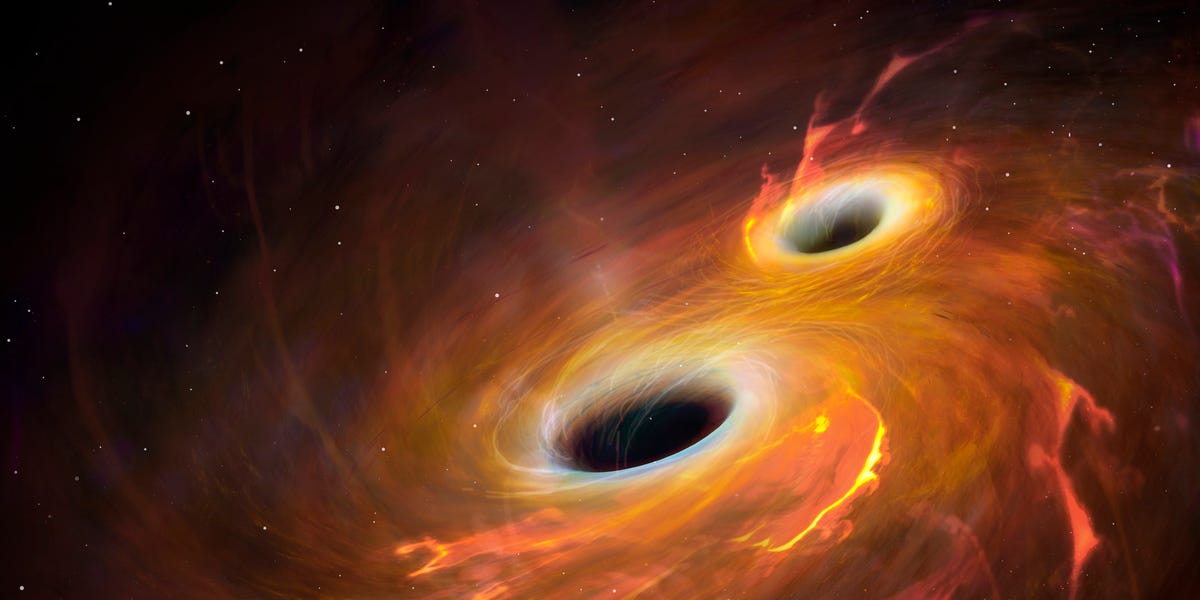
Somewhere between “we have no idea what most of the universe is made of” and “let’s check whether tiny black holes are drifting past Mars,” modern cosmology has become wonderfully strange. Scientists are hunting for ancient black holes that may help explain dark matter, the invisible cosmic glue that outweighs ordinary matter and quietly bosses galaxies around like a strict but unseen stage manager.
The phrase “black holes made of dark matter” is catchy, but the more accurate scientific idea is even more interesting: primordial black holes may not be made of dark matter; they may be some or all of the dark matter. These hypothetical objects could have formed in the first fraction of a second after the Big Bang, long before stars existed, when the universe was hotter, denser, messier, and generally less committed to personal boundaries.
If primordial black holes exist, they could rewrite several chapters of cosmic history. They might explain part of the dark matter mystery, reveal what happened during cosmic inflation, seed early supermassive black holes, and give physicists a new way to test gravity, quantum mechanics, and particle physics at energies no laboratory can reach.
What Are Primordial Black Holes?
Most black holes known today form when massive stars collapse or when compact objects merge. A star needs enough mass to crush itself into a black hole after its nuclear fuel runs out. Primordial black holes are different. They are not supposed to come from dead stars. They could have formed directly from dense pockets in the newborn universe.
Imagine the early cosmos as a boiling ocean of energy, radiation, and density fluctuations. If one region became dense enough, gravity could have overwhelmed everything else and collapsed that patch into a black hole. No star required. No dramatic supernova finale. Just the universe making a tiny cosmic trapdoor before breakfast.
The possible mass range is enormous. Some primordial black holes could have been lighter than a paperclip, while others could have been many times more massive than the Sun. The smallest ones would have evaporated by now through Hawking radiation, a quantum effect that causes black holes to slowly lose energy. Larger ones, such as asteroid-mass or Earth-mass primordial black holes, might still be roaming the universe today.
Why Connect Ancient Black Holes to Dark Matter?
Dark matter does not absorb, reflect, or emit light, which makes it spectacularly rude to telescopes. Scientists infer its existence because galaxies rotate too quickly, galaxy clusters hold together too well, and gravitational lensing reveals extra mass that ordinary stars and gas cannot explain.
For decades, many researchers expected dark matter to be a new kind of particle, such as a WIMP, axion, or other exotic candidate. Those searches are still active and important. But despite powerful underground detectors, particle accelerators, and space observatories, no dark matter particle has been confirmed. That absence has encouraged scientists to revisit an old idea: maybe at least some dark matter is not a particle at all, but a population of compact objects formed in the early universe.
Primordial black holes fit several dark matter requirements. They are dark, interact mainly through gravity, can be long-lived if massive enough, and could have formed before galaxies. In cosmic terms, they are suspiciously qualified for the job.
The Big Catch: They Cannot Be Too Common
Here is where the plot thickens. If primordial black holes made up all dark matter, they should leave evidence. Scientists have looked for that evidence in many ways: microlensing, gravitational waves, gamma rays, the cosmic microwave background, dwarf galaxies, star clusters, and planetary motion. So far, no confirmed detection has appeared.
That does not mean the idea is dead. It means the allowed hiding places are shrinking. Many mass ranges are already strongly constrained. For example, searches using the Subaru Telescope’s Hyper Suprime-Cam observed the Andromeda galaxy to look for brief brightening events caused by tiny black holes passing in front of stars. If those black holes were common enough to be most of dark matter in certain mass ranges, the survey should have found many microlensing events. It found far fewer than expected.
In other words, scientists are not asking, “Could primordial black holes exist?” as much as they are asking, “Which masses are still allowed, how many could there be, and what would finally expose them?” The hunt has become a cosmic game of hide-and-seek, except the seekers use billion-dollar telescopes and the hiders might be atom-sized objects with asteroid-level mass.
How Scientists Search for Primordial Black Holes
1. Microlensing: Watching Stars Flicker
Microlensing is one of the most powerful tools in the search. When a compact object passes between Earth and a distant star, its gravity bends and magnifies the star’s light. The star briefly brightens, then returns to normal. The object doing the lensing may be invisible, but gravity gives it away.
This method can detect objects that emit no light, including rogue planets, stellar remnants, and potentially primordial black holes. NASA’s Nancy Grace Roman Space Telescope is expected to be especially useful because it will repeatedly monitor dense star fields with high precision. Roman may help distinguish statistically between free-floating planets and Earth-mass primordial black holes.
The difficulty is that microlensing events are rare, brief, and easy to confuse with other astrophysical signals. A single event may not scream, “Hello, I am a primordial black hole.” Instead, scientists need patterns: event durations, rates, mass distributions, and comparisons with what normal planets and stars should produce.
2. Gravitational Waves: Listening to Black Holes Collide
Gravitational-wave observatories such as LIGO, Virgo, and KAGRA detect ripples in spacetime from violent cosmic events. When two black holes spiral together and merge, they produce a gravitational-wave signal that carries information about their masses, spins, and distance.
Some black hole mergers have sparked interest because their masses or properties are unusual. Could some of these merging black holes be primordial rather than stellar? Possibly, but proving it is difficult. Stellar evolution can produce many black hole masses, and repeated mergers inside dense star clusters can create heavier black holes too.
A stronger clue would be a black hole with a mass below what ordinary stellar collapse can produce. If gravitational-wave detectors found a clearly sub-solar-mass black hole, that would be a major hint of primordial origin. Stars are not expected to collapse into black holes lighter than the Sun, so such an object would be like finding a dinosaur footprint in fresh cement: surprising, suspicious, and worth calling experts immediately.
3. Hawking Radiation: Looking for the Final Flash
Stephen Hawking showed that black holes are not completely black. Quantum effects near the event horizon should cause them to emit radiation. The smaller the black hole, the hotter it is and the faster it evaporates. Very small primordial black holes could end their lives in bursts of high-energy particles and gamma rays.
Space observatories such as NASA’s Fermi Gamma-ray Space Telescope can search for signs of these bursts. A confirmed Hawking radiation event would be revolutionary. It would support quantum predictions about black holes and potentially reveal unknown particles emitted during the explosion.
So far, no confirmed primordial black hole evaporation has been found. But the search remains valuable because even non-detections set limits on how many small primordial black holes can exist.
4. Planetary Wobbles: Could Mars Notice One Passing By?
One of the more delightfully weird proposals involves the orbit of Mars. Some simulations suggest that if asteroid-mass primordial black holes make up dark matter, one might pass through the inner solar system roughly once per decade. It would not swallow Earth, steal your coffee, or open a portal under the garage. But its gravity might slightly disturb a planet’s orbit.
Mars is a promising target because spacecraft and ranging measurements track its position with extraordinary precision. A close flyby of a compact dark object could create a tiny orbital wobble, possibly detectable after careful analysis. The challenge would be separating such a signal from ordinary asteroids, measurement noise, and other gravitational nudges.
This kind of search shows how creative dark matter science has become. Scientists are not just looking underground or at distant galaxies. They are also asking whether our own solar system is a detector, quietly recording the passage of invisible cosmic debris.
Are These Black Holes Really “Made of Dark Matter”?
Not exactly. In standard primordial black hole scenarios, they formed from extremely dense regions of ordinary energy and radiation in the early universe. After formation, they behave like dark matter because they are compact, dark, slow-moving on cosmic scales, and gravitationally influential.
However, newer theoretical work also explores interactions between black holes and dark matter particles. For example, dense dark matter around black hole binaries might leave subtle imprints in gravitational waves. Some models even consider dark-sector particles affecting small black holes, changing how they evaporate or survive. These ideas are speculative, but they show why black holes have become laboratories for dark matter physics.
So the title works as a hook, but the scientific nuance matters: primordial black holes are not usually described as being made of dark matter. They are candidates for dark matter, probes of dark matter, and possible partners in dark-sector physics.
Why the Search Matters
Finding primordial black holes would be one of the biggest discoveries in modern astrophysics. It would prove that black holes can form without stars. It would reveal extreme conditions in the first moments after the Big Bang. It could explain part of the missing matter problem. It might also help scientists understand why supermassive black holes appeared so early in cosmic history.
Even if primordial black holes make up only a small fraction of dark matter, they could still be important. A few ancient black holes in the right mass range might seed early galaxies, influence star formation, or create rare gravitational-wave events. Science does not always require an idea to explain everything. Sometimes explaining one stubborn piece of the puzzle is enough to change the picture.
The Evidence So Far: Intriguing, Not Conclusive
The honest answer is that scientists have not confirmed primordial black holes. There are hints, constraints, candidates, and clever proposals, but no smoking-gun detection. Many once-promising mass ranges are now limited by observations. That is not failure; that is science doing its job. A good hunt does not just find suspects. It also clears the innocent and narrows the field.
Future surveys may dramatically improve the search. NASA’s Roman Space Telescope could detect enormous numbers of microlensing events. The Vera C. Rubin Observatory’s Legacy Survey of Space and Time will repeatedly scan the sky and may help identify rare transient signals. LIGO-Virgo-KAGRA and future gravitational-wave detectors may uncover black holes with masses or spins that are difficult to explain through ordinary stellar evolution.
The next decade could be decisive. Either primordial black holes will step out of the theoretical shadows, or scientists will corner them into smaller and stranger hiding places.
Experience-Based Reflections: What This Hunt Teaches Us About Science
Following the search for ancient black holes is a reminder that science is not a straight hallway. It is more like a house designed by an eccentric architect: doors open into staircases, staircases lead to observatories, and one closet contains a model of the early universe wearing a tiny “under construction” sign.
The experience of reading about primordial black holes can be both thrilling and humbling. Thrilling, because the idea is cinematic: invisible ancient objects from the birth of time may be drifting through galaxies, bending starlight, shaking spacetime, and possibly nudging planets. Humbling, because every exciting possibility must survive brutal testing. The universe does not care how elegant a theory sounds in a headline.
One useful lesson is that “not found yet” does not mean “not worth searching for.” Dark matter itself is known mainly through gravity, not direct detection. That makes the investigation feel like reconstructing an invisible animal from footprints, broken branches, and the suspicious fact that the forest keeps moving. Primordial black holes are one possible animal. Particle dark matter is another. Modified gravity theories lurk nearby, occasionally raising their hands.
Another lesson is that modern astronomy is increasingly statistical. A single flickering star may be ambiguous. A catalog of thousands of flickers can become evidence. One strange gravitational-wave signal may be a curiosity. Hundreds of events can reveal patterns. The hunt for primordial black holes depends on patience, clean data, and a willingness to say, “Interesting, but not enough yet.” That phrase may not sell movie tickets, but it keeps science honest.
There is also something wonderfully democratic about the methods. Scientists use giant observatories, yes, but the principles are understandable. Gravity bends light. Merging black holes shake spacetime. Small black holes may evaporate. A passing compact object can tug on a planet. These ideas sound wild, but they are rooted in physical effects that can be measured.
For writers, educators, and curious readers, the topic is a gift. It connects the Big Bang, dark matter, quantum theory, black holes, telescope technology, and even Mars navigation into one grand detective story. It also offers a healthy warning: cosmic mysteries are rarely solved by one magic answer. Primordial black holes may explain all dark matter, some dark matter, or none of it. Any of those outcomes would teach us something valuable.
Personally, the most fascinating part is how the search turns absence into information. When Subaru does not see enough microlensing events, that result matters. When Fermi does not see expected gamma-ray bursts, that matters. When LIGO finds black holes that fit ordinary models, that matters too. Science advances not only through fireworks, but also through carefully documented silence.
If primordial black holes are ever confirmed, the discovery will feel like finding fossils from the universe’s first heartbeat. If they are ruled out as major dark matter candidates, the result will still sharpen the hunt for whatever dark matter really is. Either way, scientists are learning how to interrogate the invisible universe with more imagination than ever before. And honestly, if your job involves asking whether Mars wobbled because an ancient atom-sized black hole flew by, you are legally required to enjoy at least part of your workday.
Conclusion
Scientists are hunting for ancient black holes because they may offer a rare bridge between cosmology, dark matter, gravity, and quantum physics. Primordial black holes remain hypothetical, but they are not fantasy. They are serious candidates tested by real observations, from microlensing surveys and gravitational-wave detectors to gamma-ray telescopes and planetary motion studies.
The most accurate takeaway is this: primordial black holes are not proven, and they may not be the whole dark matter story. But they remain one of the most fascinating possibilities in astrophysics. If found, they could reveal what the universe was doing before stars existed. If not found, their absence will still guide scientists toward better answers. In the search for dark matter, even the cosmic dead ends glow a little.