

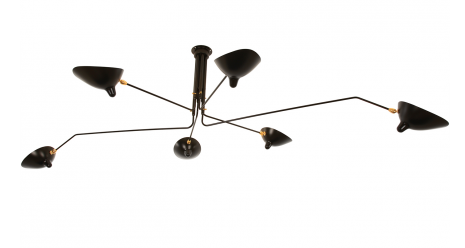
The Serge Mouille 6-Arm Rotating Ceiling Lamp does not quietly illuminate a room. It stretches across the ceiling like an elegant mechanical insect, directs light in six different directions, and makes an ordinary chandelier look as though it forgot to finish getting dressed.
Designed in 1958, this sculptural ceiling lamp combines slender steel arms, expressive aluminum reflectors, and precisely engineered brass joints. The result is a fixture that feels architectural without becoming cold, artistic without becoming impractical, and unmistakably mid-century without looking trapped in a vintage catalog.
Its enormous visual reach makes it particularly attractive for large living rooms, dining areas, galleries, lofts, and open-plan interiors. Yet buying one involves more than admiring its dramatic silhouette. Room dimensions, ceiling structure, bulb selection, authenticity, installation, and furniture placement all deserve careful attention.
Historical and product details synthesized from official Serge Mouille sources, MoMA, Design Within Reach, Lumens, and Architectural Digest.
What Is the Serge Mouille 6-Arm Rotating Ceiling Lamp?
The Serge Mouille 6-Arm Rotating Ceiling Lamp is a large adjustable ceiling fixture composed of six tubular arms extending from a central canopy. Each arm ends in a distinctive curved reflector, sometimes described as a shell, hood, eyelid, or casquette. The heads can be tilted, while the arms can be rotated to change both the shape of the fixture and the direction of its light.
That adjustability separates the lamp from a conventional chandelier. Instead of casting one symmetrical pool of illumination, it can send light toward a dining table, seating group, painting, bookshelf, or architectural surface. The owner is effectively given six small spotlights disguised as a single piece of modern sculpture.
Authorized contemporary editions are handmade in France using steel bodies, aluminum reflectors, and brass swivels. Depending on the edition and market, the fixture may be offered in black, white, or a two-tone arrangement with black outer arms and white inner arms. The interiors of the reflectors are typically bright white, helping bounce and soften the light.
A ceiling lamp with serious wingspan
This is not a fixture for a space that becomes nervous around large objects. U.S. specifications commonly describe two arms measuring approximately 54 inches and four measuring about 31 inches, with a height near 24 inches. European technical listings may show an overall dimension between roughly 245 and 271 centimeters, depending on how the adjustable arms are positioned and measured.
In practical terms, the lamp can spread across approximately eight to nearly nine feet. Because the arms move, its final footprint is partly determined during installation. That flexibility is useful, but it also means buyers should request the current technical drawing rather than planning around a single retailer photograph.
Dimensions, materials, movement, electrical specifications, and authorized-edition information.
Why Serge Mouille’s Design Still Looks Radical
Serge Mouille trained as a metalworker and silversmith before becoming one of the most recognizable lighting designers of the twentieth century. His background helps explain why his lamps feel less like assembled products and more like drawings made from metal.
When Mouille began developing lighting in the early 1950s, decorative fixtures often relied on glass, ornament, polished metal, or colorful materials. His response was almost stubbornly restrained: thin black lines, white reflector interiors, carefully shaped metal, and visible joints. Where another designer might have added crystals, Mouille added another elbow.
The six-arm ceiling lamp represents this philosophy at a grand scale. Its composition is expansive but visually light. The narrow arms occupy space without forming a heavy mass, and the asymmetrical reflectors prevent the design from feeling rigid. From one angle it resembles a mobile; from another, a constellation; from below, perhaps a very stylish creature considering whether to land.
Organic forms without decorative clutter
Mouille frequently looked to anatomy and nature. His lamps suggest bones, limbs, insects, shells, and plant stems without literally copying any of them. This biomorphic quality gives the fixture warmth. Although the materials are industrial, the silhouette never feels purely mechanical.
The contrast is essential to the lamp’s longevity. Straight steel tubes create discipline, while the curved shades introduce sensuality. Brass joints provide small points of visual richness. Black finishes emphasize the drawing-like outline; white versions dissolve more gently into pale ceilings.
Movement is part of the composition
The lamp was not designed to have one permanently correct pose. Rotating arms and tilting reflectors allow its shape to evolve. One configuration might appear balanced and horizontal, while another can feel energetic and intentionally uneven.
This is functional movement, not a party trick. Redirecting a reflector can reduce glare, emphasize artwork, brighten a dark corner, or improve light over a table. The lamp remains decorative even when switched off, but its adjustable geometry proves that Mouille was designing a working tool rather than merely a ceiling ornament.
Design history and market context supported by MoMA, Phillips, Christie’s, Architectural Digest, Artsy, and official Serge Mouille histories.
Materials and Craftsmanship
The Serge Mouille 6-Arm Rotating Ceiling Lamp uses a deliberately limited material palette. The body and arms are steel, the sculpted reflectors are aluminum, and the articulated connections incorporate brass. Each material performs a specific job.
- Steel arms: Provide the necessary stiffness for the extended structure while preserving a thin profile.
- Aluminum shades: Keep the reflector heads relatively light and allow them to be formed into complex curves.
- Brass swivels: Create durable adjustment points and introduce subtle visual contrast.
- Lacquered surfaces: Unify the fixture and protect the metal while preserving its sculptural clarity.
The reflector shape is particularly important. It partially shields the bulb from direct view while throwing light outward. The glossy white interior helps maximize reflection, even when the exterior is black. This makes the lamp capable of producing useful illumination without sacrificing its famous graphic appearance.
Authorized editions are commonly stamped or numbered and supplied with a certificate of authenticity. Production involves handwork in France, using forms and techniques connected to the original designs. Minor signs of hand fabrication should not automatically be interpreted as flaws; the lamp is not supposed to resemble an anonymous, machine-perfect office fixture.
How Much Light Does It Provide?
Six light sources sound powerful, but the experience depends heavily on bulb output, reflector direction, ceiling color, room size, and surrounding finishes. The lamp is better understood as a flexible combination of ambient and directional lighting than as a glowing chandelier that floods every surface equally.
U.S. versions are often specified for E26-base bulbs with a maximum rating of up to 60 watts per socket. That figure represents the electrical limit, not a recommendation to install six blazing incandescent suns. Modern dimmable LED bulbs can deliver substantial light while producing less heat and consuming less energy.
Choose bulbs for the room, not just the socket
For a living room, warm-white LEDs around 2700K usually complement wood, leather, textiles, and evening use. A dining area may also benefit from 2700K or 3000K bulbs, depending on whether the goal is cozy atmosphere or slightly crisper visibility.
Because the reflectors hide much of the bulb, compact bulb shapes generally work better than oversized decorative globes. Bulb dimensions should be checked against the current fixture specification. Dimming compatibility should also be verified across the bulbs, wall dimmer, and electrical system. Few things destroy a refined atmosphere faster than six expensive lights flickering like they have received alarming news.
Layer the lighting
Even with six heads, this lamp should not be expected to handle every lighting task in a large room. The most successful interiors combine it with discreet recessed lighting, wall sconces, table lamps, or floor lamps.
The ceiling fixture can provide the visual centerpiece and broad directional light, while secondary sources create softer illumination at eye level. This layered approach reduces harsh shadows and prevents the room from feeling like a beautifully designed interrogation chamber.
Technical specifications and authorized-edition details cross-checked with official European and U.S. distributors, Design Within Reach, Studio Twenty Seven, and 1stDibs.
Best Rooms for a Six-Arm Serge Mouille Ceiling Lamp
Large living rooms
In a spacious living room, the fixture can visually connect several furniture zones. One head might illuminate a reading chair, two can wash the main seating group, and another can point toward artwork or a fireplace wall.
Its horizontal reach is especially useful in rooms where a compact pendant would look undersized. The lamp fills the ceiling plane without creating the heavy visual block of a large drum shade or crystal chandelier.
Dining rooms
Over a long rectangular table, the extended arms can follow the furniture’s proportions. The reflectors should be aimed carefully so guests receive flattering light rather than direct glare. Nobody wants dessert served beneath six tiny spotlights aimed at their foreheads.
The fixture often works best when the table is visually simple. A restrained wood, stone, or lacquered surface allows the ceiling lamp to remain the main sculptural gesture.
Open-plan interiors and lofts
Large lofts can make standard fixtures appear lost. The six-arm lamp has enough scale to define a zone within an open plan while preserving visual openness. Its thin arms do not obstruct views in the way a bulky chandelier might.
Entry halls and galleries
A generous entry hall can support the lamp’s dramatic first impression. In a gallery-like setting, the adjustable heads can also contribute to accent lighting, though sensitive artwork may require dedicated fixtures with tighter control over brightness, heat, and ultraviolet exposure.
How to Style the Lamp Without Creating a Design Showroom
The Serge Mouille ceiling lamp is closely associated with mid-century modern interiors, but surrounding it exclusively with famous vintage icons can make a home feel like a furniture auction preview. A more natural room combines periods, textures, and price points.
Pair graphic metal with softer materials
The lamp’s sharp black lines look particularly effective against plaster walls, pale paint, linen curtains, wool rugs, warm timber, and rounded upholstery. These materials soften its industrial character without competing with the silhouette.
Repeat black sparingly
A few black elements elsewhere in the room can connect the fixture to the interior. Consider a narrow picture frame, a table base, cabinet hardware, or one dark chair. Avoid repeating black on every available object unless the desired mood is “luxury spy headquarters.”
Use contrast with traditional architecture
The fixture can be surprisingly successful in rooms with decorative moldings, fireplaces, paneled walls, or older architectural details. The contrast between historic surfaces and modern metalwork gives both elements more presence.
Respect negative space
Because the lamp creates a complicated drawing overhead, the room benefits from some visual quiet below. One large artwork may work better than a crowded gallery wall. A clean dining table often looks stronger than a permanent forest of decorative objects.
Installation and Space Planning
A qualified electrician should install the Serge Mouille 6-Arm Rotating Ceiling Lamp. The fixture must be connected correctly, grounded according to applicable requirements, and secured to a ceiling structure capable of supporting it.
Although the lamp may weigh less than its width suggests, its extended arms create leverage and require careful handling. Installation is not the moment to improvise with a random electrical box, one stepladder, and a friend whose primary qualification is owning a screwdriver.
Measure in three dimensions
Do not check only the room’s width. Measure ceiling height, fixture drop, door swings, tall cabinetry, curtains, and the position of nearby walls. Consider how the arms will rotate and whether people will need to walk beneath them.
For placement over a dining table, the furniture helps protect the fixture’s footprint from foot traffic. In an open living room, verify that the lowest components remain comfortably above circulation paths.
Create a paper or tape mockup
Before ordering, mark the central canopy location and use painter’s tape, string, or paper strips to represent the arm lengths. This simple exercise reveals whether the lamp will feel appropriately dramatic or merely enormous.
It also helps determine how the arms should be arranged. A room with an off-center table, fireplace, or sectional sofa may benefit from an asymmetrical configuration rather than a perfectly balanced starburst.
Authenticity, Reissues, and Reproductions
Serge Mouille’s lighting has been widely copied. Some reproductions borrow only the general shape, while others imitate specific proportions and construction details. The difference matters because this is not merely a style category; it is a documented design with authorized editions and a significant collector market.
Officially authorized reissues are produced in France and are generally numbered, stamped, and accompanied by a certificate of authenticity. Buyers should request clear documentation, current electrical certification, finish information, lead times, and warranty terms.
Questions to ask before purchasing
- Is the lamp an authorized edition, an original vintage example, or a reproduction?
- Does it include a serial number and certificate of authenticity?
- Is the exact model approved or listed for use in the United States?
- What are the current arm lengths, overall dimensions, and canopy measurements?
- Which bulbs and dimmers are compatible?
- Are replacement parts and service available?
Original vintage lamps occupy a different market from authorized contemporary editions. Auction prices can be substantial, especially for rare configurations with strong provenance. Condition, restoration, rewiring, finish, documentation, and production history all affect value.
For most homeowners, an authorized edition offers a clearer route to appropriate wiring, predictable specifications, and after-sales support. A vintage example may be more collectible, but it should be inspected by specialists familiar with both historic design and electrical safety.
Authenticity and collectible-market context drawn from the authorized manufacturer, Serge Mouille USA, Phillips, Christie’s, Artsy, 1stDibs, and Chairish.
Care and Maintenance
Routine maintenance is straightforward but should be gentle. Switch off the fixture and allow the bulbs to cool before cleaning. Dust the arms and reflectors with a soft microfiber cloth. Avoid abrasive pads, aggressive solvents, or soaking the joints.
The bright interior of each shade may show dust more readily than the dark exterior, so periodic cleaning helps preserve light output. Bulbs should be replaced with compatible products that stay within the fixture’s electrical and physical limits.
If an arm becomes difficult to rotate or a head no longer holds its position, contact the authorized seller or a qualified service professional. Applying household lubricant to a carefully engineered brass joint is not an ideal experiment, particularly on a five-figure design object.
Is the Serge Mouille 6-Arm Ceiling Lamp Worth It?
For the right room and buyer, the Serge Mouille 6-Arm Rotating Ceiling Lamp offers something uncommon: historical importance, functional adjustability, hand-finished construction, and enough sculptural presence to define an entire interior.
It is not a sensible choice for every home. The lamp requires substantial ceiling space, professional installation, careful lighting design, and a significant budget. Buyers who simply need bright overhead light can solve that problem far more economically.
Its value lies in the combination of utility and authorship. The fixture does not merely imitate mid-century style; it helped establish the visual language that countless later lamps borrowed. Its slender arms, biomorphic shades, monochrome finish, and visible joints remain recognizable because the original idea was unusually complete.
Viewed that way, the six-arm ceiling lamp is not extravagantly complicated. It is six reflectors, a handful of tubes, several joints, and an enormous amount of design intelligence.
Living With the Lamp: A 500-Word Experience
The following is an illustrative composite of what living with the Serge Mouille 6-Arm Rotating Ceiling Lamp can feel like in a large residential interior.
The first surprise is scale. Product photographs rarely communicate how far the arms extend across the ceiling. During installation, the fixture may temporarily look less like a lamp and more like a small aircraft being assembled indoors. Once the arms are positioned, however, that width begins to make sense. Instead of occupying the center of the room as a heavy object, it draws thin lines through otherwise unused space.
In daylight, the lamp behaves primarily as sculpture. Against a white ceiling, a black edition creates a confident graphic outline. The arms seem to float because the tubes are so slender relative to their reach. Morning sunlight can create a second composition of shadows, briefly doubling the fixture across the ceiling and upper walls.
The room also begins to feel more organized. One long arm can visually point toward the dining area, while another aligns with a sofa or painting. This orientation is subtle, but it helps connect furniture that previously seemed to occupy separate islands. The lamp becomes a kind of overhead map.
At night, adjustment matters more than expected. A reflector aimed toward a pale wall produces soft indirect illumination. Another directed downward can brighten a reading chair. Two heads can focus on a dining table, while the remaining lights create atmosphere around the room. Finding the best arrangement may take several evenings, partly because every adjustment affects both lighting and appearance.
Dimming transforms the experience. At full output, six bulbs can make the room energetic and functional. Lower levels emphasize the white shade interiors and turn each reflector into a small pool of warm light. The black arms almost disappear after dark, leaving the illuminated heads suspended in space.
There are practical lessons. Bulbs that are too cool can make the fixture feel severe. Bulbs that protrude beyond the shades weaken the silhouette and may create glare. A compatible warm dimmable LED generally preserves the atmosphere while keeping energy use and heat under control.
Visitors tend to notice the lamp immediately, although not everyone identifies it by name. Some see an insect, others a mobile, a branch, or a constellation. The best reaction is often a pause followed by, “What is that?” The fixture creates curiosity without relying on glitter or ornament.
Over time, the lamp becomes less of a dramatic purchase and more of an architectural companion. It changes with the furniture, rotates toward new artwork, and supports different activities. A dining room can become a workspace during the day and return to softer evening light later.
Its strongest quality may be that it never becomes visually passive. Many expensive objects gradually disappear into familiarity. The six-arm Mouille lamp continues to look slightly alive. Its arms imply movement even when still, and its reflectors always appear ready to turn toward whatever is happening next.
Conclusion
The Serge Mouille 6-Arm Rotating Ceiling Lamp remains compelling because it solves several design problems at once. It illuminates a broad area, supports directional adjustment, introduces a major sculptural statement, and retains a remarkably light visual presence.
Its 1958 design still feels contemporary because Mouille avoided fashionable decoration. Instead, he relied on proportion, movement, material knowledge, and a memorable relationship between straight arms and curved reflectors.
Before buying, confirm the exact dimensions, electrical specifications, structural requirements, authenticity documentation, and bulb compatibility. When those details are handled properly, the lamp can become more than the brightest object in the room. It can become the reason the entire room makes sense.
Note: Dimensions, prices, electrical listings, finishes, production schedules, and installation requirements may differ by market or edition. Confirm the latest technical documents with an authorized seller and use a qualified electrician.