

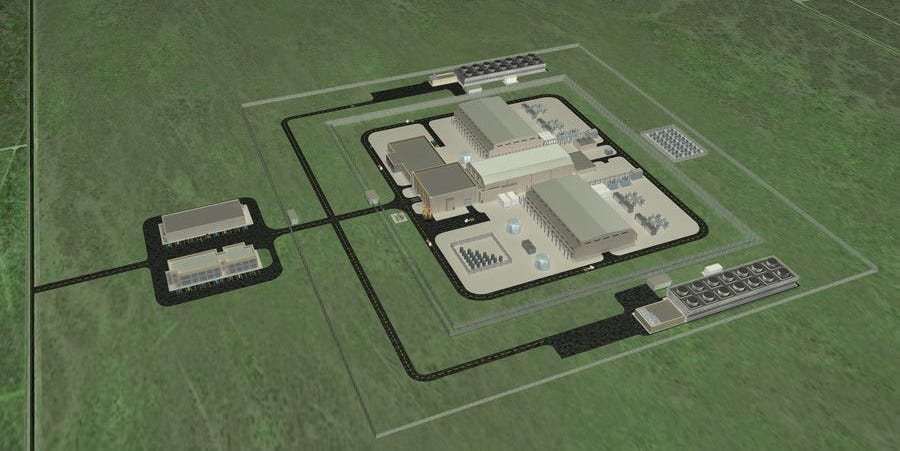
For decades, nuclear power has had the public image of a giant concrete fortress: expensive, slow to build, heavily regulated, and not exactly the kind of thing you would describe as “nimble.” Nuclear plants were the energy equivalent of an aircraft carrierpowerful, impressive, and absolutely not something you casually order in a multipack.
That image is starting to change. Across the United States, a new generation of smaller nuclear reactors is moving from computer renderings and conference speeches into license applications, construction permits, supply-chain planning, and early site work. These technologies are commonly called small modular reactors, or SMRs. Some are miniature versions of familiar light-water reactors. Others use molten salt, sodium, helium, or advanced fuel designs that sound like they escaped from a science-fiction lab wearing a hard hat.
The promise is simple: make nuclear power smaller, cheaper, faster to build, easier to finance, and better suited for a grid increasingly powered by wind, solar, batteries, data centers, electric vehicles, and industrial plants that cannot run on good intentions alone. The challenge is equally simple: prove it in the real world, not just in glossy brochures with blue-tinted renderings and heroic sunrise photos.
What Are Small Modular Reactors?
Small modular reactors are nuclear reactors designed to produce less electricity than traditional large nuclear plants. A conventional U.S. nuclear reactor often generates around 1,000 megawatts or more. Many SMR designs sit in the range of tens to a few hundred megawatts. Microreactors go even smaller, sometimes in the single-digit megawatt range, which makes them interesting for remote communities, military bases, mining sites, disaster recovery, and industrial campuses.
The word “modular” is the secret sauce. Instead of building nearly everything on-site in one enormous, customized construction project, SMRs are designed so major components can be manufactured in factories and then transported to the site. In theory, that could mean better quality control, repeatable designs, shorter construction schedules, and lower financial risk.
Think of the difference between building one custom mansion from scratch and producing a high-quality modular home in a controlled factory environment. The mansion may be beautiful, but the invoice arrives wearing sunglasses and holding a cigar. The modular approach aims to make nuclear construction more predictable.
Why the Nuclear Industry Wants to Go Smaller
The biggest obstacle facing nuclear energy in the United States has rarely been the physics. The hard part has been money, time, regulation, supply chains, public trust, and the terrifying ability of large infrastructure projects to make budgets swell like bread dough in July.
Large reactors can produce huge amounts of reliable, carbon-free electricity, but they require massive upfront investment. Even when a project eventually delivers valuable power for decades, the early financial burden can scare off utilities and investors. SMRs are designed to reduce that problem by lowering the size of each investment step.
Lower Upfront Cost
A smaller reactor should cost less to build than a giant plant, even if the cost per megawatt is not automatically lower. This is important. “Smaller” does not magically mean “cheaper electricity.” A cupcake is cheaper than a wedding cake, but feeding 200 guests with cupcakes can still get expensive. The real goal is to reduce project risk and make the first bite financially manageable.
Factory Production and Repeat Builds
The nuclear industry is betting that repeat manufacturing will drive down costs. If one design can be built again and again, engineers, regulators, suppliers, and construction crews can learn from each project. That learning curve is essential. The first unit is usually the most expensive because it carries the burden of design finalization, licensing, supply-chain development, and “Oops, nobody told us that valve would take 30 months to arrive.”
Better Fit for Modern Power Grids
SMRs may also fit more naturally into modern grids. A utility may not need a 1,200-megawatt plant all at once. It might prefer to add 300 megawatts now, another 300 later, and more after demand grows. This matters as electricity demand rises from artificial intelligence, data centers, reshored manufacturing, heat pumps, and electric transportation.
Real Projects Are Moving Forward
The phrase “nuclear renaissance” has been used so many times that it should probably be placed in a museum next to other optimistic energy slogans. This time, however, there are concrete developments worth watching.
NuScale: The First NRC-Certified SMR Design
NuScale became the first small modular reactor design certified by the U.S. Nuclear Regulatory Commission. That certification was a major milestone because it showed that an SMR design could complete a rigorous federal safety review. NuScale’s approach uses light-water reactor technology, which is familiar to regulators and the existing nuclear workforce.
However, NuScale’s journey also shows the difficulty of making SMRs commercially competitive. Its planned project with a group of municipal utilities in the western United States was canceled after projected costs rose and customer commitments fell short. That does not kill the SMR idea, but it does provide a useful splash of cold water. New nuclear technology still has to survive the unforgiving math of electricity markets.
TerraPower Natrium in Wyoming
TerraPower’s Natrium project in Kemmerer, Wyoming, is one of the most closely watched advanced nuclear projects in the country. Backed by Bill Gates and supported by the U.S. Department of Energy’s Advanced Reactor Demonstration Program, the plant is planned near a retiring coal facility. That location is not accidental. Coal communities already have transmission infrastructure, industrial workforces, and a strong connection to energy production.
The Natrium design uses a sodium-cooled fast reactor paired with thermal energy storage. Its base output is planned at 345 megawatts, with the ability to boost output to about 500 megawatts for periods when the grid needs more power. That flexible output could make advanced nuclear more useful alongside renewable energy, where supply can change with weather and time of day.
TVA and the BWRX-300 at Clinch River
The Tennessee Valley Authority is advancing plans for a GE Vernova Hitachi BWRX-300 small modular reactor at the Clinch River site in Tennessee. The BWRX-300 is a boiling water reactor design that leans on established nuclear technology rather than attempting to reinvent the entire machine from scratch.
This approach has a practical advantage: regulators, operators, and suppliers already understand many aspects of light-water reactor systems. If the goal is to deploy sooner rather than someday-after-the-moon-opens-a-condo-market, using familiar technology may help.
Holtec SMR-300 at Palisades
Holtec is pursuing plans to deploy two SMR-300 units at the Palisades site in Michigan, where the company is also working to restart the existing Palisades nuclear plant. This combination is important because it shows how old nuclear sites may become platforms for new nuclear development.
Existing nuclear sites often have valuable assets: trained workers, grid connections, security infrastructure, cooling access, local tax familiarity, and communities that already know what living near a nuclear plant looks like. Building at such sites could reduce some of the headaches associated with starting from zero.
Kairos Power, Google, and TVA
Kairos Power is developing fluoride salt-cooled high-temperature reactor technology. Its Hermes 2 demonstration plant in Oak Ridge, Tennessee, is tied to a broader agreement involving Google and the Tennessee Valley Authority. The project is designed to supply clean electricity to the TVA grid and help offset power demand from Google data centers in the region.
This is a preview of a major trend: technology companies are becoming serious nuclear customers. AI does not run on vibes. Data centers need enormous quantities of reliable electricity, and many companies want that electricity to be carbon-free every hour, not just averaged across a year.
X-energy and Dow in Texas
X-energy and Dow are pursuing advanced nuclear reactors at Dow’s Seadrift, Texas, manufacturing site. The plan involves four Xe-100 reactors that could provide both electricity and industrial steam. That second part matters. Many industrial processes need high-temperature heat, not just electrons flowing through wires.
Decarbonizing electricity is hard. Decarbonizing industrial heat is harder. If advanced reactors can provide reliable heat for chemicals, refining, steel, hydrogen, or desalination, their market could extend well beyond the electric grid.
Why “Cheaper” Is Still a Question, Not a Trophy
SMRs are often described as cheaper nuclear reactors, but the word “cheaper” deserves careful handling. They may be cheaper to finance because each unit is smaller. They may be cheaper to build after factories and supply chains mature. They may be cheaper for customers that need clean power at specific locations. But none of that is guaranteed.
The first wave of SMRs will likely be expensive because first-of-a-kind projects always carry extra costs. Licensing, engineering, specialized manufacturing, fuel qualification, operator training, and quality assurance are not discount-bin activities. Nuclear does not become economical because someone wrote “modular” on a slide deck.
The real economic test is whether the industry can move from first-of-a-kind to next-of-a-kind to many-of-a-kind. If utilities order one reactor here and one reactor there, costs may stay high. If companies build fleets of the same design, using the same suppliers and standardized construction methods, SMRs have a stronger shot at delivering on their cost promise.
The Fuel Problem: HALEU and Supply Chains
Several advanced reactor designs need high-assay low-enriched uranium, usually called HALEU. This fuel is enriched more than conventional reactor fuel but still far below weapons-grade material. HALEU can help advanced reactors operate efficiently, but the United States does not yet have a large commercial supply chain for it.
That is a major bottleneck. You can design the world’s most elegant reactor, but if the fuel supply is thin, the project schedule starts looking nervous. The federal government is supporting domestic HALEU production to reduce dependence on foreign sources and help advanced reactors move from demonstration to deployment.
Safety, Waste, and Public Trust
Supporters argue that many SMR designs include passive safety features, meaning they can cool themselves using natural physical processes rather than relying entirely on pumps, operator action, or external power. Smaller cores may also reduce certain accident risks. Advanced fuels such as TRISO particles are designed to retain radioactive materials under extreme conditions.
Still, nuclear energy comes with responsibilities that cannot be waved away with a cheerful infographic. Used nuclear fuel remains radioactive and must be managed securely. The United States still lacks a permanent geologic repository for commercial spent nuclear fuel. Security, emergency planning, transportation, safeguards, and community consent all remain central issues.
Public trust will be as important as engineering. Communities will want clear answers: Who pays if costs rise? Where does the waste go? What happens during extreme weather? How many permanent jobs are created? Who benefits from the electricity? Nuclear projects that treat local residents like an inconvenient comment section will struggle.
Where Smaller Reactors Could Make the Biggest Difference
Replacing Coal Plants
Retiring coal plants are natural candidates for SMRs. They already have transmission lines, industrial zoning, water access in some locations, and skilled energy workers. A small reactor could preserve part of the local tax base while replacing high-carbon generation with reliable clean power.
Powering Data Centers
Data centers are becoming one of the loudest demand signals in the energy market. Tech companies want clean, dependable electricity that runs day and night. SMRs could serve this market if they can be licensed, built, and priced competitively.
Industrial Heat
Factories, chemical plants, refineries, and hydrogen producers need heat. Advanced reactors that deliver both electricity and high-temperature steam could unlock cleaner industrial operations. This may become one of the most important SMR markets because it is harder for wind and solar alone to meet industrial heat needs.
Remote and Resilient Power
Microreactors could power remote military bases, Arctic communities, mines, and disaster-response operations. These applications often depend on diesel fuel that must be shipped long distances at high cost. A small reactor with long refueling intervals could provide reliable power where ordinary grid service is weak or nonexistent.
What Must Happen Next
For smaller nuclear reactors to succeed, the United States needs more than clever designs. It needs working projects that finish close to budget, regulatory reviews that remain rigorous but efficient, a domestic nuclear fuel supply chain, trained workers, community support, and customers willing to sign real power contracts.
The early 2030s will be crucial. If projects in Wyoming, Tennessee, Michigan, Texas, and other locations move forward successfully, SMRs could become a practical tool in America’s clean-energy toolbox. If costs rise sharply or schedules slip badly, enthusiasm may cool. The industry knows this. Investors know this. Regulators know this. Even the renderings probably know this.
Experience Notes: What the SMR Shift Feels Like on the Ground
To understand why smaller nuclear reactors are attracting attention, imagine you are sitting in a town that has depended on a coal plant for generations. The plant is not just a machine. It is paychecks, school funding, diners filled at lunch, Little League sponsorships, and the reason a transmission line runs through the county in the first place. When that plant retires, people do not experience “energy transition” as a clean chart with green arrows. They experience uncertainty.
This is where SMRs become more than a technology story. They offer the possibility of using old energy assets for a new energy era. A retired coal site may already have roads, grid connections, cooling infrastructure, and workers who understand high-reliability operations. A smaller reactor could fit into that landscape more easily than a massive traditional nuclear plant. It would not replace every coal job one-for-one, and nobody should pretend otherwise. But it could give energy towns a future that is not limited to watching old smokestacks come down.
Now picture an industrial manager at a chemical plant. The company has climate goals, customers asking for lower-carbon products, and equipment that needs steam every hour of every day. Solar panels help, wind contracts help, but the plant still needs firm heat. Batteries can store electricity, but they do not magically solve every industrial process. For that manager, an advanced reactor is not a political symbol. It is a potential tool: steady heat, steady power, fewer emissions, and less exposure to volatile fuel prices.
Or think about a data center operator. Servers do not care whether the sun is shining. They care about uptime. Artificial intelligence has made electricity demand grow faster than many grid planners expected. The digital economy may feel weightless to users, but behind every chatbot, cloud folder, video stream, and recommendation engine is a building full of machines quietly eating electricity like a teenager after football practice. Nuclear power’s ability to run around the clock suddenly looks very attractive.
There is also a human side to the regulatory process. Engineers may spend years answering detailed safety questions before a shovel touches the ground. That can feel painfully slow to developers, but nuclear safety culture exists for a reason. The public is not wrong to demand proof. The best SMR companies will not treat regulation as a villain. They will treat it as part of building trust.
In practical terms, the next decade will be about patience and receipts. Not hype. Not slogans. Receipts. Did the reactor get licensed? Did construction start? Did the supply chain deliver? Did the budget hold? Did the plant operate safely? Did customers buy the power? Smaller nuclear reactors are on the way, but the energy world has learned to be suspicious of grand entrances. The reactors that matter most will not be the ones with the prettiest announcements. They will be the ones that plug into the grid, run safely, and make the economics work without requiring a miracle in a hard hat.
Conclusion
Smaller, cheaper nuclear reactors may become one of the most important energy stories of the next decade. They promise clean, reliable power in a package that could be easier to finance, faster to build, and better matched to modern electricity demand. Small modular reactors could help replace coal plants, power data centers, support heavy industry, and strengthen remote or vulnerable grids.
But promise is not performance. SMRs still face cost uncertainty, fuel supply challenges, licensing hurdles, waste questions, and the simple reality that first-of-a-kind infrastructure is rarely cheap or easy. The good news is that real projects are now moving forward in the United States. The better news is that the industry is being forced to prove itself where it counts: construction sites, factory floors, regulatory reviews, and power contracts.
If the next generation of nuclear developers can deliver repeatable designs, strong safety performance, and credible economics, the phrase “small nuclear reactor” may stop sounding futuristic and start sounding practical. And in the energy business, practical is a beautiful word.