

Television comedy had no shortage of shiny new toys in 2025. The Studio turned Hollywood panic into prestige farce. The Chair Company expanded Tim Robinson’s anxious-surrealist universe. Several returning sitcoms also found fresh energy. Yet the comedy show that made the biggest creative leap was neither new nor particularly interested in behaving like an awards-season darling.
It was South Park, a series old enough to have fans who once watched it after sneaking downstairs past their bedtime and now watch it after putting their own children to bed.
Across Seasons 27 and 28, Trey Parker and Matt Stone transformed their animated institution from a familiar cultural commentator into something sharper, riskier, and more engaged. The show did not merely reference the news. It crashed through the front door of American politics, media, technology, and corporate entertainment, tracked mud across the carpet, and then asked why everyone looked uncomfortable.
The result was divisive, occasionally messy, and unmistakably alive. That is exactly why South Park took the biggest step forward in 2025.
South Park Returned With Something to Prove
The 2025 run arrived after an unusually long gap between conventional seasons. Season 27 premiered on Comedy Central on July 23, followed by five episodes before the continuing story moved into the five-episode Season 28 in October. Although the labeling confused some viewers, the two seasons effectively formed one connected ten-episode run.
For a series that began in 1997, simply returning would have been an achievement. Returning with urgency was something else.
Recent South Park installments had still produced memorable jokes, but the show sometimes appeared trapped between nostalgia and repetition. Randy Marsh’s marijuana business had consumed enormous amounts of screen time. Feature-length streaming specials replaced the old weekly rhythm. Political commentary occasionally felt cautious, delayed, or buried beneath familiar character routines.
Then 2025 arrived and the writers stopped circling the runway.
Instead of relying on Mr. Garrison as a presidential stand-in, the show directly depicted President Donald Trump. Instead of making generalized jokes about “both sides,” it built an extended narrative around presidential power, corporate obedience, lawsuits, federal agencies, religious influence, artificial intelligence, and the strange merger of politics with online entertainment.
The show had rediscovered its appetite. More importantly, it had found a reason to be dangerous again.
The Season Premiere Abandoned the Safety Rail
“Sermon on the ’Mount” Made the New Direction Clear
The Season 27 premiere, “Sermon on the ’Mount,” was not a gentle reintroduction. It was a flamethrower wearing mittens.
The episode targeted the Trump administration, the injection of Christianity into public schools, threats against media organizations, the cancellation of Stephen Colbert’s late-night program, and Paramount’s own relationship with political power. Trump was portrayed as insecure, litigious, and romantically involved with Satan, echoing the show’s earlier treatment of Saddam Hussein while abandoning the fictional buffer once provided by Mr. Garrison.
The episode even used an intentionally grotesque AI-style promotional video as part of its attack on political propaganda and corporate submission. The technique mattered because it blended the subject of the joke with the production method. Artificial imagery was not merely discussed; it became part of the punch line.
The White House responded by dismissing the series as irrelevant. Parker answered the controversy at San Diego Comic-Con with a deadpan apology that was very clearly not an apology. The exchange pushed South Park beyond entertainment coverage and into the national political conversation.
For a supposedly fading cartoon, that was a remarkable amount of noise.
It Replaced Detached Cynicism With a Clearer Point of View
For decades, South Park was associated with a particular comedic philosophy: everyone is ridiculous, passionate people are probably hypocrites, and certainty is often the first step toward public humiliation.
That approach created some brilliant television. It also produced the familiar criticism that the series treated unequal positions as equally foolish. A corrupt institution and the people protesting it could both become targets, sometimes leaving the impression that caring itself was the real offense.
The 2025 seasons did not completely abandon that instinct. Parker and Stone still mocked activists, politicians, billionaires, commentators, corporations, children, parents, and their own viewers. No sacred cow received protective bubble wrap.
However, the show became more willing to identify where power actually lived.
The sharpest jokes were directed upward: at government officials, corporate executives, technology investors, media personalities, and institutions able to shape public life. The children of South Park remained selfish and confused, but their confusion increasingly reflected systems created by adults.
Parker later explained that the show had not simply decided to “get political.” Politics itself had become inseparable from pop culture, online video, podcasts, memes, and celebrity spectacle. That observation became the organizing principle of the season.
The Episodes Turned Headlines Into Stories
The biggest improvement was not merely that South Park became topical again. The show began converting current events into character-driven comic premises rather than assembling a list of references and calling it dinner.
“Got a Nut” Examined the Grievance Economy
In “Got a Nut,” Clyde adopts the combative language of online debate culture, while Cartman attempts to compete with him. Their schoolyard rivalry becomes a parody of podcasters and influencers whose business model depends on provoking opponents, manufacturing outrage, and declaring victory before anyone has finished speaking.
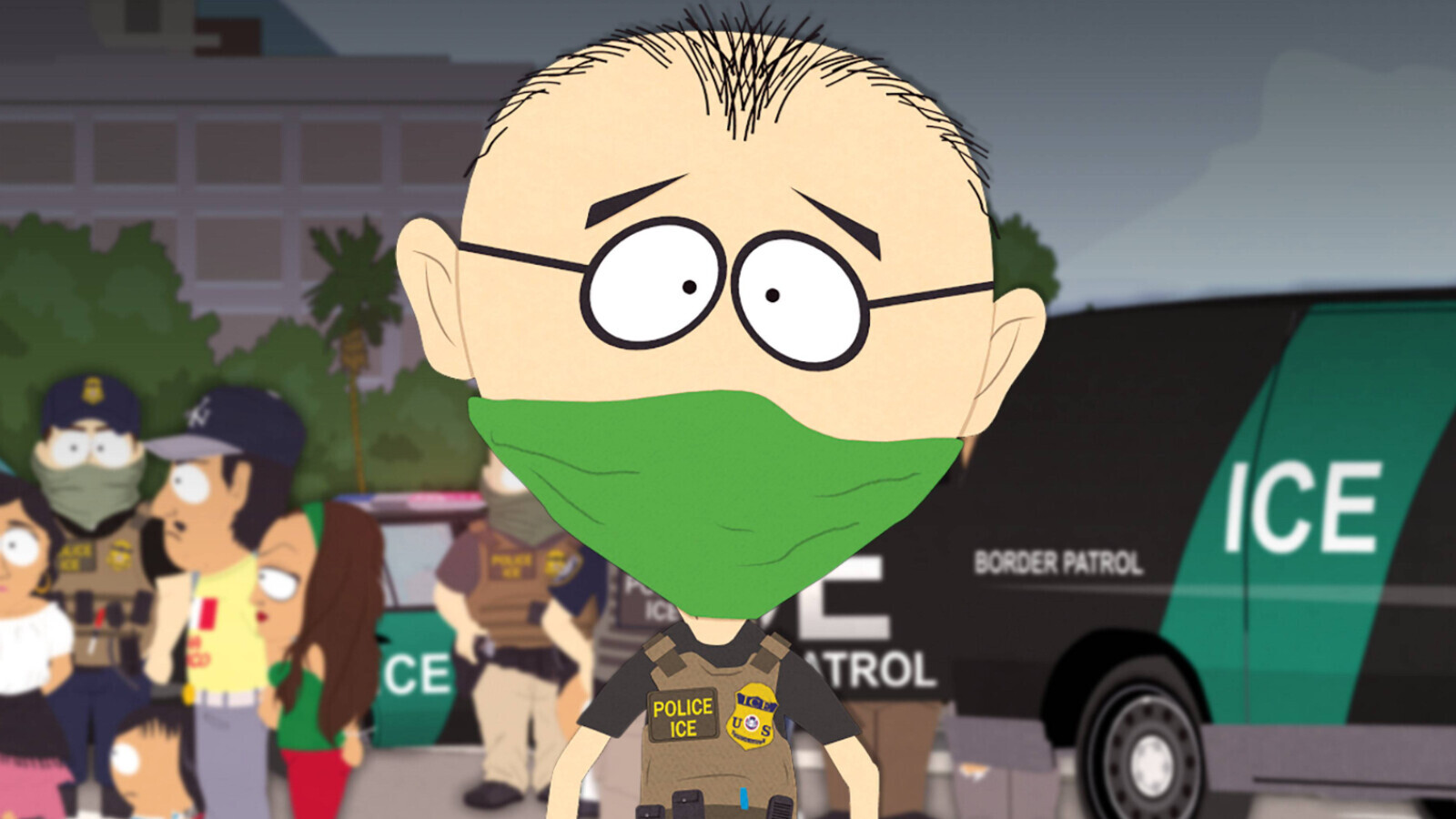
Meanwhile, Mr. Mackey loses his school job and joins Immigration and Customs Enforcement. The story uses his financial desperation to connect federal budget choices with the machinery of immigration enforcement. Kristi Noem is depicted through grotesque exaggeration, but the episode’s stronger idea is that institutions can recruit ordinary people by making other forms of stability disappear.
The satire is broad. It is not exactly a quiet French film in which two people stare at rain for 97 minutes. Yet beneath the shouting is a coherent argument about how insecurity, attention, and resentment become political products.
“Sickofancy” Brought the Attack Home
“Sickofancy” returned to Randy and Sharon Marsh while continuing the Trump-and-Satan storyline. Sharon helps Randy recover from a ketamine spiral, and the family finally moves away from Tegridy Farms, a setting that had dominated the series for years.
That change carried symbolic weight. Selling the farm allowed the show to loosen one of its most restrictive long-running plots. Randy could remain a magnificently irresponsible disaster without every episode having to return to the same marijuana-business joke.
The episode also mocked the federal takeover of Washington, D.C., and treated government spectacle as another branch of reality television. Instead of presenting politics as a distant process, the season portrayed it as a show that aggressively inserts itself into everyone’s day.
“Wok Is Dead” Connected Tariffs With Toy Mania
One of the year’s most effective stories involved Butters trying to obtain a Labubu doll for his girlfriend. The collectible-toy craze collided with trade policy as tariffs increased the difficulty and cost of getting the desired gift.
That premise sounds absurd until one remembers that economics often reaches ordinary people through extremely ordinary purchases. Most viewers do not experience international trade as a chart presented at a conference. They experience it when a toy, appliance, phone, or bag suddenly costs more.
By making Butters the center of the story, South Park translated a complicated policy argument into a recognizable emotional crisis: a sweet, anxious child trying not to disappoint someone he likes while adults turn commerce into a geopolitical wrestling match.
“Conflict of Interest” Took On Prediction Markets
“Conflict of Interest” focused on a prediction-market application that allows students to wager on increasingly disturbing outcomes. Kyle and Cartman clash as speculation, prejudice, and social media incentives blend together.
The episode understood that online betting is no longer confined to sports. Financialized platforms can turn elections, wars, celebrity scandals, and human suffering into tradable entertainment. The darker the possibility, the more attention it may attract.
That is a very South Park idea: humanity builds a sophisticated new technology and immediately uses it to gamble on whether somebody’s mother will cause an international incident.
Season 28 Expanded the Targets Beyond Washington
Season 28 continued the same narrative, but it widened the lens. The targets now included viral nonsense, cryptocurrency, artificial intelligence, Silicon Valley ideology, defense officials, and the global comedy business.
“Twisted Christian” Mixed Memes, Billionaires, and Prophecy
The premiere incorporated the viral “6-7” trend, Peter Thiel, Palantir, Christian apocalyptic thinking, and the possibility that Cartman might be connected to the Antichrist.
On paper, that sounds like someone emptied a junk drawer onto the writers’ table. In execution, the pieces shared a theme: powerful adults attempting to impose cosmic meaning on chaotic information.
The children repeat meaningless online phrases. Billionaires pursue grand theories about civilization. Religious figures interpret political events as prophecy. Everyone is desperate to locate a pattern, even if the pattern is drawn in crayon and smells faintly of Cartman.
“The Woman in the Hat” Used Self-Criticism as a Weapon
One of the smartest decisions of the year was allowing the characters to complain that South Park had become too political.
Stan, Kyle, and Kenny participate in a “South Park Sucks Now” meme-coin scheme while the White House faces a supernatural crisis. The episode acknowledges the criticism that the series had become consumed by one political storyline, then folds that criticism into a joke about crypto speculation and fandom.
This self-awareness prevented the season from becoming a sermon. The creators clearly believed in the direction they had chosen, but they remained willing to portray themselves as repetitive old men shouting about politics through construction-paper children.
“Sora Not Sorry” Found the Horror Inside AI Video
In “Sora Not Sorry,” Butters uses generative video technology for revenge, triggering an epidemic of fake clips at school. Detective Harris struggles to determine what is real while fabricated footage spreads faster than anyone can investigate it.
The episode captured a basic problem of generative media: producing convincing evidence can become easier than verifying it. Once every person can manufacture a video, denial becomes available to the innocent and guilty alike.
Rather than turning the subject into a dry lecture about digital literacy, the show placed the technology in Butters’ hands. Of course an anxious child with poor judgment and years of accumulated humiliation would use a powerful creative tool responsibly. What could possibly go wrong besides everything?
“Turkey Trot” Looked at Comedy’s Own Compromises
The Thanksgiving episode combined Cartman’s questionable “race science,” competition between government personalities, and criticism of American comedians who accepted lucrative appearances at the Riyadh Comedy Festival.
That last target was especially important. A show criticizing corporate and political compromise also had to consider the compromises made by comedians themselves. The episode asked whether performers who champion free expression at home should accept money from governments accused of suppressing it abroad.
The satire was not perfectly subtle, but subtlety has never been Cartman’s preferred seasoning. The episode demonstrated that the series was willing to examine its own industry rather than treating comedy as automatically courageous.
The Corporate Backstory Made the Satire More Powerful
The creative leap occurred during a major business negotiation. Paramount secured long-term global streaming rights to South Park, while Parker and Stone’s production company received a new agreement to continue producing episodes through 2030. Reports valued the broader package at more than $1.25 billion, with the streaming component valued at roughly $300 million annually over five years.
That enormous deal created a delicious contradiction. The creators were becoming even more financially connected to Paramount while broadcasting jokes about Paramount’s fear of political retaliation.
Instead of hiding that tension, the premiere dragged it into the story.
This is where the season felt genuinely bold. It is easy for a comedy to attack a distant institution. It is harder to make your employer part of the joke immediately after signing one of television’s richest agreements.
The series did not pretend to exist outside capitalism. It weaponized its privileged position within it.
The Audience Response Disproved the Irrelevance Argument
Comedy Central reported that the Season 27 premiere reached approximately 5.9 million cross-platform viewers during its first three days. It also achieved the program’s strongest audience share in more than 25 years.
Those numbers do not mean every viewer loved the episode. Some watched because they were delighted. Others watched because they were furious. A few probably watched because the internet said there was an animated president in bed with Satan and curiosity remains one of humanity’s least dignified instincts.
Still, cultural relevance is not measured only by approval. It is measured by whether a work generates discussion, imitation, criticism, response, and renewed interest.
By that standard, South Park was undeniably relevant in 2025.
Why the Biggest Step Forward Was Not the Same as Perfection
The 2025 run had weaknesses. The irregular schedule made the season difficult to follow. Several episodes attempted to carry so many topical ideas that individual plots felt crowded. The continuing Trump-and-Satan narrative sometimes overshadowed Stan, Kyle, Kenny, and the town’s wider cast.
Viewers who preferred standalone childhood adventures had legitimate reasons to feel neglected. Political satire can become exhausting when the audience already encounters the same figures in every news feed, podcast, notification, and family group chat that should have been muted three Thanksgivings ago.
The shock comedy also produced diminishing returns. Once an episode has shown the president naked beside Satan, escalation becomes a difficult staircase to climb.
Yet artistic progress does not require flawless execution. It requires movement.
South Park moved away from creative comfort. It abandoned an overused setting, adopted a more direct perspective, confronted its corporate environment, experimented with serialized storytelling, and engaged with technologies that are changing how truth and entertainment function.
Some swings missed. At least the show was swinging again.
The Experience of Watching South Park’s 2025 Run
Watching the 2025 episodes felt less like settling into a traditional sitcom and more like opening a group chat moments after a national scandal. You knew the discussion would be chaotic, somebody would cross a line, and Cartman would somehow make the situation worse while insisting he had solved it.
The first surprise was the speed. Many political comedies respond to events through monologues, sketches, or carefully prepared weekly segments. South Park converted the atmosphere of the moment into complete animated stories. Although the production schedule was uneven, the episodes felt close enough to current events that viewers could recognize not only the headlines but also the strange emotional texture surrounding them.
That immediacy created a distinctive tension. A joke about tariffs, prediction markets, viral memes, or generative video did not feel like a historical reference polished months earlier. It felt like the writers had been scrolling through the same bewildering feeds as everyone else and had responded by locking Butters in a room with dangerous technology.
The second surprise was how uncomfortable the show was willing to become. The premiere did not offer viewers the safety of a fictional president or a perfectly balanced list of targets. It planted a flag, then used the flagpole for an inappropriate visual gag.
For some viewers, that directness was thrilling. Here was a major television comedy refusing to soften its attack during a period when media companies appeared increasingly nervous about government pressure, lawsuits, mergers, and regulatory approval.
For others, it felt repetitive or partisan. Fans accustomed to the show’s traditional “everyone is terrible” approach could interpret the season as an abandonment of its identity.
That disagreement became part of the viewing experience. Every episode seemed to continue after the credits through social media arguments, reaction videos, political statements, and debates about whether South Park had become brave, biased, brilliant, desperate, or all four before breakfast.
The most enjoyable episodes were those that filtered enormous issues through small desires. Butters only wanted a toy. Mr. Mackey needed a paycheck. Students wanted attention. Cartman wanted victory without effort, admiration without merit, and snacks without sharing. In other words, Cartman remained Cartman.
Those familiar motivations kept the satire from floating away into cable-news space. Even when the stories involved federal agencies or international policy, the emotional logic remained grounded in jealousy, fear, greed, loneliness, and the catastrophic human need to look cool in front of classmates.
The AI episode was particularly effective because it turned a distant technological concern into a school crisis. Viewers did not need to understand model architecture or synthetic-media research. They only needed to understand that Butters had discovered a tool capable of making believable fake videos. The rest followed with the inevitability of Kenny standing near heavy machinery.
The experience could also be frustrating. The split between Seasons 27 and 28 was confusing, and delays weakened the rhythm. At times the serialized political plot seemed determined to appear in every episode, like a guest who has missed three separate hints that the party ended.
Nevertheless, the inconsistencies contributed to the sense that the show was being made under pressure rather than assembled by committee. It felt handmade, reactive, and occasionally recklessthe same qualities that made early South Park exciting.
By the end of the run, the most satisfying realization was not that the series had returned to its old form. It had not. The creators were older, the television business was different, and the national conversation had become stranger than many of the show’s original plots.
The satisfaction came from seeing a long-running comedy accept that it could not survive by pretending nothing had changed. Instead of endlessly recreating its greatest hits, South Park found a new source of energy in the collision between government, entertainment, technology, and attention.
Watching it was not always comfortable. It was rarely predictable. It was occasionally exhausting. But it never felt like background noise.
For a comedy approaching its fourth decade, that may be the most impressive achievement of all.
Conclusion: South Park Chose Relevance Over Comfort
South Park took the biggest step forward in 2025 because it stopped behaving like a protected television monument.
Parker and Stone treated the show as a living piece of satireone capable of changing its methods, challenging its audience, criticizing its corporate home, and admitting when its own obsessions had become ridiculous.
Seasons 27 and 28 were not universally loved, nor were they consistently elegant. They were loud, crude, overloaded, politically aggressive, and sometimes held together with the narrative equivalent of duct tape.
They were also ambitious.
The show connected tariffs to collectible toys, AI video to schoolyard revenge, prediction markets to moral detachment, meme coins to fan outrage, and presidential politics to the entertainment economy. It found jokes inside subjects that often resist parody because reality already appears to be performing a poorly supervised improv exercise.
Most importantly, South Park proved that longevity does not have to mean creative retirement. A comedy can be 28 seasons old and still provoke official statements, record-setting attention, furious arguments, and the nervous laughter that occurs when a joke lands slightly too close to reality.
In 2025, the biggest step forward was not becoming more polished. It was becoming more fearless.
Editorial note: This article synthesizes official episode information, reported audience data, creator interviews, entertainment-industry reporting, and critical analysis published by reputable U.S. media outlets.