

Note: This article is written for web publication and synthesizes real, publicly available information about compact tokamak fusion, Tokamak Energy’s ST40 spherical tokamak, high-temperature superconducting magnets, and the road toward commercial fusion power.
Fusion energy has spent decades living in the same mental neighborhood as flying cars, robot butlers, and “I’ll only watch one episode.” It sounds wonderful, it keeps appearing in headlines, and yet it always seems to be just over the next hill. But compact tokamaks are starting to change that story. One machine in particular, Tokamak Energy’s ST40 spherical tokamak, has pushed plasma to temperatures above 100 million degrees Celsius, a level widely discussed as relevant for commercial magnetic-confinement fusion.
That does not mean a fusion plant is quietly powering your toaster tomorrow morning. The grid is not yet humming with star-fire from a compact reactor tucked behind a hedgerow in Oxfordshire. But it does mean something important: a privately built, relatively small spherical tokamak has achieved a temperature once associated mainly with giant public research machines. In the world of fusion, that is not a baby step. That is a toddler suddenly clearing a high jump.
What Is a Tokamak, and Why Is Everyone So Excited?
A tokamak is a machine designed to confine extremely hot plasma using powerful magnetic fields. Traditional tokamaks are often described as doughnut-shaped because their plasma sits inside a torus. The magnetic fields twist around the plasma, helping keep charged particles away from the machine walls long enough for fusion reactions to become possible.
The basic idea is simple in the way climbing Mount Everest is “just walking uphill.” Fusion happens when light atomic nuclei, such as forms of hydrogen, combine to form heavier nuclei and release energy. The sun does this naturally because gravity supplies immense pressure. On Earth, scientists must create the right combination of temperature, density, and confinement time. That combination is often summarized by the “triple product,” a key measure of plasma performance.
In a power plant, energy from fusion would be captured as heat. That heat could then be used to make steam, spin turbines, and generate electricity, much like conventional thermal power plants. The difference is that fusion promises carbon-free power without the same long-lived waste profile associated with today’s fission reactors. That promise is why governments, private companies, national laboratories, and investors are still chasing fusion after more than 70 years of scientific wrestling.
Why the ST40 Compact Tokamak Matters
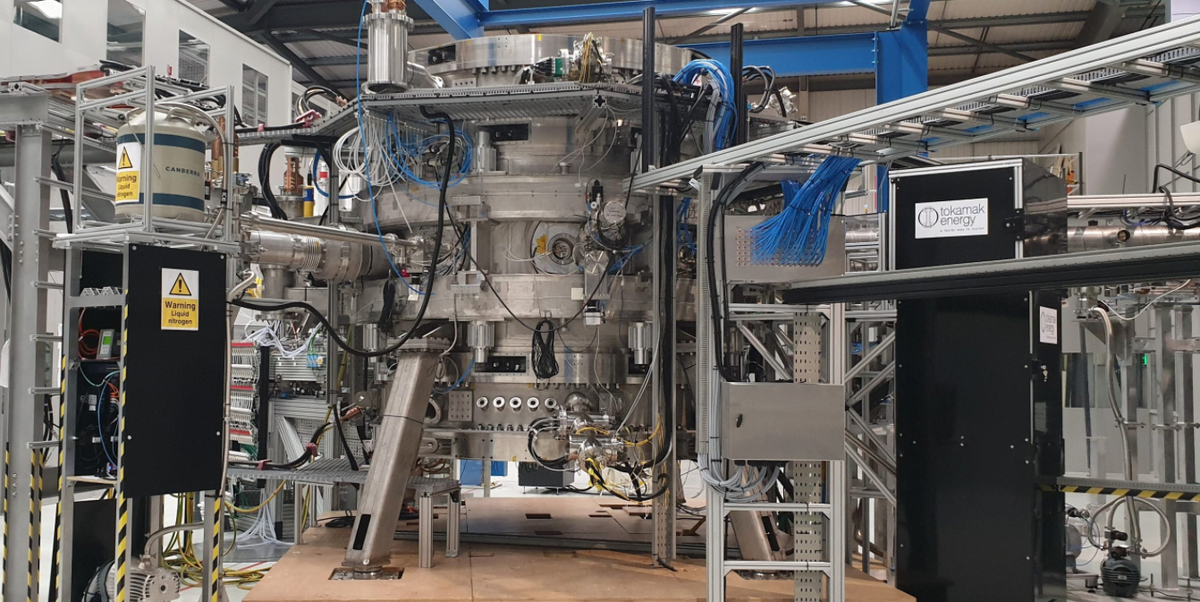
Tokamak Energy’s ST40 is not a conventional giant tokamak. It is a compact, high-field spherical tokamak. Instead of looking like a wide doughnut, a spherical tokamak is closer to a cored apple. This tighter geometry can, in theory, produce efficient plasma confinement in a smaller machine. Smaller matters because fusion power plants must eventually be built, maintained, financed, licensed, repaired, and operated in the real world, where “make it bigger” is not always a business strategy.
In 2022, ST40 achieved a plasma ion temperature of 100 million degrees Celsius. A peer-reviewed paper later reported ion temperatures above 100 million degrees Kelvin, or about 8.6 keV, in the compact high-field spherical tokamak. That is a serious milestone because high ion temperature is one of the required ingredients for practical magnetic-confinement fusion.
The achievement was especially interesting because ST40 did it in a much smaller device than many historic fusion machines. The experiment also involved collaboration with U.S. national laboratory researchers, including work connected with Princeton Plasma Physics Laboratory and Oak Ridge National Laboratory. The plasma pulses were short, measured in fractions of a second, but the result showed that compact spherical tokamaks can reach fusion-relevant temperatures.
Commercial Fusion Is More Than “It Got Hot”
Here is where we must put on the lab coat of honesty. Reaching 100 million degrees Celsius is impressive, but commercial energy production requires more than making plasma hotter than a dragon’s bad mood. A fusion power plant must produce more useful energy than it consumes, sustain or repeat the reaction reliably, protect internal components from extreme neutron bombardment, manage heat exhaust, breed or source tritium fuel, and generate electricity at a competitive cost.
That is why the phrase “on the verge” should be read carefully. ST40 is not a plug-and-play power station. It is a proof point. It helps demonstrate that the compact spherical tokamak route is technically credible. The next question is whether that credibility can be engineered into a full pilot plant that sends net electricity to the grid.
Tokamak Energy’s roadmap has focused on pairing spherical tokamak design with high-temperature superconducting, or HTS, magnets. HTS magnets are important because strong magnetic fields can improve plasma confinement. If magnets can generate powerful fields efficiently and in a compact footprint, the whole machine can potentially shrink. In fusion engineering, smaller can mean faster construction, lower capital cost, and easier iteration. That is the kind of sentence investors like to hear without requiring a translation from plasma physicist to human.
The Role of High-Temperature Superconducting Magnets
Magnets are the invisible hands of a tokamak. They shape, squeeze, and guide plasma that is far too hot to touch any material wall. Conventional superconducting magnets require extreme cooling. High-temperature superconductors can operate at comparatively higher cryogenic temperatures and maintain strong performance in high magnetic fields.
Tokamak Energy has been developing HTS magnet systems alongside its spherical tokamak program. Its Demo4 system is described by the company as a world-first high-field HTS fusion magnet system. The point is not merely to set a laboratory record, but to build magnet technology that can survive the practical demands of a future fusion pilot plant.
This matters because fusion has a long history of dazzling scientific results that are hard to turn into hardware. A commercial plant will need magnets that do not behave like delicate museum pieces. They must be manufacturable, maintainable, and reliable. They must also work with the rest of the plant: cryogenic systems, power electronics, vacuum vessels, shielding, blanket modules, diagnostics, and control software. Fusion is not one invention. It is an orchestra, and every instrument is on fire.
What Comes After ST40?
ST40’s achievement was a milestone, not the finish line. Through 2026, Tokamak Energy has described a major upgrade program for ST40 in collaboration with the U.S. Department of Energy and the United Kingdom’s Department for Energy Security and Net Zero. The upgrade is intended to advance technologies such as lithium plasma-facing components and radio-frequency heating.
Those details are important. Lithium systems may help with plasma-facing surfaces and fuel-cycle questions. Radio-frequency heating gives researchers another way to add energy to plasma and explore operating scenarios. These are not glamorous headline phrases, but they are the nuts and bolts of moving from “hot plasma” to “useful power plant.”
Tokamak Energy has also presented concepts for a fusion pilot plant under the U.S. Milestone-Based Fusion Development Program. In 2024, the company discussed a high-field spherical tokamak plant concept capable of producing hundreds of megawatts of fusion power and a smaller amount of net electricity, with a target for pilot-plant operation in the mid-2030s. That timeline is ambitious, but ambition is basically the native language of fusion.
Why Compact Fusion Could Change the Energy Market
The strongest argument for compact tokamak fusion is not just that it is scientifically elegant. It is that it could solve a practical energy problem: the world needs enormous amounts of clean, reliable, on-demand power. Solar and wind are growing quickly, but they depend on weather and storage. Fission nuclear plants provide firm carbon-free power, but face cost, construction, waste, and public acceptance challenges. Natural gas is flexible, but it emits carbon dioxide.
Fusion, if commercialized, could offer firm clean power with fuel derived from abundant or breedable sources. A fusion plant could theoretically run day and night, supporting heavy industry, data centers, cities, desalination, hydrogen production, and grid stability. That is why the commercial fusion race has become more than a science story. It is now an energy security story, a climate story, and an industrial strategy story.
Compact tokamaks add another layer to that promise. If a smaller machine can achieve the same physics conditions as a larger one, developers may be able to build pilot plants faster and learn through iteration. That is the same logic that transformed rockets, batteries, chips, and software: build, test, improve, repeat, and try not to explode anything important.
The Hard Problems Still Standing in the Way
Fusion’s remaining challenges are not small. First, plasma must be controlled with extreme precision. A fusion plasma is not a campfire; it is a charged, turbulent, self-organizing storm. It can develop instabilities, lose confinement, dump heat into machine walls, and generally behave like a cat in a thunderstorm.
Second, materials must withstand punishing conditions. Deuterium-tritium fusion produces energetic neutrons. Those neutrons can damage materials, activate components, and change mechanical properties over time. A commercial plant must be designed for inspection, maintenance, replacement, and safe handling of activated materials.
Third, tritium supply is a major issue. Tritium is radioactive and scarce. Future fusion plants are expected to breed tritium from lithium inside blanket systems, but breeding enough tritium reliably is one of the key engineering hurdles still to be proven at scale.
Fourth, economics matter. A fusion plant cannot merely work; it must work affordably. The world already has cheap solar, improving batteries, existing nuclear, hydropower, geothermal, and gas turbines. Fusion must eventually compete not with a fantasy energy market, but with real technologies that are constantly improving.
Why the ST40 Result Still Deserves Attention
Despite the caveats, ST40 deserves attention because fusion progress is cumulative. Commercial fusion will not arrive as one magical “Eureka!” moment. It will arrive through a chain of solved problems: better magnets, hotter plasmas, longer pulses, improved confinement, smarter diagnostics, tougher materials, tritium breeding, efficient heat extraction, and credible plant design.
ST40’s 100-million-degree milestone checks one box on that long list. It shows that a compact high-field spherical tokamak can reach temperatures relevant to commercial fusion. That matters because the spherical tokamak approach aims to produce high plasma pressure relative to magnetic field strength, potentially enabling smaller and more economical reactors.
In plain English: if fusion ever becomes a mainstream power source, machines like ST40 may be remembered as the scrappy prototypes that proved smaller reactors could punch above their weight.
Compact Tokamak vs. Giant Tokamak: David, Goliath, and Plasma
Large international projects such as ITER remain vital because they test reactor-scale physics, superconducting systems, and integrated fusion engineering. But compact private-sector machines offer a different kind of advantage: speed. Smaller devices can be upgraded faster. They can test ideas quickly. They can fail, teach, and return to the lab without requiring an international diplomatic summit and a calendar measured in decades.
That does not make compact tokamaks automatically better. It makes them complementary. Big machines explore full-scale reactor conditions. Compact machines explore agility, high-field operation, and commercial design loops. The fusion future may not belong to one approach. It may be shaped by several designs competing, cross-pollinating, and occasionally borrowing each other’s best ideas like students before a group project deadline.
The Commercial Energy Production Question
So, is this compact tokamak truly on the verge of commercial energy production? The fairest answer is: it is on the verge of proving whether its path to commercial production is practical. That distinction matters.
ST40 has shown fusion-relevant temperature. Tokamak Energy is advancing magnet systems, upgrading the device, and designing pilot-plant concepts. The company is working within public-private programs and collaborating with national laboratories and industrial partners. These are all signs of a serious commercialization pathway.
But commercial energy production requires a plant that produces net electricity, connects to the grid, operates reliably, earns regulatory approval, and makes financial sense. That has not yet been achieved by any tokamak company. The next decade will determine whether compact spherical tokamaks can move from promising experiments to bankable infrastructure.
Experience Section: What This Technology Feels Like From the Outside
Following compact tokamak fusion as a technology story feels a little like watching a championship game where the scoreboard updates once every few years. For a long time, the public heard the same joke: fusion is 30 years away and always will be. It was a funny line because it felt true. But the mood around fusion has changed. The joke is still around, but now it is told with one eyebrow raised, because private companies are building hardware, governments are funding milestone programs, and customers are beginning to imagine real power purchase agreements.
The most striking experience is the scale contrast. When people imagine fusion, they picture huge machines, giant concrete halls, and international megaprojects with budgets that make calculators sweat. Then they see a compact spherical tokamak like ST40 and realize that fusion research can happen in a smaller, faster, more entrepreneurial form. It does not make the science easy, but it makes the development culture feel different. Instead of one enormous cathedral of physics, the field now has workshops, startups, supplier networks, and pilot-plant roadmaps.
There is also a psychological shift in how milestones are interpreted. A temperature record by itself is not a power plant. Anyone who has followed energy technology learns to be cautious. Plenty of breakthroughs look magnificent in a press release and then quietly vanish into the swamp of scale-up. Still, ST40’s 100-million-degree achievement feels different because it fits into a broader technical pattern: stronger magnets, better plasma modeling, improved diagnostics, high-field compact designs, and serious public-private collaboration.
For engineers, the exciting part is not the headline temperature alone. It is the growing list of practical questions being attacked directly. How do you heat plasma efficiently? How do you handle exhaust heat? How do you stop materials from degrading? How do you build HTS magnets that are powerful but not absurdly expensive? How do you design a blanket that can breed tritium and extract heat? These are gritty questions. They do not sparkle like “artificial sun,” but they are the questions that decide whether fusion becomes an industry.
For energy users, the experience is more cautious optimism. A factory manager, data center operator, or city planner does not need poetry about star power. They need electricity that is clean, dependable, affordable, and available when demand spikes. Compact tokamak fusion promises exactly that, but promises do not run air conditioners. The coming test is whether companies can turn physics milestones into contractual, regulated, grid-connected assets.
For the average reader, the best way to understand ST40 is this: it is not the finish line, but it is a loud knock on the door. The machine has shown that compact spherical tokamaks can reach temperatures once reserved for much larger devices. Now the challenge is to hold the heat, control the plasma, build the plant, close the fuel cycle, satisfy regulators, and make the economics behave. Fusion is still hard. But for the first time in a long time, “hard” no longer sounds like “impossible.” It sounds like an engineering schedule.
Conclusion
Tokamak Energy’s compact ST40 spherical tokamak has earned its place in the commercial fusion conversation. By reaching plasma ion temperatures above 100 million degrees Celsius and supporting a broader program of HTS magnet development, public-private collaboration, and pilot-plant design, it has helped move fusion from distant dream to serious engineering race.
The key word is “race.” No compact tokamak is commercially producing electricity yet. The remaining hurdles are huge: sustained net energy, materials durability, tritium breeding, heat management, licensing, cost, and grid integration. But the progress is real enough to deserve attention. Compact tokamaks may not replace every power source, and they may not arrive as quickly as their boldest supporters hope. Still, they are now close enough to commercial relevance that the energy world is watching carefully.
If ST40 and its successors succeed, the payoff could be enormous: clean, firm, low-carbon power available on demand. That would not just be another energy technology. It would be one of the biggest infrastructure shifts of the century. For now, the compact tokamak is not yet the sun in a bottle. But the bottle is getting better, the magnets are getting stronger, and the countdown to commercial fusion feels a little less like science fiction every year.