

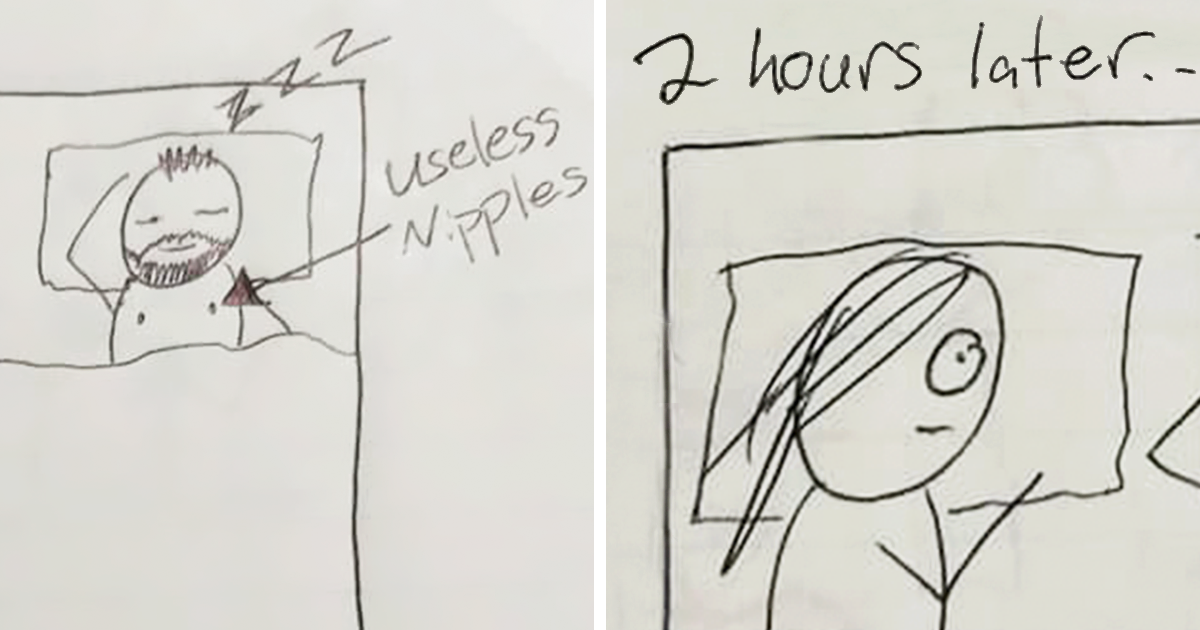
Some relationship problems require a long talk, a therapist, or at least a group chat with three brutally honest friends. Others can be solved with a cup of coffee, five stick-figure drawings, and the phrase every exhausted parent understands in their bones: “Let me show you what my night looked like.”
That is exactly why the story of Mattea Goff, a Texas mom who drew a comic to explain to her husband why she was so tired, became such a viral parenting moment. Her husband, Kris, was not painted as a villain twirling a mustache while the baby screamed. In fact, Mattea made it clear that he was a loving, involved dad. The problem was simpler and funnier: he slept like a decorative log while she handled the midnight circus of breastfeeding, soothing, baby flailing, spit-up, and the kind of sleep deprivation that makes a person stare at the refrigerator and wonder why the laundry is inside.
The comic worked because it translated invisible exhaustion into something visible. Instead of saying “I’m tired” for the 900th time, she drew the entire night: baby wakes, mom feeds, baby squirms, mom freezes, baby spits up, dad sleeps peacefully enough to be mistaken for furniture. By morning, he is ready to cuddle. She is ready to join a witness protection program under the name “Please Don’t Touch Me.”
Why This Viral Mom Comic Hit Such a Big Nerve
The title sounds lighthearted: This Woman Drew A Comic To Explain To Her Husband Why She’s So Tired, And It Will Crack You Up. But the reason it spread so fast is that it was funny and painfully accurate. Parents recognized the exact math of newborn nights: one person gets “sleep,” the other gets a sequence of short, interrupted unconsciousness breaks between feedings, diaper checks, soothing, and silently plotting revenge against snoring.
Mattea’s drawings centered on breastfeeding, but the message reached far beyond nursing parents. Bottle-feeding parents, adoptive parents, stay-at-home parents, working parents, and basically anyone who has ever cared for a tiny human at 3:17 a.m. understood the joke. Babies do not care that adults have jobs, skeletons, or hopes. They operate on baby time, which is mostly “now,” “again,” and “louder.”
The genius was in the simplicity
The comic did not need polished art or complicated dialogue. That was the point. A messy little doodle can say what a polished essay sometimes cannot. It showed how one parent may technically be “in the room” while the other is actually on duty. The baby may be inches away from both adults, but only one brain is awake enough to hear the grunt, reach for the burp cloth, check the latch, dodge the tiny foot, and wonder whether the wet spot is milk, spit-up, sweat, tears, or all four in a charming postpartum smoothie.
That is why people laughed. Not because exhaustion is funny by itself, but because recognition is funny. When a comic captures your private chaos exactly, you laugh the way people laugh when the smoke alarm stops: with relief, disbelief, and a little bit of eye twitching.
The Real Issue: Newborn Exhaustion Is Not “Just Being Tired”
Newborn sleep is famously fragmented. Babies wake often because they need feeding, comfort, diaper changes, and help settling. Breastfed newborns commonly feed many times in a 24-hour period, including at night. Even when the baby is healthy and everything is going “normally,” the parent doing most of the nighttime care can become deeply worn down.
This is the part many non-breastfeeding partners miss. From the outside, it can look like the nursing parent is lying down most of the night. From the inside, it feels like being a 24-hour diner, emotional support mattress, milk machine, crisis manager, and tiny-wrist restraint specialist. The body may be horizontal, but the brain is running a full emergency operations center.
Interrupted sleep is its own special monster
There is a difference between sleeping six hours and being in bed for six hours while waking every 45 to 90 minutes. Parents know this difference so well they should receive a minor honorary degree in sleep fragmentation. A person can technically spend the night in bed and still wake up feeling like they were gently run over by a stroller parade.
That is what Mattea’s comic captured: the unfairness of appearances. A partner may wake up and think, “We both went to bed at the same time.” Meanwhile, the nursing parent has lived through five separate weather events, three baby gymnastic routines, two feeding sessions, one mysterious wet patch, and a dark spiritual negotiation with the ceiling fan.
Why Humor Makes Hard Conversations Easier
One reason the comic became so beloved is that it did not start with blame. It started with a joke. That matters. In relationships, especially during the newborn stage, everyone is tired, everyone is sensitive, and everyone has the emotional durability of a soggy paper towel. A direct complaint can easily turn into defensiveness. A funny drawing can sneak past the guard tower.
Humor says, “Look at this ridiculous thing we are surviving.” It gives both partners a way to laugh before they problem-solve. Mattea’s drawings allowed Kris to see the night from her perspective without feeling attacked. That is powerful because the best relationship conversations are not about winning a case in the Court of Marriage. They are about helping the other person finally see the full picture.
Visual storytelling turns “you don’t get it” into “here, look”
Words can fail when a person is sleep-deprived. Anyone who has cared for a newborn knows the brain starts deleting basic files. You forget words like “spoon.” You pour coffee into a cereal bowl. You call the baby by the dog’s name and the dog by your own name. So sitting down to calmly explain nighttime breastfeeding fatigue can feel impossible.
A comic solves that problem by showing instead of telling. In Mattea’s case, the five-panel format made the experience instantly understandable: one parent repeatedly wakes, the other remains blissfully unconscious, the morning mood gap makes perfect sense. It is not a lecture. It is a tiny documentary with better punchlines.
The Mental Load Behind the Midnight Feed
The viral comic focuses on physical exhaustion, but it also points toward a bigger topic: the mental load. This is the invisible planning, noticing, anticipating, remembering, and emotional monitoring that keeps family life running. It is not just feeding the baby; it is knowing when the baby last ate, whether the diaper rash cream is running low, which side the baby nursed on last, when the pediatrician appointment is, and whether the tiny socks have vanished into the same portal that eats adult Tupperware lids.
Research and parenting experts frequently note that this cognitive labor often falls disproportionately on mothers or primary caregivers. Even in households where both partners are loving and hard-working, one person may become the default manager of the home. The other person may “help,” but helping is not the same as owning responsibility.
Helping is good; ownership is better
Here is the difference. Helping sounds like: “Tell me what to do.” Ownership sounds like: “I noticed we are low on wipes, so I ordered more.” Helping waits for instructions. Ownership sees the system. Helping changes one diaper. Ownership knows where diapers are, when the next size is needed, and why the diaper cream should not live inside the toy bin next to a suspiciously sticky giraffe.
Mattea’s comic is funny because it shows the moment when one partner finally understands a slice of that system. The question is not whether Kris loved his family. Clearly, he did. The question was whether he could see the invisible parts of the night. Once he saw them, he could respond with more empathy.
What Partners Can Learn From This Comic
The easiest takeaway is “don’t sleep through everything,” but that is only the beginning. Some partners truly are heavy sleepers. Some cannot breastfeed. Some work long hours or have different nighttime capacities. Fair enough. Nobody is suggesting that every household must split every minute exactly down the middle like a courtroom settlement over Cheerios.
The deeper lesson is that support must be active, not theoretical. A partner who cannot breastfeed can still burp the baby, change diapers, refill the water bottle, bring snacks, wash pump parts, handle the morning toddler shift, take the baby after the first feed, schedule pediatrician visits, clean bottles, prep lunches, or protect the nursing parent’s nap like a tiny dragon guarding treasure.
Useful support sounds specific
Instead of asking, “Do you need help?” try asking, “Do you want me to take the baby after this feed so you can sleep for two hours?” Instead of saying, “Just wake me up,” try setting an alarm for one shift. Instead of waiting for a list, learn the routine. The exhausted parent should not have to become the household project manager at 2 a.m. with one eye open and a baby attached.
Specific support reduces resentment because it removes the burden of constant delegation. It also builds trust. When a parent knows their partner can handle a task without being coached through every sock, bottle, wipe, burp, and swaddle, the exhausted brain can finally loosen its grip.
Why Moms Loved the Comic So Much
People shared Mattea’s drawings because they felt seen. That phrase gets used a lot online, but here it fits. New parenthood can be isolating. You are awake at strange hours doing repetitive, tender, messy work that disappears almost immediately. The baby is fed, then hungry again. The diaper is changed, then dramatic again. The laundry is folded, then the baby produces a laundry sequel with special effects.
When a comic turns that hidden labor into a public joke, it gives parents permission to say, “Yes, this is hard.” Not “I hate my baby.” Not “my partner is awful.” Not “I regret everything.” Just: “This is hard, and I am allowed to be tired.” That is a surprisingly healing sentence.
It also gave couples a conversation starter
A lot of people tagged partners in the comic because it said the quiet part out loud. Sometimes it is easier to send a funny post than to begin a serious conversation from scratch. A comic can become the doorway: “This is hilarious, but also, this is why I’m exhausted. Can we talk about nights?”
That is the magic of relatable parenting humor. It is not just entertainment. It is social translation. It turns private frustration into shared language. And in a household with a newborn, shared language is valuable, especially when both adults are operating on cold coffee and the last three functioning brain cells.
How to Turn the Laugh Into a Better Routine
The comic is funny, but the best ending is not just “dad finally understands.” The best ending is “the family changes the system.” A conversation after the laugh can lead to practical shifts that make nights less brutal.
Start with a full inventory
Write down everything that happens between bedtime and breakfast. Include feeding, burping, diapering, soothing, pump parts, bottles, laundry, snack refills, water refills, medication reminders, toddler wake-ups, pet care, and morning reset. Seeing the list helps both partners realize that “the baby woke up” is not one task. It is a chain reaction with pajamas.
Assign ownership, not vague intentions
Decide who owns which parts of the night. Maybe the nursing parent feeds while the other parent handles diapers and burping. Maybe one person takes the early shift and the other takes morning duty. Maybe weekends look different from weekdays. The exact plan matters less than the fact that both people understand it.
Protect recovery time
A nap is not a luxury when a parent has been up all night. It is maintenance. Nobody calls charging a phone “self-care.” The same logic applies to a human body, even if that body is wearing yesterday’s shirt and answering to “Mom” in seven different tones.
Experiences Related to This Viral Mom Comic
Many parents have their own version of Mattea’s comic, even if they have never drawn it. One mom might describe waking at midnight, 1:40, 3:05, and 5:20 while her partner says in the morning, “Wow, the baby slept great.” That sentence alone has launched a thousand side-eyes. Another parent might remember standing in the kitchen at dawn, holding a baby in one arm and a cold pancake in the other, while everyone else in the house seemed suspiciously refreshed.
The experience is not always about breastfeeding, either. A bottle-feeding parent may spend the night measuring formula, warming milk, washing bottles, tracking ounces, and soothing gas bubbles that sound like they were designed by a tiny villain. A pumping parent may finish feeding the baby only to start pumping, then washing parts, then labeling milk, then calculating whether there is enough stored for tomorrow. By the time they lie down, the baby is stretching like a sunrise yoga instructor and preparing to begin Act Two.
There is also the emotional experience of being the default responder. Many parents become so tuned to the baby that they wake before the first full cry. They hear a rustle, a squeak, a tiny breath change. Their partner hears nothing short of a marching band falling down the stairs. This difference can create resentment, even when nobody intends harm. The exhausted parent thinks, “How can you not hear that?” The sleeping partner thinks, “Why didn’t you wake me?” The baby thinks, “Excellent, everyone is awake. I shall now hiccup dramatically.”
One practical experience many families share is the turning point conversation. It often happens after a blowup, a teary morning, or a joke that lands a little too close to the truth. The parent carrying the heavier night load finally says, “I need you to understand that I am not just tired. I am depleted.” That word matters. Tired means a nap might fix it. Depleted means the system is taking more than it gives back.
Couples who improve usually stop treating nighttime care as one person’s natural territory. They experiment. Maybe the non-nursing partner takes the baby from 6 a.m. to 8 a.m. every day. Maybe they handle all diaper changes before feeds. Maybe they become the official burp-and-resettle captain. Maybe they prep a bedside station with water, snacks, clean burp cloths, diapers, wipes, and a phone charger, because nothing says romance like remembering the nipple cream before midnight.
Another common experience is discovering that appreciation helps, but it does not replace participation. “You’re amazing” is nice. “I cleaned the pump parts and ordered more diapers” is poetry. Compliments are emotional confetti; useful action is structural support. Parents need both, but if the house is on fire, start with the hose before writing a sonnet.
The comic also reminds families that humor can preserve tenderness during a difficult season. Newborn life can make couples feel like coworkers on a failing submarine. Everyone is tired, the alarms never stop, and someone is always wet. Laughing together does not erase the hard parts, but it can keep partners on the same team. A silly doodle can say, “I love you, but please witness the chaos I survived while you were dreaming peacefully beside me.”
Ultimately, Mattea Goff’s viral mom comic endures because it is not just about one tired woman and one confused husband. It is about the universal need to be understood. Parenthood asks people to do invisible work every day, often while smiling for photos and pretending the coffee is still warm. When someone finds a way to make that invisible work visibleand funnyit becomes more than a meme. It becomes a mirror, a conversation starter, and maybe even the first step toward a better night’s sleep.
Conclusion
This Woman Drew A Comic To Explain To Her Husband Why She’s So Tired, And It Will Crack You Up is more than a viral parenting story. It is a perfect example of how humor can reveal the truth hiding under everyday family life. Mattea Goff’s drawings made people laugh because they were simple, honest, and wildly relatable. They showed the gap between being physically present and truly understanding what another person experiences.
For new parents, the lesson is not that one partner is always wrong or that every family must divide nights the same way. The lesson is that exhaustion needs visibility, support needs specificity, and love works better when it comes with action. Sometimes the best way to explain why you are tired is not another argument. Sometimes it is a five-panel comic, a cup of coffee, and the courage to say, “Here is what you slept through.”
Note: This article is written in original American English and synthesized from real public reporting, parenting resources, health guidance, and research on newborn care, breastfeeding, household labor, and the mental load. Source links are intentionally not included to match the requested publishing format.