

Nuclear fusion has spent decades living in the awkward neighborhood between world-changing science and the world’s longest-running “coming soon” announcement. The promise remains irresistible: reproduce the reaction that powers the stars, generate enormous amounts of energy without burning fossil fuels, and avoid the runaway chain reactions associated with conventional nuclear fission.
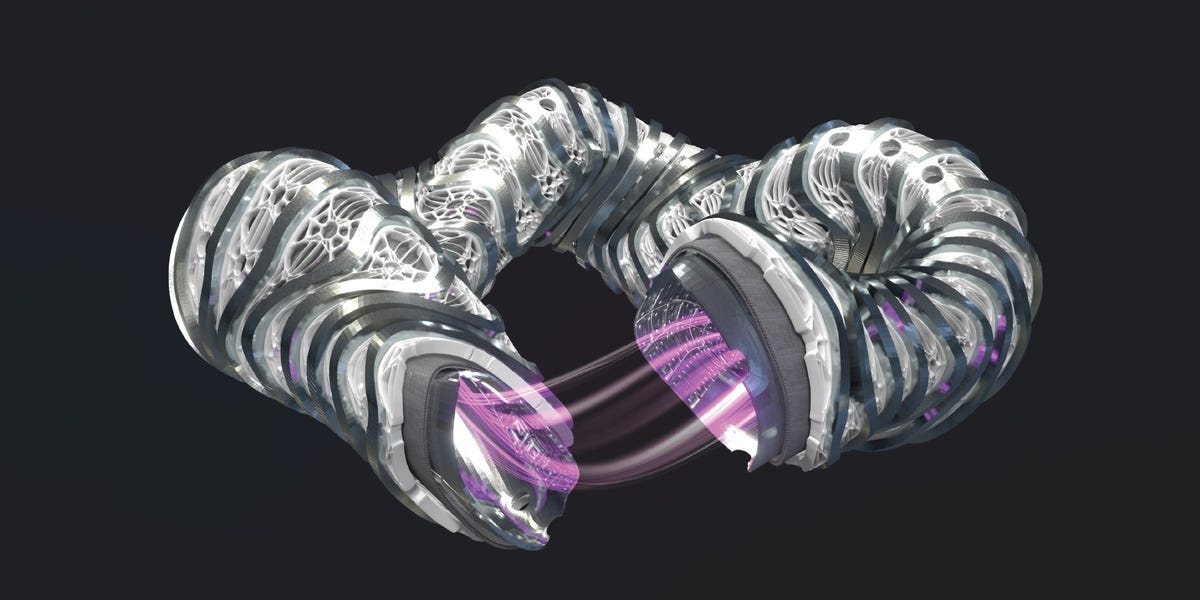
Most fusion headlines have focused on tokamaks, the symmetrical, doughnut-shaped machines that use powerful magnets and an electrical current inside the plasma to keep superheated fuel under control. But another magnetic-confinement design is twisting its way back into the spotlight. It is called the stellarator, and it looks less like a perfect doughnut than a pastry designed during an earthquake.
That twisted geometry is not decorative. It may solve several of the problems that make sustained fusion so difficult. Recent records at Germany’s Wendelstein 7-X, new superconducting magnets, artificial intelligence, improved simulation tools, and emerging American pilot-plant projects have strengthened the case that a twisted stellarator reactor could become one of the most practical routes to commercial fusion power.
What Is a Twisted Stellarator Reactor?
A stellarator is a magnetic-confinement fusion machine that holds extremely hot plasma inside a toroidal, or ring-shaped, chamber. Its external magnets create a three-dimensional magnetic field that twists as it travels around the machine. Charged plasma particles follow those magnetic field lines instead of immediately crashing into the reactor wall.
The concept was developed in the early 1950s by Princeton astrophysicist Lyman Spitzer. He initially imagined a figure-eight-shaped tube whose geometry would prevent charged particles from drifting out of confinement. Later stellarators replaced the obvious figure eight with more compact, continuously twisted magnetic configurations.
Fusion fuel is usually discussed in terms of two hydrogen isotopes: deuterium and tritium. When their nuclei collide at sufficiently high temperatures, they can fuse into helium while releasing a high-energy neutron. The reaction does not begin easily. The positively charged nuclei naturally repel one another, so the fuel must be transformed into plasma and heated to temperatures of roughly 100 million degrees Celsius or more.
No known solid container can directly hold material that hot. Magnetic fields therefore serve as an invisible bottle. Unfortunately, plasma has the personality of a cat being placed in a bathtub: energetic, unpredictable, and highly motivated to escape.
Why the Magnetic Field Must Twist
A simple circular magnetic field cannot provide adequate confinement because particles experience different field strengths on the inner and outer sides of the torus. Those differences create drifts that can gradually push particles out of the plasma.
A stellarator solves the problem by introducing rotational transform. As magnetic field lines travel around the torus, they also rotate around the plasma’s smaller cross-section. Particles therefore experience different regions of the magnetic field, helping average out the drifts that would otherwise carry them toward the wall.
In a tokamak, much of this twist is generated by driving a powerful electrical current through the plasma itself. A stellarator creates the required field primarily or entirely with external magnets. That difference sounds minor, but it changes how the machine operates.
Stellarator vs. Tokamak: Why the Twisted Design Matters
Tokamaks are simpler to visualize and have historically achieved stronger plasma performance. Their rotationally symmetric shape also made them easier to model during the era when computers were significantly less powerful than a modern wristwatch.
The price of that simplicity is dependence on plasma current. Strong currents can trigger instabilities and disruptions, causing the plasma to lose confinement suddenly. Modern tokamaks use sophisticated controls to prevent or mitigate these events, but disruptions remain an important engineering concern for future power plants.
Because a stellarator’s confining field comes from external magnets, it does not require the same large transformer-driven plasma current. It is therefore naturally suited to steady-state operation and is less vulnerable to certain current-driven disruptions. In principle, a stellarator power plant could run continuously rather than producing a sequence of separate plasma pulses.
Continuous operation matters commercially. Electric utilities generally prefer generating equipment that behaves like dependable infrastructure, not a science experiment that needs to stop, reset, catch its breath, and reconsider its life choices every few hours.
Three-Dimensional Geometry Becomes a Feature
Early stellarators struggled with poor confinement because particles following complicated three-dimensional paths could leak out more quickly than expected. For years, tokamaks raced ahead while stellarators acquired a reputation for having beautiful theory, difficult engineering, and magnetic coils that resembled metal noodles tied by a committee.
Modern stellarator research has reversed much of that story. Rather than accepting whatever magnetic field a set of coils happened to produce, scientists now begin with the plasma behavior they want. Optimization software then searches for a plasma boundary and magnet arrangement that minimize particle losses, improve stability, manage turbulence, and provide room for maintenance equipment.
This approach has produced quasi-symmetric and quasi-isodynamic configurations. They are not perfectly symmetric in physical space, but charged particles can experience them as though useful forms of symmetry were present. The result is better confinement without surrendering the stellarator’s steady-state advantages.
Wendelstein 7-X Provides the Strongest Evidence Yet
The most important modern stellarator experiment is Wendelstein 7-X, or W7-X, operated by the Max Planck Institute for Plasma Physics in Germany with substantial international participation, including support from the Princeton Plasma Physics Laboratory.
W7-X is not a power plant. It does not use deuterium-tritium fuel to generate commercial fusion energy, and it does not send electricity to the grid. Its purpose is to determine whether a carefully optimized stellarator can produce the plasma performance and long-duration operation required for a future reactor.
In 2025, W7-X maintained record-setting high-performance plasma conditions for 43 seconds. Researchers reported a fusion triple productcombining plasma temperature, density, and energy-confinement timethat approached tokamak-level performance during a sustained discharge. The duration was especially significant because it allowed researchers to observe physics relevant to genuinely steady-state operation rather than a fleeting experimental peak.
Forty-three seconds is obviously not the same as operating a power station for forty-three years. However, researchers note that once a plasma lasts longer than the machine’s important thermal and physical timescales, extending operation becomes increasingly an engineering challenge involving heating, cooling, component durability, and power supply.
W7-X has also demonstrated methods for controlling impurities and removing heat through an island divertor. A divertor acts as the reactor’s exhaust system, guiding escaping particles and thermal energy toward specially protected surfaces. Managing that exhaust may be as important as achieving the fusion reaction itself. A reactor that produces marvelous plasma but melts its interior is less a power plant and more an extremely expensive toaster.
American Research Is Reinventing the Stellarator
The United States does not currently operate a machine as large as W7-X, but American laboratories, universities, and private companies are pursuing several complementary stellarator strategies.
HSX Explores Quasi-Helical Symmetry
The Helically Symmetric Experiment at the University of Wisconsin–Madison is the world’s only operating stellarator designed around quasi-helical symmetry. HSX allows researchers to compare optimized and deliberately altered magnetic configurations in the same machine.
In one line of research, scientists modified currents in individual coils to change the magnetic geometry and reduce an instability associated with plasma turbulence. Experiments such as these help confirm whether theoretical optimization produces measurable improvements in real plasma rather than merely creating attractive computer graphics.
Permanent Magnets Could Simplify Construction
Princeton Plasma Physics Laboratory researchers have built a compact stellarator called MUSE using permanent magnets. Traditional stellarators depend on large, precisely shaped electromagnetic coils. Permanent magnets can contribute some of the three-dimensional field shaping without requiring electrical power or elaborate cooling systems.
MUSE is an experimental device, not a miniature commercial reactor. Its significance is architectural: permanent magnets could make small stellarators cheaper to construct, accelerate testing, and reduce the complexity of selected future systems.
Thea Energy Is Flattening the Magnets
New Jersey-based Thea Energy is developing a planar-coil stellarator architecture. Instead of manufacturing every magnet as a uniquely twisted three-dimensional object, its approach combines simpler planar encircling coils with arrays of planar shaping magnets.
The company’s Eos system is intended to demonstrate an integrated, steady-state stellarator and generate fusion neutrons at scale. The underlying idea is economically important: complex magnetic fields do not necessarily require every physical component to be equally complex. Software-controlled arrays of standardized coils could be manufactured, replaced, and scaled more easily than individually sculpted magnets.
Type One Energy Is Moving Toward a Utility Project
Type One Energy is developing Infinity One at the former Tennessee Valley Authority Bull Run fossil-fuel site near Oak Ridge, Tennessee. Infinity One is planned as an engineering verification platform rather than an electricity-producing fusion plant. It is expected to test high-temperature superconducting magnets, assembly methods, maintenance procedures, and operating systems relevant to a later reactor.
TVA and Type One Energy are also developing plans for Infinity Two, a proposed grid-scale stellarator power plant in the roughly 350-megawatt class. TVA has described potential deployment in the mid-2030s, while stressing that the project remains subject to development, engineering, and commercial readiness.
The involvement of a major public utility is meaningful. Utilities evaluate availability, maintenance, construction schedules, safety, and electricity costsnot merely whether a plasma looks impressive for several milliseconds. Infinity Two is not guaranteed to succeed, but the project signals that stellarator development is beginning to encounter real power-industry requirements.
Supercomputers and AI Are Untying the Magnetic Knot
Designing a stellarator is an inverse problem. Engineers know the plasma behavior they want, but they must determine which combination of plasma shape, magnetic field, coil geometry, structural support, heating system, divertor, blanket, and maintenance access can produce it.
Changing one feature can affect nearly everything else. Improving particle confinement might create coils that are impossible to manufacture. Simplifying a coil might increase heat losses. Making space for maintenance equipment might weaken magnetic performance. Stellarator optimization is essentially multidimensional chess, except every piece is made of plasma and some moves require a supercomputer.
Oak Ridge National Laboratory has used its Summit supercomputer to support an optimized stellarator power-plant concept for Type One Energy. Meanwhile, PPPL researchers are developing machine-learning tools and digital models that can evaluate configurations much faster than traditional workflows. These systems can screen large design spaces before expensive engineering begins.
Artificial intelligence will not magically invent a finished reactor. It can, however, act as a high-speed design assistant. It can identify promising configurations, estimate plasma behavior, predict engineering conflicts, and help scientists spend their detailed simulations on candidates that have already survived an initial digital obstacle course.
Researchers are even exploring compact hybrids that combine features of tokamaks and stellarators. Such designs could use some plasma current while relying on three-dimensional shaping to improve stability, potentially capturing benefits from both approaches.
The Hard Problems Have Not Disappeared
Stellarator progress is real, but describing commercial fusion as inevitable would be premature. No stellarator has yet produced net electricity, operated with a self-sufficient deuterium-tritium fuel cycle, or demonstrated commercially acceptable maintenance and component lifetimes.
Magnets Must Be Manufactured With Extraordinary Accuracy
Stellarator confinement depends on the precise magnetic field predicted by optimization software. Manufacturing errors, assembly tolerances, thermal movement, and structural deformation can introduce unwanted field variations. High-temperature superconductors may allow stronger and more compact magnets, but they must withstand electromagnetic forces while maintaining accurate alignment.
Plasma Exhaust Must Be Controlled
Even excellent confinement cannot keep every particle inside forever. Helium ash, impurities, and heat must leave the plasma in a controlled manner. Three-dimensional stellarator geometry produces complicated exhaust patterns, requiring divertors that can survive intense heat without contaminating the plasma. Researchers are combining experiments and simulations to predict where escaping particles will land and how those loads can be distributed.
Neutrons Will Punish Reactor Materials
Deuterium-tritium fusion releases 14.1-megaelectron-volt neutrons. Because neutrons carry no electric charge, magnetic fields cannot confine them. They strike the blanket and structural materials, depositing energy while gradually displacing atoms, producing helium, changing material properties, and weakening components.
Oak Ridge National Laboratory describes the fusion environment as an exceptional materials-science challenge. Future first walls and structural systems must tolerate neutron damage, thermal cycling, mechanical stress, and interactions with tritium while remaining maintainable and economically replaceable.
A Reactor Must Breed Its Own Tritium
Deuterium is readily available from water, but tritium is scarce and radioactive. A commercial reactor would likely surround the plasma with a lithium-containing blanket. Fusion neutrons would interact with the lithium to produce replacement tritium, which must then be extracted, processed, and returned to the fuel system.
DOE identifies tritium breeding, fuel-cycle integration, plasma-facing components, structural materials, confinement systems, and plant engineering as core development challenges for commercial fusion. A reactor must breed at least as much usable tritium as it consumes while accounting for processing delays, decay, leakage, and inventory requirements.
Scientific Gain Is Not the Same as Electricity
The National Ignition Facility has repeatedly produced more fusion energy from a target than the laser energy delivered directly to that target, including an April 2025 experiment that produced 8.6 megajoules from 2.08 megajoules of laser energy. That is a major scientific achievement, but it does not represent net electricity from an entire facility.
A stellarator power plant must exceed an even broader threshold. It must generate enough fusion heat to cover plasma heating, magnets, pumps, cryogenic systems, fuel processing, cooling, electricity conversion, and internal plant loadsthen sell enough remaining electricity to justify construction and maintenance costs.
Why a Twisted Stellarator Could Propel Fusion Forward
The strongest argument for stellarators is not that they make fusion easy. Nothing involving hundred-million-degree plasma, superconducting magnets, nuclear materials, and multibillion-dollar infrastructure qualifies as easy.
The argument is that stellarators may exchange one category of difficulty for another that is more manageable. Tokamaks simplify the shape but require active control of a current-carrying plasma. Stellarators complicate the magnets so the plasma can be more naturally stable and continuously confined.
Modern computation changes that trade-off. Magnetic shapes that were nearly impossible to calculate in the 1960s can now be optimized across physics and engineering constraints. Advanced manufacturing can produce components with tighter tolerances. High-temperature superconductors can provide stronger fields. Permanent magnets and planar coil arrays could reduce hardware complexity. AI can explore designs faster, while experiments such as W7-X and HSX test whether those designs work outside a computer.
The stellarator may therefore be arriving at its ideal historical moment. Its physics was proposed before the necessary computational and manufacturing tools existed. Today, those supporting technologies are finally catching up with the original idea.
Experience-Based Lessons From Following Stellarator Development
Watching stellarator research mature offers useful lessons about how breakthrough energy technologies actually advance. Progress rarely arrives as one dramatic invention. It comes from many smaller improvements that gradually stop a system from being impossible, then stop it from being impractical, and finally attempt to make it affordable.
Lesson One: A Record Is Valuable Only When It Answers the Right Question
A record plasma temperature can sound spectacular, but temperature alone does not make a reactor. Scientists also need sufficient density, energy-confinement time, stability, impurity control, and repeatability. W7-X’s 43-second performance mattered because it combined several useful plasma conditions over a duration relevant to steady-state physics.
The experience is similar to testing a car. Briefly reaching 200 miles per hour is one achievement. Driving safely for thousands of miles while controlling heat, vibration, fuel consumption, and component wear is a differentand commercially more importantachievement.
Lesson Two: The Most Photogenic Component May Not Be the Biggest Problem
The glowing plasma naturally receives attention, but practical fusion may be decided by equipment surrounding it. Divertors, blankets, cooling systems, tritium-processing equipment, remote-maintenance tools, and neutron-resistant materials are less glamorous than a miniature artificial sun. They are also the systems that determine whether the machine can operate reliably.
This is common in advanced engineering. The central scientific principle may work before the surrounding infrastructure becomes durable enough for everyday use. Aviation did not become a global industry merely because wings could create lift. Reliable engines, navigation, maintenance, manufacturing standards, airports, and trained operators were equally necessary.
Lesson Three: Complexity Can Be Moved Rather Than Eliminated
A stellarator does not remove complexity. It moves complexity from real-time plasma control into magnetic design, computation, and manufacturing. That may be a favorable exchange because engineers can optimize and inspect physical hardware before operation, whereas a plasma disruption develops inside an operating machine.
Thea Energy’s planar magnets and PPPL’s permanent-magnet research illustrate this principle. Instead of abandoning the complicated magnetic field, researchers are searching for simpler components that can collectively create it. Software assumes more of the design burden so the hardware can become more standardized.
Lesson Four: Utility Participation Changes the Conversation
A laboratory asks whether an experiment can reveal new physics. A utility asks whether equipment can be permitted, financed, repaired, staffed, connected to the grid, and operated during a winter demand peak. Both perspectives are necessary, but they produce different design priorities.
TVA’s participation in the proposed Infinity Two project introduces questions that fusion companies eventually must answer. How often will major components be replaced? How much electricity will the plant consume internally? Can operators maintain it without waiting for a small army of plasma physicists? What happens when a pump fails on a Sunday evening?
Those ordinary questions are signs of maturity. A technology becomes real not when people stop discussing extraordinary physics, but when they begin worrying about spare parts and maintenance schedules.
Lesson Five: Healthy Competition Is Better Than Declaring a Winner Early
Tokamaks, stellarators, laser fusion systems, magnetized targets, field-reversed configurations, and other approaches are exploring different compromises. It is too early to crown a single winner. A future energy system may use several fusion technologies for different applications, just as today’s grid combines turbines, solar panels, hydroelectric dams, batteries, and fission reactors.
The stellarator’s resurgence strengthens the overall fusion field by providing an alternative path. If its twisted magnets can deliver stable plasma, practical maintenance, manageable exhaust, sufficient tritium breeding, and competitive electricity costs, its strange shape may become one of the most recognizable pieces of twenty-first-century energy infrastructure.
Conclusion
A twisted stellarator reactor will not propel nuclear fusion forward through geometry alone. Its promise comes from a convergence of optimized plasma physics, high-performance computing, artificial intelligence, advanced superconductors, precision manufacturing, permanent magnets, planar coil systems, and serious power-plant engineering.
Wendelstein 7-X has shown that optimized stellarators can sustain high-quality plasma for meaningful durations. American research programs are simplifying magnets and studying turbulence, while private companies are converting decades of stellarator science into engineering platforms and proposed utility projects.
Enormous obstacles remain. Commercial machines must survive neutron exposure, exhaust extreme heat, breed tritium, convert fusion energy into electricity, permit practical maintenance, and compete economically with other power sources. None of those requirements can be solved with optimism, clever marketing, or a particularly inspirational picture of the Sun.
Still, the stellarator is no longer merely fusion’s eccentric backup plan. Its twisted magnetic field could provide exactly what a power plant needs most: stable, continuous operation. The design may look as though someone dropped a doughnut into a particle accelerator, but the future of fusion has never been required to look simple.