

Note: This article is written in original American English for web publishing and is based on real public information about VCF East 2018, the Cactus 6502 homebrew computer, and the broader history of 1970s-style front-panel computing.
A Retro Computer That Wasn’t Trying to Fool Anyone
At Vintage Computer Festival East 2018, also known as VCF East XIII, the exhibit hall was packed with the sort of machines that make computer historians smile and modern laptop users nervously check their warranty stickers. There were classic systems, repair stories, period-correct peripherals, and enough beige plastic to make the 1980s feel personally summoned. But among those old warriors, one machine stood out precisely because it was not old.
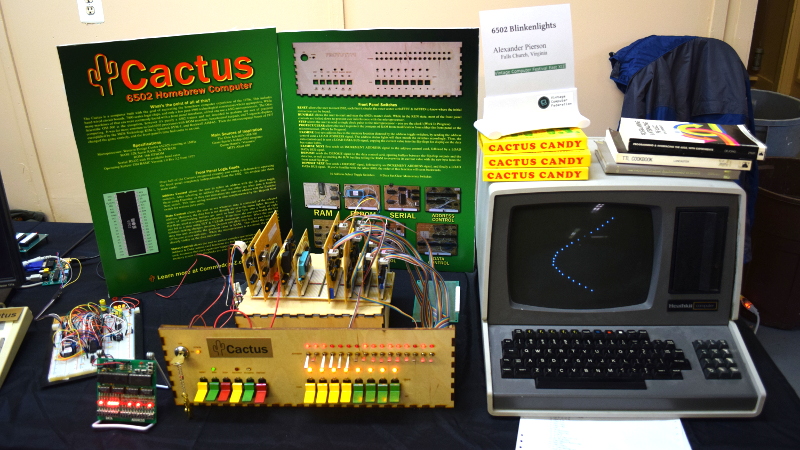
That machine was Cactus, a homebrew 6502 computer created by Alexander “Z” Pierson. It looked like it had marched out of a mid-1970s hobbyist magazine: rows of LEDs, toggle switches, hand-built boards, and a front panel that invited visitors to do something most modern computers never ask of ustouch the machine’s thoughts directly. Yet Cactus was not an antique. It was a modern project built to recreate the feeling, discipline, and delight of early microcomputing.
That is the most interesting thing about Cactus. It was not retro because it had to be. It was retro because it wanted to be. In a world where computers hide behind glass screens, sealed cases, cloud services, and cheerful software updates that arrive at the worst possible time, Cactus made computing physical again. It turned memory, buses, and control signals into something a visitor could see, step through, and manipulate with a satisfying click.
What Was VCF East 2018?
VCF East 2018 took place in Wall, New Jersey, at the InfoAge Science and History Museums, a fitting venue for an event dedicated to keeping computing history alive. The show featured hands-on exhibits, technical talks, workshops, museum tours, vendors, consignment areas, and projects that ranged from restored mainframes to personal computers, robots, terminals, and homebrew systems. The point was not merely to display old hardware behind velvet ropes. The real magic of VCF East was interaction.
Visitors could see machines running, talk to the people who restored or built them, and learn why each system mattered. That format is important because old computers are not just boxes with circuits inside. They are tools, cultural artifacts, engineering compromises, business bets, and personal memories. A silent Apple II on a shelf tells one story. An Apple II running software while someone explains why its design mattered tells a much better one.
Cactus fit that environment beautifully. It was not a museum specimen, but it respected museum history. It belonged in the same room as original machines because it translated their ideas for a new audience. It showed that vintage computing is not only about preservation. It is also about reinterpretation, experimentation, and occasionally spending a heroic amount of time wiring something because blinking lights make the soul happy.
Meet Cactus: A 6502 With Blinkenlights
The heart of Cactus is the 6502 family of 8-bit microprocessors. The 6502 earned its legendary status by powering or influencing some of the most important personal computers and game systems of the late 1970s and 1980s, including machines such as the Apple II, Commodore PET, Commodore 64, and others. It was affordable, capable, and friendly enough for a generation of hobbyists and engineers to build dreams around it.
However, there is a funny historical wrinkle. When many people imagine early hobby computers, they picture front panels covered in switches and lights, like the Altair 8800 or IMSAI-style machines. Those systems let users enter data, examine memory, and control the computer at a very low level through the panel itself. But the 6502 era quickly moved toward keyboards, monitors, ROM monitors, BASIC interpreters, and more consumer-friendly designs. In other words, the 6502 became famous in computers that felt more like appliances and less like control panels from a spaceship that had misplaced its instruction manual.
Cactus asks a deliciously nerdy question: what if a 6502 computer had received the full front-panel treatment? What if it behaved like a 1970s homebrew machine, complete with toggle switches, LEDs, step controls, and the pleasure of manually investigating memory? The result is part educational tool, part art object, and part electronic time machine.
Why the Front Panel Matters
A front panel is more than decoration. On early computers, it was often the main interface. Before friendly screens, mice, icons, and search bars, operators used switches to set addresses and data values, then watched lights reveal the state of the system. It sounds primitive until you realize how transparent it is. You are not clicking an icon labeled “Run.” You are commanding the machine at the level of bits.
That makes Cactus unusually instructive. Modern computers are extraordinary, but they are also deeply abstract. Most users never see memory addresses, bus activity, CPU stepping, or the relationship between code and hardware. Cactus brings those concepts out of hiding. Address and data lines become visible. A program is no longer a mystical creature living inside software. It is a sequence of instructions stored somewhere specific, moved in specific ways, and executed step by step.
This is why Cactus drew attention at VCF East 2018. Visitors were not just looking at an old-looking object. They were looking at an explanation of computing itself. The lights were not merely aesthetic. They were teaching aids with charisma. And yes, charisma matters. A blinking LED can sometimes explain a concept faster than a 40-slide lecture deck with tasteful gradients.
Modern Parts, Old-School Spirit
Cactus did not attempt to be a perfect clone of a 1970s machine. That would have missed the point. Instead, it blended old-school design language with practical modern choices. The project used a WDC 65C02, a CMOS descendant of the original 6502. That matters because a fully static CMOS processor can support the sort of clock control that makes front-panel operation much easier. When humans are manually stepping through a system, the computer must be patient. Nobody wants a CPU that says, “Too late, meat person, I have already run 4,000 instructions while you were deciding which switch to flip.”
The machine also used SRAM rather than a historically messier collection of older memory parts. From a purist’s perspective, that may sound like cheating. From a builder’s perspective, it sounds like sanity wearing a clean shirt. The goal was not to recreate every inconvenience of the 1970s. The goal was to recreate the experience that made those systems meaningful: visibility, control, and discovery.
According to public coverage of the project, Cactus used a backplane design with multiple hand-wired cards. The CPU, RAM, and EPROM cards formed the core computer, while additional logic supported front-panel operation. This kind of construction gives the project a modular, inspectable personality. It is the opposite of a mystery motherboard where all the important details disappear beneath black chips and proprietary layouts.
The Beauty of “Because I Can” Engineering
Some projects exist because the world urgently needs them. Others exist because someone looked at history, saw a gap, and thought, “That should exist.” Cactus belongs proudly to the second category. It is not trying to replace a laptop, run a modern browser, edit 4K video, or help anyone ignore cookies on a website. Its purpose is more interesting: to make computing understandable and enjoyable at the hardware level.
That kind of engineering is easy to underestimate. Practicality is not the only measure of value. Museums, classrooms, maker spaces, and hobbyist communities thrive on projects that reveal how things work. Cactus is valuable because it creates a bridge between eras. It connects the front-panel drama of early hobby computers with the 6502 ecosystem that shaped personal computing and gaming history.
It also captures something many retrocomputing fans already know: constraints are fun when they are chosen. Nobody wants a slow, limited computer as their only tool for modern life. But as a learning device, a slow and visible computer can be wonderful. It gives the user time to think. It turns each action into a small event. It reminds us that speed is not always the same as understanding.
Why the 6502 Was the Perfect Choice
The 6502 is beloved for good reasons. Introduced in the mid-1970s at a famously low price compared with competing processors, it helped make personal computing more accessible. It appeared in influential computers and game systems and became a favorite among hobbyists because it was powerful enough to be useful while still simple enough to understand deeply.
For a project like Cactus, that simplicity is a virtue. The 6502 instruction set, 16-bit address space, and 8-bit data bus make it approachable for learners. You can explain the architecture without requiring visitors to first earn a graduate degree and a stress headache. Yet it is not a toy. It is historically important hardware with real software culture behind it, including BASIC environments, machine-code programming, and decades of community documentation.
Cactus benefits from that history. By using a 6502-family processor, the project taps into a vast body of knowledge while presenting it through a front-panel interface that the chip rarely received in its original golden age. That mismatch is exactly what makes the project charming. It is like giving a classic sports car a dashboard from a submarineodd at first, then suddenly irresistible.
Hands-On Computing in an Untouchable Age
One reason Cactus resonated at VCF East 2018 is that many original vintage computers are too valuable, fragile, or rare for casual hands-on use. A collector may be happy to demonstrate an Altair or IMSAI, but not necessarily thrilled when a stranger with a coffee cup and unpredictable elbows starts flipping switches. That is understandable. Forty-year-old hardware deserves respect, and sometimes respect looks like keeping both hands in your pockets.
Cactus changed the equation. Because it was newly built, it could be handled more freely. Visitors could sit down, examine memory, run BASIC programs through an attached terminal, and experience the ritual of low-level computer operation without endangering a museum-grade artifact. That made it more than an exhibit. It became an invitation.
This is where modern retro-inspired builds can outperform untouched originals in education. A restored machine teaches preservation. A new machine built in an old style teaches principles. Both are valuable, but Cactus had the advantage of being built to be used. It was not a relic behind glass. It was a conversation with a power switch.
Retro Design as a Teaching Strategy
Good educational tools reduce distance between the learner and the concept. Cactus does that physically. Instead of hiding computation behind software layers, it exposes the machine’s behavior in a way that is visual and tactile. Want to understand memory? Examine it. Want to understand control flow? Step through it. Want to appreciate how much effort early users invested in doing simple tasks? Toggle a few values by hand and feel your respect increase in real time.
The project also encourages patience. That may sound quaint, but patience is a technical skill. Debugging hardware, reading bus states, checking assumptions, and understanding timing all require a slower, more deliberate mindset. Cactus rewards that mindset. It makes the user meet the computer halfway.
For students, makers, and retrocomputing newcomers, that can be transformative. Modern devices often encourage consumption. Cactus encourages investigation. It says: here is the machine, here are the signals, here are the switches, now let’s see what happens. That kind of interaction can turn curiosity into comprehension.
Cactus and the Culture of Homebrew Computing
The original homebrew computer movement was not only about hardware. It was about access. Enthusiasts wanted to own computers, understand them, improve them, and share ideas. Clubs, newsletters, magazines, kit suppliers, and informal communities helped turn computing from an institutional activity into a personal one.
Cactus honors that culture. Its hand-wired construction, modular cards, and visible logic feel connected to the era when building a computer meant knowing what every board did and why. At the same time, Cactus is not trapped in nostalgia. It uses modern availability, modern documentation, and modern maker culture to revisit an earlier style of computing with fresh eyes.
That is an important distinction. Nostalgia can become costume. Cactus is closer to interpretation. It borrows the language of vintage hardware to ask new questions: What did early interaction feel like? What can we learn by slowing down? Why do visible systems inspire trust and curiosity? And why, after all these years, do blinking lights still make intelligent adults grin like raccoons discovering a snack drawer?
The Endless Project Problem
One of the most relatable details about Cactus is that it was not truly finished. Passion projects rarely are. A builder starts with a clear goal, reaches it, then immediately sees ten improvements. More serial ports. Better front-panel logic. Audio. Video. Tape storage. Core memory experiments. A cleaner board layout. A nicer enclosure. A new idea that arrives at midnight and ruins sleep in the name of progress.
That ongoing nature is part of Cactus’s identity. It is not just a computer; it is a process. The public version shown at VCF East 2018 represented a milestone, not a final destination. Later descriptions of the project pointed toward improved front-panel behavior, single-step refinement, software-controlled switching, games, and BASIC interaction. That evolution shows a project alive in the best way.
In retrocomputing, “done” can be a suspicious word. Restoration, emulation, documentation, and homebrew design all invite continuous improvement. Cactus captures that spirit. It is a machine built from affection, research, technical patience, and the quiet madness required to wire many small things correctly.
Why Cactus Still Matters
Cactus matters because it demonstrates that retrocomputing is not merely backward-looking. It can be inventive, analytical, and surprisingly modern. The project uses old ideas to solve a modern problem: how do we make computers understandable again?
Today, many people use powerful machines every hour without having any clear sense of what happens beneath the interface. That is not a moral failure. Modern systems are incredibly complex. But projects like Cactus offer a refreshing counterpoint. They strip computing down to a scale where cause and effect are visible. Flip a switch. Watch a light. Step an instruction. Observe the machine.
That experience is not only educational; it is emotionally satisfying. There is joy in directness. There is joy in a system that does not pretend to be magic. Cactus is honest hardware. It says, “I am a computer, and here is what I am doing.” That honesty is rare enough to feel radical.
Experience Section: What It Feels Like to Encounter Cactus
Imagine walking into the VCF East 2018 exhibit hall after passing tables of familiar names: Apple, Commodore, Atari, Tandy, DEC, terminals, disk drives, cables, and monitors glowing with the soft confidence of old phosphor. The room sounds different from a modern technology show. There is less marketing thunder and more conversation. You hear keyboards with real travel, floppy drives performing tiny mechanical drum solos, and people saying things like, “This one still boots,” with the reverence normally reserved for medical miracles.
Then you notice Cactus. At first, your brain files it under “old computer, probably expensive, do not sneeze near it.” The front panel has the right visual vocabulary: LEDs, switches, symmetry, and that unmistakable aura of a machine that expects you to know hexadecimal. But then you learn it is new. That changes everything. Instead of being a fragile survivor, it is a deliberate reconstruction of a feeling. It is not pretending to be from 1976. It is asking why 1976-style interaction was so compelling in the first place.
Sitting in front of a machine like Cactus would feel different from using a polished emulator on a laptop. An emulator is convenient, but convenience can flatten the experience. With Cactus, every action has weight. A switch moves. A light answers. You become aware that data is not an abstract cloud of invisible convenience. It is a pattern. It has position, timing, and consequences. Even a simple operation can feel like a small ceremony.
The best part is the humility it creates. Modern users are accustomed to computers obeying quickly, silently, and often without explanation. Cactus makes you slow down and negotiate. You must think about addresses, values, states, and steps. Mistakes are not hidden behind friendly undo buttons. They are part of the lesson. If something goes wrong, the machine does not scold you; it simply sits there with its lights, waiting for you to become more careful.
That experience also makes the past feel less distant. It is easy to romanticize early computing as a golden age of heroic simplicity, but front-panel operation reminds you that early users worked hard. Loading, testing, and debugging could be tedious. Yet that tedium came with intimacy. Users understood their machines because they had to. Cactus lets modern visitors sample that intimacy without requiring them to give up Wi-Fi, online banking, or the ability to order tacos from a phone.
For builders, Cactus is inspiring because it gives permission to make impractical things with serious intent. Not every project has to become a product. Not every machine has to be optimized for speed, cost, or market size. Sometimes the purpose of a build is to preserve a sensation, answer a historical “what if,” or teach a concept in the most memorable way possible. Cactus succeeds because it knows exactly what it wants to be: a retro computer by choice, a teaching machine by design, and a love letter written in LEDs.
Conclusion
VCF East 2018: Cactus, Retro Because It Wants To Be is more than a catchy title. It describes a project with a clear philosophy. Cactus is not retro by accident, limitation, or nostalgia alone. It is retro as an act of design. It chooses switches over abstraction, lights over invisibility, and hands-on learning over passive display.
Alexander Pierson’s Cactus reminds us that old computing ideas still have power when they are rebuilt with care. The project connects the 6502’s historic importance with the tactile drama of front-panel computers, creating something that feels both familiar and new. It belongs to the maker tradition, the museum tradition, and the educational tradition all at once.
Most importantly, Cactus proves that retrocomputing is alive when people keep building, questioning, repairing, and reimagining. The past does not have to sit still. Sometimes it lights up, waits for a switch to flip, and teaches the future how computers really work.