

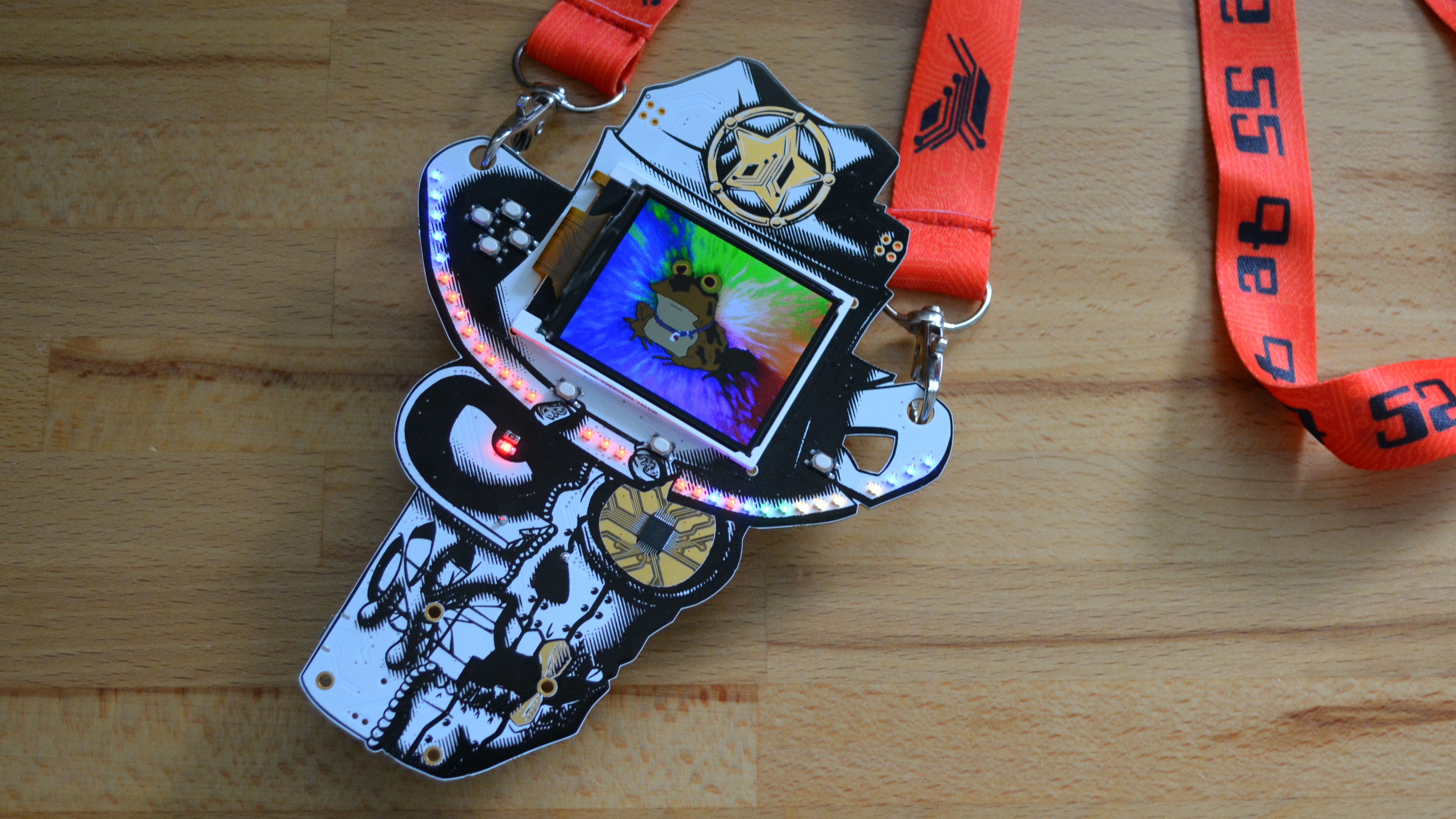
The AND!XOR DEF CON 26 badge is the kind of hacker hardware that makes a normal conference lanyard look like a grocery receipt with a neck strap. It is not merely a badge. It is a wearable PCB, a tiny game console, a puzzle box, a blinking conversation starter, a wireless experiment, and a miniature monument to the glorious chaos of #badgelife.
Officially, the AND!XOR DC26 badge was an unofficial DEF CON badge. Unofficial, in this case, does not mean “less serious.” It means it did not get you through the conference door, but it absolutely got you stopped in hallways by curious hackers asking, “What is that thing, and why does it look like Bender survived a robot cowboy apocalypse?”
This video review-style breakdown explores what made the AND!XOR DEF CON 26 badge special: its hardware choices, visual design, software personality, badge-to-badge gameplay, puzzle structure, and lasting place in hacker conference culture.
What Is the AND!XOR DEF CON 26 Badge?
The AND!XOR DEF CON 26 badge was a hackable electronic conference badge created for DEF CON 26 in Las Vegas. AND!XOR, pronounced “AND not X OR,” is a hardware and software team known for building artistic, interactive, RF-enabled badges that merge embedded engineering with humor, puzzles, games, and community mischief.
The DC26 badge carried the theme “The Wild West of IoT.” That phrase is doing a lot of work. The design had a western flavor, the software leaned into game-like exploration, and the badge-to-badge communication played with the idea of connected devices forming a network. It was IoT, but with more LEDs, more jokes, and fewer smart refrigerators silently judging your midnight snack choices.
At its core, the badge was built around an ESP32-WROVER module, which gave it Wi-Fi, Bluetooth, processing power, and external PSRAM. For a conference badge, that is not a tiny sprinkle of capability. That is the embedded equivalent of showing up to a campfire with a flamethrower and a warranty disclaimer.
First Impressions: PCB Art With Personality
The first thing that stands out is the look. AND!XOR continued its Bender-inspired badge lineage, but the DEF CON 26 version pushed the character into a rougher, western-themed world. Compared with earlier versions, the DC26 badge looked more refined, more deliberate, and more visually layered.
The board used a white solder mask, black silkscreen, and gold-plated copper accents. That combination gave the badge a clean but gritty look. The black silkscreen added detail and shading, while the gold copper features made certain design elements pop. Instead of feeling like a circuit board with artwork printed on top, the PCB itself became the artwork.
This is one of the best things about #badgelife: the hardware is not hidden in a plastic shell. The circuit board is the canvas. Traces become lines. Components become facial features. LEDs become animation. A microchip is not just a microchip; it might also be the pupil of a tired robot eye that has seen too many unsecured MQTT brokers.
Hardware Review: ESP32-WROVER at the Center
The ESP32-WROVER was a smart choice for a badge this ambitious. It provided the processing power and wireless capability needed for games, graphics, badge communication, and a rich software environment. The WROVER variant also includes external SPI RAM, which mattered because the badge’s software stack and scripting features were memory-hungry.
Earlier badges often had to make harsh tradeoffs between display quality, animation, storage, and interactivity. The DC26 badge stepped up with a more capable platform. That gave the team room to experiment with features that would have been painful on a smaller microcontroller.
Color Screen and Graphics
The badge included a color LCD screen, upgraded from the smaller display used in previous AND!XOR designs. More pixels meant more visual possibility, but also more pressure on memory bandwidth and display performance. The team had to balance animation smoothness with storage behavior and real-world badge reliability.
That is the unglamorous side of beautiful embedded devices: every flashy animation has a tiny engineer in the background muttering about SPI speeds, SD card timing, frame rates, and whether the laws of physics are being personally rude today.
LEDs, Bling, and the IS31FL3736 Driver
No DEF CON badge review is complete without discussing blinkiness. The AND!XOR DC26 badge used an ISSI/Lumissil IS31FL3736 LED matrix driver, a chip designed to control LED matrices over I2C. The badge used it to drive its RGB LED effects and the red eye detail that gave the design extra attitude.
This matters because LED-heavy badges can quickly consume pins, processor time, and developer patience. A dedicated LED driver offloads much of that work, allowing the main processor to focus on gameplay, display updates, communication, and puzzle logic.
USB Console and CP2102N
The badge also used a Silicon Labs CP2102N USB-to-UART bridge, which made the USB console experience more approachable. Instead of relying only on battery power or awkward wireless terminal access, users could plug the badge into a computer and interact with it through a serial console.
That decision made the badge feel more like a real development board. It invited exploration. You did not have to stare at the badge and wonder what secrets it held. You could connect, type, poke, break things responsibly, and then pretend you meant to do that.
Software Review: More Than Blinky Lights
The AND!XOR DEF CON 26 badge was not just a passive decoration. It had games, unlocks, terminal interaction, Easter eggs, and puzzle mechanics. The review experience felt closer to exploring a tiny embedded world than testing a gadget.
One of the most memorable features was the console-driven adventure element. The badge supported command-line interaction, including commands that felt familiar to anyone who has spent time in a Unix-like shell. It also included a text-adventure style experience reminiscent of classic games like Zork or Colossal Cave Adventure.
That combination was delightful. You had a physical badge hanging from your neck, but you were also navigating a text-based digital space through a terminal window. The result felt nostalgic without being stale. It was old-school computing filtered through modern embedded hardware and conference badge culture.
LULZCODE: Because Normal Scripting Was Too Calm
One of the most wonderfully absurd parts of the DC26 badge ecosystem was LULZCODE, an extension of LOLCODE adapted for microcontroller use. LOLCODE is already a joke-flavored esoteric programming language. AND!XOR took that weirdness and pushed it toward badge control, allowing scripts to interact with low-level badge features.
That is both ridiculous and brilliant. In normal product development, someone might ask, “What is the cleanest scripting interface for this embedded platform?” In #badgelife, someone asks, “What if the badge could understand meme grammar and still control peripherals?” Then everyone nods because sleep left the building months ago.
LULZCODE gave the badge a personality that matched its physical design. It was not merely functional; it was funny, strange, and very much built for hackers who enjoy the journey as much as the solution.
Badge-to-Badge Gameplay: The Wild West of IoT
The “Wild West of IoT” theme was not just decorative. The badge was designed around wireless interaction and badge-to-badge communication. The idea was that multiple badges at the conference could participate in a networked game environment, creating a playful, social layer on top of the hardware.
This is where the badge moved beyond “cool object” and became “conference experience.” A badge that only blinks is fun for a few minutes. A badge that communicates with other badges becomes a reason to meet people, compare progress, exchange discoveries, and form temporary hallway alliances that may or may not survive the next puzzle clue.
DEF CON has always had a strong culture of puzzles, reverse engineering, cryptography, social interaction, and playful competition. The AND!XOR badge captured that spirit in physical form. It rewarded curiosity. It encouraged users to connect, explore, and experiment.
Puzzles, Unlocks, and the Joy of Not Knowing Everything
The badge included unlockable elements that acted like a progress tracker for discoveries. That design choice is important because it gives users feedback. Instead of leaving people completely lost in a maze of hidden functions, the badge could acknowledge progress and encourage deeper exploration.
Good badge puzzles are tricky to design. If they are too easy, everyone finishes them before lunch. If they are too hard, the badge becomes a beautiful necklace with unresolved emotional baggage. The DC26 badge found a strong middle ground by layering different types of interaction: visual clues, terminal commands, software behavior, hardware features, and community discussion.
That layered design is why badges like this continue to matter. They are not just collectibles. They are portable learning platforms. A curious user might begin by watching LEDs and end up learning about serial communication, I2C peripherals, firmware structure, wireless protocols, graphics performance, and hardware debugging.
Why the Video Review Still Matters
A good video review of the AND!XOR DEF CON 26 badge does more than show the board spinning under nice lighting. It captures scale, texture, responsiveness, and personality. You can see how the screen behaves, how the LEDs animate, how the board looks in the hand, and how the console experience feels in real use.
For hardware like this, video matters because static photos rarely tell the whole story. A PCB badge is meant to be worn, handled, powered, explored, and shown off under questionable hotel conference lighting. The moment the LEDs start moving and the terminal responds, the object becomes alive in a very hacker-ish way.
The DC26 badge video review also preserved a moment in #badgelife history. DEF CON badges are often built in limited quantities. Many are distributed, traded, modified, repaired, lost, or placed reverently in drawers next to old USB cables and adapters nobody can identify. A video review helps future makers understand what worked and why people cared.
Strengths of the AND!XOR DC26 Badge
It Balanced Art and Engineering
The badge looked great, but the design was not only cosmetic. The component placement, display, LEDs, and PCB artwork worked together. The hardware served the theme, and the theme made the hardware more memorable.
It Encouraged Real Interaction
The USB console, games, unlocks, and wireless features encouraged users to do more than stare at blinking lights. The badge wanted to be explored. It rewarded hands-on curiosity.
It Had a Strong Identity
Many gadgets have features. Fewer have a personality. The AND!XOR DC26 badge had both. From the Bender-inspired western design to LULZCODE and the Wild West IoT theme, it knew exactly what kind of weird little machine it wanted to be.
Minor Drawbacks and Practical Considerations
As impressive as the badge was, it was still a small-run hacker device. That means users should expect some rough edges. Complex badge firmware can have quirks. Wireless gameplay at a packed hacker conference can be unpredictable. Battery life depends on display use, LEDs, and how aggressively the badge is being explored.
There is also a learning curve. A beginner could enjoy the animations and artwork, but getting the most out of the badge required comfort with serial terminals, puzzle thinking, and embedded systems curiosity. That is not a flaw, exactly. It is part of the point. This was not a toy badge pretending to be educational; it was an educational badge pretending to be a toy, which is much sneakier.
Who Was This Badge For?
The AND!XOR DEF CON 26 badge was ideal for hardware hackers, embedded developers, reverse engineers, puzzle lovers, DEF CON attendees, PCB art fans, and anyone who thinks “wearable IoT botnet game” sounds like a reasonable weekend plan.
It was also a great example for makers who want to build their own conference badges. The design shows how important it is to integrate hardware, firmware, art, community, and story. A memorable badge is not just a bill of materials. It is an experience.
Experience Notes: What Using a Badge Like This Feels Like
Using the AND!XOR DEF CON 26 badge feels less like reviewing a gadget and more like being handed a tiny mystery with a battery pack. The first few minutes are visual. You notice the PCB art, the shape, the glossy contrast, the gold details, the LEDs, and the way the badge refuses to behave like a normal event credential. A normal badge says, “Hello, my name is.” This badge says, “Howdy, partner, open a terminal.”
The next stage is curiosity. You plug it into a computer, open a serial connection, and suddenly the badge has a second life. The screen and LEDs are still there, but the terminal makes the experience deeper. Commands become clues. Output becomes atmosphere. Even simple text feels exciting because it is coming from a custom object around your neck, not a cloud service asking you to reset your password for the fifth time this month.
What makes the experience memorable is the way the badge mixes physical and digital feedback. Press a button, and something changes. Unlock a feature, and the badge reacts. Explore the console, and the device starts to feel less like a finished product and more like a tiny world with rules you are allowed to question.
At a conference, that experience becomes social. Someone sees the badge blink and asks about it. Another person has found a clue. A third person has a theory that sounds completely unhinged until it works. Suddenly, the badge is not just hardware; it is a networking tool for humans. It creates conversations without needing business cards, elevator pitches, or the phrase “synergy,” which should be banned from at least three planets.
The best part is that a badge like this teaches without announcing that it is teaching. You may begin by admiring the artwork, then drift into learning about USB serial drivers, LED matrix control, I2C peripherals, SPI display performance, power management, wireless communication, scripting languages, and embedded debugging. That is the secret genius of #badgelife: it hides a workshop inside a collectible.
The AND!XOR DEF CON 26 badge also proves that constraints can make hardware better. Limited space, limited power, limited manufacturing time, and limited production volume force creative choices. Every component has to justify its place. Every animation has to earn its cycles. Every puzzle has to fit inside the personality of the object. The result is not perfect in the mass-market sense, but it is far more interesting than perfect. It has fingerprints, jokes, compromises, and ambition.
As a review experience, the badge holds up because it feels alive. It is funny, technical, stylish, and slightly chaotic in the best possible way. It represents a moment when hobbyist hardware, conference culture, PCB art, and embedded software all met in the desert and decided to wear a cowboy hat.
Conclusion: A Standout Badge in DEF CON #Badgelife
The AND!XOR DEF CON 26 badge remains one of the more memorable unofficial badges from the DEF CON hardware scene. It combined strong visual design, capable embedded hardware, interactive software, wireless gameplay, terminal-based puzzles, and a theme that gave the entire project character.
Its ESP32-WROVER core, color display, LED driver system, USB console, LULZCODE scripting, and Wild West IoT concept made it more than a collectible. It was a playful development platform, a puzzle device, and a wearable piece of hacker art.
For anyone interested in electronic conference badges, embedded systems, PCB art, or the culture of DEF CON, the AND!XOR DC26 badge is worth studying. It shows what happens when engineers stop asking, “What is the minimum viable product?” and start asking, “How much delightful weirdness can we fit around someone’s neck?”
Note: This article is a fully rewritten, original synthesis based on publicly available information about the AND!XOR DEF CON 26 badge, its hardware, software, design goals, and #badgelife context.