

“`
The 555 timer is the cockroach of integrated circuits, and that is meant as a compliment. It has survived changing logic families, shrinking packages, and several generations of engineers declaring that surely something newer must replace it. Give the chip a resistor, a capacitor, and a modest power supply, and it will blink, buzz, delay, pulse, or oscillate with almost suspicious enthusiasm.
Then there is the ATtiny: a small AVR microcontroller that can imitate a timer, generate pulse-width modulation, read sensors, remember settings, change behavior on command, and generally make the 555 look like a talented specialist standing next to a programmable multitool. That leads to the playful claim behind this article: you can always use an ATtiny instead of a 555.
Technically, that claim is often true. Practically, the interesting question is not whether an ATtiny can replace a 555 timer, but whether it should.
Why the 555 Timer Still Refuses to Retire
A classic 555 contains two comparators, an internal voltage divider, a set-reset latch, a discharge transistor, and an output stage. The divider establishes reference points near one-third and two-thirds of the supply voltage. When the trigger input drops below the lower threshold, the latch sets. When the threshold input rises above the upper threshold, the latch resets. That compact analog arrangement supports several useful operating modes.
Astable mode: the endless square-wave machine
In astable mode, the timing capacitor repeatedly charges and discharges, creating a continuous pulse train. The familiar approximate relationship is:
f ≈ 1.44 / ((R1 + 2R2) × C)
This is perfect for LED flashers, simple tone generators, clock sources, and basic PWM-like control. It is also satisfyingly visible on a breadboard: change a resistor, and the blinking changes. No compiler, no programmer, and no mysterious checkbox labeled “divide clock by eight.”
Monostable mode: one trigger, one pulse
In monostable mode, a trigger starts one timed output pulse. Its approximate width is:
t ≈ 1.1 × R × C
That makes the 555 a natural choice for switch debouncing, power-on delays, pulse stretching, and timeout functions. The circuit is easy to understand and can operate without software, which is either beautifully elegant or tragically lacking in firmware updates, depending on the engineer.
The electrical advantages are real
A bipolar NE555 can operate from supplies well above the voltage tolerated by many small microcontrollers, and its output stage can deliver far more current than an ATtiny GPIO pin. CMOS 555 variants add lower power consumption, improved low-voltage operation, cleaner transitions, and reduced supply-current spikes. In a rugged, single-purpose circuit, those characteristics matter more than the ability to store a custom startup melody.
What an ATtiny Brings to the Timing Party
An ATtiny is not simply a digital delay box. Even older devices such as the ATtiny85 include hardware timers, PWM channels, an analog-to-digital converter, an analog comparator, interrupts, nonvolatile memory, and low-power sleep modes. Newer tinyAVR families add more capable timer peripherals, event routing, configurable logic, and flexible clock options.
That means one eight-pin microcontroller can reproduce the basic behavior of a 555 while also doing jobs that would otherwise require extra resistors, capacitors, counters, gates, flip-flops, or additional timer chips.
Timing becomes a number instead of an RC estimate
With a 555, timing depends on component values, capacitor leakage, resistor tolerance, temperature, and the behavior of the chip’s threshold circuitry. With an ATtiny, timing is normally derived from a clock and digital counter. Change a register or firmware constant, and a 700-millisecond pulse becomes a 12.5-second pulse without replacing a capacitor the size of a grape.
The microcontroller is not magically perfect. Its internal oscillator has tolerance and temperature drift, so precision applications may require calibration or an external clock source. Still, digital timing is usually easier to repeat, tune, and extend over long intervals than a large-value RC network.
PWM is easier to control and easier to change
A 555 can generate variable duty cycles, but achieving a convenient adjustment range or an accurate 50% waveform may require steering diodes, extra resistors, or another logic stage. An ATtiny hardware timer can produce PWM with a programmable period and duty cycle. Firmware can ramp brightness smoothly, apply a nonlinear response curve, change frequency when a button is held, or store the last setting in EEPROM.
The crucial word is hardware. Good ATtiny timing designs configure a timer peripheral and let it toggle an output pin. They do not depend on a long chain of blocking software delays while the processor sits there counting imaginary sheep.
One chip can perform a sequence, not merely a delay
Suppose a device must wait two seconds, drive a solenoid at full power for 150 milliseconds, reduce power with PWM, watch a sensor, and shut down if no movement is detected. A 555 solution may grow into a small village of timing chips and logic. An ATtiny can handle the sequence as a state machine:
“`
That is where the microcontroller stops being a substitute and starts being the more natural architecture.
How an ATtiny Can Emulate a 555
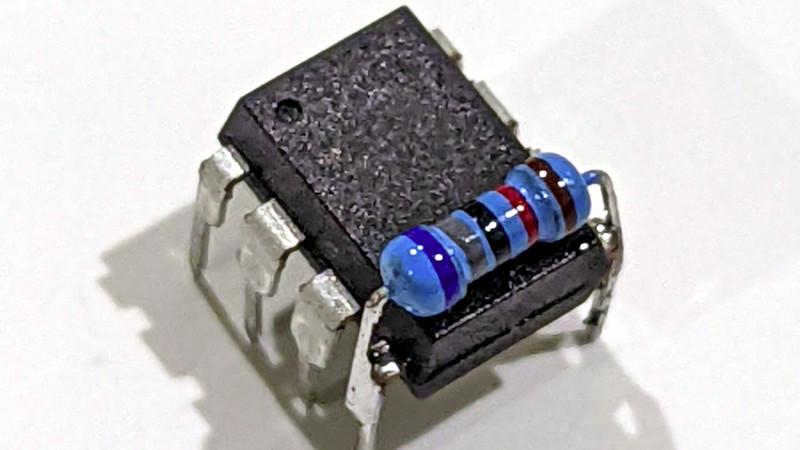
A hobby project known as the ATTiny555 demonstrated the joke literally by using an ATtiny to reproduce behavior associated with a 555-style device. The broader lesson is more useful than the novelty: peripherals inside a microcontroller can recreate threshold decisions, latch-like state changes, timed outputs, and discharge control.
Trigger and threshold inputs
The ATtiny can monitor external voltages through its ADC or analog comparator. Firmware can compare sampled values with thresholds corresponding approximately to one-third and two-thirds of the supply. A comparator interrupt can react faster and with less processor involvement than repeatedly polling the input in a loop.
Output and discharge behavior
A GPIO pin can represent the 555 output, while another pin controls a transistor that discharges an external capacitor. However, this is not automatically a pin-for-pin electrical replacement. The ATtiny’s voltage range, current capability, output resistance, protection structures, startup state, and response latency differ from those of a real 555.
For a demonstration, those differences are manageable. For a product, they require proper engineering rather than optimistic pin naming.
Reset and control-voltage functions
A reset input is straightforward: use an interrupt-capable pin or the microcontroller’s hardware reset where appropriate. Emulating the control-voltage pin is more involved because that pin changes the 555’s analog thresholds continuously.
An ATtiny can sample a control voltage and calculate new digital limits, but its sampling rate, resolution, filtering, and response time determine how closely the result resembles the analog original. It can imitate the function, but it does not automatically become electrically identical.
Where the ATtiny Clearly Wins
Long or unusual timing intervals
Hours-long delays expose the weak side of simple RC timing. Large capacitors have broad tolerances and leakage, while very large resistors make a circuit more vulnerable to contamination and input leakage. An ATtiny can count timer ticks, use a watchdog oscillator, or wake periodically from sleep without relying on a heroic electrolytic capacitor that may have its own opinions about time.
Multiple modes and user controls
A single push button can select flash rate, brightness, sleep duration, and diagnostic mode. The ATtiny can recognize short presses, long presses, and double taps. Doing the same with pure 555 circuitry is possible, but “possible” is a dangerous word in electronics. It often means the schematic will soon need a second page.
Calibration and repeatability
Firmware can apply a stored correction factor measured during production. It can also compensate for sensor readings or supply conditions. This is especially useful when several units must behave similarly rather than merely “somewhere around five seconds.”
A smaller total system
A 555 itself is wonderfully compact, but the surrounding circuit may not be. When a design needs several timing stages, mode selection, counters, and logic, an ATtiny can reduce the total component count. The result may be a smaller board with fewer assembly points and fewer tolerance-sensitive parts.
Where the 555 Is Still the Better Answer
A one-function circuit that must be instantly understandable
For a basic one-shot or oscillator, the 555 schematic often explains itself. A technician can probe the timing capacitor, inspect the trigger, and understand the fault without obtaining source code or guessing which firmware version was installed years earlier.
Higher-voltage operation
Many 555 variants comfortably operate at supply voltages that would damage an ATtiny. A microcontroller design may need a regulator, level shifting, input protection, and a separate driver. Suddenly the “one-chip replacement” has acquired an entourage.
Output-current requirements
Never assume an ATtiny pin can replace a 555 output directly. Microcontroller GPIO is intended for logic-level loads and modest current. Relays, motors, solenoids, power LEDs, and large capacitive loads generally need a transistor, MOSFET, or driver IC, plus appropriate protection components. The GPIO pin is a messenger, not a forklift.
No programming step
A 555 can be assembled and tested without a firmware toolchain. An ATtiny requires programmed flash, a programming interface, correct clock configuration, and a process for tracking code revisions. For a hobbyist making one flexible prototype, that is minor. For a factory producing thousands of simple modules, it is a genuine production consideration.
Predictable behavior without software
A carefully designed 555 circuit can be robust and independent of software crashes. A microcontroller adds clocking, reset, brownout, electromagnetic compatibility, startup, and firmware-state concerns. None are fatal, but all must be handled. The ATtiny is more capable because it has more states, and more states create more ways to be creatively wrong.
Four Practical Replacement Examples
1. LED flasher
A 555 solution uses two resistors and a capacitor to set the flash rate. An ATtiny solution can use a hardware timer and one current-limiting resistor. The ATtiny becomes worthwhile when the pattern needs fades, pauses, random sparkle, battery monitoring, or selectable modes. For one steady blink, the 555 remains hard to beat.
2. Delayed relay controller
A 555 can create a power-on delay, but a microcontroller can add contact debounce, minimum on-time, restart lockout, status indication, and controlled brownout recovery. In either design, the relay needs a driver transistor and flyback protection. The ATtiny does not grant diplomatic immunity from inductive voltage spikes.
3. Adjustable PWM dimmer
A potentiometer can adjust a 555 oscillator directly. With an ATtiny, the potentiometer feeds the ADC and firmware maps the reading to duty cycle. The digital version can filter noisy readings, provide a true off position, use perceptual brightness correction, and keep the PWM frequency outside the most annoying audible range.
4. Missing-pulse detector
A 555 monostable can flag an input stream that stops arriving. An ATtiny timer can do the same while recording how many pulses were missed, adapting the timeout to measured speed, and distinguishing startup from a genuine fault. That extra context can turn a crude alarm into a useful controller.
A Sensible Decision Checklist
Choose a 555 when the function is simple, the supply voltage is high, output drive matters, component-level transparency is valuable, and the timing tolerance is acceptable. Choose an ATtiny when the behavior is likely to change, several timing stages are needed, long delays matter, calibration is useful, or inputs and outputs must interact intelligently.
Also consider the engineering environment. A team comfortable with firmware may prefer an ATtiny because changes are fast and testable. A team maintaining equipment for decades may prefer a 555 because the circuit can be understood with a schematic and a multimeter. The technically clever choice is not always the maintainable choice.
Practical Experience Notes: What Usually Happens on the Bench
The first practical lesson appears during breadboarding. A 555 oscillator often reaches the “it blinks!” stage faster. Insert the chip, add the timing network, connect an LED, and the circuit announces success. The ATtiny version begins with several invisible prerequisites: the programmer must communicate, the clock configuration must be correct, the selected pin must really support the intended timer output, and the board must have proper decoupling. The 555 wins the first five minutes with the confidence of a veteran game-show contestant.
Then the requirements change. Someone asks for two quick flashes followed by a three-second pause. With the 555, the neat little oscillator begins attracting diodes, another capacitor, perhaps a counter, and increasingly defensive explanations. With the ATtiny, the change is a few lines in a state machine. This is the moment when the microcontroller repays its setup cost.
Another common experience involves timing accuracy. A breadboarded 555 may appear stable during a short test, yet a long delay can shift when a different capacitor is installed, the room warms up, or a finger approaches a high-impedance timing node. The ATtiny tends to produce more repeatable intervals, but it can still surprise anyone who assumes the internal oscillator is a laboratory reference. For ordinary blinking and delays, it is excellent. For accurate clocks or communication timing, calibration or a better clock source becomes part of the design.
PWM projects reveal a different contrast. A 555 lets you see the analog mechanism directly: the capacitor voltage ramps between thresholds while the output flips state. That makes it a superb teaching circuit. The ATtiny hides the ramp inside a digital counter, but it offers cleaner control. Frequency and duty cycle can be adjusted separately, transitions can be synchronized, and the output can change in response to sensors or commands without rebuilding the timing network.
Power consumption is not decided by the chip name alone. A classic bipolar 555 can draw more current than a sleeping microcontroller, while a CMOS 555 can be remarkably frugal. An ATtiny that spends most of its time asleep and wakes briefly on an interrupt may be ideal for a battery device. An ATtiny left running at a high clock rate merely to blink an LED is less impressive. Measuring the complete circuit is more useful than winning an argument with a data-sheet headline.
The most important bench habit is to inspect startup behavior. What happens during the first milliseconds after power is applied? A 555 may produce an unwanted pulse if its reset and timing nodes are not controlled. An ATtiny pin may float or remain configured as an input until firmware initializes it. Loads such as relays and MOSFET gates need pull-down or pull-up resistors so the safe state exists before either chip becomes fully awake.
Debugging also feels different. With a 555, the oscilloscope usually goes straight to the timing capacitor, trigger, threshold, and output pins. With an ATtiny, the best tools may include a logic analyzer, spare diagnostic pin, serial output, or debug interface. Firmware should expose enough state to make failures observable. Otherwise, replacing a transparent analog problem with an invisible digital problem is not progress; it is merely redecorating the mystery.
Finally, experienced designers tend to stop treating this as a rivalry. The 555 is not obsolete because microcontrollers exist, and the ATtiny is not excessive merely because a resistor-capacitor network could work. Both are inexpensive ways to express timing behavior. The best choice is the one that minimizes the total burden: parts, code, power, testing, maintenance, risk, and future changes.
Conclusion: Use the Smallest Idea That Solves the Whole Problem
Yes, an ATtiny can replace a 555 in an enormous range of circuits. It can generate pulses, create delays, produce PWM, monitor thresholds, detect missing events, and coordinate complicated sequences. It can also adapt, remember, measure, and communicateverbs that a traditional timer does not keep in its vocabulary.
But “can replace” is not the same as “automatically improves.” The 555 remains excellent when a circuit needs one straightforward timing function, wide supply tolerance, strong output drive, and zero firmware. The ATtiny wins when timing is only one part of a larger behavior.
The smartest design rule is therefore less dramatic than the title: use the 555 when the circuit is fundamentally analog and simple; use the ATtiny when the behavior is programmable and likely to grow. When someone insists that one device is always superior, hand that person the breadboard and let the requirements change halfway through the build.
Note: Electrical limits, clock accuracy, startup behavior, and load-driving requirements must be verified against the exact ATtiny, 555 variant, supply voltage, and operating conditions used in the final design.