

Note: This article is written as an original, publication-ready synthesis based on verified reports, official wildlife information, and real Florida alligator guidance.
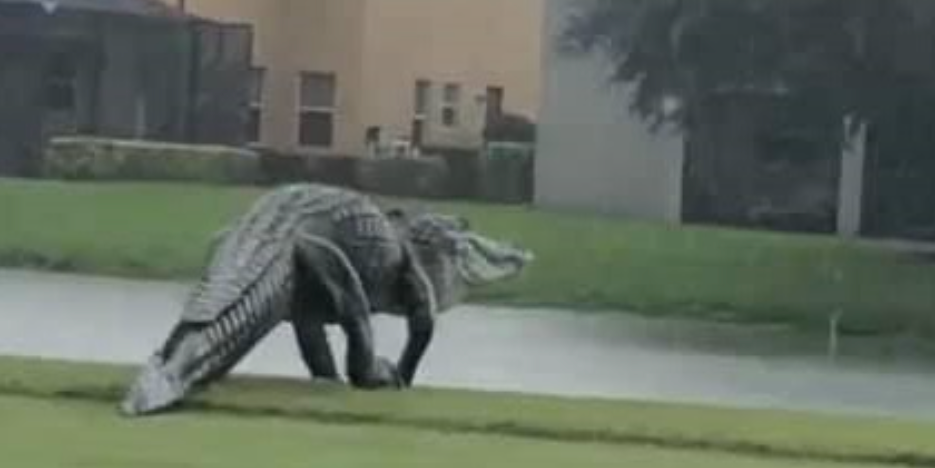
A viral photo of a giant gator on a Florida golf course has the internet doing what the internet does best: squinting, arguing, zooming in, declaring it fake, then suddenly becoming a reptile expert before lunch. The image looks almost too dramatic to be real: a massive American alligator strolling across manicured grass like it booked the 10:40 tee time and forgot its visor.
So, how big is the famous Florida golf course gator? The best answer depends on which viral sighting people are talking about. The widely shared Myakka Pines Golf Club alligator in Englewood, Florida, was estimated at about 12 to 13 feet long. Another celebrity gator, “Chubbs” at Buffalo Creek Golf Course in Palmetto, has often been estimated around 15 feet. A later viral gator at Valencia Golf & Country Club in Naples was described by witnesses as possibly around 17 feet, though that number should be treated as an unverified visual estimate rather than an official measurement.
In other words: yes, the gator is huge. No, it probably did not escape from Jurassic Park. And yes, if your golf ball lands beside it, that ball now belongs to Florida.
The Viral Florida Golf Course Gator: Real or Fake?
The most famous “giant gator on a golf course” photo came from Myakka Pines Golf Club in Englewood, Florida. The animal was photographed near the seventh green, and the images quickly spread online because the alligator looked absurdly large against the neat green surface and flagstick. Many viewers suspected Photoshop. That is understandable. When a reptile looks like it could charge rent, skepticism is healthy.
However, reports from the golf course and news outlets confirmed the sighting was real. The gator was said to be moving from one pond to another, a normal behavior for alligators in Florida’s wet, pond-filled landscapes. Course staff estimated the animal at roughly 12 to 13 feet long. That is enormous, but still within the possible range for a large male American alligator.
The photo went viral partly because of perspective. A low camera angle, open turf, and the clean geometry of a golf course make the animal stand out dramatically. Golf greens are designed to look smooth and controlled; alligators are designed to look like armored swamp submarines. Put those two things together and the result is instant internet fuel.
So, How Big Is the Giant Gator?
The Myakka Pines gator was estimated at about 12 to 13 feet. That is likely the most reliable answer for the classic viral photo. A 13-foot American alligator is not just “big.” It is a top-tier adult male, the kind of animal that makes even longtime Floridians pause for a respectful second before saying, “Well, that’s Florida.”
For comparison, adult female alligators rarely exceed 10 feet, while males can grow much larger. Florida’s official state record for alligator length is 14 feet 3.5 inches, and the state record by weight is a 1,043-pound male measuring 13 feet 10.5 inches. That means a 12- or 13-foot golf course gator is not impossible at all. It is simply rare, impressive, and very good at ruining a short putt.
The key word is “estimated.” Viral photos almost never come with a tape measure, a wildlife biologist, and a cooperative alligator willing to lie still for science. Most online size claims are visual guesses. A 15-foot estimate may be close for a known large male, but a 17-foot claim should be viewed carefully unless the animal was officially measured. Alligators are often exaggerated in casual reports, especially when the witness is standing several yards away thinking, “Please do not notice me.”
Meet Chubbs: Florida’s Other Golf Course Legend
No discussion of giant golf course alligators is complete without Chubbs, the massive gator associated with Buffalo Creek Golf Course in Palmetto, Florida. Chubbs became a viral sensation after video showed him slowly crossing the course while golfers looked on in disbelief. He has been widely described as about 15 feet long and has reportedly been a familiar presence at the course for years.
Chubbs became famous because he seemed almost casual. He was not sprinting, snapping, or acting like a movie monster. He was simply walking, which somehow made him more impressive. A giant alligator moving slowly across a fairway has the calm confidence of a creature that knows nobody is going to ask it to hurry.
Golfers and staff have often treated Chubbs like an unofficial mascot, though “mascot” may be too cute a word for an animal with a jawline built like heavy machinery. The sensible rule is simple: admire from a long distance, do not approach, do not feed, and do not attempt a selfie. No profile picture is worth becoming a cautionary tale.
Why Do Giant Alligators Show Up on Florida Golf Courses?
Florida golf courses are basically alligator-friendly real estate. They often contain ponds, canals, marshy edges, sunny banks, and quiet stretches of water. To a golfer, that pond is a water hazard. To an alligator, it is a studio apartment with snacks.
American alligators are found throughout Florida in lakes, marshes, ponds, rivers, swamps, creeks, and canals. Golf courses often overlap with exactly these habitats. In many communities, courses were built around wetlands or included artificial ponds for drainage and landscaping. Over time, those water features can become home to fish, turtles, birds, frogs, insects, and other animals. That means food, cover, and basking space for alligators.
Research has also shown that alligators living on golf courses may use habitat differently and may shift their diets compared with alligators in more natural settings. That does not mean golf courses are “bad” alligator habitat in every way, but it does show how human-designed landscapes can change the behavior of large predators.
Are Florida Golf Course Alligators Dangerous?
Alligators are wild predators, so they deserve caution. At the same time, most alligators do not want trouble with people. Serious alligator injuries in Florida are rare, but risk increases when people feed alligators, approach them, swim near them, let pets roam near the water, or ignore warning signs.
The Florida Fish and Wildlife Conservation Commission advises people to keep a safe distance from alligators, never feed them, swim only in designated areas during daylight hours, and keep pets away from the water’s edge. Feeding alligators is especially dangerous because it can cause them to lose their natural fear of humans and associate people with food. Once that happens, a gator can become a nuisance animal and may need to be removed.
On a golf course, the safest move is also the easiest: leave the gator alone. If your ball rolls near the animal, take a drop. Golf has many penalties; “argued with prehistoric reptile” should not be one of them.
How to Estimate an Alligator’s Size Without Getting Close
Wildlife experts often use rough visual clues to estimate alligator size, but casual observers should never approach one to check. One commonly mentioned field clue is that the distance in inches from the tip of an alligator’s snout to its eyes can roughly correspond to the animal’s total length in feet. For example, a snout-to-eye distance of about 10 inches may suggest an alligator around 10 feet long.
That method is only a rough estimate, and it is not an invitation to walk up with a ruler. Photos can distort size depending on angle, zoom, lens compression, background objects, and whether the animal is closer to the camera than it appears. Golf course photos are especially tricky because flagsticks, greens, and open turf can make a large animal look even more dramatic.
The safest and most honest answer for viral images is this: the Myakka Pines gator was likely around 12 to 13 feet; Chubbs has been estimated around 15 feet; and any claim beyond Florida’s official verified records should be considered unconfirmed unless measured by qualified professionals.
Why the Photo Went Viral
The giant gator photo went viral because it combines three irresistible ingredients: Florida, golf, and a creature that looks like it missed the extinction memo. People love images that challenge their sense of scale. A deer on a golf course is charming. A goose on a golf course is annoying. A 13-foot alligator on a golf course is breaking news with teeth.
The setting also matters. Golf courses represent order: trimmed grass, quiet carts, polite claps, and tiny pencils. An alligator represents ancient survival, raw biology, and the firm suggestion that nature did not read the club rules. That contrast creates a perfect viral image.
There is also a strong “only in Florida” factor. Florida’s wildlife stories often travel far beyond the state because they feel both unbelievable and completely plausible. A giant alligator crossing a fairway during a normal round of golf sounds like a joke until you remember that Florida has roughly 1.3 million alligators and water features everywhere.
What Golfers Should Do When They See a Gator
If you see an alligator on a Florida golf course, the first rule is simple: do not panic, and do not approach. Most gators will move along if left alone. Give the animal plenty of room, alert course staff, and follow posted warnings. If the alligator is blocking play, wait or skip the hole. A double bogey is better than a wildlife incident report.
Never try to scare, touch, chase, feed, or pose near an alligator. Do not throw objects at it. Do not assume it is slow just because it is lying still. Alligators can move quickly over short distances, especially when startled or defensive. They are not marathon runners, but they do not need to be. They only need one bad decision from a person who wanted a closer video.
Pet owners should be extra careful around golf course ponds, canals, and lakes. Small animals can resemble natural prey. Keep pets leashed and away from the water’s edge, especially around dusk and dawn, when alligators are more active.
Are These Giant Gators Becoming More Common?
Giant viral gators may seem more common because smartphones are everywhere. Years ago, a golfer might have told friends at the clubhouse about a huge alligator, and the story would have grown by two feet with every retelling. Today, the same sighting becomes a video, a social post, a news segment, and a debate about whether the animal is real.
Florida’s alligator population is healthy and stable, and alligators are found in every county in the state. Large males have always existed, but now they are more visible to the public because people live, travel, golf, fish, and film near alligator habitat. The result is not necessarily more giant gators; it is more cameras pointed at them.
That said, Florida’s mix of human development and wetland habitat does create frequent opportunities for encounters. Golf courses, residential ponds, drainage canals, and community lakes all bring people and alligators into the same landscape. Coexistence works best when people respect the animal’s space and avoid behaviors that make alligators associate humans with food.
The Bottom Line: Big, Real, and Best Viewed From Far Away
The viral photo of a giant gator on a Florida golf course is real, and the animal was truly massive. The famous Myakka Pines alligator was estimated around 12 to 13 feet long. Chubbs, the Buffalo Creek celebrity gator, has been estimated around 15 feet. Some later viral sightings have been described as even larger, but those claims should be treated as estimates unless officially measured.
For readers asking, “How big is it?” the practical answer is: big enough to respect, big enough to photograph from far away, and definitely big enough that your lost golf ball is not worth retrieving.
Experience Section: What It Feels Like to See a Giant Gator on a Golf Course
Imagine arriving for a quiet round of golf in Florida. The sun is out, the grass is bright, and the only thing you are worried about is whether your drive will land in the fairway or take its usual business trip into the pond. Then someone in your group freezes. They do not yell. They do not swing. They simply point.
Across the green, a giant alligator is moving with slow, heavy confidence. It does not look rushed. It does not look confused. It looks like it has done this before and expects everyone else to be mature about it. The tail drags behind like a dark rope. The back is ridged and armored. The head is broad enough to make the flagstick look nervous.
The first reaction is disbelief. Your brain tries to resize the animal into something normal. Maybe it is closer to the camera. Maybe the angle is strange. Maybe it is not that big. Then it takes another step, and the illusion disappears. It is that big.
The second reaction is silence. People who normally have plenty to say about club selection suddenly become wildlife philosophers. Nobody wants to be the person who says, “Let me get closer.” Even the loudest golfer in the group develops a deep respect for personal boundaries.
Then come the jokes, because humor is how humans handle fear without admitting it. Someone says the gator is playing through. Someone says it owns the course now. Someone else announces that the ball near the pond is officially retired. The jokes are funny because everyone knows the truth: the alligator is not a prop. It is a wild animal, and the correct response is distance.
For visitors, the experience can be unforgettable. Florida has a way of mixing ordinary leisure with astonishing wildlife. One minute you are choosing between a 7-iron and an 8-iron; the next minute you are watching a living dinosaur-shaped reptile cross a fairway. It reminds you that the landscape is shared. The golf course may have scorecards, sprinklers, and cart paths, but it is also part of a larger ecosystem.
The best experience is the safe one. Watch from far away. Take a quick photo if you can do so without approaching. Let course staff handle the situation. Do not feed the animal, do not crowd it, and do not turn a rare wildlife moment into a dangerous stunt. A giant gator sighting should become a great story, not an emergency call.
And when the round continues, you may notice the course differently. The ponds are no longer just hazards. The reeds are no longer just background. Every splash deserves a second look. Florida golf has sand traps, water hazards, and occasionally a 13-foot reminder that nature always gets the final tee time.
Conclusion
The viral photo of a giant gator on a Florida golf course captured attention because it looked unreal, but the story behind it is very real. Florida’s golf courses often sit beside ponds, canals, and wetlands where American alligators naturally live. The famous Myakka Pines gator was likely around 12 to 13 feet long, while other viral golf course gators, including Chubbs at Buffalo Creek, have been estimated even larger. The smartest takeaway is not fear, but respect. Alligators are part of Florida’s wild identity, and safe coexistence means keeping distance, never feeding them, and letting wildlife stay wild.