

Embedded deployment has a reputation for being the part of product development where optimism goes to wear a tiny hard hat. A prototype works beautifully on one engineer’s desk, then refuses to behave on a second board, a different microcontroller, or the version that must ship to customers. Suddenly, the team is juggling hardware dependencies, firmware builds, communication protocols, debugging tools, test rigs, and the famous phrase nobody wants to hear: “It worked yesterday.”
That is exactly why Luos is interesting. Luos brings a microservices-inspired approach to embedded systems, helping developers split hardware products into modular services that can communicate across nodes, boards, networks, and applications. Instead of treating a device as one tightly tangled software blob, Luos encourages teams to think in reusable features: a motor service, a sensor service, a control service, a communication service, or an application service. In plain English, it helps embedded teams stop building firmware spaghetti and start building firmware with labeled drawers.
The result is faster embedded deployment, cleaner architecture, easier debugging, and better reuse across projects. For teams building robotics, IoT devices, industrial systems, smart appliances, connected machines, or cyber-physical products, Luos can simplify the path from prototype to production without pretending that embedded work is magically easy. The wires are still real. The constraints are still real. But the architecture becomes much less dramatic.
What Is Luos?
Luos is a lightweight orchestration technology for embedded and cyber-physical systems. It is designed to help developers organize device functionality into independent software blocks called services. These services can run on one microcontroller or be distributed across several boards, while still communicating through a consistent interface.
In traditional embedded development, many features are packed into a single main program. That may be fine for a weekend project, but it becomes painful when a product grows. Add a new sensor, change a board, split work across multiple microcontrollers, or connect the device to a host computer, and the software can become a delicate tower of “please don’t touch that file.” Luos approaches the problem differently by separating features into modular services that can be developed, moved, reused, and connected more easily.
Embedded microservices, without the cloud buzzword fog
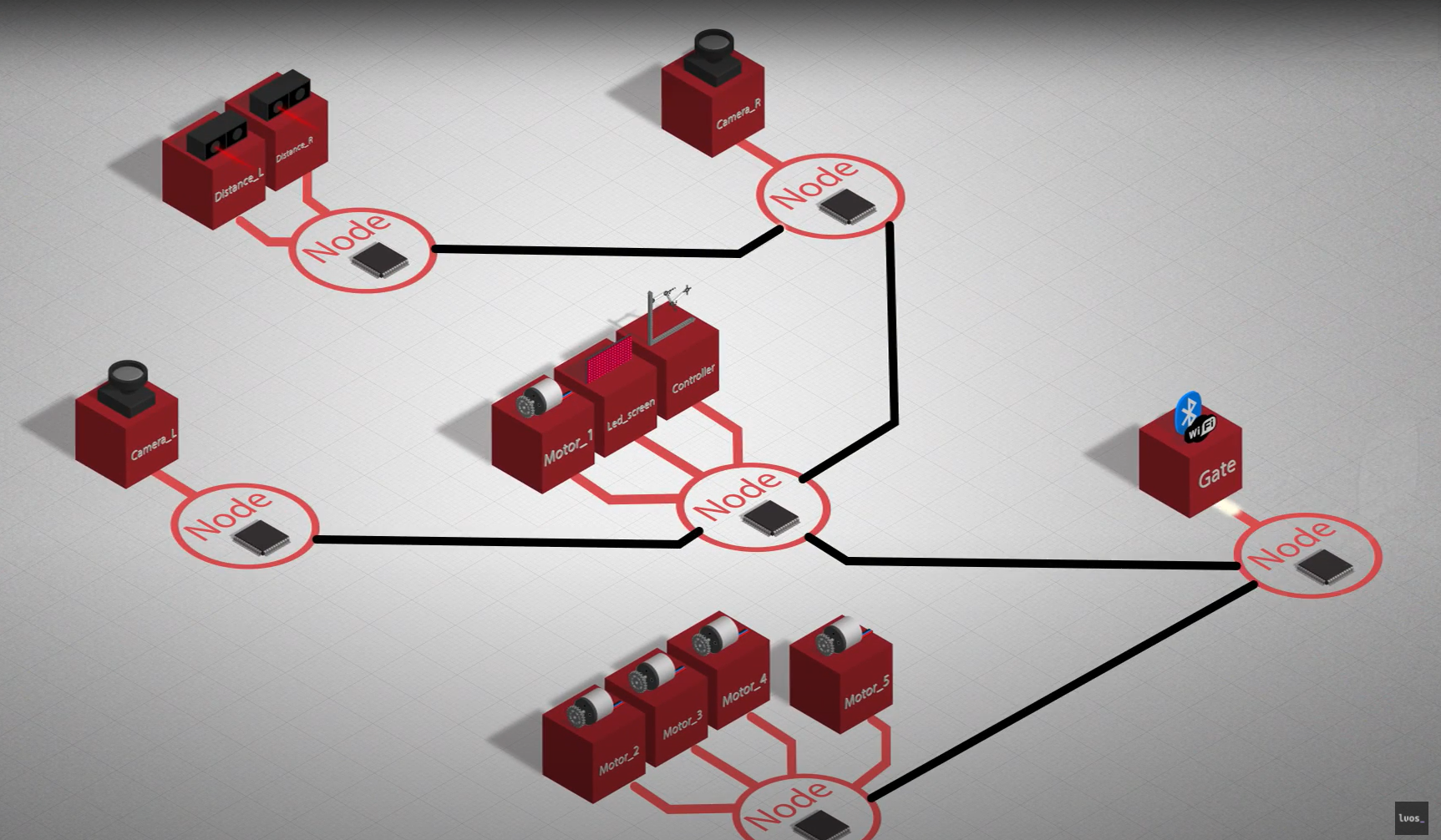
In web development, microservices usually mean independent software services that communicate through defined interfaces. Luos adapts that idea to embedded systems. A service might manage a motor, read a distance sensor, handle a laser range finder, compute inverse kinematics, or expose data to another application. The important point is that each service has a clear role and can communicate with other services in the Luos network.
This does not mean developers can ignore embedded realities such as memory, latency, power, buses, interrupts, and timing. Instead, Luos gives those realities a more manageable structure. It lets engineers design around product functions rather than being trapped by the location of each hardware resource.
Why Rapid Embedded Deployment Is So Hard
Embedded deployment is difficult because software and hardware are inseparable. A web app can usually run on a laptop, a server, or a container with minor changes. Embedded firmware, meanwhile, may depend on a specific microcontroller, board layout, driver, bus, clock, bootloader, memory map, and power condition. It is less “write once, run anywhere” and more “write once, then politely negotiate with silicon.”
Several challenges slow embedded teams down:
- Hardware coupling: Application logic is often mixed with drivers and board-specific code.
- Limited reuse: Code written for one board may need heavy rewriting for another.
- Complex communication: Multi-board products require message handling, error management, priority rules, and network coordination.
- Testing friction: Hardware-in-the-loop testing is powerful, but physical devices can become pipeline bottlenecks.
- Deployment risk: Firmware updates must be reliable, secure, and recoverable, especially in field devices.
Luos does not erase these challenges, but it helps organize them. By making functionality modular and discoverable, it gives developers a cleaner foundation for rapid embedded deployment, continuous integration, and long-term maintainability.
How Luos Simplifies Embedded Deployment
1. It turns features into services
The core Luos idea is simple: develop functionality as services, not as one giant main program. A service is a block of code that provides a specific function and communicates with other services in the network. This makes the product architecture easier to understand because each feature has a defined purpose.
For example, imagine a mobile robot. Without a modular architecture, the firmware may mix wheel control, battery monitoring, obstacle detection, communication, navigation logic, and diagnostic output in one messy codebase. With Luos, the robot can be organized into services: motor control, battery service, distance sensor service, navigation service, and gateway service. Each service does its job and communicates with the others.
That separation matters during deployment. If the team improves the distance sensor logic, it should not need to untangle unrelated motor code. If the product adds a second sensor board, the architecture can expand without turning the firmware into a haunted house.
2. It supports distributed architectures
Many modern embedded products use more than one computing unit. A device may include a main controller, sensor boards, actuator boards, wireless modules, and a connection to a host computer or cloud application. Luos is designed for this kind of distributed system. Services can exist across different nodes and still be discovered and accessed through the Luos network.
This is valuable because product teams often start with a simple prototype and later discover that the final product needs more boards, more processing, or a different layout. With a traditional tightly coupled design, this can trigger major rewrites. With Luos, the team can think more in terms of services and less in terms of “which exact chip owns this feature forever.”
3. It provides topology awareness
One of the most useful Luos concepts is the routing table. In a Luos network, detection can create a map of nodes and services, allowing services to find and interact with one another. This makes a distributed embedded product easier to manage because the architecture can be discovered instead of being hard-coded everywhere.
For deployment, this is a big deal. When boards or services are added, removed, or moved, the system can refresh its understanding of the network. Developers still need to design responsibly, of course. Service IDs may change after detection, so applications should avoid assuming fixed IDs. But the routing-table model gives teams a structured way to manage topology instead of manually babysitting every connection.
4. It improves code reuse
Luos packages are independent blocks of code used by the Luos engine. A package can contain a service, a physical communication layer, or another reusable function. The documentation encourages organizing packages in independent folders so they can be copied into other projects more easily.
This directly supports rapid embedded deployment. When a team builds a reliable motor service or sensor package, it can reuse that work in another product rather than starting from scratch. Reuse is not glamorous, but it is one of the fastest ways to stop burning engineering time on problems the team already solved six months ago.
5. It helps teams scale from prototype to product
A good prototype proves that a concept can work. A good product proves that the concept can be built, tested, updated, maintained, and explained to a new engineer who was not present during the original caffeine-fueled miracle. Luos helps with that second part.
Because services are modular, developers can test and maintain features more cleanly. Because communication is handled through a consistent model, different services can interact without every module needing intimate knowledge of every other module. Because topology can be detected, the device can become more flexible as the architecture grows.
Luos and the Embedded DevOps Mindset
Rapid deployment is not only about writing code quickly. It is about moving reliable code from development to hardware, from hardware to test, and from test to production with fewer surprises. That is where embedded DevOps practices become important.
Modern embedded teams increasingly use continuous integration, automated builds, static analysis, hardware-in-the-loop testing, and staged firmware delivery. Luos fits naturally into this mindset because modular services are easier to build, test, and reason about than monolithic firmware. When each service has a clear responsibility, CI pipelines can validate smaller units before checking system-level behavior.
CI/CD for embedded systems
Embedded CI/CD is more complicated than standard software CI/CD because the target hardware matters. Cross-compilation, limited memory, timing constraints, physical test devices, and specialized toolchains all add friction. Still, the benefits are hard to ignore: faster feedback, fewer integration surprises, stronger collaboration, and more repeatable builds.
With Luos, teams can organize firmware into reusable services and packages, which pairs well with automated build environments. A pipeline can compile service code, run static analysis, execute unit tests where possible, then deploy validated builds to hardware test benches. When the product architecture is modular, failures are easier to trace. A sensor service that fails a regression test points to a much smaller search area than “somewhere in the firmware swamp.”
Hardware-in-the-loop testing
Hardware-in-the-loop testing is especially important for embedded products because simulation cannot catch every electrical, timing, or integration issue. Luos can make HIL testing more manageable by giving test tools access to services as named, discoverable features. Instead of writing custom test glue for every board revision, teams can interact with services through consistent interfaces.
For example, a test bench could query a distance sensor service, command a motor service, monitor status messages, or validate the response of an application service. This makes automated testing more practical and helps catch problems before devices leave the lab and begin their exciting new career as customer support tickets.
Real-World Use Cases for Luos
Robotics
Robots are natural candidates for Luos because they combine sensors, actuators, controllers, and communication layers. A robot may need motor drivers, encoders, cameras, range sensors, battery monitors, and high-level planning software. Luos can help organize these capabilities into services that are easier to deploy and update.
Industrial IoT
Industrial IoT devices often live in complex environments where reliability matters. They may monitor equipment, control actuators, gather telemetry, or communicate with supervisory systems. A modular Luos architecture can help teams add features without destabilizing the entire firmware base.
Smart appliances
Smart appliances include multiple subsystems: displays, sensors, motors, connectivity, safety logic, and user controls. Luos can simplify the relationship between these subsystems by making each function accessible as a service.
Connected test equipment
Test equipment often evolves over time. A team may add new sensor modules, interface boards, or measurement functions. With Luos, those functions can be represented as services, making the system more adaptable and easier to extend.
How Luos Supports Faster Debugging
Fast deployment depends on fast debugging. If engineers spend three days finding a bug every time they change a board, deployment speed becomes a motivational poster rather than a measurable outcome.
Luos helps debugging by improving visibility. Services have names, types, aliases, and roles. The routing table can show what exists in the network. A gate can connect the embedded architecture to external tools, allowing developers to interact with services from a host computer. This kind of access is useful because embedded bugs often hide between modules, not inside a single line of code.
Consider a product where a motor fails to respond. In a monolithic system, the team may need to inspect application logic, driver code, communication handling, timing, and board setup all at once. In a Luos-style system, the team can ask more focused questions. Is the motor service detected? Is its alias correct? Is the application sending the right message? Is the driver service responding? Is the node visible in the routing table? Debugging becomes less like hunting ghosts and more like checking a map.
Security and Reliable Updates Still Matter
Rapid deployment should never mean reckless deployment. Embedded products may run in homes, factories, vehicles, medical-adjacent environments, or remote locations. A bad update can be expensive, embarrassing, or dangerous. That is why teams should combine modular architecture with secure update practices.
For connected devices, over-the-air update systems should be designed with secure communication, authentication, rollback, staged rollouts, and monitoring. Updates should be tested under unpleasant conditions such as power loss, poor connectivity, packet drops, and interrupted downloads. The goal is simple: never turn a smart device into a decorative brick.
Luos can support this broader update strategy by making embedded functionality more modular and discoverable. However, teams still need production-grade update infrastructure, signed firmware, compatibility checks, fleet visibility, and a clear recovery plan. Architecture helps, but it does not replace discipline.
Best Practices for Using Luos in Rapid Embedded Deployment
Design services around product capabilities
Start by identifying what the product does from a user and system perspective. Motors, sensors, displays, communication modules, diagnostics, and control logic are good candidates for services. Avoid making services so tiny that the architecture becomes noisy, but do not make them so large that they become monoliths wearing fake mustaches.
Keep hardware-specific code isolated
One of the biggest advantages of Luos is reducing the grip hardware has on application logic. Keep drivers and board-specific details in the appropriate services or packages. This makes it easier to reuse application logic when hardware changes.
Use aliases thoughtfully
Aliases help developers identify services in a human-readable way. Use clear names such as left_motor, battery_monitor, or front_distance_sensor. Future team members will thank you, possibly with actual words instead of silent resentment.
Plan for detection and changing IDs
Because detection can assign service IDs based on topology, avoid building fragile logic around fixed IDs. Use the routing table and filtering tools to locate services by type, alias, or role. This makes the system more resilient when the architecture changes.
Connect Luos to automated testing
Do not wait until the final prototype to test the whole system. Use CI builds, static analysis, unit tests, integration tests, and hardware-in-the-loop testing. Luos services can make this easier because the architecture is already divided into functional blocks.
Document each service
For every service, document what it does, what messages it expects, what messages it sends, and what assumptions it makes. Good documentation is not a luxury. It is a time machine that saves future engineers from asking why a function named temporary_fix_2_final_REAL controls the entire product.
Common Mistakes to Avoid
Luos can simplify embedded deployment, but it is not a magic wand. Teams can still create confusing systems if they ignore architecture basics. The first mistake is creating services without clear boundaries. If every service knows too much about every other service, the system becomes distributed spaghetti instead of modular software.
The second mistake is skipping test automation. Modular code helps, but deployment speed comes from repeatable validation. Automated builds and tests are essential when multiple people are changing firmware, drivers, and hardware configurations.
The third mistake is treating deployment as only a development concern. Production deployment requires versioning, compatibility management, update policies, rollback plans, monitoring, and support workflows. A fast prototype is nice. A maintainable fleet is better.
The Business Value of Luos
From a business perspective, Luos can help reduce time-to-market by improving reuse and lowering integration friction. When developers can build features as services, move them between projects, and test them more easily, teams spend less time rebuilding the same foundation.
Luos can also improve product flexibility. If a company wants to release multiple device variants, modular services make it easier to share common functionality while changing specific hardware modules. That matters for startups trying to move quickly and for established manufacturers managing product families.
Finally, Luos can reduce maintenance pain. Products do not stop evolving after launch. Bugs appear, components change, customers request features, and supply chains occasionally decide to become adventure novels. A modular embedded architecture gives teams a better chance of adapting without rewriting the entire firmware stack.
Experience-Based Insights: What It Feels Like to Deploy Faster With Luos
Working with a Luos-style architecture changes the emotional temperature of embedded development. In a traditional project, adding a new board or feature can feel like pulling one cable from a box of holiday lights. You hope only one thing changes, but somehow the display flickers, the motor timing shifts, and the build system begins speaking in riddles. With Luos, the experience is more orderly because each feature has a place to live.
One practical experience is that project conversations become clearer. Instead of saying, “The firmware is not reading the sensor correctly,” the team can say, “The distance sensor service is detected, but the navigation service is not receiving the expected messages.” That difference sounds small, but it saves hours. Clear architecture creates clear debugging language, and clear debugging language prevents meetings from becoming group therapy with oscilloscopes.
Another experience is improved confidence when reusing code. In many embedded teams, engineers hesitate to reuse older firmware because it is too deeply tied to a specific board. The code may work, but moving it feels risky. Luos packages and services encourage a cleaner separation of functionality, so a proven feature can be carried into a new project with fewer hidden dependencies. That does not mean copy-paste becomes a professional strategy, but it does mean reuse becomes intentional instead of suspicious.
Luos also helps when teams are split across specialties. Hardware engineers, firmware developers, application developers, and test engineers often think about the same product from different angles. A service-based model gives everyone a shared vocabulary. The hardware team can talk about nodes. The firmware team can talk about services and packages. The test team can talk about detected capabilities and expected messages. The product team can talk about features. Everybody still has their own coffee preferences, but at least the architecture makes sense.
During deployment, the biggest benefit is fewer “all-or-nothing” moments. In a monolithic firmware design, a small change can feel risky because everything is connected in unclear ways. With Luos, teams can reason about the part of the system they changed. A motor service update still needs testing, but it does not automatically imply rewriting the battery monitor or communication bridge. This supports more frequent releases, better regression testing, and faster iteration.
There is also a learning curve. Teams must think carefully about service boundaries, naming, message design, and detection behavior. Poorly designed services can still create confusion. However, that planning is healthy. It forces architecture decisions into the open instead of hiding them inside a giant main.c file that nobody wants to touch after launch.
The most realistic way to describe Luos is this: it makes embedded deployment feel more like building a system and less like taming a mysterious creature. You still need engineering discipline. You still need test coverage. You still need secure update practices. But the workflow becomes easier to explain, easier to scale, and easier to maintain. For embedded teams under pressure to move quickly without sacrificing reliability, that is a very welcome upgrade.
Conclusion
Luos simplifies rapid embedded deployment by bringing modular, service-based architecture to hardware products. Instead of forcing developers to manage every feature inside one tightly coupled firmware structure, Luos helps teams divide functionality into services that can communicate across nodes and networks. That makes embedded systems easier to build, test, debug, reuse, and scale.
For robotics, IoT, industrial devices, smart appliances, and connected machines, this approach can reduce development friction and improve long-term maintainability. Luos does not remove the hard parts of embedded engineering, but it gives teams better tools for handling them. In a world where products need to ship faster, update safely, and adapt to changing hardware, Luos offers a practical path toward cleaner embedded deployment.
Note: This article is written for web publication in standard American English and is based on real Luos concepts, embedded microservices practices, modular firmware architecture, CI/CD principles, and reliable deployment guidance. It avoids copied source text, unnecessary source-link blocks, and citation placeholders.