

Note: This article is based on a reported online account involving a collector’s dolls, along with broader guidance on protecting collectibles, setting household boundaries, and keeping children safe around small collectible items.
Some people collect stamps. Some collect vintage cameras. Some collect tiny plastic celebrities wearing gowns that cost more than a utility bill. Whatever the collection may be, there is one universal rule: do not touch someone else’s stuff without permission.
That rule became painfully relevant for one woman after she discovered unexpected visitors in her childhood bedroom, handling her boxed collectible dolls and trying to open them for a young child. What should have been an ordinary family visit turned into a miniature crisis involving unopened packaging, emotional memories, personal boundaries, and the terrifying sound every collector fears: cardboard bending.
The story struck a nerve because it was never really about “just toys.” It was about privacy, ownership, sentimental value, and the strange belief that if an adult owns something colorful, a child is automatically entitled to play with it. Spoiler alert: that is not how adulthood works. A boxed collector doll is not a community snack bowl.
A Quiet Bedroom Turned Into a Collector’s Emergency
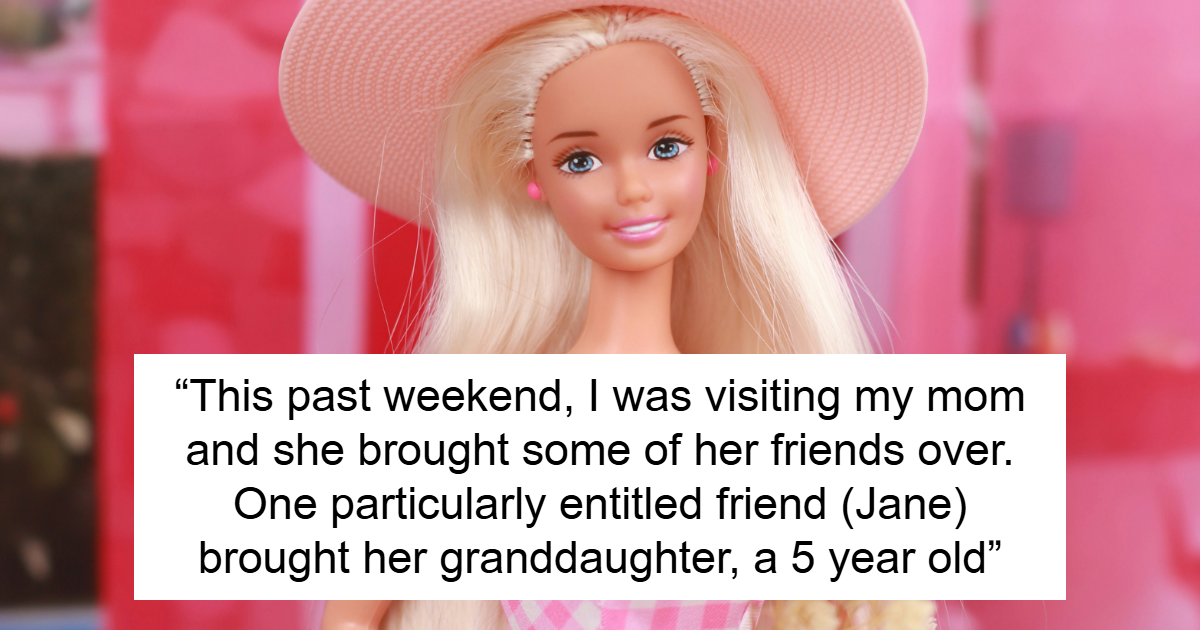
According to the reported account, the woman had kept a small collection of collector-edition Barbie dolls and other boxed dolls in her childhood room at her parents’ home. She lived in a smaller apartment, so the room served as a safe storage space for items that carried both monetary and emotional value.
These were not random toys tossed into a bin after a birthday party. The dolls had been gifts from her father, who worked abroad and brought home special items over the years. Each one represented a memory, a moment, or a piece of a relationship. For collectors, that type of connection matters just as much as the resale value.
During a visit, the woman reportedly found her mother’s friend inside the room with a young granddaughter. The guest had been looking through the woman’s closet and handling the boxed dolls. One was reportedly being offered to the child as though it were a free prize from a game show no one else had agreed to host.
The child wanted the doll. The guest expected the owner to hand it over. The owner said no.
And honestly, that should have been the shortest story in history.
Instead, the situation became awkward because some people treat another person’s belongings as negotiable whenever a child starts crying. But tears do not create ownership rights. A tantrum is not a coupon. And “she really likes it” is not a legal transfer of property.
The woman and her mother ultimately installed a lock on the bedroom door after the incident. That may sound dramatic to people who have never collected anything more fragile than grocery receipts, but it was a practical response to a clear boundary problem.
Why Opening a Collectible Toy Can Be a Big Deal
To someone outside the collector world, an unopened toy box may look like unnecessary packaging. To a collector, that box can be part of the item itself. It protects the doll, preserves the display, confirms authenticity, and helps maintain condition.
Original packaging is often one of the factors that affects collectible toy value. Condition, rarity, completeness, accessories, and demand all matter, but an unopened item in clean packaging can be significantly more attractive to collectors than one that has been removed, played with, or damaged.
That does not mean every sealed doll is secretly worth enough to fund a beach house. Most collectibles are not magic retirement plans in plastic windows. Still, the owner gets to decide whether an item stays sealed, gets displayed, or gets opened during a ceremonial midnight unboxing with dramatic music playing in the background.
The important part is ownership. The collector decides. Not a guest. Not a neighbor. Not someone’s nephew who spotted a shiny box. Not even a child who delivers an Oscar-worthy performance in the living room.
Collectible Packaging Is More Than Cardboard
For many collectors, packaging tells part of the story. It may include the original artwork, edition number, promotional design, certificate, accessories, or brand history. A vintage doll box, action figure blister pack, LEGO set, trading-card wrapper, or limited-edition plush tag can be as meaningful as the object inside.
Once packaging is ripped, taped, crushed, stained, or thrown away, it usually cannot be restored to its original condition. That is why collectors can react strongly when someone casually says, “Why don’t you just open it?”
Because “just open it” can mean “just reduce its value, erase part of its presentation, and ruin the exact condition I spent years preserving.”
The Real Problem Was Not the Child
It would be easy to blame the child in this story, but children are naturally curious. They see a doll, they want to hold it. They see a colorful box, they assume something exciting lives inside. That is normal.
The adult was responsible for managing the situation.
Parents, grandparents, relatives, and guests should explain the difference between a toy meant for play and a collectible meant for display. Kids do not automatically know that distinction, especially when an item looks like something available in a toy aisle.
A better response would have been simple: “Those dolls belong to someone else. We can look, but we cannot touch unless she says yes.” Even better: “Let’s find something you are allowed to play with.”
There is no need to turn a child’s disappointment into a stranger’s financial loss or emotional pain. Teaching children to respect other people’s belongings is not mean. It is one of the earliest and most useful lessons in life.
It can also be a safety issue. Many collectible toys, miniatures, accessories, and decorative pieces include small detachable parts that may not be appropriate for young children. U.S. consumer-safety guidance warns that products containing small parts may pose choking risks for younger children.
Adult Toy Collecting Is Not Childish
There is a persistent myth that adults who collect dolls, action figures, plush toys, model cars, trading cards, or pop-culture memorabilia are somehow refusing to grow up. In reality, adult collecting is a huge part of the modern toy market.
Adults collect for nostalgia, design, fandom, creativity, personal expression, investment potential, and the calming ritual of organizing a collection. Some people display rare Star Wars figures. Others hunt for vintage Barbie dolls. Some build elaborate LEGO cities. Others line shelves with Pokémon cards, anime statues, Funko Pops, Labubu figures, or tiny haunted mushrooms with names that sound like indie bands.
Recent toy-market reporting has shown that adults are a major source of collectible toy spending, particularly for limited-edition figures, blind-box products, and nostalgia-driven releases.
That growth makes sense. Adults have more purchasing power, more nostalgia, and often a strong desire to reconnect with characters or hobbies from childhood. Collecting can also be a creative hobby. It involves research, cataloging, display planning, restoration, photography, community discussions, conventions, and the occasional late-night eBay decision that feels wise until the shipping fee appears.
There is nothing childish about caring deeply for something you enjoy. The childish part is entering someone else’s room and assuming their possessions are available for public use.
How Collectors Can Protect Their Toys From Curious Guests
No one wants their home to feel like a museum guarded by laser beams and a stern British narrator. Still, collectors deserve practical ways to protect their belongings, especially when visitors, relatives, or children are around.
Set the Rules Before Visitors Arrive
Be direct before a gathering. A simple sentence works: “My collection room is private, so please keep children out of that area.”
This may feel awkward at first, but unclear boundaries create more awkwardness later. It is better to sound slightly formal before guests arrive than to discover someone has opened a limited-edition item because they assumed it was available.
Use Closed Displays or Storage Cabinets
Glass-front cabinets, display cases, shelves with doors, storage bins, and locked closets can reduce accidental handling. Closed storage is especially useful for fragile items, boxed collectibles, dolls with delicate clothing, limited-edition figures, vintage toys, and anything with tiny accessories.
Display cases also help with dust, sunlight, humidity, and accidental bumps. They may not stop every determined visitor, but they create an important visual message: this is a collection, not a play area.
Document Valuable Items
Collectors should photograph their items, save receipts, record edition details, and keep an updated inventory. A strong inventory can include purchase dates, product names, condition notes, serial numbers, appraisal records, and close-up photos of packaging.
Insurance organizations commonly recommend documenting possessions with photographs, videos, receipts, and written records, particularly for valuables and collectibles.
This is useful not only for theft or damage claims, but also for personal organization. When a collection grows, it becomes surprisingly easy to forget whether you already own the glow-in-the-dark version, the convention exclusive version, or the version wearing a tiny hat that cost $37 for reasons no accountant could explain.
Review Insurance Coverage
Standard homeowners or renters insurance may provide some personal-property coverage, but collectors with higher-value items should read the policy carefully. Some collections may need separate coverage, an appraisal, or a scheduled personal-property policy.
Specialized collectibles coverage can be worth considering when a collection has meaningful replacement value. Appraisals, receipts, detailed photos, and current market research may help establish appropriate coverage.
How To Say No Without Starting a Family War
When someone asks for a collectible, the best response is usually short and calm.
“I’m sorry, but that is part of my collection and it is not available.”
You do not need to explain the market value. You do not need to defend your hobby. You do not need to apologize for keeping something you purchased, inherited, or received as a gift.
If the person keeps pushing, repeat the boundary instead of entering a debate.
“I understand she likes it, but it is not a toy for guests. Please do not handle it.”
That is firm without being cruel. The goal is not to embarrass anyone. The goal is to stop the behavior before a collectible becomes a casualty.
And when someone says, “But she is only a child,” remember this: children are capable of hearing no. Adults should be capable of saying it.
Related Experiences: When Collectors Have To Defend Their Collections
Stories like this resonate because many collectors have experienced smaller versions of the same problem. The details may differ, but the feeling is familiar: someone sees a personal collection and mistakes it for a shared resource.
The “Can I Borrow This Forever?” Relative
One common situation involves a family member who notices a collectible and casually asks to borrow it for a child, a party, a school project, or a photo shoot. The request may sound harmless, but “borrow” can become risky when the item is rare, fragile, or difficult to replace. A doll can return with tangled hair. A boxed action figure can come back with crushed corners. A vintage toy can disappear into the mysterious black hole known as “I thought my kid put it somewhere.” Collectors quickly learn that lending an item is not always generous; sometimes it is simply expensive.
The Friend Who Thinks Everything Is a Decoration
Another familiar experience happens when visitors treat collectibles like ordinary home décor. They pick up a figure, move it for a selfie, rearrange a shelf, or place a drink beside a display case. The collector may smile politely while internally hearing the soundtrack from a disaster movie. Decorative does not mean disposable. A room can look inviting without becoming interactive. Good guests admire collections the same way they admire artwork: with their eyes first, their hands only when invited, and their beverages several feet away.
The Kid Who Sees a Toy, Not a Treasure
Children are often innocent participants in these situations. They see a doll and naturally assume it is meant for play. That is why adults should prepare them before entering a collector’s room. “Those are display items” is a useful phrase. So is “We can look, but we do not touch.” A thoughtful host may also keep a few inexpensive toys nearby for visiting children. This creates a better outcome for everyone: the child gets something appropriate to play with, the parent avoids a stressful moment, and the collector does not have to perform emergency surgery on a bent cardboard box.
The “It’s Just Plastic” Comment
Collectors often hear dismissive comments from people who do not share the hobby. “It is just plastic.” “It is only a doll.” “Why keep it in the box?” Those comments miss the point. Plenty of treasured things are made from ordinary materials. A wedding ring is metal. A photograph is paper. A childhood keepsake may be plastic, fabric, cardboard, or wood. Value is not determined only by material. It comes from memory, rarity, effort, history, and the meaning a person attaches to an object.
The Lock That Becomes a Peacekeeping Tool
Some collectors eventually decide that a lock is easier than repeated explanations. That does not mean they are paranoid or unfriendly. It means they have learned from experience. A locked display cabinet, bedroom door, or storage closet removes ambiguity. Visitors no longer have to guess whether an item is available. The answer is physically clear. It also protects collectors from the emotional exhaustion of watching guests too closely. A lock is not an insult to polite visitors. It is simply a practical tool for protecting items that matter.
The Lock Was Never Really About the Dolls
At the center of this story is a simple truth: people deserve control over their belongings.
The woman was not selfish for keeping her collectible toys. She was not unreasonable for refusing to give one away. She was not dramatic for installing a lock. Her dolls represented memories, money, care, and personal joy. A guest entering her room, searching through storage, and trying to open or claim an item crossed several boundaries at once.
Collectibles may be dolls, action figures, cards, comic books, plush toys, model trains, vintage games, or anything else that makes a person happy. The category does not matter. Respect does.
So the next time you visit someone with a shelf full of mysterious little treasures, remember the golden rule: admire the collection, ask before touching, and never volunteer someone else’s property as a gift.
Because nothing ruins a pleasant visit faster than discovering you have accidentally become the villain in someone else’s collectible-toy origin story.