

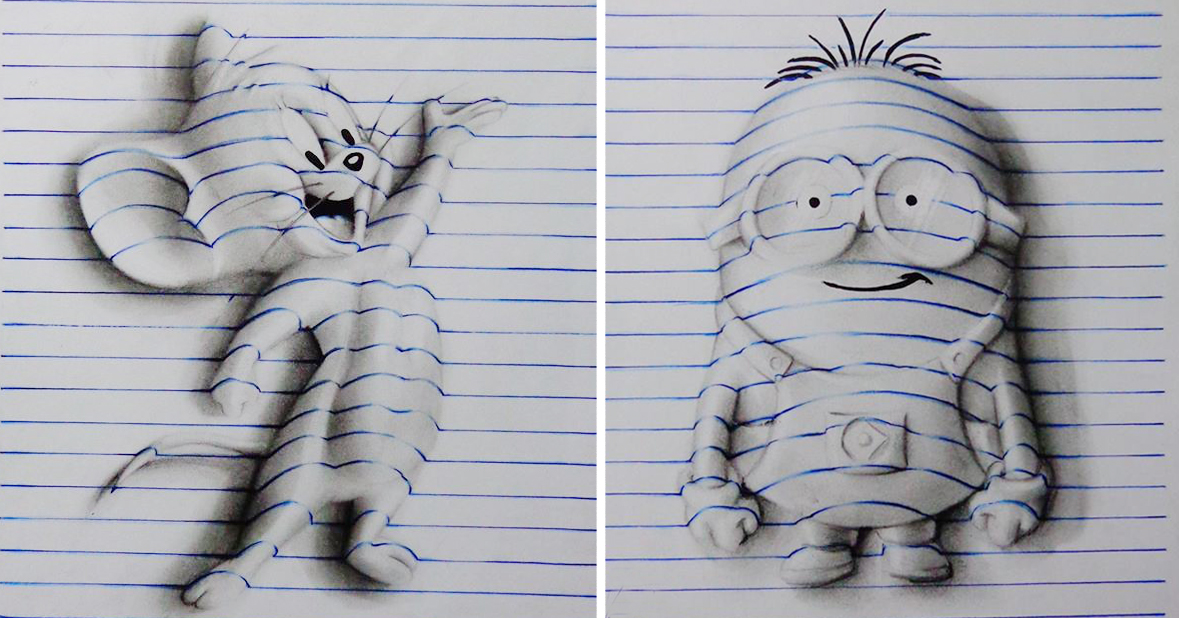
Most people look at lined notebook paper and see homework, grocery lists, or a place to test whether a pen still works. Brazilian artist João A. Carvalho saw an alternate dimension.
Using ordinary pencils, carefully distorted lines, and strategic shading, Carvalho transformed flat pages into eye-bending scenes. Cartoon characters appear to push through the paper. Holes seem to open beneath the viewer. Waves, faces, and everyday objects rise above surfaces that remain stubbornly two-dimensional.
The drawings became an online sensation in 2014, when Carvalho was 15 and creating art under the name J Desenhos. Their appeal was immediate: the materials were familiar, but the results looked impossible.
Meet the Teen Artist Behind the 3D Notebook Drawings
João Carvalho was a self-taught young artist from Brazil when his unusual notebook illustrations began circulating across art, design, technology, and entertainment websites. Reports from the period noted that he had started experimenting with this particular style only a few months earlier, around June 2014.
That short timeline made the work even more surprising. Carvalho was not using expensive software, professional drafting equipment, or a studio guarded by a serious-looking person with a clipboard. He was working with paper and pencilssupplies available in almost any classroom.
His artistic identity, J Desenhos, was especially fitting. “Desenhos” means “drawings” in Portuguese, and drawing was the entire engine of the project. The work depended on observation, patience, perspective, and the willingness to treat every familiar notebook line as something flexible.
Instead of accepting the page as a flat background, Carvalho made it an active part of each composition. The lines bend over imaginary forms, disappear behind characters, or plunge into dark openings. In effect, the paper becomes both the canvas and one of the performers.
How Flat Paper Appears to Become Three-Dimensional
Carvalho’s drawings work because the brain is an enthusiastic problem solverand occasionally an overconfident one. When it sees overlapping forms, curved contours, cast shadows, and changes in scale, it interprets those visual clues as depth.
Curved Lines Describe Invisible Form
A normal ruled page contains straight, evenly spaced horizontal lines. Carvalho recreates or modifies those lines so they curve around an illustrated subject. A line that arches upward can suggest a raised surface, while one that dips downward may imply a cavity.
The technique resembles the contour lines used on topographic maps. Those maps describe hills and valleys without building actual hills and valleys on the kitchen table. Carvalho’s notebook lines perform a similar job, guiding the eye across imaginary volume.
Shading Supplies Weight and Depth
Curved lines establish the basic geometry, but shading makes the illusion convincing. Dark values suggest recesses, blocked light, and cast shadows. Lighter areas appear closer to the viewer, while gradual transitions make rounded forms feel smooth.
A believable cast shadow is particularly powerful. If a character appears to cast a shadow onto the page, the brain concludes that the character must be hovering above it. The object is still graphite and paper, naturally, but the visual system has already filed a tiny complaint with reality.
Perspective Controls the Viewing Angle
Some 3D drawings rely on anamorphic perspective. In anamorphic art, an image is intentionally stretched or distorted so that it looks correct from one specific angle. Viewed from directly above, the drawing may appear unusually long. Viewed from the intended positionor through a camerait suddenly seems to stand upright.
This method is often associated with sidewalk art that creates the illusion of cliffs, stairways, or objects emerging from pavement. On notebook paper, the same principle can make a can, cube, hand, or cartoon figure appear to occupy real space.
What Makes João Carvalho’s Style So Memorable?
Plenty of artists create realistic pencil drawings. Carvalho’s distinctive contribution was turning the visual language of school notebooks into part of the illusion.
He Used an Everyday Object as a Creative Constraint
Lined paper is normally designed to impose order. It keeps handwriting level and discourages sentences from wandering downhill. Carvalho reversed that purpose. His lines buckle, twist, and wrap themselves around objects as though the notebook has developed a mischievous personality.
The limitation became a recognizable style. Viewers can understand the trick because they know what notebook paper is supposed to look like. Every distortion therefore feels more dramatic.
He Balanced Realism With Playfulness
Carvalho’s portfolio included dark openings, abstract forms, human faces, waves, and recognizable cartoon characters. Minions were among the subjects highlighted in early coverage, and later pieces incorporated familiar consumer objects and physical props.
These choices made the work approachable. A technically perfect study of geometric solids might impress an art instructor, but a cheerful character apparently escaping from algebra paper has a better chance of being shared by several thousand delighted strangers.
He Let the Process Remain Visible
The drawings do not completely hide their materials. Viewers can still see pencil marks, lines, shading, and the page beneath them. That visibility creates a satisfying tension: the audience understands that the image is handmade while simultaneously responding to it as a three-dimensional scene.
It is illusion without concealment. The magician has left the trapdoor open, yet the trick remains enjoyable.
From Notebook Experiment to Internet Phenomenon
Carvalho’s work spread rapidly across creative publications and social platforms in late 2014. The combination of youth, accessible materials, and immediately understandable visuals made the drawings ideal for online audiences.
Photographs also helped preserve the illusions. A camera fixes the viewer’s position, allowing anamorphic pieces to be presented from their strongest angle. The photograph becomes part of the artwork’s delivery system, even when the original drawing exists on an ordinary sheet of paper.
Follow-up coverage in 2016 showed that Carvalho had continued developing the project. Later compositions used more elaborate shading and sometimes included real objects placed around the drawings. A pencil, hand, or beverage can positioned beside an illustration could blur the boundary between the physical world and the drawn one.
That continuation matters. Viral fame can make a creative breakthrough look like a lucky accident. A growing body of work reveals the less glamorous truth: improvement comes from repeating the process, studying failures, and sharpening technical control.
3D Drawing Has a Much Longer Artistic History
Although Carvalho gave the technique a fresh notebook-based identity, art designed to “fool the eye” is centuries old. The French term trompe-l’oeil describes images made to convince viewers that painted objects or spaces are real.
Historic painters used realistic scale, architectural frames, highlights, shadows, and projecting elements to make objects appear to extend beyond a picture’s surface. Anamorphosis developed another branch of visual deception by requiring the audience to view a distorted image from a precise location.
Modern street artists apply those ideas to sidewalks and public plazas. Photographers, filmmakers, installation artists, and digital designers use related principles when manipulating scale and perspective. Carvalho brought the tradition to a modest surface associated with schoolwork, proving that an old optical idea can feel new when the setting changes.
What Young Artists Can Learn From Carvalho’s Work
Start With the Supplies You Already Have
Creative development does not always require premium tools. A pencil, eraser, ruler, colored pencil, and inexpensive paper are enough to study perspective, contour, light, and shadow.
Better materials may eventually offer richer tones or smoother blending, but they cannot replace observation. Carvalho’s early drawings attracted attention because of the ideas and execution, not because the pencils arrived in a velvet-lined case.
Make Limitations Part of the Design
Restrictions can encourage original decisions. A ruled page supplies a repeating pattern. A small sketchbook forces careful composition. A limited set of pencils makes value control more important.
Instead of waiting for ideal circumstances, artists can ask a more useful question: “What can this particular material do that another material cannot?” That shift turns an obstacle into a style.
Practice Seeing, Not Merely Drawing
Successful 3D notebook art depends on noticing how light behaves, where shadows fall, and how forms change from different viewpoints. Drawing a real cup from an angle teaches more than memorizing a generic cup symbol.
Young artists can improve by studying simple objects under a desk lamp. Cubes reveal planes and cast shadows. Spheres teach gradual shading. Cylinders demonstrate curved contours. They are not glamorous models, but they never arrive late or request snacks.
Share Progress Without Expecting Perfection
Carvalho’s story also shows how online platforms can connect emerging artists with an international audience. However, attention should not become the only measure of success. Likes reveal what attracted viewers on a particular day; they do not provide a complete evaluation of artistic growth.
A healthy portfolio includes experiments, revisions, and unsuccessful attempts. The page that did not quite “pop” may teach more about perspective than the one that collected the most reactions.
How to Create a Simple 3D Notebook Drawing
- Choose a basic form. Begin with a sphere, cube, cylinder, or simple cartoon silhouette.
- Mark a viewing position. Decide whether the finished image should be viewed from above or from a low angle.
- Sketch lightly. Use faint pencil marks so unwanted construction lines can be removed.
- Draw horizontal guidelines. Keep them straight until they approach the subject.
- Bend the lines around the form. Curve them upward over raised areas or downward into recessed ones.
- Build the shadows gradually. Establish a consistent light source and darken the areas facing away from it.
- Add a cast shadow. This anchors the illusion and separates the imagined object from the page.
- Test with a camera. Photograph the page from several angles and adjust distorted areas.
Beginners should resist the urge to press hard immediately. Dark graphite is stubborn, rather like a cat that has discovered a warm laptop. Light construction marks allow corrections before the final values are added.
A Hands-On Experience With 3D Notebook Art
Trying this technique changes the way you look at a notebook. At first, the horizontal lines seem helpful because they provide a built-in grid. Five minutes later, they become tiny blue supervisors monitoring every questionable curve.
Imagine beginning with a simple round hole. You draw an oval near the center of the page, then allow each horizontal line to curve around its edge. Inside the oval, you add closely spaced dark bands, keeping the deepest area almost black. A soft shadow extends along one side.
From directly overhead, the first attempt may resemble a squashed bagel. This is normal and possibly useful if you were secretly drawing breakfast. When you lower the camera, however, the oval begins to look circular. The shadow stretches away from the opening, and the dark center suddenly appears deeper.
The experience reveals that the illusion is not created by one dramatic pencil stroke. It emerges through dozens of small decisions: the width of a curve, the direction of the light, the softness of an edge, and the distance between neighboring lines.
A second attempt usually becomes more ambitious. You might draw a hand reaching through the page. The fingers require careful proportions, while the notebook lines must disappear behind them and return on the other side. Adding shadows beneath the fingertips gives them separation from the surface.
This is where patience enters wearing heavy boots. One incorrect shadow can flatten a finger. A line bent in the wrong direction can make the page look inflated instead of torn. Erasing too aggressively may damage the paper, leaving a fuzzy patch that catches graphite like a tiny carpet.
Yet the mistakes are oddly encouraging because their effects are visible. Lighten one shadow, strengthen another, photograph the page again, and the image improves. The feedback loop is immediate: draw, observe, adjust, repeat.
Sharing the finished piece adds another layer to the experience. Friends may rotate the picture, lean toward the screen, or ask whether part of it was digitally edited. The most satisfying response is often not “That is perfect,” but “Waithow did you do that?” Curiosity means the illusion has worked.
The exercise also produces a new respect for Carvalho’s drawings. What looks playful and effortless online requires planning, steady value control, spatial reasoning, and repeated testing. His achievement at 15 was not simply that he discovered a clever visual trick. It was that he learned to control the trick well enough to develop a recognizable artistic voice.
After completing one drawing, blank paper no longer looks entirely blank. A line can become a ridge. A shadow can become a doorway. A page can behave like a stageand your pencil gets to handle the special effects budget.
Conclusion: A Pencil Can Open Another Dimension
João Carvalho’s 3D notebook drawings remain compelling because they combine technical skill with a simple, generous idea: extraordinary art can begin with ordinary materials.
By bending familiar notebook lines, controlling perspective, and adding carefully placed shadows, the young Brazilian artist made characters and shapes appear to escape the page. His work connects historic illusion art with modern internet culture while offering an encouraging lesson to beginners.
You do not need a perfect studio before you start creating. Sometimes all you need is a pencil, a page, and the suspicion that those straight blue lines are not being completely honest with you.