

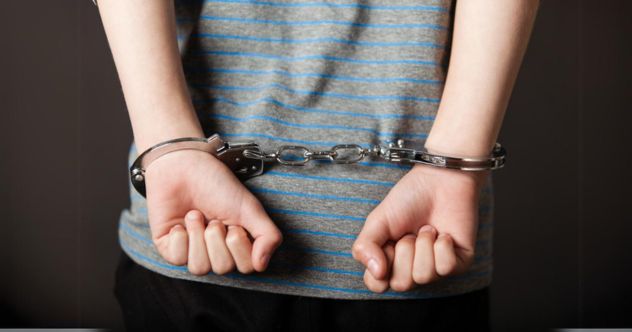
Children break rules. They scribble on desks, make noises at terrible moments, argue with teachers, and occasionally transform a quiet classroom into something resembling a low-budget disaster movie. Traditionally, adults respond with detention, a call home, lost privileges, or a very long conversation beginning with, “What were you thinking?”
In the cases below, however, ordinary discipline took an extraordinary turn. Police officers were called, handcuffs appeared, and children entered the juvenile justice system over conduct involving a French fry, an erasable marker, a homemade clock, bodily noises, and other incidents that might ordinarily have ended in the principal’s office.
Calling these arrests “ridiculous” does not mean every child behaved perfectly. Some allegedly struck staff members, damaged property, or resisted instructions. The disturbing part was the mismatch between the child’s age, the alleged behavior, and the decision to use criminal procedures instead of age-appropriate intervention. When the solution to elementary-school misbehavior involves fingerprinting, mug shots, or a patrol car, common sense has apparently left campus without signing out.
1. The 12-Year-Old Arrested for Eating a French Fry
A snack became a criminal matter
In October 2000, 12-year-old Ansché Hedgepeth entered Washington, D.C.’s Tenleytown-AU Metro station while eating French fries. Because eating was prohibited inside Metro stations, a transit officer stopped her during a zero-tolerance enforcement operation.
Instead of receiving a warning, she was handcuffed, searched, transported to police headquarters, fingerprinted, and held until her mother arrived. The policy produced a strange legal imbalance: an adult could receive a citation, but officers did not then have the same citation option for a juvenile, so the child was arrested.
A federal appeals court later upheld the arrest’s legality while acknowledging that officials had handled the situation poorly. Metro subsequently changed its policy. Apparently, society survived the incident without creating a specialized French Fry Crimes Unit.
2. The 12-Year-Old Handcuffed for Doodling on a Desk
Erasable ink, permanent memories
In 2010, New York City student Alexa Gonzalez wrote messages such as “Lex was here” and “I love my friends Abby and Faith” on a classroom desk. She used a lime-green erasable marker, making the offense less “destruction of property” and more “a cleaning wipe has entered the chat.”
Nevertheless, police removed the 12-year-old from her Queens middle school in handcuffs and detained her at a precinct for several hours. Her mother said the experience left Alexa emotionally distressed. School officials later acknowledged that the arrest should not have happened.
The incident became a widely cited example of how zero-tolerance school policies can transform manageable student misconduct into a police matter. Asking Alexa to clean the desk would have repaired the property. Arresting her created a much larger mess.
3. The 13-Year-Old Arrested for Burping in Class
The class clown met the criminal code
An Albuquerque, New Mexico, seventh grader was arrested in 2011 after repeatedly making fake burping noises during physical education class. Reports indicated that he continued disrupting the lesson after being sent into the hallway, leaning toward the classroom so other students could still hear him.
Annoying? Certainly. A persuasive case for after-school detention? Absolutely. Yet a school police officer handcuffed the 13-year-old, transported him to juvenile detention, and held him for roughly an hour under a state law prohibiting interference with the educational process.
The boy’s mother challenged the arrest in federal court. The litigation eventually reached the Supreme Court, which declined to hear the case. In an earlier dissent, future Supreme Court Justice Neil Gorsuch argued that arresting a class clown for burping went too far. Generations of teachers somehow controlled similar noises without requesting backup.
4. The Florida Student Arrested for Passing Gas
One classroom disruption that literally stank
In 2008, a Florida middle school student was arrested after school officials accused him of intentionally passing gas to disrupt his classroom. The police report also alleged that he turned off computers being used by other students.
The additional computer interference made the incident more complicated than a single accidental emission. Even so, the resulting arrest and charge for disrupting a school function became national news because of the obvious question: At what point did classroom flatulence become a law-enforcement specialty?
A teacher may need to remove a disruptive student, contact the family, document repeated behavior, or assign consequences. Introducing police custody can convert an immature joke into a frightening legal experience without teaching the child why the conduct was inappropriate. It also guarantees that the phrase “arrested for farting” will follow the case forever, which may be the least dignified entry imaginable in a juvenile file.
5. The 7-Year-Old Detained Over a $5 Dispute
Lunch money led to hours in custody
In December 2012, Bronx third grader Wilson Reyes was accused of taking $5 that another student had dropped. A struggle involving several children followed, and police were called.
Wilson’s family said the 7-year-old was removed from class, handcuffed, questioned at school, and later held at a police precinct for hours. His relatives maintained that he had not taken the money. The allegation ultimately did not result in a prosecution, but the experience had already delivered its punishment.
Schools must investigate theft and physical conflict. However, treating a second grader like the mastermind of an international lunch-money syndicate is difficult to defend. The incident showed how rapidly a small playground dispute can escalate when police replace teachers, counselors, and parents as the first responders to childhood conflict.
6. The 6-Year-Old Arrested After a Kindergarten Tantrum
Salecia Johnson’s outburst ended in handcuffs
In 2012, 6-year-old Salecia Johnson had a major outburst at Creekside Elementary School in Milledgeville, Georgia. According to police accounts, she pushed students, threw objects, damaged school property, and knocked over a small shelf that injured the principal’s leg.
The behavior required immediate intervention to protect Salecia and the people around her. The controversial decision came next: Police handcuffed the kindergartner, placed her in a patrol car, and charged her with offenses that included simple battery and property damage.
The charges were later dismissed because of her age. Critics argued that trained staff, crisis specialists, and family involvement should have replaced arrest. A 6-year-old in emotional crisis needs firm boundaries and safe de-escalation. She is unlikely to gain profound moral clarity from staring at the back seat of a police cruiser while her feet do not reach the floor.
7. The 14-Year-Old Arrested for Bringing a Homemade Clock
Ahmed Mohamed’s science project triggered a bomb scare
In September 2015, 14-year-old Ahmed Mohamed brought a homemade digital clock to MacArthur High School in Irving, Texas. Ahmed, who was interested in engineering and robotics, reportedly wanted to show the device to his teachers.
After the clock beeped during class, a teacher thought it looked suspicious. Police questioned Ahmed, handcuffed him, and transported him to a juvenile detention facility on suspicion that the device might have been intended as a hoax bomb. Authorities soon determined that it was not an explosive, and Ahmed was not criminally charged.
The arrest generated international criticism and the hashtag #IStandWithAhmed. Supporters said the response reflected bias toward a Muslim student of Sudanese heritage. Whatever one thinks of the clock’s appearance, the episode sent a peculiar message to young inventors: Please explore science, technology, engineering, and mathematicsbut perhaps leave your enthusiasm safely bubble-wrapped at home.
8. The 11-Year-Old Arrested After a Pledge Dispute
An important distinction hidden by the headline
In 2019, an 11-year-old student at a Florida middle school refused to stand for the Pledge of Allegiance. A substitute teacher challenged his decision even though students were not required to participate. The exchange escalated, school administrators and an officer became involved, and the child was arrested.
School officials emphasized that he was not formally arrested merely for declining to stand. The stated allegations involved disrupting school and resisting an officer after the argument intensified. That distinction matters, but it does not make the chain of events reassuring.
The confrontation began over an activity the student had a right to decline. A trained adult could have ended the matter by allowing the class to continue. Instead, an unnecessary debate grew until an 11-year-old entered the juvenile justice system. Sometimes the most effective de-escalation technique is simply not turning a constitutional choice into a classroom showdown.
9. The 6-Year-Old Zip-Tied and Taken to Juvenile Detention
Kaia Rolle’s arrest helped change Florida law
Kaia Rolle was 6 years old when she was arrested at an Orlando charter school in September 2019. Staff members said she had kicked and hit people during a tantrum. A school resource officer fastened zip-tie restraints around her wrists, placed her in a police vehicle, and transported her to a juvenile processing center, where she was fingerprinted and photographed.
Body-camera footage later showed the crying child pleading with adults not to arrest her. The officer had failed to obtain the supervisory approval required by department policy for arrests involving children younger than 12. He was fired, and charges against Kaia and another young child he had arrested that day were dropped.
Public outrage contributed to Florida legislation restricting arrests of children younger than 7, although advocates have argued that the minimum should be higher. Kaia’s case illustrates a basic developmental truth: A first grader having a meltdown may need evaluation, family support, rest, counseling, or specialized services. She does not need a mug shot suitable for the world’s saddest elementary-school yearbook.
10. The 8-Year-Old Arrested After a Cafeteria Dispute
The handcuffs were too large for his wrists
In December 2018, an 8-year-old boy with behavioral and emotional disabilities was arrested at a Key West, Florida, elementary school. According to reports, a substitute teacher confronted him for not sitting properly during lunch. The situation escalated, and the boy was accused of punching the teacher.
Police body-camera footage showed officers telling the crying child that he was going to jail. Standard handcuffs were too large to secure his small wrists. He was nevertheless booked and briefly jailed on a felony battery allegation.
The boy’s mother and civil-rights attorneys later filed a lawsuit against the city, police, school district, and school employees. The central question was not whether hitting a teacher should be ignored. It was whether arresting a disabled 8-year-old was a reasonable response to conduct that began as a school discipline problem. When police equipment does not physically fit the suspect, that may be the universe offering a fairly obvious hint.
Why Do Minor School Incidents Become Arrests?
Many of these stories grew from zero-tolerance rules adopted to make schools safer. Serious threats, weapons, and violence clearly require decisive action. Trouble begins when the same enforcement machinery is applied to doodling, childish noises, defiance, emotional crises, or minor disputes.
School resource officers are trained law-enforcement professionals. Their tools include commands, detention, handcuffs, searches, and criminal charges. Teachers, counselors, psychologists, and behavioral specialists use a different toolbox. When schools rely on officers for routine discipline, childish behavior can be interpreted through a criminal lens.
The consequences are not distributed equally. A 2024 U.S. Government Accountability Office analysis found that, using 2017–2018 national data, Black, American Indian or Alaska Native, and Native Hawaiian or Pacific Islander students experienced arrest rates roughly two to three times those of White students. Disparities became even greater for some boys with disabilities.
Federal guidance has stressed that educators should handle school discipline while law enforcement focuses on genuine safety and criminal concerns. Civil-rights organizations describe the alternative pattern as part of the school-to-prison pipeline: Minor rule violations become police referrals, arrests, court appearances, and exclusion from education.
The Human Experience Behind Child Arrests
What the child may experience
For an adult, an arrest is frightening. For a young child, it can be incomprehensible. Children may not understand charges, legal rights, or why familiar adults have allowed strangers to place them in restraints. A small child often interprets events in immediate emotional terms: “Everyone is angry,” “I am being taken away,” or “My family cannot find me.”
That fear can outlast the incident. Returning to the same classroom, hallway, or cafeteria may trigger anxiety. A child may stop trusting teachers, police officers, or school administrators. Even when charges disappear, the memory does not receive an automatic expungement order.
What parents and caregivers may experience
Families frequently learn about these arrests through urgent phone calls made after police are already involved. Parents may race to a school or detention facility without knowing exactly what happened. They must comfort the child while simultaneously locating records, speaking with administrators, considering legal representation, and protecting the child’s educational future.
There can also be a painful sense of powerlessness. A parent may agree that the child behaved badly while still believing that handcuffs were excessive. Supporting accountability and opposing criminalization are not contradictory positions. A family can say, “My child must not hit,” and also say, “My 6-year-old should not be fingerprinted.”
What teachers and school employees may experience
Teachers face genuine challenges. A disruptive or aggressive student can frighten classmates, interrupt learning, damage property, and injure staff. Educators should not be expected to absorb violence or manage severe behavioral crises without support.
The better lesson from these cases is not that teachers must tolerate everything. It is that schools need effective alternatives before a crisis occurs: trained behavioral teams, counselors, clear de-escalation procedures, special-education support, safe rooms, family communication, and enough staff to respond without immediately dialing the police.
What officers may experience
Officers assigned to schools can be placed in an awkward position. An administrator calls, presents a distressed child, and asks for action. The officer may be working under broad laws against disorderly conduct, battery, disruption, or interference with education. Once law enforcement assumes control, informal school discipline can become an official investigation.
Clear agreements between police departments and school districts can prevent this mission creep. Officers should know which incidents require a law-enforcement response and which must remain under educator control. A child rolling her eyes at a teacher is not a public-safety emergency, no matter how impressively dramatic the eye roll may be.
What communities can learn
Communities do not have to choose between safe schools and compassionate discipline. The most promising approaches combine firm behavioral expectations with age-appropriate consequences, restorative practices, disability accommodations, mental-health services, and police involvement reserved for serious danger.
Parents can ask school districts whether officers participate in ordinary discipline, whether families are contacted before a child is questioned, and what de-escalation training employees receive. Administrators can examine arrest data for racial and disability disparities. Police departments can prohibit restraints on very young children except in extraordinary safety emergencies.
Most importantly, adults can remember that immature behavior is partly what childhood is for. Children require correction, but correction should help them develop judgment rather than introduce them prematurely to booking rooms, court dates, and criminal records.
Conclusion: Discipline Should Teach, Not Traumatize
These cases of children arrested for ridiculous reasons reveal what happens when proportionality disappears. A French fry becomes contraband. A washable doodle becomes criminal damage. A science project becomes a suspected bomb. A classroom noise becomes grounds for juvenile detention.
Some of the children engaged in behavior that deserved consequences. However, consequences should reflect age, intent, disability, actual danger, and the educational purpose of discipline. Arrest should be a last resort for genuine safety threats, not a substitute for classroom management or crisis care.
Schools teach children through every adult response. When adults remain calm, set boundaries, repair harm, and reconnect a student with the community, children learn responsibility. When adults escalate minor misconduct into criminal processing, children may learn only that authority is frightening and mistakes are permanent.
Keeping schools safe is serious work. That is precisely why decisions about arrest should involve more judgment than a zero-tolerance slogan and more flexibility than a pair of one-size-fits-all handcuffs.