

Note: This article is for general wellness education and is not a substitute for medical advice. Anyone with chronic pain, recent injury, dizziness, pregnancy-related concerns, or a medical condition should check with a qualified healthcare professional before starting a new yoga routine.
If your hamstrings feel like old guitar strings and standing on one foot makes you wobble like a shopping cart with one bad wheel, welcome to the club. Flexibility and balance are not magical gifts reserved for dancers, gymnasts, or that one person in yoga class who appears to be made of warm taffy. They are trainable skills. Better yet, yoga is one of the most practical, low-impact ways to build both at the same time.
Yoga for flexibility and balance combines slow movement, mindful breathing, gentle stretching, strength work, and body awareness. Instead of forcing your body into dramatic shapes, a smart yoga practice teaches your muscles and joints to move with more ease while helping your nervous system feel steady and focused. That means better posture, smoother movement, fewer “oops” moments when stepping off a curb, and a body that feels less like a rusty folding chair by lunchtime.
The best part? You do not need to be flexible to start yoga. Saying “I’m too stiff for yoga” is like saying “I’m too hungry to eat.” Yoga is how you build flexibility. You also do not need circus-level balance. A wall, chair, yoga block, folded blanket, or your own sense of humor can support you while your body learns.
Why Flexibility and Balance Matter More Than You Think
Flexibility is your ability to move joints through a comfortable range of motion. Balance is your ability to control your body’s position, whether you are standing still, walking, reaching, turning, or pretending you did not just trip over absolutely nothing. Together, they affect how easily you move through daily life.
Good flexibility helps you bend, twist, squat, reach overhead, sit more comfortably, and exercise with better form. Balance helps you stay stable when you shift weight, climb stairs, walk on uneven ground, carry groceries, or step out of the shower without performing accidental modern dance. These skills become especially important as people age, but they matter at every stage of life.
Modern routines do not exactly help. Many people spend hours sitting at desks, driving, looking down at phones, or working in positions that tighten the hips, round the shoulders, and stiffen the spine. Over time, the body adapts to what it does most often. If your most frequent pose is “Laptop Shrimp,” your hips, back, chest, and neck may eventually file complaints.
Yoga gently interrupts those patterns. It stretches tight areas, strengthens underused muscles, improves coordination, and trains the body to move with awareness. That combination is what makes yoga different from simply touching your toes for five seconds and hoping for the best.
How Yoga Improves Flexibility
Yoga improves flexibility through repeated, controlled movement and sustained stretches. When you move slowly into poses and breathe steadily, your muscles receive a signal that it is safe to release tension. Over time, the body becomes more comfortable in larger ranges of motion.
Unlike aggressive stretching, yoga encourages gradual progress. You are not trying to win a hamstring argument. You are teaching your tissues, joints, and nervous system to cooperate. A forward fold, for example, does not have to mean hands flat on the floor. It might mean bent knees, hands on blocks, and a peaceful agreement with gravity.
Key areas yoga can help loosen
Many beginner-friendly yoga poses target the areas that get tight from sitting, stress, or repetitive movement. The hips often need attention because long periods of sitting shorten the hip flexors. The hamstrings and calves can become stiff from inactivity, running, or standing for long periods. The chest and shoulders may tighten from desk work, while the spine can lose comfortable rotation and extension when daily movement is limited.
Poses such as Cat-Cow, Downward-Facing Dog, Low Lunge, Seated Forward Fold, Supine Twist, and Child’s Pose can gradually improve range of motion. The secret is consistency. One heroic stretch session every three months will not transform your mobility. Small, regular practice wins.
How Yoga Builds Better Balance
Balance is not just about your feet. It involves your eyes, inner ear, muscles, joints, core strength, attention, and proprioception, which is your body’s ability to sense where it is in space. Proprioception is why you can touch your nose with your eyes closed and why Tree Pose becomes more interesting the moment your cat walks by.
Yoga improves balance by making you shift weight, stabilize your joints, activate your core, and focus your attention. Standing poses such as Mountain Pose, Warrior II, Chair Pose, Tree Pose, and Triangle Pose teach your body to organize itself from the ground up. Your feet become more active. Your ankles learn to respond. Your hips and core help you stay upright. Your brain starts paying attention instead of mentally scrolling through tomorrow’s to-do list.
Balance training also builds confidence. When you practice wobbling safely, wobbling becomes less scary. In yoga, a wobble is not failure. It is feedback. Sometimes it is also comedy, but mostly it is feedback.
The Best Yoga Poses for Flexibility and Balance
The following poses are practical, beginner-friendly, and useful for developing both flexibility and balance. Move slowly, breathe naturally, and avoid sharp pain. Mild stretching sensation is normal; pain is a red flag, not a motivational quote.
1. Mountain Pose
Mountain Pose looks simple, but it is the foundation of standing balance. Stand with your feet hip-width apart or gently touching. Spread your toes, press evenly through the feet, lengthen the spine, relax the shoulders, and let the arms rest by your sides.
This pose teaches posture, alignment, and body awareness. It also helps you notice whether you tend to lean forward, collapse into one hip, lock your knees, or grip the floor with your toes like a nervous eagle.
2. Cat-Cow
Cat-Cow is excellent for spinal mobility. Begin on hands and knees. Inhale as you gently arch your back, lift your chest, and look slightly forward. Exhale as you round your spine and let your head relax. Move slowly for 6 to 10 rounds.
This pose warms the back, improves coordination between breath and movement, and helps reduce stiffness after long periods of sitting.
3. Downward-Facing Dog
Downward-Facing Dog stretches the calves, hamstrings, shoulders, back, and arches of the feet. Start on hands and knees, tuck your toes, lift your hips up and back, and keep your knees bent if your hamstrings are tight.
The goal is not to force your heels down. The goal is to lengthen the spine, create space in the back body, and build strength through the hands, arms, shoulders, and legs.
4. Low Lunge
Low Lunge is a favorite for opening the hip flexors, especially for people who sit a lot. Step one foot forward between your hands and lower the back knee to the mat. Keep your front knee over your ankle and gently lengthen through the front of the back hip.
You can place blocks under your hands or rest your hands on your front thigh. Stay for several breaths, then switch sides. Your hips may not send a thank-you card immediately, but they will appreciate the memo.
5. Tree Pose
Tree Pose is one of the classic balance poses for a reason. Stand tall, shift weight into one foot, and place the sole of the opposite foot on your ankle, calf, or inner thigh. Avoid pressing directly into the knee. Bring your hands to your chest or extend them overhead.
Keep your gaze on one steady point. If needed, practice near a wall or keep one hand on a chair. Tree Pose strengthens the ankles, legs, hips, and core while improving focus. It also reminds everyone that trees sway. You are allowed to sway too.
6. Warrior II
Warrior II builds strength and stability while opening the hips and inner thighs. Step your feet wide, turn one foot out, bend the front knee, and extend your arms in opposite directions. Keep the torso upright and look over the front hand.
This pose improves balance because it challenges your base of support. It also builds endurance in the legs and teaches you to stay calm while your front thigh begins sending dramatic emails.
7. Triangle Pose
Triangle Pose combines hamstring flexibility, hip opening, spinal length, and balance. From a wide stance, straighten the front leg without locking the knee, reach forward, and place your hand on your shin, a block, or the floor. Extend the other arm upward if comfortable.
The key is to lengthen both sides of the torso rather than collapsing downward. A block is not cheating. A block is the floor being polite.
8. Chair Pose
Chair Pose strengthens the thighs, glutes, calves, ankles, and core. Stand with feet hip-width apart, bend the knees, send the hips back, and lift the chest. Reach your arms forward or overhead.
This pose improves functional balance because it resembles the movement pattern of sitting and standing. It is also a fast way to discover muscles you forgot were paying rent.
9. Seated Forward Fold
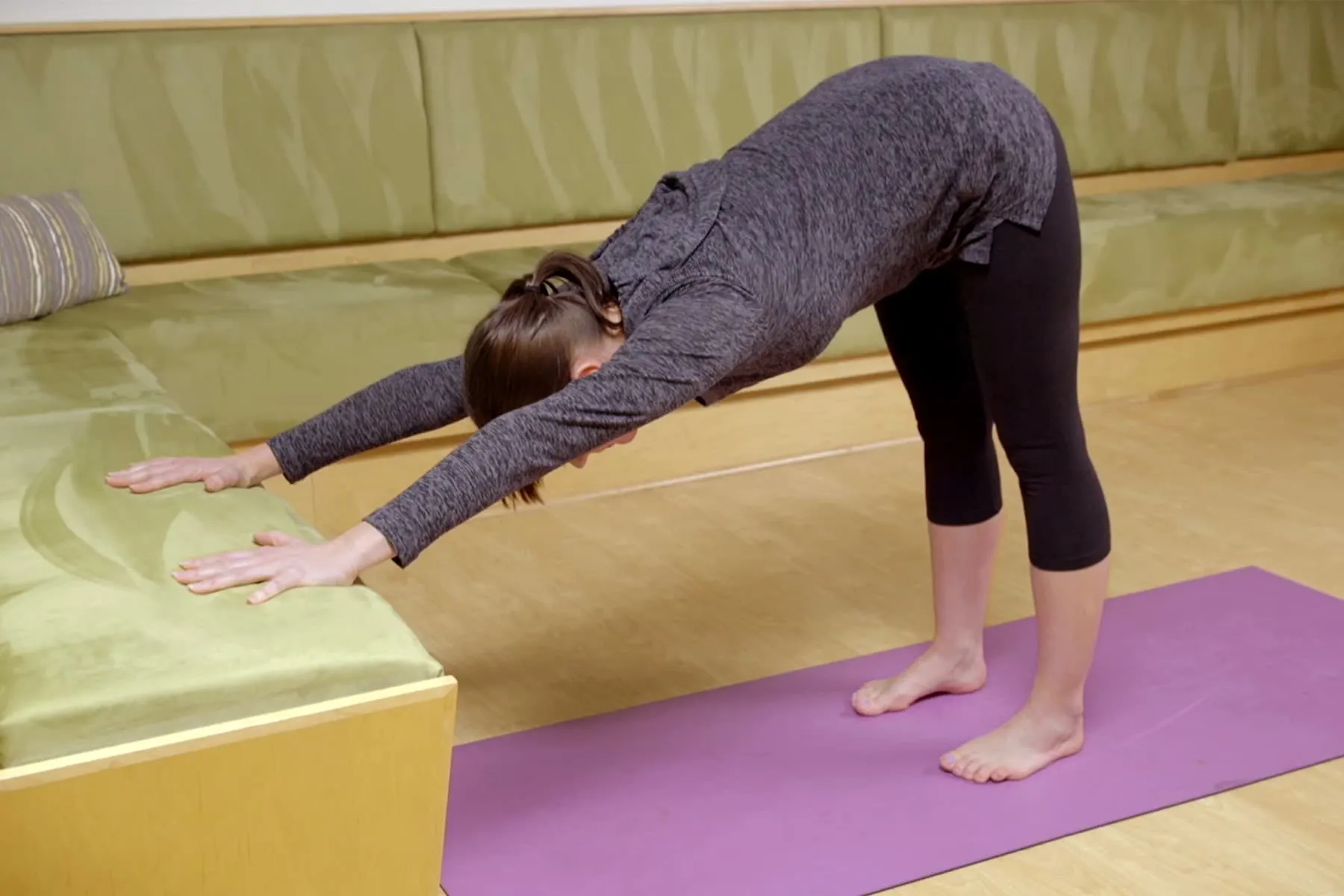
Seated Forward Fold stretches the hamstrings, calves, and lower back. Sit with legs extended, bend your knees slightly, lengthen your spine, and fold forward from the hips. Use a strap around the feet if helpful.
Do not yank yourself forward. The spine should feel long, not crumpled. This pose works best when practiced patiently, with slow breathing and zero arguments with your hamstrings.
10. Supine Twist
Supine Twist helps release the back, outer hips, and chest. Lie on your back, hug one knee toward your chest, and guide it across your body. Keep both shoulders relaxed as much as possible. Switch sides after several breaths.
This is a gentle way to improve rotational mobility and unwind tension at the end of a practice.
A Simple 20-Minute Yoga Routine for Flexibility and Balance
You can use this beginner-friendly sequence three to five times per week. Move at a relaxed pace and rest whenever needed.
Warm-up: 4 minutes
Begin with Mountain Pose for 5 slow breaths. Then move through Cat-Cow for 8 rounds. Follow with Child’s Pose for 5 breaths and a gentle Downward-Facing Dog for 5 breaths.
Flexibility focus: 7 minutes
Practice Low Lunge on each side for 5 breaths. Move into Triangle Pose on each side for 4 to 5 breaths. Then sit down for Seated Forward Fold for 6 to 8 breaths. Keep the knees bent if needed.
Balance focus: 6 minutes
Practice Chair Pose for 3 to 5 breaths, rest, then repeat once. Move into Warrior II on each side for 5 breaths. Finish with Tree Pose on each side for 3 rounds of steady breathing. Use a wall or chair if needed.
Cool down: 3 minutes
Lie down for Supine Twist on both sides. End with one minute of quiet breathing. Let your body absorb the work instead of immediately launching yourself back into emails, errands, or snack negotiations.
Tips to Make Yoga Safer and More Effective
Start slowly. Your body does not need to be shocked into flexibility; it needs to be invited. Move into each pose with control and stop before pain. Breathe steadily and avoid holding your breath, especially during balance poses.
Use props. Blocks, straps, blankets, pillows, chairs, and walls make yoga more accessible. Props help you maintain good form, reduce strain, and stay in poses long enough to benefit from them. They are tools, not training wheels of shame.
Pay attention to alignment, but do not become obsessed with looking perfect. Bodies vary. Bone structure, injury history, strength, flexibility, and limb length all affect how a pose appears. A safe pose in your body may look different from the photo on a yoga website.
Practice consistently. Ten minutes most days can be more effective than a long, intense session once in a while. Flexibility and balance improve through repetition. Think of yoga as brushing your body’s teeth: small maintenance, big payoff.
Choose the right style. Hatha, gentle yoga, Iyengar-inspired classes, chair yoga, beginner vinyasa, and restorative yoga can all be useful depending on your needs. If your main goal is flexibility and balance, look for classes that include slow transitions, standing poses, hip openers, spinal mobility, and clear instruction.
Common Mistakes Beginners Should Avoid
The first mistake is pushing too hard. Flexibility does not improve faster because you grimace dramatically. In fact, forcing stretches can create irritation or injury. Aim for a sensation you can breathe through comfortably.
The second mistake is skipping strength. Flexibility without strength can leave joints feeling unstable. Balance poses and standing poses help build the muscular control needed to use your new range of motion safely.
The third mistake is comparing yourself to others. Someone else’s Triangle Pose has nothing to do with your progress. Yoga is not a competitive furniture-folding contest. Your job is to notice your own body and improve from where you are.
The fourth mistake is ignoring the feet. Balance begins at the base. Spread your toes, press through the whole foot, and notice whether your arches collapse or your weight rolls to the outer edges. Better foot awareness often leads to better balance almost immediately.
The fifth mistake is rushing. Slow transitions are where a lot of balance training happens. Moving from Warrior II to Triangle Pose with control can teach your body more than simply arriving in the final shape.
Who Can Benefit from Yoga for Flexibility and Balance?
Yoga can benefit office workers who feel stiff from sitting, runners with tight calves and hamstrings, older adults who want to improve stability, athletes who need better movement quality, beginners returning to exercise, and anyone who wants to feel more comfortable in their body.
It can also support everyday function. Reaching for a high shelf, picking something up from the floor, turning to check behind you, carrying a backpack, gardening, dancing, traveling, or walking on uneven sidewalks all become easier when your body is mobile and stable.
For people with limited mobility, chair yoga can be a useful entry point. Many yoga movements can be done seated or with support. A chair can help improve posture, breathing, joint motion, and confidence without requiring getting down to the floor.
How Long Does It Take to Notice Results?
Some people feel better after the first session because gentle movement increases circulation, reduces tension, and improves body awareness. Noticeable flexibility changes often take several weeks of consistent practice. Balance may improve quickly in some poses, especially when you practice frequently and use good focus.
Progress is rarely perfectly linear. One day Tree Pose feels calm and graceful. The next day you wobble like a flamingo in a wind tunnel. That does not mean you lost progress. Sleep, stress, hydration, fatigue, attention, and even the surface under your feet can affect balance.
Track progress by how you feel and move, not just by how deep you can stretch. Can you stand taller? Bend with less discomfort? Move more smoothly? Catch your balance faster? Sit on the floor more comfortably? Those are real wins.
Breathing: The Secret Ingredient
Breathing is not decoration in yoga. It helps regulate tension, improve focus, and create rhythm. When you breathe slowly, your body often feels safer and more willing to release tightness. During balance poses, steady breathing can calm the nervous system and sharpen concentration.
Try this simple method: inhale through the nose for a count of four, exhale for a count of four to six, and keep the jaw relaxed. Use this rhythm during seated stretches, standing poses, and cool-downs. If counting feels annoying, simply breathe in a way that feels smooth and unforced.
Experience Section: What Practicing Yoga for Flexibility and Balance Really Feels Like
The first experience many people have with yoga for flexibility and balance is surprise. Not dramatic enlightenment. Not instant pretzel powers. Just surprise. You may step onto the mat thinking, “This will be gentle,” and five minutes later Chair Pose politely informs you that your legs have questions. Yoga has a funny way of looking calm while quietly challenging every stabilizing muscle you forgot existed.
At the beginning, flexibility work can feel humbling. A forward fold may reveal that your fingertips and the floor are in a long-distance relationship. Low Lunge may make your hip flexors act like they have never been invited to stretch before. Downward-Facing Dog may feel less like a peaceful resting pose and more like your calves filing a formal complaint. This is normal. The body needs time to trust new positions.
Balance practice is even more honest. Tree Pose can expose the difference between “I am standing” and “I am actually balancing.” The first time you lift one foot, your ankle may wobble, your toes may grip, and your face may develop the intense expression of someone defusing a tiny bomb. Then you touch the wall, breathe, try again, and realize something important: balance is not stillness. Balance is constant adjustment.
After a few weeks of consistent practice, the changes often show up in ordinary life before they show up in dramatic poses. You may notice that bending down to tie your shoes feels easier. Your shoulders may not creep toward your ears as often. Your back may feel less stiff when you get out of a chair. You may step over a puddle without wobbling. You may stand on one foot to put on pants and survive the event with dignity.
One of the best experiences is learning how much props can change the practice. A yoga block under the hand in Triangle Pose can turn frustration into alignment. A strap in Seated Forward Fold can make the stretch feel controlled instead of desperate. A wall beside Tree Pose can help the nervous system relax. Once the body feels supported, it often opens more naturally.
Another memorable shift is mental. Yoga for flexibility and balance teaches patience in a very physical way. You cannot bully yourself into better balance. You cannot rush tissue adaptation. You cannot shame your hamstrings into lengthening. The practice rewards curiosity, consistency, and a sense of humor. Some days your balance will be excellent. Some days the floor will seem unusually magnetic. Both days count.
Many people also discover that breathing changes everything. A pose that feels tight and awkward may soften after three slow exhales. A balance pose that feels shaky may become steadier when the eyes focus and the breath slows. This is where yoga becomes more than stretching. It becomes a conversation between the body and mind, preferably one where nobody yells.
The most useful experience is realizing that yoga progress is personal. You do not need to look advanced to benefit. A modified pose done with awareness is more valuable than a dramatic pose done with strain. Touching the floor is not the goal. Moving better, feeling steadier, breathing easier, and living with more confidence are better goals.
In real life, yoga for flexibility and balance is not about becoming a human noodle or standing on one foot forever. It is about building a body that can adapt. A body that bends without panic. A body that steadies itself when the sidewalk surprises you. A body that feels less stiff in the morning and less drained at night. That is the quiet magic of the practice: small movements, repeated often, gradually make daily life feel smoother.
Conclusion
Yoga for flexibility and balance is one of the most accessible ways to improve how your body moves and feels. Through gentle stretching, standing poses, slow transitions, breath awareness, and mindful strength work, yoga helps build range of motion and stability at the same time.
You do not need to be flexible, coordinated, young, athletic, or naturally graceful to begin. You only need a little space, a few minutes, and the willingness to wobble without taking it personally. Start with beginner-friendly poses, use props, move slowly, and practice consistently. Over time, your hips may loosen, your posture may improve, your balance may sharpen, and your body may feel more like a reliable partner instead of a mysterious collection of tight spots.
The mat is not a stage. It is a laboratory. Show up, breathe, experiment, laugh when necessary, and let progress happen one steady pose at a time.