

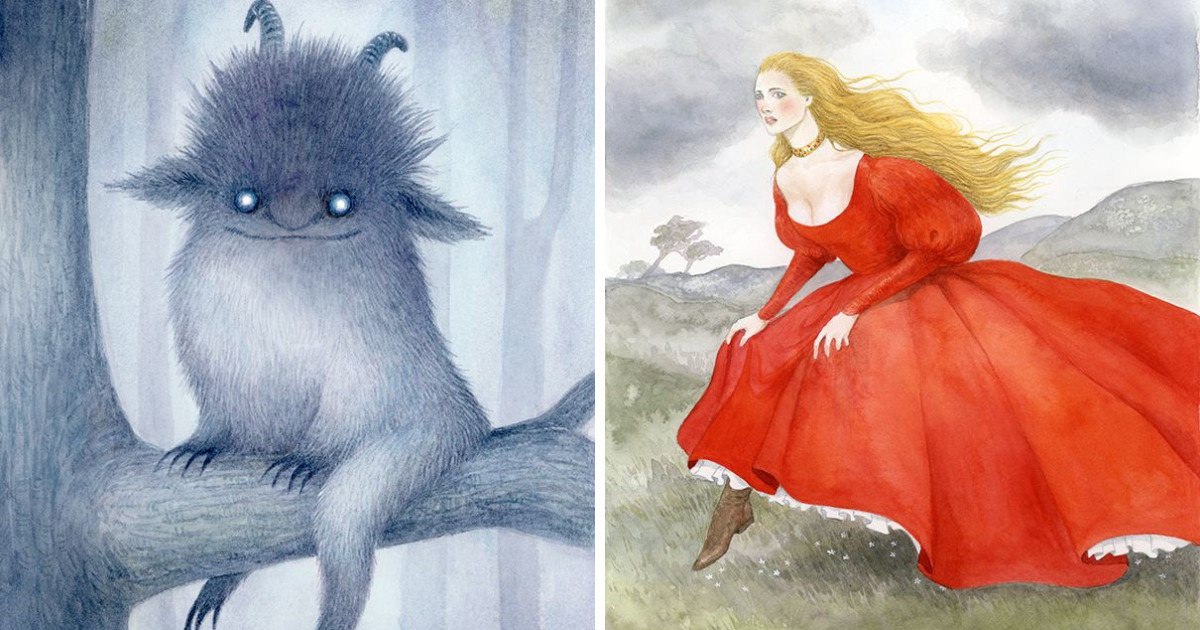
Some art walks into the room wearing tap shoes. Emily Hare’s watercolor art tiptoes in with moss on its boots, a pocket full of fairy dust, and the suspicious confidence of a creature that definitely knows where the mushrooms are hiding. Her work feels soft at first glance, but look longer and the quiet colors begin whispering tiny myths. There are forest beings, strange beasts, shy monsters, luminous water spirits, and fantasy creatures that appear as if they wandered out of a half-remembered dream and politely refused to go back.
The charm of Hare’s art lies in this delicious contradiction: it is gentle, but never empty; whimsical, but not sugary; delicate, but full of personality. Her watercolor illustrations invite viewers into the world of Strangehollow, a fantasy setting filled with folklore, fairytales, humor, and just enough peril to keep the tea from getting cold. If your inner daydream has been stuck under fluorescent lighting lately, these soft-hued paintings may be exactly the visual vacation it ordered.
Who Is Emily Hare?
Emily Hare is a UK-based watercolor artist and illustrator known for fantasy, folklore, fairytales, and creature-filled storytelling. Her art often centers on imaginary beasts, enchanted forests, magical beings, and odd little personalities that feel both ancient and freshly invented. Her official site describes her work as art for people seeking escapism, magic, mystery, joy, and wonder. That is a pretty accurate map of the territory.
Hare’s best-known creative world is Strangehollow, a richly illustrated fantasy universe populated by creatures that seem to have their own migration patterns, snack preferences, grudges, and questionable social habits. Instead of simply painting “cute fantasy animals,” she builds a visual ecosystem. Each creature feels like it belongs somewhere. It might live under a root, beside a cold pool, in a dark forest, or just outside your peripheral vision while you pretend not to be nervous.
Why Her Watercolor Art Feels So Dreamlike
Watercolor is a natural home for softness. The medium uses pigment suspended in water, usually applied to paper, and its famous glow comes from transparency. Light passes through thin color layers, bounces off the paper, and returns to the eye with a luminous quality that opaque media often cannot imitate. In Hare’s hands, that glow becomes atmosphere. Her creatures do not merely sit on the page; they seem to emerge from mist, memory, and damp woodland air.
Soft watercolor art works because it leaves room for imagination. A hard black outline tells the eye exactly where to stop. A pale wash says, “Come closer, but bring your own curiosity.” Hare often uses subtle drawing, gentle color transitions, and careful layering to create forms that feel alive without becoming overly polished. The result is art that feels handmade in the best possible way. You can sense the brush, the water, the paper, and the artist’s patience.
Soft Hues With Personality
Pastel watercolor can sometimes become decorative wallpaper: pretty, polite, and slightly afraid of having an opinion. Hare avoids that trap by giving her soft palette narrative weight. Pale teal, mossy green, muted lavender, dusty rose, and warm earthy browns do not simply look pleasant; they build mood. A creature painted in gentle colors may still look mischievous, lonely, ancient, or mildly offended. That emotional range keeps the softness from turning bland.
Her color choices also suit fantasy worldbuilding. Loud colors can be thrilling, but soft hues create the sense that we are seeing something rare. The viewer becomes a careful observer, like someone kneeling beside a forest path after spotting a tiny footprint. The art does not shout, “Here is a monster!” It murmurs, “There may be a monster nearby, and it may be wearing moss as a hat.” Honestly, who could resist?
The Magic of Strangehollow
Strangehollow is not just a gallery theme; it is a story world. Hare’s books and paintings present a place of enchanted forests, witches, familiars, monsters, water spirits, dragons, selkies, and creatures with wonderfully odd names. This matters because fantasy illustration becomes more powerful when the viewer senses a world beyond the frame. A single painting can feel like one page torn from a field guide, a folktale, or a traveler’s notebook.
One of the reasons people connect with this work is that it revives the old pleasure of bestiaries: those books that catalog creatures as if imagination were a branch of natural science. Hare’s creatures are not generic. They often appear to have habits, habitats, and hidden rules. Viewers are not just asking, “What does it look like?” They are asking, “Where does it sleep? What does it eat? Should I pet it? Why do I suspect the answer is no?”
Folklore, Fairytales, and a Little Comic Mischief
Hare’s art is rooted in folklore and fairytale traditions, but it rarely feels dusty. Instead of copying familiar fantasy tropes, she reshapes them through humor and character. The creatures may be strange, but they are not distant. Some appear noble. Some appear shy. Some look like they know exactly what happened to your missing biscuit. That small comic spark makes the work feel accessible, especially for viewers who love fantasy but do not want every magical forest to look like it is auditioning for a thunderstorm.
This balance between wonder and wit is a major part of Hare’s appeal. Her watercolor paintings can be elegant without becoming stiff. They can be eerie without becoming harsh. They can be cute without collapsing into cuteness overload. In internet terms, they are “adorably suspicious,” which is one of the highest compliments a fantasy creature can receive.
Why Watercolor Is Perfect for Fantasy Creatures
Fantasy art often deals with the unseen: magic, memory, dream logic, and creatures that do not fit neatly into ordinary reality. Watercolor is especially good at suggesting those in-between states. Wet-on-wet washes can create soft edges and blooming textures. Glazing can build luminous depth. Dry brush can add fur, bark, feathers, scales, or the scratchy dignity of an elderly woodland gremlin.
Because watercolor is partly controlled and partly unpredictable, it mirrors the spirit of fantasy. Water spreads. Pigment settles. Edges feather. Colors mingle in ways that are difficult to command completely. A skilled artist can guide these effects, but never bully them. That makes watercolor ideal for Hare’s imaginary beings. They feel discovered rather than manufactured, as if the paint itself helped coax them into existence.
Transparency Creates Emotional Light
In watercolor, the white of the paper often acts as the light source. Instead of adding heavy highlights at the end, the artist preserves brightness from the beginning. This gives soft watercolor illustrations a special glow. In Hare’s work, that glow supports the feeling of enchantment. A creature’s eye, a pale pool, a moonlit wing, or a misty background can feel illuminated from within.
This is one reason her paintings are so easy to linger over. They do not exhaust the eye. The viewer can rest inside them. The soft edges and transparent layers create a calm visual rhythm, while the creature designs and story details reward closer attention. It is comfort art with teeth, claws, or at least a suspiciously lumpy tail.
The Appeal of Soft-Hued Art in a Very Loud World
Modern digital life is not exactly famous for subtlety. Screens flash. Feeds refresh. Everything wants to be brighter, faster, louder, and more urgent than the thing above it. Soft-hued watercolor art offers a different kind of attention. It slows the viewer down. It asks for patience. It makes you notice tiny shifts in color and expression. In a world of visual shouting, Hare’s paintings feel like a candlelit conversation with a creature who may or may not be trustworthy.
That quietness is not weakness. Soft art can be deeply memorable because it works through atmosphere rather than impact. Hare’s pieces invite emotional participation. The viewer fills in the mist, the backstory, the sound of leaves, the smell of rain on bark. The painting becomes a doorway rather than a poster. For fantasy lovers, that doorway is often the whole point.
Escapism With Texture
Escapism sometimes gets treated like a guilty pleasure, but good fantasy art does more than help us avoid reality. It gives us a symbolic place to process curiosity, fear, tenderness, humor, and awe. Hare’s watercolor creatures are charming because they feel emotionally textured. They are not just “nice to look at.” They suggest moods: wonder, caution, affection, loneliness, playfulness, and the very specific feeling of finding a small magical animal that may ruin your picnic.
This kind of visual storytelling can be surprisingly grounding. The softness of watercolor calms the eye, while the fantasy subject matter wakes up the imagination. It is a rare combination: soothing but not sleepy, playful but not shallow, gentle but not forgettable.
How Her Style Stands Out in Contemporary Illustration
Contemporary illustration is full of digital brilliance, and digital tools can produce astonishing art. Hare’s watercolor work stands out because it keeps the physical character of traditional painting visible. The slight irregularities matter. The paper texture matters. The washed edges matter. The places where color pools or fades are not flaws; they are the fingerprints of the medium.
Her style also stands out because she uses traditional craft to serve imaginative worldbuilding. This is not nostalgia for nostalgia’s sake. The old-school brush-and-paper approach supports the story. It makes Strangehollow feel like a discovered manuscript, a field journal, or an illuminated creature guide that somehow survived damp weather and a few bad decisions involving goblins.
Character Design That Feels Alive
Great creature design is not only about anatomy. It is about attitude. Hare’s creatures often have silhouettes and expressions that communicate personality quickly. A hunched back, a tilted head, a heavy paw, a delicate fin, or a pair of watchful eyes can tell us whether a creature is gentle, dangerous, bashful, or the type to steal shiny buttons. The watercolor treatment softens the presentation, but the design choices keep the characters vivid.
This is especially important for fantasy art. Viewers may not know the lore yet, but they can feel it. A good creature looks as though it has been seen before by someone, somewhere, under conditions that were probably damp, moonlit, and poorly documented. Hare’s creatures often have that quality. They feel invented, but not random.
What Artists Can Learn From Emily Hare’s Watercolor Approach
Artists who admire Hare’s soft watercolor style can learn several practical lessons from it. First, subtle does not mean unfinished. Pale color can carry a composition when values, shapes, and focal points are handled thoughtfully. Second, storytelling strengthens technique. A beautifully painted creature becomes more compelling when it seems to belong to a larger world. Third, humor is not the enemy of beauty. A little weirdness can make an elegant painting more memorable.
Another lesson is the power of restraint. Many beginners overwork watercolor because they try to correct every bloom, edge, and irregular patch. But watercolor often rewards the artist who knows when to stop. Leaving space, preserving light, and letting the medium breathe can create a livelier result than polishing every corner into obedience. Watercolor is not a spreadsheet. It is more like a polite river with strong opinions.
Building Atmosphere Without Overloading Detail
Hare’s art shows that atmosphere can do as much storytelling as detail. A misty background, a few carefully placed textures, and a limited palette can suggest a whole environment. Not every leaf needs to be painted. Not every scale needs a résumé. The trick is choosing the details that matter most: the glint in an eye, the curve of a horn, the damp shine of a pool, the soft shadow under a creature’s feet.
This approach helps the viewer participate. When art leaves some areas open, imagination steps in. The viewer completes the forest, hears the twig snap, and decides whether the adorable creature is safe to approach. Again, the answer is probably “only if it approaches you first.”
Why Collectors and Fans Love This Kind of Art
Soft fantasy watercolor appeals to several kinds of viewers at once. Illustration fans enjoy the drawing skill. Fantasy readers enjoy the implied stories. Collectors enjoy the handmade quality of original watercolor paintings. Casual viewers enjoy the calm, charming mood. And creature lovers, of course, enjoy the chance to meet new imaginary animals without having to update their insurance.
Hare’s art also fits beautifully into the broader popularity of cozy fantasy, folklore-inspired design, cottagecore aesthetics, and nature-based escapism. People are drawn to art that feels intimate, handmade, and emotionally restorative. Her paintings offer that while still keeping a little wildness. The softness welcomes you in; the strangeness keeps you exploring.
Experience Notes: Living With Soft-Hued Watercolor Art
Spending time with soft-hued watercolor art is a different experience from scrolling past a bright digital image. The first thing you notice is usually the mood, not the mechanics. A pale wash of blue can feel like morning fog. A warm blush of pink can feel like late sunlight. A muted green can make the whole room seem quieter, as if a forest has politely moved into the corner and promised not to shed too many leaves.
In a home, watercolor art has a calming presence. It does not dominate a wall the way a high-contrast poster might. Instead, it changes with the light. In the morning, the paper texture may become more visible. In the evening, the colors may soften into something almost secretive. This makes watercolor especially rewarding to live with. The piece does not reveal itself all at once. It becomes part of the room’s rhythm.
For creative people, looking at watercolor can also be a gentle reminder that not everything needs to be forced. The medium teaches patience. Paint moves at the speed of water, not at the speed of panic. A wash needs time to dry. A second layer needs the first layer to settle. A mistake may become a texture, a shadow, or a strangely useful cloud. That is a good lesson for art, and frankly, for being a human with an inbox.
Soft fantasy watercolor has an extra emotional benefit: it makes imagination feel safe again. Many adults slowly lose the habit of daydreaming because life gets crowded with deadlines, notifications, errands, and serious-looking documents. Then a painting like Hare’s comes along with a mossy creature, a glowing pool, or a suspicious little beast, and suddenly the mind remembers how to wander. That wandering is not wasted time. It is where stories, ideas, and small personal joys often begin.
There is also a tactile pleasure in watercolor art, even when viewed digitally. You can almost feel the grain of the paper and the drag of the brush. You can imagine the water pooling, the pigment feathering outward, the artist waiting for the right moment to add a darker accent. In a culture where many images feel instantly generated and instantly forgotten, visible process gives art emotional weight. It says: someone sat with this. Someone made choices. Someone let the creature arrive slowly.
For beginner artists, Hare’s work can be inspiring without being discouraging. Yes, the skill level is high, but the softness of the medium makes the process feel approachable. It encourages sketching gently, layering gradually, and treating blank paper not as an enemy but as a quiet field where something odd and wonderful might appear. You do not need to build an entire fantasy universe on day one. Start with a wash, a shape, a creature eye, a crooked mushroom. The forest can grow later.
For viewers, the best way to enjoy this kind of art is slowly. Do not simply ask, “Is it pretty?” Ask what kind of world it suggests. Ask what happened five minutes before the scene and what might happen five minutes after. Ask whether the creature is friendly, hungry, ancient, lost, or pretending to be all four. Soft-hued watercolor rewards that kind of playful attention. It turns looking into a small adventure.
Conclusion: A Gentle Doorway Into Wonder
Emily Hare’s watercolor art delights because it understands something important about fantasy: wonder does not always need fireworks. Sometimes it needs pale washes, careful lines, mossy textures, strange little faces, and a world that feels half-hidden behind the trees. Her soft-hued paintings invite viewers to slow down, look closer, and remember that imagination can still be tender, funny, eerie, and alive.
In a noisy visual culture, Hare’s work offers a quieter spell. It is watercolor art for people who love folklore, creature design, fairytales, gentle colors, and the possibility that the forest may be full of odd neighbors. If your inner daydream has been waiting for a softer place to land, Strangehollow might just be the enchanted clearing it was looking for.